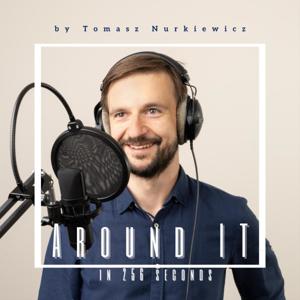
Around IT in 256 seconds

Around IT in 256 seconds

By Tomasz NurkiewiczTechnology
Download on the App Store

Around IT in 256 seconds episodes

  • #97: Ruby: help every programmer to be productive and to be happy

    Yukihiro Matsumoto, the creator of Ruby programming language,

    famously said: “I hope to see Ruby help every programmer in the
    world to be productive, and to enjoy programming, and to be happy.”
    Honestly, not many programming languages were built with developer’s
    happines in mind. And to be honest, Ruby is a joy to work with. It’s
    fairly easy to learn, easy to read, yet, very powerful. Also, with the
    appearance of Ruby on Rails, it became insanely productive. But first
    things first.

    Read more: https://nurkiewicz.com/97

    Get the new episode straight to your mailbox: https://nurkiewicz.com/newsletter

    5 min
  • #96: Border Gateway Protocol: the duct tape that makes the Internet work

    Border Gateway Protocol, BGP for short, is probably the most

    important protocols you might have never heard of. Well, you did at
    least once, in October 2021. When Facebook, WhatsApp, Instagram and
    Messenger all went down because of BGP misconfiguration. Or that one day
    back in 2008 when all YouTube traffic was accidentally routed to
    Pakistan. Because of BGP… misconfiguration. So what’s the big deal with
    BGP? First we must understand how the Internet works.

    Read more: https://nurkiewicz.com/96

    Get the new episode straight to your mailbox: https://nurkiewicz.com/newsletter

    5 min
  • #95: SQLite: the most ubiquitus database on the planet. And beyond!

    SQLite is by far the most common SQL database ever deployed. Are you

    lsitening to this on iPhone or Android device? It runs SQLite. Or maybe
    through a web browser? Chrome, Safari, Firefox, Opera and Android
    Browser all use SQLite underneath. Are you running MacOS or Windows?
    It’s built-in. Most Linux distributions have it as well. “But I’m
    listening to your podcast while driving a car”, you say. Well, most
    automotive systems use SQLite internally. If you happen to listen to my
    podcast while coding in PHP or Python, they include SQLite out-of-the
    box. Oh, and it’s the default choice for Ruby on Rails as well. I’m
    pretty sure SQLite is used somewhere on the International Space Station
    and it maybe even landed on other planets? So, what makes this unsung
    hero so popular to run at least one trillion databases
    worldwide?

    Read more: https://nurkiewicz.com/95

    Get the new episode straight to your mailbox: https://nurkiewicz.com/newsletter

    5 min
  • #94: Scala: language with academic background and huge industry adoption

    Scala is a programming language running on the Java Virtual Machine.

    It’s statically typed, and you can use it both as functional and
    object-oriented language. Even at the same time. The functional side of
    Scala supports higher-order (and higher-kinded) types. For those of you
    know what it means. On the other hand, object-relational features of
    Scala are equally strong. Including powerful trait composition, that you
    can somewhat compare to multiple inheritance. Combine than with great
    Java interoperability and no wonder why Scala became a go to language
    for many ex-Java developers.

    Read more: https://nurkiewicz.com/94

    Get the new episode straight to your mailbox: https://nurkiewicz.com/newsletter

    5 min
  • #93: K-means clustering: machine learning algorithm to easily split observations into multiple buckets

    K-means clustering is an algorithm for partitioning data into

    multiple, non-overlapping buckets. For example, if you have a bunch of
    points in two-dimensional space, this algorithm can easily find
    concentrated clusters of points. To be honest, that’s quite a simple
    task for humans. Just plot all the points on a piece of paper and find
    areas with higher density. For example, most of the points are located
    on the top-left of the plane, some at the bottom and a few at the
    centre-right. However, this is not that straightforward once you can no
    longer rely on graphical representation. For instance, when your data
    points live 3-, 4- or 100-dimensional space. Turns out, this is not that
    uncommon. Let me clarify.

    Read more: https://nurkiewicz.com/93

    Get the new episode straight to your mailbox: https://nurkiewicz.com/newsletter

    5 min
  • #92: Clojure: a languages that will change the way you think about programming

    Clojure is a dynamically, strongly typed programming language. It’s a

    dialect of Lisp running on the Java Virtual Machine. Lisp is 6
    decades old and has a really weird syntax. That weird syntax is called
    Polish prefix notation. Basically, in every other language
    you’ve used math operators like plus or minus are infix. It means they
    are placed between operands. For example, 1 + 2. In
    Clojure, you always put the operator (or any other function for that
    matter) in front. So simple addition becomes… + 1 2.

    Read more: https://nurkiewicz.com/92

    Get the new episode straight to your mailbox: https://nurkiewicz.com/newsletter

    5 min
  • #91: Asynchronous communication: loose coupling in distributed systems

    There are two main ways to communicate between components in your

    distributed system: synchronous and asynchronous. Synchronous
    communication is like making a phone call. The system on the other side
    must be present and you actively wait for a response to your every
    question. Examples of this style include REST, SOAP and GraphQL.

    Read more: https://nurkiewicz.com/91

    Get the new episode straight to your mailbox: https://nurkiewicz.com/newsletter

    5 min
  • #90: Mastodon: next-generation, open source social network

    After many dramatic events around Twitter lately, many people,

    including myself, began experimenting with Mastodon. Superficially it’s
    an open-source clone of the former that anyone can deploy and host.
    However, once you look deeper, it’s actually a completely different
    philosophy and architecture. Let’s focus on how Mastodon federated
    network is built. To understand the difference, we’ll start from
    scratch.

    Read more: https://nurkiewicz.com/90

    Get the new episode straight to your mailbox: https://nurkiewicz.com/newsletter

    5 min
  • #89: RabbitMQ: A proven message broker for asynchronous communication

    RabbitMQ is a message broker, allowing asynchronous communication in

    distrubuted systems. The key advantages of RabbitMQ include: 15 years of
    open source history, battle proven Erlang implementation and support for
    industry standard protocols. RabbitMQ is among the most popular
    implementations of message brokers. Others include ActiveMQ for Java, celery for Python and Kafka - if you consider it a message
    broker. Also, pretty much all cloud providers have their proprietary
    implementations, like, Google
    Pub/Sub, Amazon
    Kinesis, Azure
    Service Bus and so on. RabbitMQ at its core implements AMQP, a standard protocol for
    information interchange. So not only it’s open source, it’s also built
    on top of open standards.

    Read more: https://nurkiewicz.com/89

    Get the new episode straight to your mailbox: https://nurkiewicz.com/newsletter

    4 min

About Around IT in 256 seconds

From the publisher's feed

Podcast for developers, testers, SREs... and their managers. I explain complex and convoluted technologies in a clear way, avoiding buzzwords and hype. Never longer than 4 minutes and 16 seconds. Because software development does not require hours of lectures, dev advocates' slide decks and hand waving. For those of you, who want to combat FOMO, while brushing your teeth. 256 seconds is plenty of time. If I can't explain something within this time frame, it's either too complex, or I don't understand it myself.