
Sign up to save your podcasts
Or

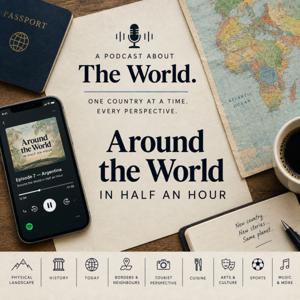


Belgium is famous for medieval squares, busy ports, chocolate and political negotiations that can last for months. In 2010, it took 541 days after a federal election to form a new government — though a caretaker government continued running the country in the meantime. That episode captures a larger truth: Belgium is small on the map, but its political arrangements are anything but simple.
Ray travels from the canals of Bruges and the streets of Brussels to the battlefields of Flanders and the industrial history of Wallonia. Along the way, we explore Belgium’s independence, its role in two world wars, its colonial rule in Congo, and the food, art and inventions that have travelled far beyond its borders.
Welcome to Belgium, where borders divide languages and regions, but also connect the country to some of Europe’s biggest stories.
Seventy percent of the Chernobyl disaster's radioactive fallout came down not on the plant's own country, but here. A third of the population died in the Second World War. And the man who's run the place since 1994 calls himself, without much irony, Europe's last dictator. Ray heads into Belarus for rebuilt cities, reintroduced bison, a Nobel Peace Prize awarded to a man still sitting in prison, and a country caught, quite literally, between Russia and the rest of Europe.
For more than three hundred years, Barbados was the one Caribbean island that never changed hands between European powers — a colonial oddity that shaped everything from its rum to its politics. Ray visits the birthplace of the world's oldest rum brand, the only place George Washington ever set foot outside continental North America, and the country that swapped a Queen for a President in 2021 and named Rihanna a National Hero on the very same night.
It's built almost entirely on the world's largest river delta, born out of a language movement and a war of independence, and it just elected its first government since a 2024 uprising ended fifteen years of one-party rule. Ray wades into Bangladesh for Sundarbans tigers, the world's longest natural beach, a Nobel Peace Prize won by lending $27 to bamboo weavers, and a country that's literally the only one on Earth named after its own language.
It's smaller than greater London, sits between two much bigger neighbors, and has somehow ended up mattering to the United States Navy, the Saudi royal family, the global pearl trade, and Formula 1, all at once. Ray crosses the King Fahd Causeway into Bahrain — ancient Dilmun, a 1783 dynasty that still rules today, an oil discovery that changed the whole Gulf, and a 2011 uprising whose aftermath is still being argued over.
Quick geography check: what ocean is the Bahamas in? If you said Caribbean, you're in good company and also wrong — the entire archipelago of roughly 700 islands sits in the Atlantic Ocean, which never technically touches these islands at all. This episode covers Christopher Columbus's actual first Americas landfall here in 1492, the 40,000-strong Lucayan population wiped out entirely by Spanish slavers within a generation, Nassau's brief and genuine run as a functioning pirate republic complete with Blackbeard, and Pompey's 1830 Exuma slave uprising. We bring it up to the present with Hurricane Dorian, the Category 5 storm that stalled directly over Grand Bahama in 2019 and is still reshaping government policy seven years later, the Sand Dollar digital currency it produced, Sam Bankman-Fried's 2022 arrest in Nassau, and Prime Minister Philip Davis's early-2026 election, called specifically to avoid hurricane season. Plus Sidney Poitier's historic Best Actor Oscar, Junkanoo's genuinely disputed origins, cracked conch, swimming pigs, pink sand beaches, and why a country spread across nearly 700 islands somehow fits, by total land area, inside the footprint of a single mid-sized American city.
Thirty kilometers outside Baku, a hillside has been on fire, continuously, for at least a few thousand years — natural gas seeping up and igniting on contact with air, ancient enough that Zoroastrian priests built shrines around it. It's part of why Azerbaijan's name translates to "Land of Fire," and it's a fitting image for a country that produced over half the world's oil supply by 1901. This episode covers the Azerbaijan Democratic Republic of 1918, the first secular democracy in the Muslim world and among the first anywhere to grant women the vote; the Sumgait and Baku pogroms of 1988-1990; Black January, the Soviet military crackdown Azerbaijan marks as a national tragedy every year; and the other side of the Nagorno-Karabakh story we covered from Armenia's perspective back in episode eight, including exactly where the 2025 peace treaty with Armenia stands today and what's still holding up a final signature. We also get into the Aliyev family's two decades in power, today's press-freedom record according to international monitors, Garry Kasparov's cosmopolitan Soviet-era Baku childhood, mud volcanoes, UNESCO-listed Mugham music and carpet weaving, and F1 racing through downtown streets. Presented factually throughout, without taking sides on the contested parts.
Try this: picture the most Austrian song you know. If it's "Edelweiss," that's actually an American Broadway song written in 1959 — not the real, 200-year-old Austrian carol "Silent Night" that barely registers internationally by comparison. This episode uses that gap between Austria's image and its reality as a throughline: the Habsburg dynasty that ran a chunk of Europe for six centuries under rulers like Maria Theresa, the 1938 Anschluss, Austria's postwar "first victim" narrative, the 1986 Waldheim Affair that cracked that narrative open. We bring things up to the present with the country's unprecedented three-party coalition, built specifically to keep a resurgent far-right party out of government, and three straight years of recession behind a still genuinely wealthy economy. Plus Mozart, Freud, Klimt, Empress Sisi, and Arnold Schwarzenegger's improbable journey from an Austrian village to the California governor's office; Sachertorte and Vienna's UNESCO-listed coffeehouse culture; Alpine skiingistory legends from Toni Sailer to Marcel Hirscher; and why Salzburg's biggest tourist draw is a movie most Austrians shrug at.
Aboriginal Australians have been on this continent for roughly 65,000 years — the oldest continuous human culture on Earth. Then, 238 years ago, a fleet of British ships arrived and rewrote the story in about a century and a half. Australia is simultaneously one of the oldest human stories and one of the youngest nation-states on the same landmass, and it hasn't entirely figured out how those two truths sit next to each other.
Ray gets past the postcard version — Sydney Harbour, Uluru, kangaroos — and into the parts that don't fit as neatly on a tourism brochure: the legal fiction of terra nullius, the frontier violence of the 19th century, the Stolen Generations, and the 2023 Voice referendum that Australians voted down nationally and in every state. Along the way: the Great Barrier Reef, the strangeness of a country where a "quick trip" between cities can mean a longer flight than London to Rome, Cathy Freeman's lap of the Sydney Olympic track in 2000, and the legal case that finally overturned two centuries of settler law.
Also: Vegemite, meat pies, a barbecue culture built into public parks by default, and the platypus — an animal so strange that British scientists initially assumed the first specimen was a hoax.
New episodes every Monday at 7pm. Next week — Austria.
There is a monastery in Armenia where, on a clear morning, you can see Mount Ararat rising across the horizon — the mountain on Armenia's national emblem, the mountain Noah's Ark is said to have landed on, sitting entirely inside Turkey since 1921. Armenians wake up every day and see their most sacred symbol on the wrong side of a closed, hostile border.
Armenia was the first nation on Earth to adopt Christianity as its state religion, in 301 CE. In 405 CE, a monk named Mesrop Mashtots invented an alphabet that would keep Armenian identity alive through fifteen centuries without a state.
Ray takes you through the ancient kingdom of Urartu, the golden age of the Bagratuni dynasty and the lost city of Ani, the ongoing tragedy of Nagorno-Karabakh — most recently the 2023 displacement of its entire Armenian population. We meet Aram Khachaturian, whose Sabre Dance became one of the most recognisable pieces of music on Earth. We meet Charles Aznavour, a refugee's son who became one of the biggest stars in French music history. We eat khorovats grilled over open coals, lavash baked in an underground clay oven, and khash — the dawn soup that Armenian men swear cures a hangover and mends a friendship in the same bowl.
We stand at Khor Virap, looking at a mountain that isn't theirs anymore. And we ask what it means for a nation to survive on memory alone, for a while, and then decide to keep going anyway.
The mountain is still there. So are they.
New episodes every Monday at 7pm. Next week — Australia.
From the publisher's feed