
Sign up to save your podcasts
Or



Her mother is taken. Julia is thirteen, and there is a red-bearded bridegroom waiting.
Source: chapters 5–6.
Free companion guide — a map of the novel, the family tree, a chronology and a pronunciation guide: pbmills.com
A work of fiction. Julia Agrippina left no memoir and there is no manuscript.
Sejanus removes the family one chair at a time, and the household learns to count them.
Source: chapter 4.
Free companion guide — a map of the novel, the family tree, a chronology and a pronunciation guide: pbmills.com
A work of fiction. Julia Agrippina left no memoir and there is no manuscript.
Her mother carries the ashes up the Appian Way, and the crowd learns what a widow can be. Julia is four.
Source: chapter 3.
Free companion guide — a map of the novel, the family tree, a chronology and a pronunciation guide: pbmills.com
A work of fiction. Julia Agrippina left no memoir and there is no manuscript.
The Senate grants her father an authority above the provincial governors and sends him east. He does not come back.
What his daughter has of it is not grief but the household’s accounting: who was in the room, whose hand wrote it down, which version was kept and what the record was made to say afterwards. She was three.
Source: chapter 2.
Free companion guide — a map of the novel, the family tree, a chronology and a pronunciation guide: pbmills.com
A work of fiction. Julia Agrippina left no memoir and there is no manuscript.
Sostrata has weighted the corners with a lamp, an inkpot and two of her rings, because the roll is on the table between them and it is not clean.
She has been reminded that she is to begin with her birth — 6 November AD 15, at a frontier camp on the Rhine. She is not going to begin with her birth. She begins instead with the men who gave her the name, because everything that follows is a quarrel with the filing.
Source: chapter 1.
Free companion guide — a map of the novel, the family tree, a chronology and a pronunciation guide: pbmills.com
A work of fiction. Julia Agrippina left no memoir and there is no manuscript.
There is a sentence in Tacitus that nobody reads. It sits in the middle of one of the most famous passages in Latin literature, and it says that he found a private scene between the emperor Tiberius and Agrippina’s mother in a book written by Agrippina herself.
She wrote a memoir. Pliny the Elder read it too, and cited it. Then it stops. This first episode is the case for the book that follows: the borrowed head in the Centrale Montemartini, a vanished dedication at Nîmes read from its nail holes, and what it means that everything we possess is what somebody chose to keep.
Source: front matter.
Free companion guide — a map of the novel, the family tree, a chronology and a pronunciation guide: pbmills.com
A work of fiction. Julia Agrippina left no memoir and there is no manuscript.
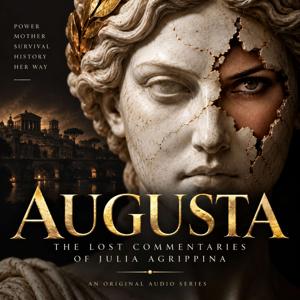
AUGUSTA is a novel by P.B. Mills, read in full and presented as the recovered private commentaries of Julia Agrippina — daughter of Germanicus, sister of Caligula, wife of Claudius and mother of Nero. Twenty-seven episodes; a new one each week.
A work of fiction. Julia Agrippina left no memoir and there is no manuscript.
From the publisher's feed