
Sign up to save your podcasts
Or

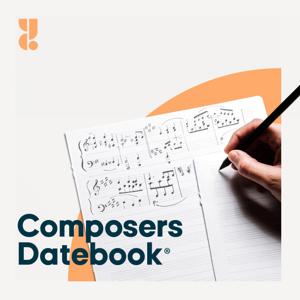

As kids, many of us received home-made presents: a sweater or pair of socks, perhaps, or — if you were unlucky — a crocheted bow tie you were forced to wear when Auntie came to visit.
On today’s date in 1720, Johann Sebastian Bach started a home-made present for his 9-year old son, Wilhelm Friedemann. It was a collection of little keyboard pieces designed to teach him to play the harpsichord, pieces now known as Bach’s Two- and Three-Part Inventions.
Here’s how J.S. Bach himself described these pieces: “Straightforward Instruction, in which amateurs of the keyboard, and especially the eager ones, are shown a clear way not only of learning to play cleanly in two voices, but also, after further progress, of dealing correctly and satisfactorily with three … all the while acquiring a strong foretaste of composition.”
In the case of little Wilhelm Friedemann, it did the trick. Not only did he master the keyboard, he became a composer himself.
Even just attentively listening to Papa Bach’s inventions can have its rewards, according to the late music critic Michael Steinberg, who wrote, “Bach has done such a good job at instilling 'a strong foretaste of composition’ that… they will make the hearer a better, … a more aware and thus a more enjoying, listener as well.”
J.S. Bach (1685-1750): Two-Part Invention #6; Simone Dinnerstein; Sony 79597
 View all episodes
 By American Public Media

4.7
176176 ratings
As kids, many of us received home-made presents: a sweater or pair of socks, perhaps, or — if you were unlucky — a crocheted bow tie you were forced to wear when Auntie came to visit.
On today’s date in 1720, Johann Sebastian Bach started a home-made present for his 9-year old son, Wilhelm Friedemann. It was a collection of little keyboard pieces designed to teach him to play the harpsichord, pieces now known as Bach’s Two- and Three-Part Inventions.
Here’s how J.S. Bach himself described these pieces: “Straightforward Instruction, in which amateurs of the keyboard, and especially the eager ones, are shown a clear way not only of learning to play cleanly in two voices, but also, after further progress, of dealing correctly and satisfactorily with three … all the while acquiring a strong foretaste of composition.”
In the case of little Wilhelm Friedemann, it did the trick. Not only did he master the keyboard, he became a composer himself.
Even just attentively listening to Papa Bach’s inventions can have its rewards, according to the late music critic Michael Steinberg, who wrote, “Bach has done such a good job at instilling 'a strong foretaste of composition’ that… they will make the hearer a better, … a more aware and thus a more enjoying, listener as well.”
J.S. Bach (1685-1750): Two-Part Invention #6; Simone Dinnerstein; Sony 79597

6,773 Listeners

38,915 Listeners

8,771 Listeners

9,202 Listeners
5,780 Listeners

927 Listeners

1,388 Listeners

1,287 Listeners
3,161 Listeners

1,975 Listeners
523 Listeners
183 Listeners
13,767 Listeners

3,083 Listeners
248 Listeners
28,135 Listeners

430 Listeners

5,470 Listeners
2,194 Listeners

14,142 Listeners
6,423 Listeners
2,515 Listeners
4,836 Listeners

574 Listeners
244 Listeners