
Sign up to save your podcasts
Or



In this episode we discuss series vs. parallel battery configurations! You'll learn why a series configuration increases voltage, while a parallel configuration can only increase current.
No sources this episode. Let us know if you have any questions at [email protected]!
Alternate episode title: Wat(t)ery Battery
Sorry about the wait for this episode! Our editor Hope was busy dropping out of grad school and then spending time with family over the holidays. But oh those long weeks ago, Hope and Ana convened to discuss electrochemical stability windows, solid electrolyte interphases (SEIs), and the pros and cons of aqueous electrolytes (as well as some proposed fixes for those cons). Cameos by Hope's sister Dana with a story about water and lithium, and by Hope's brother Alex with a note about water and lead.
Spoiler warning for The Music Man (the musical), if anyone has concerns about that
Sources:
Flame tests of metal salts: https://www.youtube.com/watch?v=nS77SPywI9w (this has nothing to do with batteries but it's pretty)
Water-in-salt electrolytes: "“Water-in-salt” electrolyte enables high-voltage aqueous lithium-ion chemistries" by Suo et al http://science.sciencemag.org/content/350/6263/938
Coating which turns into an SEI in an aqueous electrolyte: "4.0 V Aqueous Li-Ion Batteries" by Yang et al http://www.cell.com/joule/abstract/S2542-4351(17)30034-X
Summary of "4.0 V Aqueous Li-Ion Batteries": https://www.sciencedaily.com/releases/2017/09/170906135613.htm
Supplemental information of "4.0 V Aqueous Li-Ion Batteries" including video (Movie S3): http://www.sciencedirect.com/science/article/pii/S254243511730034X?via%3Dihub#mmc4 "Surprisingly, as the multimeter in the video shows, the cell managed to maintain its open circuit voltage (OCV) at 4.03 V, which gradually decayed to ca. 0.031 V overnight" - quote from the full paper (not the supplemental info)
passivation layers on lead (or galvanized) pipes (these are a similar concept to an SEI layer in a battery!): http://michiganradio.org/post/heres-what-drinking-water-pipes-look-and-without-corrosion-control
Alternate episode title: Wat(t)ery Battery
Sorry about the wait for this episode! Our editor Hope was busy dropping out of grad school and then spending time with family over the holidays. But oh those long weeks ago, Hope and Ana convened to discuss electrochemical stability windows, solid electrolyte interphases (SEIs), and the pros and cons of aqueous electrolytes (as well as some proposed fixes for those cons). Cameos by Hope's sister Dana with a story about water and lithium, and by Hope's brother Alex with a note about water and lead.
Spoiler warning for The Music Man (the musical), if anyone has concerns about that
Sources:
Flame tests of metal salts: https://www.youtube.com/watch?v=nS77SPywI9w (this has nothing to do with batteries but it's pretty)
Water-in-salt electrolytes: "“Water-in-salt” electrolyte enables high-voltage aqueous lithium-ion chemistries" by Suo et al http://science.sciencemag.org/content/350/6263/938
Coating which turns into an SEI in an aqueous electrolyte: "4.0 V Aqueous Li-Ion Batteries" by Yang et al http://www.cell.com/joule/abstract/S2542-4351(17)30034-X
Summary of "4.0 V Aqueous Li-Ion Batteries": https://www.sciencedaily.com/releases/2017/09/170906135613.htm
Supplemental information of "4.0 V Aqueous Li-Ion Batteries" including video (Movie S3): http://www.sciencedirect.com/science/article/pii/S254243511730034X?via%3Dihub#mmc4 "Surprisingly, as the multimeter in the video shows, the cell managed to maintain its open circuit voltage (OCV) at 4.03 V, which gradually decayed to ca. 0.031 V overnight" - quote from the full paper (not the supplemental info)
also here's another source for the video in case you can't access the supplemental info https://phys.org/news/2017-09-water-based-lithium-ion-batteries-explosive-reality.html
passivation layers on lead (or galvanized) pipes (these are a similar concept to an SEI layer in a battery!): http://michiganradio.org/post/heres-what-drinking-water-pipes-look-and-without-corrosion-control
Is blood useful as an electrolyte material? Can Ana's husband Doug help us understand art? Is art even worth understanding? We didn't answer all of these questions but we answered most of them
Covered this episode: blood chandelier batteries, some aimless chattery about other subjectively distressing art, and battery/fuel cell concepts for medical devices
Sources:
blood battery art (including video) (the website mixes up anodes and cathodes so watch out for that (aluminum = anode, copper = cathode)) http://vtol.cc/filter/works/until-I-die
paper battery that can use blood as an electrolyte: http://www.pnas.org/content/104/34/13574.full, http://www.npr.org/templates/story/story.php?storyId=13754475
blood fuel cell: http://www.wired.co.uk/article/fuel-cell-generates-power-from-human-blood
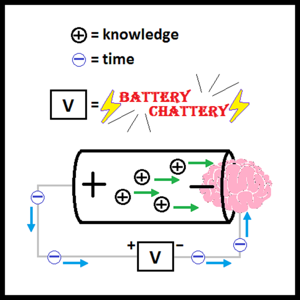
Today we're going to teach you a little something about voltage! We're also going to delve into all the ways we've been misled (by yours truly BUT ALSO BY A LOT OF OTHER PEOPLE) about the humble potato battery. Other topics of note: weddings, the curse of knowledge, theory of mind, reduction potentials again, and battery efficiency.
Sources:
https://en.wikipedia.org/wiki/Voltage
battery efficiencies: https://www.pv-magazine.com/magazine-archive/advancing-li-ion_10006681/#axzz4QbD0S6qc
research into catalysis of hydrogen reduction (aka hydrogen evolution): actually, why don't you just google it? https://scholar.google.com/scholar?hl=en&as_sdt=0%2C44&q=hydrogen+evolution+reaction+catalysts&btnG=&oq=hydrog there, now you've read some paper titles and you know as much as we do! (actually what the paper titles probably don't tell you is that platinum is REALLY a good catalyst but it's very expensive so that's why there's so much research into finding an alternative. Now you know!)
comparison of the ability of metals to catalyze a hydrogen reduction reaction: http://jes.ecsdl.org/content/152/3/J23.short
other questions? let us know at [email protected]
We start off this episode with a little bit of embarrassment and entropy, and then, with a little help from the humble potato, we answer that age-old question: between two electrode materials, how can you decide which one is going to be the anode and which one is going to be the cathode? In corrections corner, the focus is on nuclear power (special thanks to Rachel Bielajew for sending me lots of information!), but we also make time for butter and ionic liquids.
This episode features guests Spencer Johnson (check out his band, Ms. Mack and the Daddies: https://www.facebook.com/mackdaddymusic/ or follow him on Instagram @yonszenshpensz) and Andrew Smith!
Sources:
study about nuclear power preventing deaths: https://pubs.giss.nasa.gov/abs/kh05000e.html
deaths per TWh for various energy sources: http://caravel.sc.edu/2012/09/what-in-the-fukushima-should-we-do-analyzing-the-costs-of-the-fukushima-daiichi-disaster-and-japans-reactions/ see Fig. 4 (and the following citations: https://www.nextbigfuture.com/2012/06/deaths-by-energy-source-in-forbes.html, https://www.forbes.com/sites/jamesconca/2012/06/10/energys-deathprint-a-price-always-paid/#1c9fa501709b)
Thanks for listening! Email us at [email protected] with questions and suggestions!
We start off this episode with a little bit of embarrassment and entropy, and then, with a little help from the humble potato, we answer that age-old question: between two electrode materials, how can you decide which one is going to be the anode and which one is going to be the cathode? In corrections corner, the focus is on nuclear power (special thanks to Rachel Bielajew for sending me lots of information!), but we also make time for butter and ionic liquids.
This episode features guests Spencer Johnson (check out his band, Ms. Mack and the Daddies: https://www.facebook.com/mackdaddymusic/ or follow him on Instagram @yonszenshpensz) and Andrew Smith!
Sources:
study about nuclear power preventing deaths: https://pubs.giss.nasa.gov/abs/kh05000e.html
deaths per TWh for various energy sources: http://caravel.sc.edu/2012/09/what-in-the-fukushima-should-we-do-analyzing-the-costs-of-the-fukushima-daiichi-disaster-and-japans-reactions/ see Fig. 4 (and the following citations: https://www.nextbigfuture.com/2012/06/deaths-by-energy-source-in-forbes.html, https://www.forbes.com/sites/jamesconca/2012/06/10/energys-deathprint-a-price-always-paid/#1c9fa501709b)
Thanks for listening! Email us at [email protected] with questions and suggestions!
What is an anode? What is a cathode? Do we have mnemonics for remembering which is which? The answer to all three of these questions is YES
Also covered this episode: electrolytes, SOLID electrolytes, conductivity requirements for all of the aforementioned, and a little bit of entropy (more on that next time!)
No sources this episode - if you have followup questions, shoot us an email ([email protected]) and let us know so we can try to answer them in another episode!
What is an anode? What is a cathode? Do we have mnemonics for remembering which is which? The answer to all three of these questions is YES
Also covered this episode: electrolytes, SOLID electrolytes, conductivity requirements for all of the aforementioned, and a little bit of entropy (more on that next time!)
No sources this episode - if you have followup questions, shoot us an email ([email protected]) and let us know so we can try to answer them in another episode!
Welcome to Corrections (and Clarifications) Corner, where we focus on topics from previous episodes! Today it's definitely more of a clarifications corner. We start off with some talk about energy storage being centralized in few locations vs distributed to many locations, chat a little about duck curves and Nessie curves, and then move on to addressing the bipartisan-ness of the push towards renewable energy. Hope takes us on a winding detour about different ways to implement revenue-neutral carbon taxes (... sorry), Ana explains how not to write bad survey questions, and finally we wrap it all up by still being better people than Thomas Edison.
From here on out, we'll be including corrections corner at the end of full episodes. Bear with us as we figure out the optimal format for this podcast :)
Sources:
literally everything Hope knows about how an aggregation of batteries can be used as large-scale storage: http://www.utilitydive.com/news/greater-than-the-sum-how-aggregation-is-making-storage-into-a-software-bus/420753/
Nessie curves: https://www.greentechmedia.com/articles/read/hawaiis-solar-grid-landscape-and-the-nessie-curve
key findings of the Climate Change in the American Mind survey: http://climatecommunication.yale.edu/publications/politics-global-warming-may-2017/2/ (full report (pdf) here: http://climatecommunication.yale.edu/wp-content/uploads/2017/07/Global-Warming-Policy-Politics-May-2017.pdf)
household impact survey for a carbon fee & dividend policy: https://citizensclimatelobby.org/household-impact-study/
episode cover art images taken from images taken from https://www.greentechmedia.com/articles/read/the-california-duck-curve-is-real-and-bigger-than-expected (duck curve) and https://www.greentechmedia.com/articles/read/hawaiis-solar-grid-landscape-and-the-nessie-curve (Nessie curve)
Questions? Suggestions? Contact us at [email protected]
From the publisher's feed