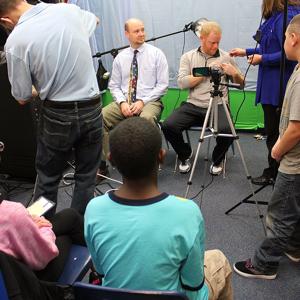
The Guardians, created by Baltimore artist Whitney Frazier and photographer Kirby Griffin, is a photo, documentary, and storytelling project that includes photo portraits, large-scale banners and digital archives that celebrate unrecognized Black female leaders across Baltimore City neighborhoods. This project provides a platform for women who spend their lives fighting for a better, more equitable Baltimore.
Tayler Mugar (00:00): My name is Tayler and I grew up in West Baltimore. I'm in the Sandtown area. I am a 28-year-old, young, black and gifted woman. And most of my childhood was, was spent at my grandmother's house because my mother chose to go back to nursing school. And so my grandmother gave us the opportunity to come back and live with her. So my mother, she can help with, you know, the kids and things like that. When my mother finishes up school. And I didn't realize the sacrifice that my mother made when I was a child and how it was impactful for me growing up, because she chose to go to nursing school, which made a difference in, you know, my life financially, especially coming from where I come from. It gave me more of it gave me more opportunities if that makes sense, because she went because she chose to go back to nursing school.
Tayler Mugar (01:09): It gave me more opportunities, which I'm, I'm grateful for her and the sacrifice that she made when she did that. And I was more so protected from that outside element because I was blessed to be under my grandmother's protection. And I had babysitters who were older and who took the time to nurture me and, you know, pay me some attention. And that was opposite from my peers, because they were subjected to, you know, parents who were victims of drug abuse and things of that nature. So that kinda made me stand out and it created me being an outcast in my own community also because, you know, I was looked at as me not being hood enough for me not being black enough. And then, you know, I go into society, , then, you know, I'm not accepted in the white culture because, of course, I'm black.
Tayler Mugar (02:10): So I wrestled between those two worlds, which is very difficult for me because when people see me, they don't see my struggle and, oh man, it's hard because it goes into that saying of, you know, thank God I don't look like what I've been through. Like, that's really real for me because I am very good at putting a mask up because I'm always the strong person, especially in my family and in my peer group, I'm always the optimistic person and always seeing like the pot of gold at the end of the rainbow, , which created a n bness in me, , recently, because it's like, you can be optimistic, but it's like, you still have to accept like when you're hurting and when you are in pain and you have to heal from that. And as, , as black people, we're taught, you know, how to survive and not how to heal.
Tayler Mugar (03:25): And, you know, I can go into my community and I can get, you know, they try to G check me, you know, G check me. Cause you know, they'll say, you know, you ain't from around here or, you know, you ain't been outside. Yes, I have not been outside. Yes. I was protected from that element, but I'm not gonna feel guilty because I was protected from that element. You're not going to make me feel shameful because I had the same access to go out and, you know, do drugs or n b myself because I was still in that element. You know, I had the choice to say, Hey, do I want to do this? So do I want to do that? And what I'm realizing as I get older is how dare you make me feel bad because of a choice that I made to be better.
Asset ID: 2021.09.12.a
Find a complete transcription on the Peale's website.
Photo by Kirby Griffin