
Sign up to save your podcasts
Or

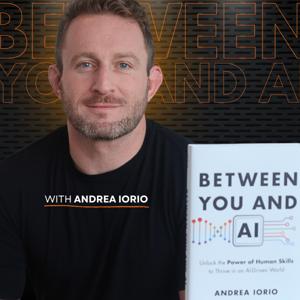


In this episode of Between "You and AI", Andrea Iorio (USA Today bestselling author and keynote speaker) explore a quiet yet profound transformation in the labor market: as artificial intelligence automates standardized cognitive tasks, manual and physical activities are beginning to gain new relevance.
Throughout the conversation, we discuss why this shift is happening, the technological and cultural forces behind it, and what it means for professionals and leaders who must prepare for an increasingly hybrid labor market—one where intellectual, social, and physical skills coexist.
We also reflect on real examples of professionals moving from highly cognitive careers to manual activities, and how the scarcity of technical skills in the physical world may become one of the major differentiators of the future.
More than a simple substitution between types of work, the episode proposes a deeper reflection: in an increasingly digital world, the value of what is physical, concrete, and tangible may rise precisely because it becomes rarer.
Key Topics
The shift in the work paradigm: from cognitive to manual
Real examples of professionals switching from intellectual tasks to manual work
How AI is replacing standardized cognitive tasks
The growing demand for physical and technical skills in infrastructure and maintenance
The cultural dimension of manual work: control, focus, and tangible accomplishment
The scarcity of specialized technical skills
How technology reshapes what is rare and valuable in the labor market
The need to combine intellectual, social, and physical skills
The role of leaders and professionals in adapting to this new landscape
Reflections on the uncertain future of work in the age of AI
Timestamps
00:00 — The impact of changes in work formats and the new demand for manual skills
00:29 — Case of a designer who leaves his career to become a house painter due to AI
00:55 — Professionals moving toward physical and craft-based activities
01:23 — Geoffrey Hinton: “If you want a job in 2030, train to be a plumber.”
01:51 — How AI infrastructure creates new demand for manual skills
02:21 — The technological reasons behind this structural shift
02:48 — The importance of the physical world in the digital economy
03:17 — Cultural and psychological aspects that increase the value of manual work
03:42 — A personal account of finding fulfillment in physical and tangible tasks
04:11 — Control, focus, and well-being in manual work
04:40 — The reassessment of the value of manual skills
05:09 — How automation changes the hierarchy of scarce skills
05:38 — How technology redefines what is rare and valuable
06:06 — Individual preparation for the new world of work
06:32 — Yuval Noah Harari’s insight on the uncertainties of AI
07:01 — The future triad: intellectual, social, and manual skills
07:27 — Using AI as a copilot while strengthening human capabilities
07:50 — Closing thoughts and invitation to reflect
Resources & Links
📘 Book — Between You and AI
https://www.amazon.com/Between-You-AI-Unlock-AI-Driven/dp/1394274333
📖 Yuval Noah Harari — Where is AI taking us?
https://www.nytimes.com/interactive/2026/02/02/opinion/ai-future-leading-thinkers-survey.html
👤 Andrea Iorio
Instagram
https://www.instagram.com/aiorio_br
LinkedIn
https://www.linkedin.com/in/andreaiorio
Website
https://www.andreaiorio.com
From the publisher's feed