
Sign up to save your podcasts
Or



For Feedbacks
Modern dating culture constantly sells us the myth of "the one" the idea that finding a perfect soulmate requires no effort, and that instant chemistry is the ultimate green flag. But what happens when the honeymoon phase ends and the real, human friction begins?
In this episode of Beyond the Surface, we sit down with Dr. Chris Grace, an experimental social psychologist and the founder of the Center for Marriage and Relationships at Biola University. Moving entirely past superficial dating hacks, they break down the cognitive, behavioral, and theological engines that actually drive human connection and long-term commitment.
Dr. Chris Grace holds a Ph.D. in Experimental Social Psychology and serves as a professor and the Director of the Center for Marriage and Relationships (CMR) at Biola University. He is a prominent speaker and the co-host of The Art of Relationships podcast.
Here's a direct link to his insightful podcast: https://podcasts.apple.com/tr/podcast/the-art-of-relationships-podcast/id1520766551
Support the show
For Feedbacks
Language is more than vocabulary and grammar...
It shapes the way we think, connect, remember, and understand the world around us.
In this episode, I'm joined by Sena, a French Literature graduate who recently returned from France, and Koray, for a relaxed and thought-provoking conversation on language and society. Together, we explore how language influences identity, the experience of living abroad, accents and stereotypes, literature, translation, social media, and the subtle ways words that shape our relationships...
This isn't a conversation about linguistics. It's a conversation about being human through language.
Whether you've ever searched for the right word, felt different in another language, or wondered why certain conversations stay with us forever, this episode is for you.
I hope you enjoy listening as much as we enjoyed recording it.
If you enjoyed this episode, don’t forget to give us a 5-star review and follow Beyond The Surface for more deep and thought-provoking conversations. Your support helps us grow and bring you even better content 😊
I'd love to hear what you think; feel free to reach out at ([email protected])
Support the show
For Feedbacks
What does it mean to feel at home?
In this episode of Beyond The Surface, I sit down with Professor Ferit Güven for a conversation about belonging, identity, memory, and the places that shape us.
Together, we explore questions that many of us carry throughout our lives: Is home a place or a feeling? Can someone have more than one home? What happens when you no longer feel at home where you once belonged? And in an increasingly connected world, has the meaning of home changed?
Drawing from philosophy, personal experience, and reflections on culture, this conversation goes beyond geography and explores one of the most fundamental human questions.
If you enjoyed this episode, don’t forget to give us a 5-star review and follow Beyond The Surface for more deep and thought-provoking conversations. Your support helps us grow and bring you even better content 😊
I'd love to hear what you think; feel free to reach out at ([email protected])
Support the show
For Feedbacks
A growing number of young men feel lost, isolated, and without direction. But why is this happening?
In this episode, we explore the silent crisis of young men; examining the psychological, social, and cultural factors shaping their lives today. From loneliness and identity to purpose and responsibility, we look beyond the headlines to understand what’s really going on with young men.
If you enjoyed this episode, don’t forget to give us a 5-star review and follow Beyond The Surface for more deep and thought-provoking conversations. Your support helps us grow and bring you even better content 😊
I'd love to hear what you think; feel free to reach out at ([email protected])
Support the show
For Feedbacks
We inherit more than eye color and last names.
We inherit definitions.
Definitions of success.
Of morality.
Of masculinity and femininity.
Of obedience.
Of what is “normal.”
Of what is “right.”
But what if many of these definitions were never truly ours?
In this episode of Beyond The Surface, we go beyond the inherited definitions that quietly shape our identities and decisions. Through some of the most famous psychological experiments in history, we explore how easily human perception, morality, and behavior can be influenced by group pressure, authority, and assigned roles.
We’ll reflect on:
If ordinary people can conform, obey, and transform under pressure…
How much of what we call “our personality” is truly chosen?
There's insightful breakdowns by Vsauce (Michael Stevens), whose videos beautifully unpack these psychological experiments and their implications.
Recommended videos:
This episode is not about judging the past.
It’s about questioning what we’ve quietly accepted...
Because sometimes growth begins when we ask:
Who defined this for me?
Support the show
For Feedbacks
What happens to consciousness when we fall asleep?
And why does the mind keep creating stories when the body is at rest?
In this episode, we explore dreaming as one of the most mysterious expressions of consciousness. From vivid narratives to fragmented images, dreams reveal a version of the mind that feels both familiar and completely foreign..
We talk about what dreams might tell us about awareness, identity, memory, and the unconscious; and whether dreaming is a different state of consciousness or simply consciousness without external limits ?
Rather than searching for definitive answers, this episode invites curiosity. Because maybe dreams aren’t meant to be solved.
Only experienced.
If you enjoyed this episode, don’t forget to give us a 5-star review and follow Beyond The Surface for more deep and thought-provoking conversations. Your support helps us grow and bring you even better content 😊
I'd love to hear what you think; feel free to reach out at ([email protected])
Support the show
For Feedbacks
In this second episode of our mind series, we explore one of the most debated questions in human thought: How much of our “free will” is actually ours?
From the shaping force of our upbringing to the subtle expectations of society, we reflect on how environments sculpt our choices long before we’re aware of them. We discuss Robert Sapolsky’s provocative challenge to free will; drawing from his book Determined, and contrast it with Daniel Dennett’s more hopeful, compatibilist view...
Together, these perspectives open a deeper conversation about agency, responsibility, and the invisible threads that guide our decisions. Rather than offering a final answer, this episode invites you to rethink what it truly means to choose 🙌
If you enjoyed this episode, don’t forget to give us a 5-star review and follow Beyond The Surface for more deep and thought-provoking conversations. Your support helps us grow and bring you even better content 😊
I'd love to hear what you think; feel free to reach out at ([email protected])
Support the show
For Feedbacks
In this first episode of our three-part series on consciousness, we open the door to one of the oldest and most mysterious questions humans have ever asked: What does it really mean to be aware?
Together, we explore the layers of the conscious and unconscious mind, how our perceptions are shaped, and why understanding our inner world matters more than we think. This isn’t a lecture; it’s a gentle, reflective conversation, grounded in philosophy, psychology, and some neuroscience.
Whether you’re here to question everything or simply to understand yourself a little better, this episode sets the foundation for a deeper journey. The next two episodes will take us further beneath the surface 🙌
If you enjoyed this episode, don’t forget to give us a 5-star review and follow Beyond The Surface for more deep and thought-provoking conversations. Your support helps us grow and bring you even better content 😊
I'd love to hear what you think; feel free to reach out at ([email protected])
Support the show
For Feedbacks
In this episode, we dive into a question almost everyone quietly asks themselves: why is reading becoming so hard? We explore it from every angle ; from the history of how humans first started reading, to how our brains evolved with storytelling, to the modern distractions that pull our attention in a hundred different directions...
We talk about how technology reshaped our reading habits, how the paradox of choice leaves us overwhelmed before we even pick up a book, and why deep reading feels almost impossible in an age of endless notifications. We even look at the cultural shifts, the psychology behind attention, and how reading used to be a slow, communal act rather than a productivity goal.
This episode isn’t a preachy READ MORE lecture; it’s a journey. A colorful one. A mix of history, a bit of science, personal reflection, and honest conversation about the state of our minds today. If you’ve ever wondered why you can binge a 3 hour podcast but struggle to read 3 pages, this one will make you feel seen 😊
If you enjoyed this episode, don’t forget to give us a 5-star review and follow Beyond The Surface for more deep and thought-provoking conversations. Your support helps us grow and bring you even better content 😊
I'd love to hear what you think; feel free to reach out at ([email protected])
Support the show
For Feedbacks
Language is one of the most human things about us; but we rarely stop to think about how it actually works. In this episode, we explore language from every angle: how writing changed the way we think, how our biology shaped the way we tell stories, and how culture, identity, and even power are woven into the words we use every day.
We touch on the big ideas from linguistics in simple, human language; how children learn to speak, why every language has its own rhythm, and why multilingual people sometimes feel like different versions of themselves. We also talk about storytelling, memory, and the invisible rules our brains follow whenever we speak.
If you’ve ever wondered why language feels so natural yet so complicated, or how it shapes the person you’ve become, this episode is for you 🫶🏿
If you enjoyed this episode, don’t forget to give us a 5-star review and follow Beyond The Surface for more deep and thought-provoking conversations. Your support helps us grow and bring you even better content 😊
I'd love to hear what you think; feel free to reach out at ([email protected])
Support the show
From the publisher's feed
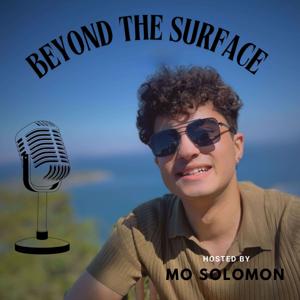
Welcome to Beyond The Surface 🎙️
A space where we slow down, think deeper, and explore the parts of life we usually rush past. Philosophy, psychology, mental health, identity and all the…
I’ve always been drawn to depth; in people, in ideas, in the way we use language to show who we are. But expressing that depth hasn’t always been easy. I grew up moving between languages and cultures, and each one brings out a different version of me. Arabic, English, Turkish… sometimes they feel like superpowers, and other times they feel like weight I have to carry.
But they’ve all shaped the way I think, the way I feel, and the way I try to make sense of the world.
Like many of you, I’ve spent years trying to understand not just who I am, but how to be. How to speak up. How to stay curious. How to believe in something without losing myself in the noise around me.
And honestly, I’m still figuring it out (:
This podcast isn’t about pretending I have the answers. It’s about exploring the questions that actually matter !!! purpose, identity, emotion, language, fear, growth and seeing what we can learn along the way.
It’s about being honest, even when it’s messy.
It’s about going deeper than the small talk we’re all tired of.
I’ve struggled with articulation, with self-doubt, with the pressure of cultural expectations. I’ve felt torn between worlds, and sometimes even between versions of myself. But every struggle has pushed me a little closer to clarity and to courage.
So if you’re someone who sometimes overthinks, who feels caught between cultures or ideas, who wants meaning but refuses to lose your authenticity; trust me, you’re in the right place.
This is where we begin.
Not with perfection.
Not with certainty.
But with honesty and a willingness to go beyond the surface 😊🤓