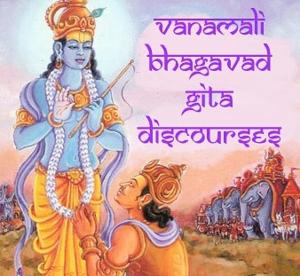
Bhagavad Gita Discourses

Bhagavad Gita Discourses

By
Download on the App Store

Bhagavad Gita Discourses episodes

  • Gita Chapter 8
    Yoga of The Impeirshable Brahman
    Sri Krishna explains the metaphysical concepts: Brahman, adhyatma, karma, adhibhuta...
    Visit: Vanamali Ashram’s Bhakti Yoga Home Page
    51 min
  • Gita Chapter 9
    The Yoga of Sovereign Knowledge and Sovereign Secret. A powerful religious impulse permeates the ninth, tenth and eleventh chapters...
    Visit: Vanamali Ashram’s Bhakti Yoga Home Page
    56 min
  • Gita Chapter 10
    The Yoga of The Divine Manifestations
    The yoga of the Gita...is the gospel of the Divinity in man which forces him out of the encasing of his lower nature to an increasing awareness of the Divine within him and outside him, through the methods of yoga...
    visit www.vanamaliashram.org
    54 min
  • Gita Chapter 11
    The Yoga of the Vision of Cosmic Form
    ...the illusion that all things exist separate from God has been dispelled from his mind. He realized that all nature is but a revelation of that Godhead...
    Mataji’s love songs are translated at at the www.vanamaliashram.org Vanamali Love Songs page. Her Vanamali love Songs album is available at the Ashram’s on-line store.
    Visit: Vanamali Ashram’s Bhakti Yoga Home Page
    54 min
  • Gita Chapter 12
    The Yoga of Devotion
    Lord Krishna unites the triple strands of divine love, divine knowledge and divine works, Bhakti, Jnana and Karma and unites them into one. Creature, creator and creation blend into one... This is the supreme teaching of the Gita.
    Visit: Vanamali Ashram’s Bhakti Yoga Home Page
    40 min
  • Gita Chapter 13
    The Yoga of the Distinction Between the Field and the Knower of the Field.
    In the thirteenth chapter, Lord Krishna says that the entire universe is a field for the play of god. This field has two parts. On the universal level it includes the whole of cosmic manifestation and on the individual level it consists of the body, mind, intellect and ego. The first cannot be separated from the other. It is only now that western science is coming to understand this truth.
    The Gita describes this all Knower or Supreme Consciousness as the kshetrajna or the knower of the field. The field may be composed of many items but the Knower is one. He is the Lord of all and is seated within the heart of every creature.
    “sarvatha panipadam tat
    sarvata shishiromukham,
    sarvathasrutimanloke,
    sarvamavritya thishtati.”
    This Being in whose embrace we live has feet of swiftness and hands of strength on all sides; It has faces, eyes and noses everywhere. It listens to both the throb of the universe as well as the silence of eternity. Though bodiless it has a million bodies. It is the perceiver of all things even though it has no sense organs. It is without attributes yet is the enjoyer and sustainer of all attributes. Attached to nothing, it supports all the action and movement of its Prakriti. It is at once the inner and the outer, the far and the near, the moving and the unmoving. It is the subtlest of the subtle, beyond the grasp of our minds as well as the density of matter which we can see and touch and smell and hear.
    It is the light of all lights beyond the darkness of ignorance. It is knowledge, the object of knowledge and the goal of knowledge. Despite its greatness it is seated in the hearts of all as the charioteer of our lives!
    At last the great teacher says to his disciple Arjuna, “O Arjuna, whatever exists whether movable or immovable know it to have come from the union of the kshetra and the kshetrajna, the field and the knower of the field”. This is the knowledge which will carry us beyond death to immortality. It is only when our inner eye opens and we see this truth that we can be called “seers”. This is that supreme consciousness about which western science is still to know. Without knowing that consciousness humankind can never know the meaning of true fulfillment or peace.

    37 min
  • Gita Chapter 14
    The Yoga of The Distinction Between The Three Gunas. What is Liberation? Who is it that is liberated and from what, when all is Spirit and Spirit alone.
    The special feature of the Gita is that it insists that "karma" or action has to be done since we live in an active universe and we cannot say that we will not act. Nature will force us to act. But this action has to be done without expectation of any personal rewards. In this way we will get out of the thrall of the law of karma. This is what is known as "nishkama karma" - when action is done as an offering to the Supreme and the results are left to Him. for indeed He is the sole doer and enjoyer. All we are asked to do is to perform the karma. This is what makes the Gita different from other schools of philosophy. Whereas all other schools say that karma is a bondage and will
    have to be given up eventually, the Gita says that karma is both the means and the end if done in the way that nature meant us to do.
    52 min
  • Gita Chapter 15
    The Yoga of The Supreme Person
    The 15th chapter delineates three Purushas - The Kshara, the Akshara and the Uttama. The Kshara is the Kshetra of the 13th chapter - all of visible nature.
    The Akshara, He says "is an eternal portion of myself that becomes the jiva in this world". "Mamaivamso jivaloke, jivabhuta sanatana". This means that each person in his spiritual reality is the very divine, however partial its actual manifestation may seem to appear to our eyes.
    We call it the jiva because it appears as a separate being in a world of creatures and we think of it in terms of its humanity alone. But in truth is is much greater than its appearance and is not bound by its humanity. It is in no way separate from the Purushottama, It is the Lord Himself and exists forever in the mortal world as the immortal atman within us. He takes up a body and casts it away
    as and when the need arises. But He is not only the Kshara and the Akshara but is above both. He is both transcendent and immanent.
    51 min
  • Gita Chapter 16
    The Yoga of The Distinction Between Divine and Demonic Qualities. ...the advice of the Gita is given by an avatar or God incarnate. The recipient of the message is Arjuna, the prototype of the struggling human soul who is ready to receive the great knowledge by his close companionship and increasing nearness to the divine Self within himself. This symbolic companionship of Krishna and Arjuna, the divine and the human soul is further dramatized by the fact that their dialogue takes place amidst the din and clamor of a battlefield. The teacher in the Gita is therefore not only the God who is transcendent but also the God in man who unveils Himself through through an increasing knowledge...
    Vanamali, Nitya Yoga
    Mataji sings her original Love songs to Lord Krishna at the end of each talk. This music is available as Vanamali Love Songs. Mataji's books & music are available at the ashram's on-line Book & Music Store.
    47 min
  • Gita Chapter 17
    The Yoga of The Three Fold Faith
    Om Tat Sat is the mantra that embodies the sraddha or faith which can divinize our every action through a consciousness of the transcendence and eminence of Reality.
    51 min

About Bhagavad Gita Discourses

From the publisher's feed

The Song Celestial unfolds a dialogue of the advice given by an avatar or God incarnate. The recipient of the message is Arjuna, the prototype of the struggling human soul who is ready to receive the…