
Sign up to save your podcasts
Or



Send a text
What makes a species invasive? Today on the BioAudio podcast my guest is Dr. Thais Bernos who is an expert in the genetics and genomics of invasive fish species. Her study subject is the tench fish introduced three times to Canada staring in the late 1800s but also introduced around the world as human populations moved and brought a favourite food with them. Join us to hear about what makes an invasion successful and how their evolutionary and population structure informs management.
Send a text
Did you know that about half your genome is made of small bits of DNA called transposable elements? These "genomic parasites" are not genes, and they are not there to help run your body... they are small selfish elements out only to replicate themselves. They can cut themselves out of your genome, duplicate and re-enter you genome... and they can disrupt things as they go. Some of them appear to be ancient viruses, now there almost like fossils, some are highly dynamic bits of DNA. They are fascinating selfish elements ... and you are crammed full of them.
Send a text
After many episodes about evolution, you might wonder... how did this all get going? Where did life come from? How did life itself start? In this episode Jacob Fine, a graduate student with a passion for RNA biology, takes us on a journey more than 4 billion years into the past... to explore what life might have looked light at the very start. We will talk about the "Darwinian threshold", LUCA, the last universal common ancestor and just what spark might have started evolution.
Send a text
In this episode Prof. Charlyn Partridge and I talk about the evolution of reproductive tactics in sunfishes.
Send a text
We normally talk about evolution of species - and the genome as a sort of inert and hardly changing thing... but the reality is quite different. Your genome is an amazingly complex things that also evolves. Here Prof. Ryan Gregory and I talk about evolution of the genome itself.
Send a text
This is part 2 of a two part lesson on how to read a scientific paper.
In part 1 Prof Joanna Coleman and I talked about the parts of a scientific paper and we compare our approaches to actually sitting down and trying to understand scientific publications. We also introduced the topic of "co-evolution".
In this episode Prof. Coleman and I actually read a paper together and we talk about it as we go. What we liked, what was important, what did we both get from this paper.
The paper we are going to read is a short, reasonably easy to read report on how bats and pitcher plants may have co-evolved.
Grafe TU, Schöner CR, Kerth G, Junaidi A, Schöner MG. A novel resource-service mutualism between bats and pitcher plants. Biol Lett. 2011 Jun 23;7(3):436-9. doi: 10.1098/rsbl.2010.1141.
If you are a university professor and would like a suggested assignment that goes along with this two part episode feel free to email the podcast and i'll explain the different assignments I have used as a follow up in different classes.
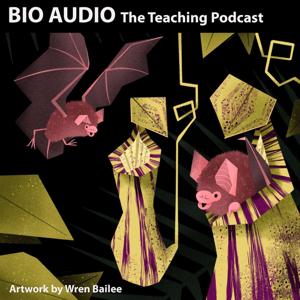
EASTER EGG - this paper inspired the cover art for BioAudio. The wonderful image that I was given permission to use by Wren Bailee.
Send a text
If you are a university professor - how often do you ask your class to read a paper... and how often do you actually explain how they should do it?
As a student, how often has someone actually walked you through how to understand scientific publications.... my guess is not enough!
Teaching from scientific publications is great, but they take practice to get onto the style of writing. As scientists, we read and write so many, sometimes we forget how steep that learning curve is. I was surprised when a student stopped me after class last year and said "but, how do I read the paper you gave us, what am I supposed to get from it? It's like a different language". The student was quite correct. Reading scientific literature is a skill we all need to learn and practice.
So Professor Joanna Coleman and I sat down and created this two part episode on how to read a scientific paper. In part 1 we talk about what goes into the different sections of a scientific paper, and we compare how each of us would approach reading a paper. We also introduce the topic of co-evolution (which is what we are going to read about). In part 2 we actually read a paper together.
Send a text
On this episode of BioAudio, Prof. Gerry Carter and I talk about the complexity of understanding the evolution of cooperation in animals groups
Send a text
In this episode Prof. Ryan Gregory of the University of Guelph and I discuss how sexual selection explains the evolution of traits that seem to have a cost to an individual's survival. It's the battle of the sexes on the BioAudio podcast.
Send a text
In this episode of the BioAudio podcast I talk to 3rd year undergraduate student Ghazal Hooshyar and she's going to explain to me what she's learned about different types of selection.
From the publisher's feed