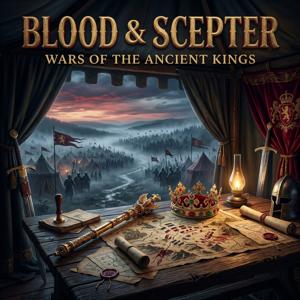
Blood & Scepter

Blood & Scepter

By Blood & Scepter ProductionsHistory
Download on the App Store

Blood & Scepter episodes

  • The Gate After the Sortie: Baghdad, 1258
    The Gate After the Sortie: Baghdad, 1258
    Welcome to Blood & Scepter. Stand at a Baghdad gate and watch for the men sent to break the siege. Some return wounded across wet ground. Others do not return. Today, we hear the fall of the city from inside the narrowing space its defenders held.
    Baghdad fell when a caliphate whose prestige far exceeded its military power confronted a Mongol army skilled at turning political isolation, encirclement, and siege engineering into surrender. The destruction was catastrophic for the city and its inhabitants, but the image of a Tigris black with ink is best understood as a powerful, unverified expression of cultural loss—not a measured account of what happened to every book, or proof that learning across the Islamic world ended in 1258.
    16 min
  • Brothers of the Bronze Age: The Great Powers Club That Fell Apart
    Brothers of the Bronze Age: The Great Powers Club That Fell Apart
    In the thirteenth century BCE, the kings of Egypt, Hatti, and their neighbors wrote to one another as brothers. They traded gold, horses, princesses, and promises. [pause] It was the first international order. A club of great powers balancing one another across the Near East. [dramatic pause] Within a few generations, the Hittite capital stood abandoned, vassal ports lay in ruins, and only Egypt remained a great power, weakened. Today: how a geopolitical system dies.
    Around 1200 BCE, a world held together by palace administrations, long-distance trade, and powerful kings began to break apart; within several decades, some of its greatest capitals had been destroyed or abandoned. The catastrophe was not a single invasion or a moment when civilization vanished, but a chain of crises in which warfare, displacement, shortages, and political failure made each other more dangerous—and forced survivors to build different societies.

    17 min
  • Night Alarm at the Ninth Legion’s Camp
    Carnyx and Gladius: Blood in the Peat Bogs of Caledonia
    Welcome to Blood & Scepter. Mud, cold rain, splintered shields, and the terrifying scream of Celtic war horns in the Scottish heather.
    In the early second century AD, one of the most battle-hardened formations in the Roman military machine—five thousand heavily armored legionaries—marched north past the frontier of Eboracum (modern York) into the swirling mists of Caledonia. They were never seen again. Their vanishing left such a wound on the Roman psyche that Emperor Hadrian traveled in person to Britain to build a stone wall sealing the empire from the terrifying northern wilderness.
    15 min
  • Shield Up: A Roman Soldier at Carrhae
    Shield Up: A Roman Soldier at Carrhae
    Welcome to Blood & Scepter. Today, you stand in a Roman formation on dry Mesopotamian ground. An arrow strikes your shield. Another finds the horse beside you. Your commander orders you forward, but the riders pull away. This is Carrhae, seen from beneath the arrows.
    Carrhae was not simply a contest between Roman infantry and Parthian archers: it was a failure of command, reconnaissance, cavalry protection, and ammunition logistics that left seven legions unable to force their enemy into a decisive close fight. For Crassus, whose wealth could not buy the military prestige of Caesar or Pompey, the campaign ended in the death of his son, the destruction of his army, and a humiliation that shaped Roman politics for decades.
    15 min

About Blood & Scepter

From the publisher's feed

Visceral, sensory-driven historical storytelling placing you in the shield wall, the cavalry charge, and the smoke-choked breach.