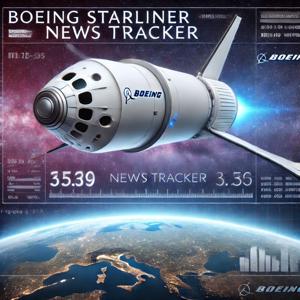
Boeing Starliner News Tracker

Boeing Starliner News Tracker

By Inception Point AINews
Download on the App Store

Boeing Starliner News Tracker episodes

  • NASA Astronauts Dispel "Abandoned in Space" Rumors, Reaffirm Confidence in Boeing's Starliner
    NASA astronauts have recently dispelled rumors suggesting they were "abandoned in space" aboard Boeing's Starliner spacecraft. These speculations arose following a longer-than-expected nine-month space mission involving astronauts Butch Wilmore and Suni Williams. Both Wilmore and Williams have shared their insights, explaining how they managed the extended duration in space and what they missed most from home. They underscored that safety remained a priority throughout their mission.
    Despite the unexpected extension and the political attention it garnered, the mission has not deterred NASA’s commitment to Boeing's Starliner program. The astronauts have publicly stated their willingness to fly on the Starliner again, reinforcing their confidence in the vehicle's reliability and safety.
    Boeing is actively collaborating with NASA to evaluate the recent mission. This collaborative effort focuses on identifying necessary changes to enhance the safety and success of future Starliner missions. As part of this strategic review, both Boeing and NASA are committed to ensuring that upcoming missions meet their stringent safety standards.
    This situation comes amid a broader dialogue about the viability and future of commercial spacecraft, with industry leaders like Elon Musk being part of the conversation. The commitment by NASA astronauts to the Starliner program underscores a continuous trust in Boeing's capabilities and the importance of commercial partnerships in advancing space exploration.
    This content was created in partnership and with the help of Artificial Intelligence AI.
    2 min
  • Boeing's Starliner Faces Thruster Malfunctions, Delaying NASA Mission
    Boeing's Starliner capsule has recently been in the spotlight due to issues with its thrusters, leading to significant delays for its intended mission. The Starliner was supposed to dock successfully, but multiple thruster malfunctions left two astronauts stranded in orbit until the matter was resolved. Consequently, these astronauts spent an extended nine months in space, but Boeing has stated that they will not receive additional compensation for their prolonged stay.
    Despite these challenges, the collaboration between NASA, JAXA, and Roscosmos signals a promising future for the Starliner. American astronauts Cardman and Fincke are part of a larger team that aims to make significant advancements in space exploration, signifying a strong partnership among international space agencies.
    Looking forward, NASA has announced that the Starliner-1 mission is anticipated to proceed once the thruster issues are addressed. Meanwhile, SpaceX continues its operations, with rocket launches from Cape Canaveral, Florida. This sequence of events underscores both the competition and collaboration present in current space endeavors, as Boeing works to overcome its technical hurdles while maintaining its role as a partner in global space missions.
    This content was created in partnership and with the help of Artificial Intelligence AI.
    2 min
  • "Boeing Starliner to Potentially Launch Again by 2025, NASA Aims for Certification"
    The Boeing Starliner, a spacecraft designed to transport astronauts to space, is set to potentially launch again before the end of 2025. The announcement, made by the space agency, reveals plans to certify the Starliner, aiming to resolve issues that have plagued the project in the past. Despite these challenges, efforts are ongoing to bring the spacecraft into operational status.
    The Starliner has been the subject of discussion among space enthusiasts and has faced public scrutiny, including comments from former President Donald Trump, who criticized NASA over the delays related to the spacecraft. Nevertheless, Boeing and NASA remain committed to overcoming technical hurdles and are working towards conducting successful manned missions with the Starliner.
    In parallel news, various unrelated events, such as the dramatic footage captured by a Ring camera showing a plane crash in Minneapolis, have also captured public attention. Additionally, on television, the show "Gogglebox," which airs on E4, features viewers watching and commenting on recent broadcasts, including topics around space exploration like the Boeing Starliner and other current events.
    This content was created in partnership and with the help of Artificial Intelligence AI.
    2 min
  • "NASA and Boeing Aim to Certify Starliner Spacecraft for Crewed Missions by 2025-2026"
    NASA and Boeing are advancing efforts to certify the CST-100 Starliner spacecraft for crewed missions, with the goal of achieving certification by late 2025 or early 2026. This development follows earlier setbacks, such as a mission originally planned for eight days which extended to 286 days due to significant technical issues with the Boeing Starliner. The spacecraft experienced these complications while on a mission, raising concerns about the spacecraft’s reliability.
    Recent updates indicate that rigorous testing is underway, aimed at addressing previous challenges and ensuring the Starliner’s readiness for safe manned space flights. The process involves comprehensive assessments to meet NASA's stringent safety and reliability standards. Once certified, Starliner will join other spacecraft in facilitating transportation to and from the International Space Station (ISS), offering more options for NASA's crewed missions.
    Developing the Starliner for human spaceflight is part of a broader strategy to strengthen NASA's commercial crew program, providing redundancy and enhancing the scope of activities conducted in low Earth orbit. Through continuous improvements and collaboration with NASA, Boeing is working to ensure that the Starliner meets the high expectations set for upcoming crewed launches.
    This content was created in partnership and with the help of Artificial Intelligence AI.
    2 min
  • Boeing Starliner's Challenges: Setbacks and NASA's Reliance on Partnerships
    Boeing's Starliner spacecraft has faced significant challenges, as highlighted in numerous reports and analyses. Despite ambitious plans, including a mission involving astronauts Sunita Williams and Barry Wilmore, the Starliner encountered multiple setbacks. Originally, Williams and Wilmore were slated to spend eight days aboard the Starliner at the International Space Station. However, the mission's timeline was disrupted by technical difficulties, contributing to delays in its commercial crew service role.
    The issues surrounding the Starliner have not gone unnoticed within the aerospace community. A YouTube discussion, “The Real Reason The Boeing Starliner Failed," attracted 2.4 million views, indicating substantial public interest and scrutiny. Such failures underscore the complexity of manned spaceflight and the pressures on Boeing as a key player in NASA's commercial crew program.
    In the broader context, the Pentagon recently awarded Boeing a $20 billion contract to produce fighter jets, illustrating the company's pivotal role in both defense and space sectors. While Boeing navigates these hurdles in space ventures, its ongoing involvement in defense manufacturing highlights its diverse capabilities and strategic importance.
    In the interim, NASA continues to rely on partnerships with other agencies and companies to sustain its operations, pending a successful resolution to the Starliner's challenges. Sunita Williams, a seasoned astronaut, is set to share insights from her mission experiences on March 31, which may provide additional context about working aboard the ISS and the potential future of the Starliner program.
    This content was created in partnership and with the help of Artificial Intelligence AI.

    2 min
  • Overcoming Setbacks: The Boeing Starliner's Journey to Reliable Space Travel
    The Boeing Starliner, a spacecraft intended to transport astronauts to the International Space Station (ISS), has faced several challenges and significant setbacks. Despite its aim to provide NASA with a reliable second option for manned space flights, the Starliner project has encountered various technical difficulties that have delayed its progress.
    The initial flight demonstration of Boeing's Starliner did not go as planned, resulting in substantial financial losses for Boeing, estimated at IDR 32.9 trillion. Although the spacecraft fell short in its first significant test, NASA remains optimistic about its future potential and continues efforts to successfully launch the vehicle.
    Compounding the situation, astronauts Sunita Williams and Barry "Butch" Wilmore, who are test pilots for the Starliner capsule, have faced extended mission timelines due to these technical issues. In a show of support, former President Donald Trump has reportedly offered to cover any overtime pay that may be necessary for the astronauts because of these delays.
    Efforts to address the technical concerns are ongoing, as Boeing and NASA strive to ensure the Starliner meets safety and operational standards. The project remains a critical component of NASA's commercial crew program, which aims to foster partnerships with private companies to facilitate human spaceflight. With continued dedication and collaboration, Boeing hopes to overcome the obstacles that have hindered the Starliner and demonstrate its capability as a viable spacecraft for NASA missions.
    This content was created in partnership and with the help of Artificial Intelligence AI.
    2 min
  • Boeing Starliner's Reliability Concerns Delay Astronaut Missions Amid Technical Challenges
    The Boeing Starliner has faced significant challenges, including propulsion failures and helium leaks, which have resulted in the capsule being deemed unsafe for astronaut return missions. These technical issues have contributed to delaying the Starliner’s planned missions and have raised concerns about its reliability in future space endeavors. The failures were highlighted in various reports, emphasizing the need for Boeing to address these critical issues to ensure the spacecraft's safety and operational integrity.
    Additionally, the effects of prolonged spaceflight on astronaut health have come into focus, with astronaut Sunita Williams experiencing notable health tolls from her missions. This has implications for the planning and preparation of future long-duration space missions, as ensuring crew health and safety remains a top priority for NASA and its partners.
    While Boeing and NASA are working to rectify these setbacks, the aerospace company faces pressure due to competitive advancements from other stakeholders in the space race. Boeing's resolution of the Starliner issues is vital for retaining its position in the commercial spaceflight industry and restoring confidence in its capabilities to safely transport astronauts.
    As these developments unfold, they underscore the complexities of human space exploration and the continuous need for technological advancement and stringent safety protocols in aerospace engineering. The focus remains on ensuring that all spacecraft meet the highest safety standards to support the expanding horizons of human presence in space.
    This content was created in partnership and with the help of Artificial Intelligence AI.
    2 min
  • "Boeing Starliner Faces Setbacks in Becoming Reliable Crew-Capable Spacecraft for NASA's ISS Missions"
    Boeing's Starliner spacecraft has encountered several challenges in its development and operation, impacting its mission to become a reliable crew-capable vehicle for NASA's International Space Station (ISS) missions. Initially designed to transport astronauts, the Starliner has faced multiple setbacks that have delayed its operational timeline.
    The Boeing Starliner faced a critical setback in its goal to be a "crew-capable" spacecraft after a failed unmanned test flight, which necessitated additional evaluations and corrective measures. This resulted in NASA deciding that the capsule may need to undergo another uncrewed test flight to ensure its systems are fully functional before carrying astronauts again. This decision underscores the need for rigorous safety standards in human spaceflight, which Boeing must meet to regain NASA's confidence.
    Meanwhile, ISS activities continue to progress with routine crew handovers and the movement of cargo ships, involving missions like Crew-9, Crew-10, and Soyuz MS-26. This ongoing activity highlights the necessity for reliable crew transport solutions, a gap the Starliner aims to fill once it overcomes its development hurdles.
    Despite Starliner's ongoing issues, NASA and Boeing are committed to resolving these challenges to enhance the spacecraft's reliability and safety, aiming to add it as a valuable asset in their roster of crew transport vehicles for future missions.
    This content was created in partnership and with the help of Artificial Intelligence AI.
    2 min
  • NASA Astronauts Stranded on ISS for 9 Months Return Safely to Earth
    NASA astronauts Suni Williams and Butch Wilmore have returned to Earth after an unplanned nine-month stay on the International Space Station (ISS). Initially launched aboard Boeing's Starliner capsule in June, they were forced to extend their mission due to technical issues with the spacecraft. These problems prevented a timely return and necessitated an extended stay on the ISS.
    The astronauts were recently rescued and brought back to Earth by a NASA-SpaceX crew. This deorbit and splashdown marked a joyful return for Williams and Wilmore, ending their unexpected prolonged mission. The astronauts' extended presence on the ISS highlighted challenges in spacecraft reliability, emphasizing the need for rigorous testing and backup plans in future missions.
    Their return was facilitated by a successful collaboration between NASA and SpaceX, showcasing the resilience and adaptability of current space exploration partnerships.
    This content was created in partnership and with the help of Artificial Intelligence AI.
    2 min
  • NASA Astronauts Safely Return to Earth After Starliner Spacecraft Malfunction
    Two NASA astronauts are set to return to Earth following a nine-month stay on the International Space Station (ISS) due to an issue with the Boeing Starliner spacecraft. These astronauts have been on the ISS since June, after an unexpected malfunction occurred during the Starliner's maiden crewed voyage. To facilitate their return, SpaceX's Dragon Crew-10 recently arrived at the ISS, turning what was initially a standard crew rotation mission into a critical operation to bring back the stranded astronauts.
    The Boeing Starliner, intended to be a consistent vehicle for crewed space travel, faced setbacks that forced NASA to delay its plan for the spacecraft. Despite extensive testing, the initial crewed mission of the Starliner encountered issues, postponing its deployment and necessitating assistance from SpaceX. The SpaceX Dragon capsule's timely arrival ensures the astronauts' safe return, as NASA navigates the technical hurdles posed by the Starliner mission.
    This content was created in partnership and with the help of Artificial Intelligence AI.
    2 min

About Boeing Starliner News Tracker

From the publisher's feed

Stay up-to-date with the latest developments on Boeing's Starliner spacecraft with the 'Boeing Starliner News Tracker' podcast. We bring you timely updates, in-depth analysis, and expert insights on everything related to the Starliner mission, space exploration, and aerospace technology. Whether you're a space enthusiast or industry professional, this podcast is your go-to source for reliable information on the Starliner’s journey. Subscribe now for daily news and stay ahead in the world of space exploration.