
Sign up to save your podcasts
Or



Sorachi Ace was bred to be a Saaz. It came out tasting like dill, and Sapporo's own published abstracts have carried dill-like as a descriptor since 2018, so the character was documented from the start and simply was not the assignment.
That is the first half of this episode. The second half is Luminosa, an open pollinated Sorachi Ace seedling collected in a Corvallis research yard in 2013 and released by Indie Hops with the 2022 harvest, which inherited the geranic acid and none of the structure underneath it.
Parent and daughter, one compound, two jobs.
In this episode:
Sorachi Ace is up as a Terroir Tuesday and Luminosa is in Variety Vitals.
Read the full breakdowns at shanferments.substack.com
Intro and outro music: Low Street by T.Nautilus
El Dorado went into the ground as a bittering hop. The pear and watermelon it is known for now sat outside the original target completely, and CLS Farms went from one experimental acre to twenty seven the following year once they saw what was there.
That is the second half of this episode. The first half is the research recap covering seven papers from June and July, including dip hopped and dry hopped beers drifting apart across three months of storage, thiol release tracked against yeast gene expression instead of measured once at the end, a rice based non alcoholic beer with a humulene figure that needs its method read alongside it, spoilage yeast doing more damage in non alcoholic beer than in standard styles, and a bright tank retrofit that carbonated an IPA up to fifty times faster with no measurable hit to hop oil.
Two segments, one episode.
In this one:
ASBC is in Seattle from August 16th to the 19th and I will be covering new research from the floor as it happens.
GrainMaker Beer Fest is in Spokane this weekend with proceeds going to fire relief and fire rescue. Donation resources are in my bio and at Washington Beer Blog.
Full breakdowns with every figure and citation at shanferments.substack.com
Intro and outro music: Low Street by T.Nautilus
If a hop you rely on keeps swinging on price or supply, the national acreage number won't explain it. It barely moved this year. Washington shed about 900 acres, Idaho picked up almost 800, and the map redrew underneath a total that looks flat. Stocks are sitting at a multi-year low, so every contract you sign this fall carries more weight than it did in a flush year.
Then, a hop that should have gone extinct decades ago. Fuggles is a low-yield hop that catches wilt and carries alpha too low to justify on a spreadsheet, and its entire UK crop now fits on about 42 hectares. It's still here because the Kentish Weald builds a chemistry, high humulene and rare farnesene, that no other ground reproduces. Grow the identical plant in Oregon or Slovenia and you get a different hop in the glass.
The acreage tells you what's leaving. The ground tells you what's worth keeping.
What to do with it:
No standalone Terroir Tuesday this week, this episode carries Fuggles in full. Back on cadence next week.
Written version with all the oil numbers, the figures and every citation is on Substack and Instagram.
Intro/Outro Song: Low Street by T.Nautilus
If Hallertau Blanc has ever let you down, the problem is probably timing, not the hop. Most of its geraniol is locked up as geranyl acetate, and only active yeast releases it. Cold dry hop it and you get the quiet version of a hop that was supposed to taste like Sauvignon Blanc.
Then, two hop papers from this year that land on the same point from opposite directions. A hybrid genome showing European and North American chromosomes refusing to blend across six generations of breeding. And a Strata storage study showing that farm and vintage swing thiol content five to seven times over while age barely moves it.
The bag tells you the variety. The origin tells you the beer.
What to do with it:
Written version with all the oil numbers, the figures and every citation is on Substack and Instagram.
Intro/Outro Song: Low Street by T.Nautilis
From the publisher's feed
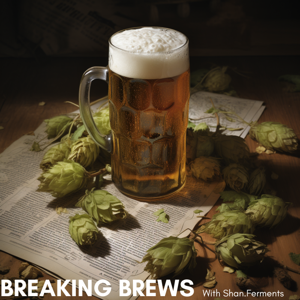
Every hop has a story the datasheet leaves out. Breaking Brews is where that story gets told, one variety and one paper at a time.
Each week, food and beverage scientist Shanleigh Thomson…
This is for brewers who want to know why, not only what. For anyone who has bought a variety on its reputation and wondered why the beer did not taste like the description on the bag. For people in the industry who do not have time to read the Journal of the American Society of Brewing Chemists but would like to know what is in it.
Shanleigh is a UC Davis Master Brewer with more than a decade in craft beverage. She teaches fermentation science at the university level and has worked with hop suppliers and beverage brands across the industry. The aim has always been the same. Real science, without the gatekeeping.
Written versions of every episode, with the full oil numbers, the figures, and every citation so you can check the work, live at Breaking Brews on Substack.
Find Me:
Substack: Breaking Brews
Instagram: @shan.ferments
LinkedIn: Shanleigh Thomson
Youtube: Shan Ferments