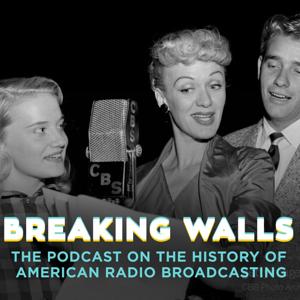
Breaking Walls

Breaking Walls

By James ScullyHistory
Download on the App Store

Breaking Walls episodes

  • BW - EP131—005: Orson Welles Is The Shadow—The Shadow Launches With Orson Welles
    In the fall of 1937, Orson Welles was busy readying for a Mercury Theater broadway production of Julius Caesar. The agency Ruthrauff and Ryan approached Welles about the possibility of starring in a weekly radio series. His signing was announced in The New York Times on August 29th, 1937. Welles’ contract allowed him to miss rehearsals and readings. He was paid seventy-five dollars per week, or roughly fifteen hundred today, for one-half hour of weekly work.
    On Sunday September 26th, at 5:30PM the new version of The Shadow debuted. The program's announcer was Ken Roberts. Opposite Welles as Margot Lane was Agnes Moorhead, along with many of the Mercury Theater players.
    The Shadow was Lamont Cranston, a wealthy man about town. He had the ability to cloak himself with invisibility and to read minds. They were tools of Mesmer, learned through years of study in the orient and India.
    Walter Gibson’s involvement in the radio series was minimal. Clark Andrews directed the first few broadcasts with Martin Gabel becoming the de facto director thereafter.
    6 min
  • BW - EP131—004: Orson Welles Is The Shadow—WOR And Network Radio In The Fall Of 1937
    The voice at the top of this clip is that of former WOR chief engineer Jack Poppele. The station went online on February 22nd, 1922.
    In 1934, WOR became one of the flagship stations of the Mutual Broadcasting System. The next March, Poppele was chiefly responsible for the creation of radio’s first directional antenna just as WOR increased its power to fifty-thousand watts.
    In December of 1936, Don Lee’s west coast chain of networks joined Mutual, giving it coast-to-coast access. But in the fall of 1937 The Mutual Broadcasting System had no top-fifty rated shows.
    Seventy-four percent of the U.S. population now had a radio set. Sunday evening’s most-heard shows belonged to Edgar Bergen, who pulled a 32.1, and Jack Benny, who pulled a 29.5. Both ran on NBC Red. Overall NBC’s Red Network had twenty-six of the nation’s top fifty shows, while CBS had nineteen, and NBC’s Blue Network had five.
    WOR’s Sunday afternoon programming had concerts, sports, and news bulletins. Their schedule was ripe for a new melodrama.
    4 min
  • BW - EP131—003: Orson Welles Is The Shadow—Les Misérables
    By late spring in 1937, the Federal Theater Project was under intense scrutiny for staging what some felt were too many left-leaning labor plays. In Washington, there were rumors funds would be cut.
    At the same time, Welles and John Houseman were rehearsing a production of The Cradle Will Rock. The play took place in "Steeltown, USA.” It followed the efforts of Larry Foreman to unionize the town's workers. This was to combat the wicked Mister Mister, who controls Steeltown’s factory, press, church, and social organizations.
    Less than three weeks before the play was to open on June 23rd, The WPA shut down the project. Welles went to Washington to argue his case. He failed. Next, he threatened to open the play himself. The government’s response was severe.
    A dozen uniformed guards took over the building. They stood at the front entrance, the box office, and in the alley outside the dressing rooms to ensure no government property was touched. But, John Houseman discovered an out. As U.S. citizens, the actors were free to enter as audience members and rise from their seats to speak their lines, so long as they weren’t on stage. The Cradle Will Rock played in the aisles. The next day everyone was fired, but it was front-page news.
    That summer NBC featured a series of Shakespeare dramas with John Barrymore, while CBS aired Shakespeare adaptations featuring Humphrey Bogart and Leslie Howard. To battle for listeners, Mutual scheduled a seven-week take on Victor Hugo’s Les Misérables, hiring Orson Welles to write, direct, and star in the production.
    Les Misérables debted on Friday, July 23rd, 1937 at 10PM, over WOR in New York. The production also marked the radio debut of the Mercury Theatre troupe. Martin Gabel was Javert. Alice Frost, Fantine. Virginia Nicolson, the adult Cosette, and it also featured soon-to-be radio mainstays like Ray Collins, Everett Sloane, Betty Garde, Hiram Sherman, Frank Readick, Richard Widmark, and Welles’ good friend, Agnes Moorehead.
    From July 23rd through September 3rd, Les Misérables captured public interest. In a press release, Welles referred to the broadcast as a “projection” of what radio could dramatically evolve into. The series had begun solely on the east coast, but audience reaction induced Mutual’s officials to give it full coast-to-coast coverage. It cemented Welles as someone who could write, produce, direct, and act for radio.
    15 min
  • BW - EP131—002: Orson Welles Is The Shadow—The Shadow As Narrator
    In 1930 publisher Street and Smith decided to try radio with hopes of boosting pulp sales. Each week a drama would be adapted from an upcoming issue of Detective Story Magazine.
    They added a mysterious host, called The Shadow, and left the link to the magazine somewhat tenuous. The show premiered over CBS on July 31st, 1930.
    Ken Roberts soon became the announcer. It wasn’t long before people were asking for a Shadow magazine. Walter Gibson became its chief writer. Meanwhile, on the air, the host became Frank Readick.
    In the fall of 1931 Detective Story Hour became The Blue Coal Radio Review. The Shadow character proved so popular, beginning on Thursday October 1st, 1931 at 9:30PM, he also narrated Street and Smith’s Love Story Hour.
    In January 1932, the first program using The Shadow as its title debuted on CBS. That fall it shifted to NBC, and then back to CBS in 1934. The success led to copycats. People kept asking for The Shadow to appear in the dramatic portions of the broadcasts. By then Gibson was writing pulp stories which featured the Shadow as the crime fighting hero. The series disappeared from CBS airwaves on March 27th, 1935. It wouldn’t reappear until the fall of 1937.
    11 min
  • BW - EP131—001: Orson Welles Is The Shadow—Orson's Early Radio Career
    In the spring of 1935, nineteen year-old Orson Welles was living in New York, appearing on stage in Katharine Cornell’s stock company and workin on CBS’ American School of the Air and The March of Time.
    The next year, Welles was on the debut episode of CBS’s Columbia Workshop. The program’s creator Irving Reiss recognized Orson’s talent, while Welles studied the creative risks The Workshop took. He began to assemble his Mercury Theater troupe just as FDR launched the Federal Theater Project.
    John Houseman invited Welles to be part of an African-American theater unit in Harlem. Their first co-production was an adaptation of Shakespeare's Macbeth. Welles changed the setting to a mythical island. Voodoo took the place of Scottish witchcraft. The play opened on April 14th, 1936, at the Lafayette Theater in Harlem. It received incredible reviews.
    By that autumn, Welles was traveling between Chicago and New York, appearing on Mutual Broadcasting’s Wonder Show, and on The Columbia Workshop.
    On Sunday April 11th, 1937 The Workshop broadcast a verse-play written especially for radio by Archibald MacLeish. It was called The Fall of the City.
    It was an allegory on the rise of fascism. The broadcast took place at the massive Seventh regiment armory on 67th street and Park avenue in New York. Reiss used over one-hundred fifty extras, and entrusted Welles to be the narrator. To get proper sonic differentiation, they built radio’s first narration booth.
    The Fall of The City was selected by The New York Times as one of the outstanding broadcasts of 1937. Time magazine noted that it proved to listeners radio was science's gift to poetry and poetic drama.
    The Fall of the City made Orson Welles a star. Mutual Broadcasting was about to give him the opportunity of a lifetime.
    17 min
  • BW - EP130: Philip Marlowe Comes to Radio (1947)
    In Breaking Walls episode 130 we head to the summer of 1947 to get to the bottom of NBC’s Philip Marlowe caper.
    ——————————
    Highlights:
    • Who was Raymond Chandler?
    • Who is Philip Marlowe?
    • Van Heflin, Movie Star
    • Radio Ratings in the Spring of 1947
    • Marlowe Launches with Red Wind
    • Initial Reviews
    • The King in Yellow
    • The Celebrated Life and Tragic Death of Jeff Chandler
    • Marlowe Leaves NBC, but CBS Picks It Up
    • Marlowe After CBS
    • Looking Ahead to Orson Welles and The Shadow
    ——————————
    The WallBreakers:
    http://thewallbreakers.com
    Subscribe to Breaking Walls everywhere you get your podcasts.
    To support the show:
    http://patreon.com/TheWallBreakers
    ——————————
    The reading material used in today’s episode was:
    • The Simple Art of Murder — By Raymond Chandler
    • Trouble Is My Business — By Raymond Chandler
    • The World of Raymond Chandler — By Raymond Chandler
    • On the Air — By John Dunning
    • The Life of Raymond Chandler — By Frank MacShane
    • Network Radio Ratings — By Jim Ramsburg
    • The Adventures of Philip Marlowe Program Guide — By Tom Nolan
    As well as articles from:
    • Billboard Magazine
    • Broadcasting Magazine
    • And Sponsor Magazine
    ——————————
    On the interview front:
    • Eve Arden, Wendell Niles, Lurene Tuttle, and Willard Waterman spoke to Chuck Schaden. Hear their full chats at SpeakingOfRadio.com.
    • Parley Baer, Mary Jane Croft, and Harry Bartell spoke to SPERDVAC. For more info, go to SPERDVAC.com.
    • Eve Arden also spoke with John Dunning for his 71KNUS program from Denver.
    • Lurene Tuttle also spoke with Frank Bresee for Same Time, Same Station.
    • William Conrad spoke with Chris Lambesis
    • Norman Macdonnell with John Hickman
    • Bob Hope with Johnny Carson
    • Raymond Chandler spoke to Ian Flemming
    ——————————
    Selected music featured in today’s episode was:
    • Cool — By Martin Denny
    • Perfida — By Jimmy Dorsey and his Orchestra
    • Living Without You — By George Winston
    • Danse Macabre — By Camille Saint-Saens
    • Loch Lomond (arranged for Choir) — By Musica Intima
    ——————————
    A special thank you to Ted Davenport, Jerry Haendiges, and Gordon Skene.
    For Ted go to RadioMemories.com, for Jerry, visit OTRSite.com, and for Gordon, please go to PastDaily.com.
    ——————————
    Thank you to:
    Tony Adams
    Steven Allmon
    Orson Orsen Chandler
    Phil Erickson
    Jessica Hanna
    Perri Harper
    Briana Isaac
    Thomas M. Joyce
    Ryan Kramer
    Earl Millard
    Gary Mollica
    Barry Nadler
    Christian Neuhaus
    Aimee Pavy
    Ray Shaw
    Filipe A Silva
    ——————————
    WallBreakers Links:
    Patreon - patreon.com/thewallbreakers
    Social Media - @TheWallBreakers

    3 hr 9 min
  • BW - EP130—010: Philip Marlowe Comes To Radio—Marlowe After CBS
    Raymond Chandler wrote three more Philip Marlowe novels: The Little Sister in 1949, The Long Goodbye in 1953, and Playback in 1958. He became a dual citizen of the U.S. and Great Britain.
    His wife, Cissy died in 1954. In 1955, he attempted suicide. Heartbroken and drunk, Chandler neglected to inter her cremated remains. They sat for fifty-seven years in a storage locker at Cypress View Mausoleum.
    Chandler was in the midst of a new Marlowe novel, Poodle Springs, when he passed away on March 26th, 1959. Robert B. Parker finished the novel thirty years later. Chandler is buried at Mount Hope Cemetery, in San Diego, California. Later that year ABC brought Marlowe to TV for the first time in a series starring Philip Carey. It lasted five months.
    James Garner starred as Marlowe in a 1969 film, while Elliott Gould played Marlowe in the cult classic Long Goodbye from 1973, and a middle-aged Robert Mitchum starred in the 1975 Farewell, My Lovely and the 1978 Big Sleep.
    Between September of 1977 and January of 1978 BBC dramatized The Big Sleep, The High Window, The Lady in the Lake, The Little Sister, and The Long Goodbye. Ed Bishop starred as Marlowe. Ten years later, BBC did a version of Farewell, My Lovely. The shows were later heard in Los Angeles over NPR’s affiliate KCRW-FM. BBC was back at it again with new adaptations of Chandler’s novels starring Toby Stephens in 2011.
    Meanwhile HBO produced two series of Marlowe TV episodes in the mid-1980s starring Powers Boothe, and both Danny Glover and James Caan have played Marlowe in made-for-TV films in the years since.
    It has recently been announced that Liam Neeson will star in a new Marlowe film in 2023.
    7 min

About Breaking Walls

From the publisher's feed

Breaking Walls: The Podcast on the History of American Network Radio Broadcasting.

More shows like Breaking Walls

Stuff You Should Know by iHeartPodcasts

Stuff You Should Know

78,328 Listeners

The Great Detectives of Old Time Radio| Daily Mystery Dramas by Adam Graham|Old Time Radio Detective Host

The Great Detectives of Old Time Radio| Daily Mystery Dramas

1,941 Listeners

Down These Mean Streets (Old Time Radio Detectives) by Mean Streets Podcasts

Down These Mean Streets (Old Time Radio Detectives)

1,058 Listeners

The Dana Gould Hour by Dana Gould

The Dana Gould Hour

2,024 Listeners

Gilbert Gottfried's Amazing Colossal Podcast by Gilbert Gottfried's Amazing Colossal Podcast

Gilbert Gottfried's Amazing Colossal Podcast

3,934 Listeners

This Day in Jack Benny by John Henderson

This Day in Jack Benny

392 Listeners

Stars on Suspense (Old Time Radio) by Mean Streets Podcasts

Stars on Suspense (Old Time Radio)

448 Listeners

Pod Save America by Pod Save America

Pod Save America

87,095 Listeners

The Daily by The New York Times

The Daily

111,809 Listeners

The Mysterious Old Radio Listening Society by Ghoulish Delights

The Mysterious Old Radio Listening Society

353 Listeners

Conan O’Brien Needs A Friend by Team Coco & Earwolf

Conan O’Brien Needs A Friend

59,416 Listeners

Literally! With Rob Lowe by Stitcher & Team Coco, Rob Lowe

Literally! With Rob Lowe

12,405 Listeners

Choice Classic Radio Detectives | Old Time Radio by Choice Classic Radio

Choice Classic Radio Detectives | Old Time Radio

201 Listeners

The Weekly Show with Jon Stewart by Comedy Central

The Weekly Show with Jon Stewart

10,711 Listeners

Real Survival Stories by NOISER

Real Survival Stories

1,327 Listeners