Breaking Walls

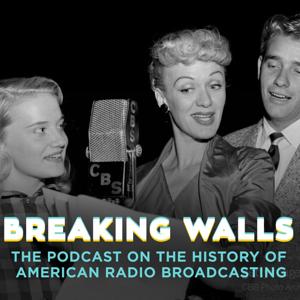
Breaking Walls

By James ScullyHistory
Download on the App Store

Breaking Walls episodes

  • BW - EP129—007: Radio, Roswell And The Flying Saucer Craze—Murrow's Report On Flying Saucers
    On April 7th, 1950, Edward R. Murrow broadcast the CBS Special “Report on Flying Saucers.” By then, Murrow was long-known for his journalistic integrity and tenacity in chasing down answers.
    A turbo jet that could fly up to six-hundred miles per hour didn’t exactly line up with witness accounts. Speed of travel aside, It wasn’t at all what Dr. Craig Hunter had described earlier.
    There were clearly conflicting points of view.
    11 min
  • BW - EP129—006: Radio, Roswell And The Flying Saucer Craze—Harris And Remley's UFO Hoax
    On Sunday April 2nd, 1950 at 7:30PM eastern time, The Phil Harris and Alice Faye Show took to the air over NBC. The Harris/Faye show peaked in December of 1948 with a rating of 26, but by this month it was down 8.5. Harris resisted taking the program into TV, as his wife Alice Faye remembered.
    Elliott Lewis’ friendship with Phil Harris went all the way back to their days on Jack Benny’s program. On that Sunday, the episode was called “Frankie’s Flying Saucer.”
    17 min
  • BW - EP129—005: Radio, Roswell And The Flying Saucer Craze—Fibber Sees A UFO
    On Tuesday nights at 9:30PM eastern time in the spring of 1950, Fibber McGee and Molly was NBC’s highest-rated show. They’d stuck with NBC while stars like Jack Benny, Edgar Bergen, George Burns, and Gracie Allen jumped to CBS. Their 17.7 was fourth overall, but their rating fell by almost six points from the year prior.
    Opposite on TV, NBC aired The Life of Riley, while CBS aired Suspense. The days of NBC’s Tuesday night comedy schedule being appointment radio were over.
    On March 28th, Fibber McGee saw a UFO.
    19 min
  • BW - EP129—004: Radio, Roswell And The Flying Saucer Craze—The Spring Of 1950 With Red Skelton
    In the spring of 1950, network radio revenue was falling for the first time since 1933. There were now over twenty-six-hundred AM and FM stations vying for advertising dollars. The US also spent the first ten months of 1949 in a recession while TV was becoming a serious threat to both prime time Network Radio and Hollywood films.
    Over a hundred TV stations were on the air, and radio’s top fifty program ratings were down thirty-percent in just two years since the record high of 1947-48. Only The Lux Radio Theater and Jack Benny had ratings higher than twenty. Meanwhile, the TV networks reported a combined income of more than twenty-nine-million dollars.
    The world was changing too. The U.S. was on the brink of war with Korea. During the week of March 26th, Wisconsin junior senator Joseph McCarthy named five ​​U.S. State Department employees as potential Communists. The senator’s actions placed him firmly in the crosshairs of Edward R. Murrow. Two-time Republican Presidential nominee Thomas Dewey was relegated to voice of reason. It would be four years before McCarthyism came to an end while Cold War fears continued to escalate.
    That Spring, with both science-fiction and UFOs en vogue, multiple shows focused on flying saucers within individual episode plots. On March 26th, 1950 The Red Skelton Show presented “Flying Saucers.” One of the co-stars was famed radio character actress Lurene Tuttle. Skelton was airing over CBS Sunday nights at 8:30PM eastern time. His March rating was 15.6, but his season number was 13.5. It was 14th overall, but down seven points from two years prior.
    On March 29th, RCA made their first color television demonstration. Their system would eventually be accepted by the FCC and would become the standard for broadcasting.The next fall Skelton took his show into TV where it would air until 1971.
    25 min
  • BW - EP129—003: Radio, Roswell And The Flying Saucer Craze—Dimension X Launches
    Until March of 1950, most reported UFO observations were seen from a great distance. On March 16th, a physician and pilot — Dr. Craig Hunter of Berkeley Springs, West Virginia — saw one close up.
    That same month, the Mutual Broadcasting System launched a series called 2000 Plus. Considered the first adult science fiction show in radio history, a month later NBC launched their own. Produced from Radio City in New York, It would be called Dimension X, and debut on Saturday April 8th at 8PM.
    The man you’re listening to is Arnold Moss. An accomplished New York actor, by 1950 he was all over the radio dial. Moss was also no stranger to playing multiple parts in a single broadcast. On May 6th, 1950 Arnold Moss starred in Dimension X’s “Knock.”
    For its time. Dimension X was a wonder. Two and sometimes three sound effects men worked each show. Each show was produced in a huge, two-story studio, giving the crew the ability to obtain tremendous echo effects.
    Blended in were futuristic musical scores, composed by Albert Berman and played on the organ. Host-narrator Norman Rose was the perfect voice, combining an authoritative resonance with a touch of dark irony.
    Arnold Moss was right at home in these futuristic dramas. He was flanked by Joan Alexander and Luis Van Rooten.
    The show was produced live for the first thirteen weeks and transcribed thereafter. It ran against Gene Autry on CBS. To help promote it, the NBC press department sent out a Radio Editors' Flying Saucer Mail Service. It was a promotional piece made up of a white saucer-shaped cardboard lettered in red and white and attached to a blue square.
    It wasn’t long before Wheaties grabbed the series with their Big Parade in the summer of 1950. They began sponsorship on July 7th. But, aside from Friday, Saturday night was radio’s lowest-rated evening. NBC won three of the four time slots between 8:30 and 10PM, but they were all comedies. While Dimension X was well-produced, it was an outlier sandwiched between The Joe Dimaggio Show and Truth of Consequences.
    Wheaties ended their big parade in August and NBC began to bump Dimension X around its schedule. It was picked up and dropped without announcement, and finally went off the air for good on September 29th, 1951.
    23 min
  • BW - EP129—002: Radio, Roswell And The Flying Saucer Craze—The Chicago Roundtable Debate
    The University of Chicago Roundtable grew out of arguments had by professors at the faculty club. In 1931 they were convinced their forum would make for good radio. WMAQ agreed. The show premiered on February 1st of that year. It began running nationally over NBC on October 15th, 1933.
    The thirty-minute time slot allowed for little grandstanding. Professors rotated with each broadcast according to their expertise. They sat at a triangular table, which put the speakers face-to-face. It had time-warning lights facing each chair and was built like a sloping pyramid, with a microphone at the top.
    If people really were seeing UFOs in the sky they had to be coming from other worlds. On December 19th, 1948 The Roundtable attempted to answer the question from a scientific point of view.
    There were no scripts, but Roundtable was the first show of its kind to issue a weekly magazine. It contained a transcript of the previous program, biographies of the participants, listener feedback, suggested topical reading, and a schedule of coming broadcasts. The University of Chicago Roundtable would air until June 12th, 1955, finally going off the air when NBC launched Monitor.
    11 min
  • BW - EP129—001: Radio, Roswell And The Flying Saucer Craze—Kenneth Arnold And The Roswell Crash
    Early on the morning of February 25th, 1942 several aerial objects were spotted over Los Angeles. It triggered the firing of thousands of anti-aircraft rounds. This was ten weeks after the bombing of Pearl Harbor and Manilla. Initially, it was thought to be a Japanese attack, but shortly after Secretary of the Navy Frank Knox said it was a false alarm. The hysteria was blamed on a weather balloon.
    During World War II soldiers reported seeing metallic spheres in the sky. The allies dubbed them “Foo Fighters.” In 1946, numerous UFO sightings were reported in Sweden. Known as “Ghost Rockets,” they put the Swedish Defense Staff on high alert. No confirmation of what they were was ever achieved. All of these paled in comparison to what happened in Washington State in June of 1947.
    On June 24th a transport with thirty-two marines on board crashed near Mount Rainier, Washington. A private pilot, Kenneth Arnold, was flying from Chehalis (SHA HAY LISS) to Yakima on a business trip. Arnold had six years of experience flying in and around the rugged Mount Rainier terrain. He went off course to look for wreckage. On April 6th, 1950 he spoke with Edward R. Murrow about his experience.
    As the objects passed Mount Rainier, Arnold turned his plane parallel to their course. He timed their rate of passage. They moved from Mount Rainier to Mount Adams —a distance of about fifty miles—in one minute forty-two seconds. That put their speed at over seventeen-hundred miles per hour. That was three times faster than any manned aircraft in 1947. The next day Arnold told his story to a newspaper in Pendleton, Oregon. The military questioned Arnold on three occasions, doubting his experience.
    But, other pilots soon told of sightings. On July 4th, The Oregon Journal received a letter from an L. G. Bernier of Richland, Washington who saw three objects flying toward Mount Rainier about one half-hour before Arnold. Bernier suggested they might have been extraterrestrial in origin. Arnold soon agreed.
    The problem with simply dismissing what Arnold saw lies in the fact that he was a credible witness. Sure, he could have been seeing things, but here was a man both highly trained and highly observational.
    Two weeks later, the most speculated UFO crash of the twentieth century was reported in Roswell, New Mexico.
    24 min
  • BW - EP128: June 1954—The End as We Knew It
    In Breaking Walls episode 128 we wrap up our six month look at 1954 by ending in June with network cancellations.
    ——————————
    Highlights:
    • The State of Radio and The Union
    • The End of Escape with John Dehner
    • News with Frank Edwards on Mutual
    • Let’s Pretend with Arnold Stang
    • Autolite Drops Suspense
    • Goodbye To Jack Benny (For Now)
    • What’s At Stake in the Fall 1954 Midterm Elections
    • CBS Cancels The Lux Radio Theatre
    • The End of James Stewart’s The Six Shooter
    • Looking Ahead to July and Roswell
    ——————————
    The WallBreakers:
    http://thewallbreakers.com
    Subscribe to Breaking Walls everywhere you get your podcasts.
    To support the show:
    http://patreon.com/TheWallBreakers
    ——————————
    The reading material used in today’s episode was:
    • On the Air — By John Dunning
    • Network Radio Ratings — by Jim Ramsburg
    • The Complete Escape and Suspense Logs — By Keith Scott
    As well as articles from:
    • Broadcasting Magazine
    • LIFE Magazine
    • Newsweek
    • Radio Guide
    ——————————
    On the interview front:
    • Parley Baer, Ken Carpenter, Elliott Lewis, and Paula Winslowe spoke to Chuck Schaden. Hear their full chats at SpeakingOfRadio.com.
    • Herb Ellis, Virginia Gregg, Jack Johnstone, Elliott Lewis, and Herb Vigran spoke to SPERDVAC. For more info, go to SPERDVAC.com.
    • John Gibson, Elliott Lewis, Vincent Price, and Arnold Stang spoke to Dick Bertel and Ed Corcoran for WTIC’s The Golden Age of Radio. Hear these full interviews at Goldenage-WTIC.org.
    • John Dehner and Vic Perrin spoke with Neil Ross at KMPC.
    • Dennis Day spoke with John Dunning for 71KNUS.
    • Morton Fine was with Dan Haefele.
    • Orson Welles with Johnny Carson.
    • Jimmy Stewart with Larry King.
    • Jack Benny spoke with CBS.
    ——————————
    Selected music featured in today’s episode was:
    • Living Without You and Too Much Between Us — By George Winston
    • The Last Rose of Summer — By Tom Waits
    • Seance on a Wet Afternoon — By John Barry
    ——————————
    A special thank you to Ted Davenport, Jerry Haendiges, and Gordon Skene.
    For Ted go to RadioMemories.com, for Jerry, visit OTRSite.com, and for Gordon, please go to PastDaily.com.
    ——————————
    Thank you to:
    Tony Adams
    Steven Allmon
    Orson Orsen Chandler
    Phil Erickson
    Jessica Hanna
    Perri Harper
    Briana Isaac
    Thomas M. Joyce
    Ryan Kramer
    Earl Millard
    Gary Mollica
    Barry Nadler
    Christian Neuhaus
    Aimee Pavy
    Ray Shaw
    Filipe A Silva
    ——————————
    WallBreakers Links:
    Patreon - patreon.com/thewallbreakers
    Social Media - @TheWallBreakers

    3 hr 3 min
  • Candy Matson: The Devil and the Deep Freeze—09/30/1949
    Airing out of KNBC in San Francisco was a ground-breaking lady detective anthology named Candy Matson.
    Produced, written and directed by Monty Masters and starring his wife, Natalie Masters, Candy Matson debuted on Saturday June 26th, 1949 at 8:30PM Pacific Time on NBC’s west-coast circuit.
    Natalie was from San Francisco and began her career with the Wayfarers Repertory of the San Francisco Little Theatre Group. The creative couple were locally successful and had nearly fifteen years of experience by 1949.
    Henry Leff was Police Detective Ray Mallas, with Jack Thomas as Rembrandt Watson.
    Candy’s number was YUkon 3-8309, and each episode began with a telephone call. The Masters' leaned heavily on their prior associations in the Bay Area. Plots were also reliant on the audience’s knowledge of local San Francisco.
    Unfortunately, because NBC was sustaining production costs, they moved the show around frequently. They’d often air a program a day or hours ahead its scheduled air date, apologizing later to the growing body of Candy Matson fans.
    Candy solved almost ninety cases. The series ran until May 20th, 1951.
    30 min

About Breaking Walls

From the publisher's feed

Breaking Walls: The Podcast on the History of American Network Radio Broadcasting.

More shows like Breaking Walls

Stuff You Should Know by iHeartPodcasts

Stuff You Should Know

78,328 Listeners

The Great Detectives of Old Time Radio| Daily Mystery Dramas by Adam Graham|Old Time Radio Detective Host

The Great Detectives of Old Time Radio| Daily Mystery Dramas

1,941 Listeners

Down These Mean Streets (Old Time Radio Detectives) by Mean Streets Podcasts

Down These Mean Streets (Old Time Radio Detectives)

1,058 Listeners

The Dana Gould Hour by Dana Gould

The Dana Gould Hour

2,024 Listeners

Gilbert Gottfried's Amazing Colossal Podcast by Gilbert Gottfried's Amazing Colossal Podcast

Gilbert Gottfried's Amazing Colossal Podcast

3,934 Listeners

This Day in Jack Benny by John Henderson

This Day in Jack Benny

392 Listeners

Stars on Suspense (Old Time Radio) by Mean Streets Podcasts

Stars on Suspense (Old Time Radio)

448 Listeners

Pod Save America by Pod Save America

Pod Save America

87,095 Listeners

The Daily by The New York Times

The Daily

111,809 Listeners

The Mysterious Old Radio Listening Society by Ghoulish Delights

The Mysterious Old Radio Listening Society

353 Listeners

Conan O’Brien Needs A Friend by Team Coco & Earwolf

Conan O’Brien Needs A Friend

59,416 Listeners

Literally! With Rob Lowe by Stitcher & Team Coco, Rob Lowe

Literally! With Rob Lowe

12,405 Listeners

Choice Classic Radio Detectives | Old Time Radio by Choice Classic Radio

Choice Classic Radio Detectives | Old Time Radio

201 Listeners

The Weekly Show with Jon Stewart by Comedy Central

The Weekly Show with Jon Stewart

10,711 Listeners

Real Survival Stories by NOISER

Real Survival Stories

1,327 Listeners