Breaking Walls

Breaking Walls

By James ScullyHistory
Download on the App Store

Breaking Walls episodes

  • BW - EP127—006: May 1954—Grace Kelly Guests On Bob Hope
    Bob Hope joined NBC’s red network in December of 1937. For the next ten years he starred on The Pepsodent Program, racking up the top-rated show five consecutive seasons between the fall of 1942 and the spring of 1947.
    Then, as radio’s ratings were hitting an all-time high, Hope opened the fall of 1947 to harsh reviews. Both the critics and public were bored with his formula. Ratings dropped and Hope responded with a shakeup the following year. Gone were Vera Vague and Jerry Colonna: the show became more of a situation comedy.
    It was the radio itself that had begun to fade. Hope spent two seasons being sponsored by Swan Soap, and then by Chesterfield, Jell-O, and American Dairy. His top show fell to fifth overall, then seventh, then tenth, thirty-third, and finally to forty-seventh in 1953. In 1954 his Friday at 8:30 rating was under 3.3.
    On May 14th his guest was the twenty-four year-old actress Grace Kelly. She’d won the Academy Award for best actress in Country Girl two months prior.
    Her fourth starring role, Dial M For Murder was about to premiere.
    Grace Kelly would appear in seven more films over the next two years. She retired after her marriage to Prince Rainier III of Monaco. Her last film was High Society, opposite Bing Crosby and Frank Sinatra.
    By 1954 Hope was appearing on TV. He did commentary for NBC’s coverage of the 1952 political conventions, and although he never had a regular TV series, he starred in two-hundred seventy two TV specials between 1950 and 1996.
    In later years he became the network’s senior statesman and his theme song, “Thanks for the Memory,” became synonymous with his comedy.
    17 min
  • John Dehner on Leaving a Disney Animation Job for Radio Acting
    In August of 1982, SPERDVAC hosted a CBS character actor panel featuring Virginia Gregg, Peggy Webber, Parley Baer, Vic Perrin, Harry Bartell, and John Dehner. In this clip Mr. Dehner explains how he came to be a radio actor in the 1940s.
    For more information on John Dehner, tune into BW - EP101: Frontier Gentleman and The Saga of Belle Siddons (1958)
    4 min
  • BW - EP127—005: May 1954—Wild Bill Hickok
    James Butler “Bill” Hickok was born on May 27th, 1837 in LaSalle County, Illinois. An excellent marksman from a young age, in 1855 he became a Kansas Abolitionist Jayhawker. From there he became a constable, joined the Pony Express parent company, was badly wounded by a bear, and committed his first justifiable homicide. This was all before the age of twenty-five.
    During the Civil War, Hickok became a Union Army teamster, a wagon master, joined the Kansas Brigade, and became a spy for the provost marshall of Missouri.
    He was also a gambler and drinker, known to carouse for days at a time. On July 21st, 1865, Hickok took part in his first duel, killing a man named Davis Tutt. He shot Tutt through the heart from seventy-five yards away.
    A subsequent interview with Harper’s New Monthly Magazine labeled him Wild Bill for the first time.
    Rather than become an outlaw, Hickok became a lawman. He was soon a deputy Marshal at Fort Riley, and scouted for Custer’s Seventh Cavalry. By December of 1867 he was a Marshall in Hays City, and later sheriff of the same town. In April of 1871 he became Marshall in Abilene, Kansas.
    That October, Hickok justifiably killed a saloon owner named Phil Coe. But, during the fight, Hickok saw a man running towards him. He wheeled and fired, killing what turned out to be his own deputy. The event haunted Hickok the rest of his life. It was the last time he was ever involved in a gunfight.
    Radio’s version bore little resemblance to the real man. The format was the same used by the producers of Hopalong Cassidy and The Cisco Kid. Bill’s comic sidekick, Jingles B. Jones was voiced by the famed Andy Devine. Guy Madison was Wild Bill. Hollywood regulars supported. It was directed by Paul Pierce.
    The show first aired over Mutual on May 27th, 1951. On May 14th, 1954 the episode was called “Dangerous Advice.” Wild Bill Hickok aired until New Year’s Eve 1954. Mutual brought it back the following July. It ran until February of 1956.
    In early 1876 Hickok was diagnosed with glaucoma. Fearing blindness, he joined friends Charlie Utter and Calamity Jane Cannary in Deadwood, Dakota Territory.
    On August 2nd, 1876 he was playing poker. He’d badly beaten a man named Jack McCall the night before at cards. Although Hickok usually sat facing the door, no such seats were available. That afternoon he was playing five-card poker and holding a pair of Aces and Eights. Jack McCall walked in and shot Hickok in the back of the head from point blank range. Wild Bill died instantly.
    He was thirty-nine.
    20 min
  • BW - EP127—004: May 1954—I Love A Mystery
    Carlton E. Morse’ I Love A Mystery first took to the air Weekdays at 3:15PM on NBC’s West-Coast network in January of 1939. Michael Raffetto starred as Jack Packard, head of the A-1 Detective Agency, with Barton Yarborough as Texan Doc Long, and Walter Paterson as the British Reggie Yorke.
    The show told of three world travelers in search of action, thrills, and mystery. From the ghost towns of wind-swept Nevada, to the jungles of vampire-infested Nicaragua, they righted wrongs, rescued women, battled evil, and explored unknown parts of the globe.
    By that autumn it was airing nationally. The show ran from the west coast for five years, first over NBC’s Red Network, then its Blue, and then CBS.
    It went off the air at the end of 1944, but was revived in the spring of 1948 on ABC and then from New York for Mutual Broadcasting in October of 1949. It ran for three more years, this time starring Russell Thorson, Jim Boles, and Tony Randall, as Thorson remembered.
    Jack Packard was a hero with quiet strength. Once a medical student, he shrugged off superstition in favor of logic. Reggie Yorke was educated, strong, and had the British stiff upper lip. Doc Long was a red-headed alley fighter from Texas who defied the laws of chance and loved women.
    Three characters could be murdered in a single episode. People were killed in ghoulish, imaginative, and sometimes mystifying ways. Throats were ripped out by wolves; there were garrotings, poisonings, and mysterious slashings.
    Although the serial went off the air in 1952, in May of 1954 a new audition record was produced for CBS in Hollywood. It starred Thorson, Ben Wright, and Parley Baer.
    25 min
  • BW - EP127—003: May 1954—An Eisenhower Press Conference And Other Current Events
    On Friday, May 14th, 1954 President Eisenhower gave a news conference, immediately opening the floor to reporters for general questions.
    The day prior The World Chess Championship was won by Mikhail Botvinnik in Moscow. On this day, The Boeing 707 was released.
    On Monday the 16th, The Kengir uprising broke out at a Soviet Labor camp. Political prisoners forced out guards and administration. It would last over a month.
    Meanwhile in the U.S., Senator McCarthy’s tirade had resulted in each political party’s questioning of the other’s loyalty, as well as talks of treason within the armed forces. Eisenhower simultaneously had both nothing, and a lot to say on these matters.
    On Tuesday, May 17th, Brown versus The Board of Education of Topeka would finally be decided.
    8 min
  • BW - EP127—002: May 1954—Ray Milland And Meet Mr. McNutley
    Meet Mr. McNutley first took to CBS’ airwaves on September 17th, 1953. Ray Milland played Ray McNutley, English professor at Lynnhaven College. Phyllis Avery was Peggy, his wife. It aired concurrently on TV with much of the same cast.
    The show would be short-lived, going off the air after June 10th, 1954. The TV show lasted one more season, changing the character’s name to McNulty in the process.
    6 min
  • Mercedes McCambridge On Radio's Imaginative Power
    In October of 1976, Chuck Schaden sat down with famed actress Mercedes McCambridge to talk about her career (full interview available to stream for free here - http://www.speakingofradio.com/interviews/mccambridge-mercedes/). During the course of the conversation, Ms. McCambridge spoke of why radio drama was—to her—the most powerful imaginative entertainment medium.
    2 min
  • BW - EP127—001: May 1954—Everett Sloane And The 21st Precinct
    As the US began May of 1954, there was word that a new Soviet bomber had the ability to reach the United States. It was displayed for the public for the first time at the Moscow May Day Parade.
    On May 7th, the Battle of Dien Bien Phu would end in a French defeat. U.S. Secretary of State John Foster Dulles declared Vietnam non-essential to security in Southeast Asia. The U.S. would not intervene for France.
    And as several massive U.S. fishing vessels were sinking off the coast of Alaska, the Boeing 707 was being released after two years of development.
    On May 1st, NBC affiliate WSM signed on with The Big Sound. WSM is a 50,000-watt clear channel station located in Nashville, Tennessee. Founded by the National Life and Accident Insurance Company, the station’s call sign stands for We Shield Millions. WSM first signed on October 5th, 1925.
    The next month on November 28th, The WSM Barn Dance took to the air for the first time. On December 10th, 1927, the program's host, "Judge" George D. Hay referred to the show for the first time, as The Grand Ole Opry.
    The Opry began running coast-to-coast on Saturday evenings in 1939. The show moved to the Ryman Auditorium in 1943. As it developed in importance, so did the city of Nashville, which became America's country music capital.
    By 1954, WSM was considered the outstanding music station in the country. That October 2nd a teenage Elvis Presley would have his only Opry performance. The times, they were a-changin’. Tonight, we’ll dive in for a closer look.
    ___________
    Welcome to Breaking Walls episode 127. My name is James Scully. Tonight we keep on with our look at 1954 by picking up in May during one of the most important months of the decade.
    ___________
    Everett Sloane was born in New York City on October 1st, 1909. At age of seven, he played Puck of Shakespeare's Midsummer Night's Dream, and decided to become an actor. In 1927 he joined a Theater company. He made his New York stage debut in 1928.
    In the 1930s Sloane was appearing on The March of Time. It was there he met a young Orson Welles. Welles hired Sloane to be part of his Mercury Theatre. He moved from New York City to Los Angeles after Welles signed his contract with RKO. Sloane had a prominent role in Citizen Kane.
    In the 1940s, he worked on both coasts, guest-starring in radio on Inner Sanctum Mysteries, The Shadow, The Mysterious Traveler, and in films such as The Lady From Shanghai, Journey Into Fear, and Prince of Foxes. By 1953 he was being featured on TV and starring on radio in The 21st Precinct as Captain Frank Kennelly.
    The 21st Precinct debuted on July 7th, 1953 over WCBS radio in New York. It put the listener into the drama from the opening phone call until the final report.
    In May of 1954 it was airing Wednesdays at 8:30PM against The Great Gildersleeve on NBC. Starring with Sloane was Ken Lynch as Lieutenant Matt King and Harold Stone as Sergeant Waters. John Ives produced and Stanley Niss directed.
    Everett Sloane continued to be a busy actor until 1965. On August 6th of that year, recently diagnosed with Glaucoma and fearing blindness, he took his own life. He was survived by his wife Lilian and two children. Everett Sloane is buried at Angelus-Rosedale Cemetery in Los Angeles.

    30 min
  • Frank Sinatra On Why He Enjoys Acting
    On May 13th, 1988, Frank Sinatra was a guest of Larry King's for an incredible chat about the legend's life and career. During the course of the chat, the conversation turned to Frank's acting career. He had this to say about it.
    The full interview can be watched here - www.youtube.com/watch?v=Y-xkTDhOpCY
    3 min

About Breaking Walls

From the publisher's feed

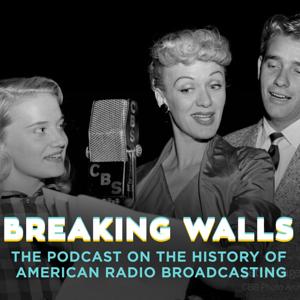
Breaking Walls: The Podcast on the History of American Network Radio Broadcasting.

More shows like Breaking Walls

Stuff You Should Know by iHeartPodcasts

Stuff You Should Know

78,328 Listeners

The Great Detectives of Old Time Radio| Daily Mystery Dramas by Adam Graham|Old Time Radio Detective Host

The Great Detectives of Old Time Radio| Daily Mystery Dramas

1,941 Listeners

Down These Mean Streets (Old Time Radio Detectives) by Mean Streets Podcasts

Down These Mean Streets (Old Time Radio Detectives)

1,058 Listeners

The Dana Gould Hour by Dana Gould

The Dana Gould Hour

2,024 Listeners

Gilbert Gottfried's Amazing Colossal Podcast by Gilbert Gottfried's Amazing Colossal Podcast

Gilbert Gottfried's Amazing Colossal Podcast

3,934 Listeners

This Day in Jack Benny by John Henderson

This Day in Jack Benny

392 Listeners

Stars on Suspense (Old Time Radio) by Mean Streets Podcasts

Stars on Suspense (Old Time Radio)

448 Listeners

Pod Save America by Pod Save America

Pod Save America

87,095 Listeners

The Daily by The New York Times

The Daily

111,809 Listeners

The Mysterious Old Radio Listening Society by Ghoulish Delights

The Mysterious Old Radio Listening Society

353 Listeners

Conan O’Brien Needs A Friend by Team Coco & Earwolf

Conan O’Brien Needs A Friend

59,416 Listeners

Literally! With Rob Lowe by Stitcher & Team Coco, Rob Lowe

Literally! With Rob Lowe

12,405 Listeners

Choice Classic Radio Detectives | Old Time Radio by Choice Classic Radio

Choice Classic Radio Detectives | Old Time Radio

201 Listeners

The Weekly Show with Jon Stewart by Comedy Central

The Weekly Show with Jon Stewart

10,711 Listeners

Real Survival Stories by NOISER

Real Survival Stories

1,327 Listeners