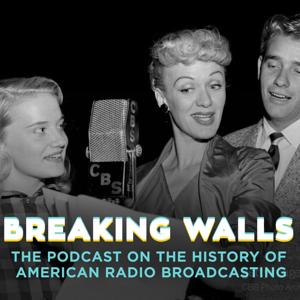
Breaking Walls: The Podcast on the History of American Network Radio Broadcasting

Breaking Walls: The Podcast on the History of American Network Radio Broadcasting

By James ScullyHistory
Download on the App Store

Breaking Walls: The Podcast on the History of American Network Radio Broadcasting episodes

  • BW - EP146—008: December 1973 With Rod Serling And The Zero Hour— Serling Is Disappointed With Radio
    Once Mutual finished running the last of the Lewis-directed Jay Kholos episodes of The Zero Hour on March 14th, 1974, they went dark for six weeks. They were busy completely changing the format.
    Now, one star would be featured in five different anthologies during a week. The show returned on April 29th. The first week’s star was Mel Torme. “Bye Bye Narco” was the first new script produced under Mutual’s umbrella.
    Cleveland Plain Dealer, June 16th, 1974
    “Rod Serling, master writer of the mysterious and macabre, is playing a game of suspense with the good earth. On the side, he serves as host of The Zero Hour, a weekday radio mystery series beamed by the Mutual Broadcasting System.
    “Serling's feelings about the recent upsurge in radio drama prompted a call to his rural home. It soon became apparent that he is disappointed with radio drama and TV.
    “Serling made it clear that he has nothing to do with the writing or producing of the twenty-five minute dramas. "I've caught the show about three times. One was passable and two I would have flunked off the air. What they're trying to do—and they may succeed—is a show that is contemporary. But it sounds campy.”
    “Serling said, "The same thing applies to The CBS Radio Mystery Theater. It has to be relevant stuff for 1974. Short of that, why not resurrect old Shadow recordings? So far, I have yet to see either show relate to our time, either in story or technique. if they're selling us nostalgia, they've succeeded. It's thoroughly reminiscent of radio thirty years ago.”
    “I'm not bad rapping it,” he said. “It's just not what I expected. I realize the economics of the situation. I wouldn’t want to spend my time writing a provocative radio drama and get a check that would buy me a carton of cigarettes. Radio drama currently has the value of an antique."
    “Won't it change for the better? “I don't know," Serling said. “I have no idea. I'm frequently wrong, anyhow. I thought Nixon would be out of office by now. And I thought Sonny Liston would be heavyweight boxing champion for 20 years.”
    “Summing up his feelings about radio and television, Serling said, “I feel the same way about radio as I do television as an art form. It doesn't rise to the occasion like it should...although television occasionally has.”
    “Radio today is more of a display case than an art form.” — Raymond P. Hart
    The Zero Hour in the new format ran thirteen additional weeks before being canceled after the July 26th, 1974, episode. In total, one-hundred-thirty episodes of The Zero Hour were produced. Most can be heard today.
    9 min
  • BW - EP146—007: December 1973 With Rod Serling And The Zero Hour—Mutual Broadcasting Takes Over
    Associated Press, December 21st, 1973, New York City.
    “The script appears strange at first. Its directions are for the ear, not the eye, and say things like: "DOORBELL ON. FOOTSTEPS. DOOR OPENED. TRAFFIC IN BG."
    "That traffic noise is 25 years old," laughs Jimmy Dwan, a veteran CBS sound effects man. "You can hear a doorman shouting on it somewhere. That doorman, he's been dead twenty years." Dwan's recorded sound effects are old, but not his script. It's of 1973 vintage, written solely for radio.
    “Yes, radio.
    “It's part of a brave new effort by two networks to bring back, in limited form, the golden days of coast-to-coast radio drama that most everyone remembers, but hasn't heard in more than a decade.
    “The Mutual Broadcasting System fired the first shot Monday with The Zero Hour, a 30-minute five-nights-a-week thriller serial hosted by writer-narrator Rod Serling of Twilight Zone fame.
    “Mutual, which says it has six-hundred-thirty affiliates, bought the series after lengthy studies proved there existed a sufficient market for radio drama on a network basis. Advertisers liked the idea, too, according to Mutual's president C. Edward Little: "We got a tremendous amount of client interest after we announced it," adding that the show will be fed from Mutual's Washington D.C., headquarters each weeknight at 7PM.
    "We feel that we'll start off with one-hundred-fifty to two-hundred stations."
    “The series will be offered on a "first refusal" basis to Mutual affiliates.
    “They also said that if the show clicks, other radio projects such as new comedy or anthology series, may follow. But they emphasized that such shows are strictly in the talking stages.” — Jay Sharbutt
    Once Mutual purchased the rights to The Zero Hour, they removed Elliott Lewis as director and Jay Kholos no longer had anything to do with the production. Both had good things to say about each other, but not for Mutual.
    44 min
  • BW - EP146—006: December 1973 With Rod Serling And The Zero Hour—Selling The Show To Mutual
    One of the radio veterans featured in this episode was Byron Kane. Another was Paula Winslowe.
    By October 1973, it was obvious that Jay Kholos couldn’t afford to keep funding new episodes of The Zero Hour thanks to AFTRA’s changing terms. He looked to make a deal with a network. The Mutual Broadcasting System and C. Edward Little were interested.
    A deal came together quickly. A press conference announcing the move was set for November 1st. We heard that presser at the beginning of this episode. The Zero Hour would be moving to Mutual on December 17th, 1973.
    Before new episodes could be broadcast, Mutual would air the thirteen five-part episodes already directed by Elliott Lewis.
    34 min
  • BW - EP146—005: December 1973 With Rod Serling And The Zero Hour—AFTRA's Moving Goal Posts
    Janet Waldo, famous for her portrayal of Corliss Archer as well as Judy Jetson, Penelope Pitstop, and Emmy Lou on The Adventures of Ozzie and Harriet, was featured in this episode of The Zero Hour.
    With AFTRA’s moving goal posts meaning that producing more episodes of The Zero Hour would cost significantly more money, in the fall of 1973, Jay Kholos had to look for either a potential production partner or a buyer.
    In the meantime, The Zero Hour continued to air in syndication over stations like WRVR in New York.
    34 min
  • BW - EP146—004: December 1973 With Rod Serling And The Zero Hour—Nixon On The Hot Seat
    A year after his re-election, President Nixon was knee-deep in the Watergate scandal. On October 10th, 1973, VP Spiro Agnew resigned, pleading no contest to charges of tax evasion and money laundering, part of a negotiated resolution to a scheme in which he accepted nearly thirty-thousand dollars in bribes while governor of Maryland.
    According to The New York Times, Nixon “sought advice from senior Congressional leaders about a replacement.” The advice was unanimous in favor of Gerald Ford. Ford agreed to the nomination, telling his wife that the Vice Presidency would be “a nice conclusion” to his career.
    On October 12th, President Nixon officially named Gerald Ford as Veep.
    The energy crisis was becoming a major issue. Nixon assured the public saying Americans wouldn’t be running out of gasoline, air travel wouldn’t stop, and heating oil would be plentiful in the winter months. Though the crisis would require some sacrifice on everyone’s part. He outlined a plan which included using less heat, less gasoline, cutting down on highway speeds as well as cutting down on lighting at home and at work. General consensus felt things would get worse before they got better.
    Meanwhile on November 10th a ceasefire was achieved in the Middle-East. A tenuous agreement was reached between Egypt and Israel that put an end to military conflict.
    By the middle of November, the Nixon White House sought to put a positive spin on things – launching what was called “The President Fights For His Administration’s Credibility.”
    Nixon’s dwindling support from Capitol Hill Republicans caused him to make a round of addresses, primarily in Republican stronghold cities, in order to reiterate his case and help approval.
    The reviews were mixed – some thought it was a valiant attempt to rescue a bad situation, while others were more convinced than ever that Nixon needed to step down.
    9 min
  • BW - EP146—003: December 1973 With Rod Serling And The Zero Hour—Selling Radio In The 1970s
    Once Jay Kholos sold the show to various radio stations, it was generally up to those stations to sell the show to sponsors. In New York, The Zero Hour was running on WRVR 106.7-FM.
    WRVR-FM was initially a public radio station owned and operated by The Riverside Church in New York. It began broadcasting on January 1st, 1961.
    The Riverside Church, located in Morningside Heights, is an interdenominational, interracial, and international church, and has long been a center of activism and social justice.
    WRVR was the first station to win a Peabody for its entire programming, in part for its documentary coverage of the civil rights movement in Birmingham in 1963. In addition to religious and philosophical discussions with Riverside clergy and theologians, WRVR programming included addresses by political and cultural leaders, like Indira Gandhi, Aldous Huxley, John F. Kennedy, and Margaret Mead. Dr. Martin Luther King Jr. delivered his pivotal “Beyond Vietnam” speech at the Riverside Church over WRVR-FM on April 4th, 1967.
    The station also featured the heralded weekly program Just Jazz with Ed Beach.
    In September 1971, WRVR went commercial and shifted to a news format, with the exception of Just Jazz, which continued until 1973. By then, WRVR was experimenting with radio drama in both golden age and new time productions.
    On September 4th, 1973, part two of The Zero Hour’s “Wife of the Red-Haired Man” took to the air.
    Radio legend Mary Jane Croft, who was also the wife of Elliott Lewis, was featured in this episode. Years later, she spoke to SPERDVAC about her radio career and late husband.
    In September of 1973, WRVR was advertising a World Hockey Association exhibition matchup which featured legends Gordie Howe and Bobby Hull.
    The New York Raiders and later The Golden Blades were intended to be the upstart WHA’s flagship franchise. They were, however, unable to compete with the NHL’s New York Rangers and the expansion New York Islanders.
    After just two seasons, The Golden Blades moved to San Diego. The WHA folded after eight years in 1979 with four teams: The Edmonton Oilers, Hartford Whalers, Quebec Nordiques, and Winnipeg Jets, joining the NHL.
    34 min
  • BW - EP146—002: December 1973 With Rod Serling And The Zero Hour—The Show Debuts
    Arizona Republic, June 11th, 1973
    “If you loved the old radio shows, you'll like what KOOL-FM has in store for you. The station has bought the brand-new radio drama series, The Zero Hour, which promises to revive the good old days, but in a modern format.
    “Announcing the new series was E. Morgan Skinner Jr., promoted last week from KOOL-AM account executive to KOOL-FM assistant station manager. Judging from the pilot tape, it should be an interesting show. Each story lasts a week. A half-hour episode is presented nightly, Monday through Friday, with the climax coming on Friday. A new show starts the following Monday.
    “KOOL has bought twenty-six weeks of the series, all that Hollywood Radio Theater has available so far. The program originally was to be started in mid-June, but the unsettled Writers Guild of America strike apparently has created some delay.
    “Current plans are to begin in mid-July. Each show will be broadcast at 7:30 p.m. on KOOL-FM and then rebroadcast on KOOL-AM at 10:30 p.m. "But that's during television's prime time," you say? That's the whole point. "Zero Hour is contemporary, but reflective of radio's golden era," said Skinner. “And they're doing the thing in such a way as to leave people free to utilize their minds.
    “By Beginning in July, it takes the series into the fall to compete against the new shows on TV. A lot of us have become disenchanted with what television has to deliver. "It's going to be interesting to see what a top-quality radio series will do against prime-time TV. The quality of this show is superb. It's crisp and well-done."
    “Hollywood Radio Theater is the brainchild of Jay M. Kholos, a veteran in the advertising and communications field. Rod Serling hosts the series. The first episode, titled "The Wife of the Red-Haired Man," stars Patty Duke Astin, John Astin and Howard Duff. The yarn is about the pursuit of a dead couple. Duff, of course, does the pursuing.” — Jack Swanson
    Before this September 3rd, 1973 debut episode of The Zero Hour, over WRVR 106.7FM in New York, Kholos spent the summer of 1973 traveling around, selling the series to stations in Syndication. After that, he was joined by Rod Serling on a promotional tour.
    Radio legend Les Tremayne played Patty Duke’s husband Albert. In November 1973, Howard Duff was a guest of Dick Bertel and Ed Corcoran’s WTIC Golden Age of Radio program. He spoke positively about his experience with The Zero Hour.
    37 min
  • BW - EP146—001: December 1973 With Rod Serling And The Zero Hour—The Big Idea
    November 1st, 1973. The Waldorf-Astoria Hotel, New York City.
    We’re listening in on a press conference hosted by the Mutual Broadcasting System. They’ve purchased the rights to air The Zero Hour from the just-heard Jay M. Kholos. The Zero Hour has thus far been hosted by Rod Serling and directed by Elliott Lewis. It’s Mutual’s first dramatic radio show in nearly twenty years.
    As Mutual Broadcasting spent much of the 1950s changing ownership groups, while national advertising was slowly abandoning radio for TV, Mutual ended its last two remaining half-hour dramas, Counterspy and Gangbusters, in November of 1957. Sports and news began to take up the majority of the network’s programming.
    Throughout the 1960s more frequent ownership and management changes continued to create network instability, before C. Edward Little was named president in 1972.
    During his time as President, Little created the Mutual Black Network, the Mutual Spanish Network, and the Mutual Southwest Network.
    Under Little's administration, Mutual became the first commercial broadcasting entity to use satellite technology for program delivery. He also hired Larry King to host an all-night phone-in talk show. King was a one-time announcer for Little at WGMA in Florida. He went on to national fame in both radio and TV, winning a coveted Peabody Award along the way.
    But that’s not why we’re eavesdropping in 1973. We’re here for the return of dramatic programming on network radio in the form of The Zero Hour which had been airing in syndication since the fall.
    Why is this such a momentous event? How did we get to this point? Tonight, we’ll find out.
    ____________
    The last network big four radio drama, Theater Five, ran on ABC and was launched on August 3rd, 1964.
    Unfortunately by the mid 1960s network radio had undergone a transformation. Theater Five’s half-hour time slot only allocated twenty-one minutes for story-time. The other nine minutes went to news, station identification, and local advertising. ABC’s affiliates also had the first right of refusal. In some big markets Theater Five ran on other radio stations.
    Two-hundred-fifty-six total episodes were produced before Theater Five was canceled after the July 30th, 1965 episode.
    For the next seven years, except for any dramatic vignettes on NBC’s Monitor, NBC, CBS, ABC, and Mutual broadcasting’s network fed programming was relegated to news, sports, talk, and music.
    Then in early 1973, an entrepreneurial ad man named Jay M. Kholos had a big idea. He grew up in Southern California around the entertainment and media industry.
    Kholos’ idea? He sensed an oncoming nostalgia wave and wanted to relaunch a high-production, serialized audio drama, but updated for the modern sensibilities of 1973.
    Kholos needed a hook. He felt by telling one story in five half hours over the course of a contained week, he could keep the listener’s attention and get them to tune back in.
    Enter Rod Serling, famed creator of The Twilight Zone. Serling had worked in radio, in Springfield, Marion, Columbus, and Cincinnati, Ohio.
    Kholos was soon in touch with Elliott Lewis. By 1973, he had nearly forty years of experience as a writer, director, actor, and producer. Kholos was able to secure the rights to several stories. Now, he needed acting talent.
    The goal was to pair name brand film and TV talent with the best Hollywood radio veterans. Howard Duff could have fit into either category. By the 1970s, Duff and Elliott Lewis had been friends for thirty years. They both helped grow the Armed Forces Radio Service during World War II.
    Duff was chosen, along with Patty Duke and John Astin to lead the first cast in an adaptation of Bill S. Ballanger’s The Wife of the Red-Haired Man.
    Kholos put the program under the umbrella of The Hollywood Radio Theater. They chose Radio Recorders, the largest independent studio in Los Angeles, for the program.
    The Zero Hour would debut in late summer.

    26 min
  • BW - EP145: November 1963 With Jean Shepherd And JFK
    In Breaking Walls episode 145 it’s the fall of 1963 and network radio drama is dead while American life is changing.
    If you’re listening to this in real time, this month marks the sixtieth anniversary of John F. Kennedy’s assassination. To go beyond its public horror and understand American society three generations ago, we’ll focus on Jean Shepherd.
    ——————————
    Highlights:
    • I, Libertine
    • Jean Shepherd Gets His Familiar WOR Time Slot
    • November 1963 Begins
    • Veteran's Day, Malcolm X, and Lenny Bruce
    • President Kennedy’s Last Trip to Florida
    • Shep's Show During JFK Last Week
    • John F. Kennedy’s Last Day
    • An Unfortunate Arthur Godfrey Episode
    • Live News Coverage As The Unthinkable Happens To President Kennedy In Dallas
    • John Kennedy Has Passed, Lee Harvey Oswald Is Arrested
    • A Weekend of Mourning With the Boston Symphony Orchestra
    • President Kennedy's Funeral Coverage
    • Jean Shepherd Eulogizes John F Kennedy
    • A Subdued Christmas Eve With Shep
    • Looking Ahead to Rod Serling and The Zero Hour
    ——————————
    The WallBreakers:
    http://thewallbreakers.com
    Subscribe to Breaking Walls everywhere you get your podcasts.
    To support the show:
    http://patreon.com/TheWallBreakers
    ——————————
    The reading material for today’s episode was:
    • Excelsior You Fathead! The Art and Enigma of Jean Shepherd — By Eugene Bergmann
    • Boom!: Talking About the Sixties — By Tom Brokaw
    • Four Days In November: The Assassination of President John F. Kennedy — By Vincent Bugliosi
    • On The Air — By John Dunning
    • Oswald's Tale: An American Mystery — By Norman Mailer
    As well as articles from:
    • The Bridgeport Post
    • The Chicago Tribune
    • The Cincinnati Enquirer
    • The Hammond Times
    • The Kansas City Times
    • The Library of Congress
    • The Los Angeles Times
    • The Miami News
    • The New York Daily News
    • The New York Times
    • The Orlando Sentinel
    And the Assassination Report of the Warren Commission
    ——————————
    On the interview front:
    • Andy Rooney spoke with CBS for their 50th anniversary in 1977
    ——————————
    Selected music featured in today’s episode was:
    • The John Coltrane Quartet in concert — November 19th, 1962
    • Pachelbel's Canon In D — By Michael Silverman
    • All I’ve Got To Do — By The Beatles
    • The Boston Symphony in concert — November 23rd, 1963
    • Some Children See Him — By George Winston
    ——————————
    A special thank you to Ted Davenport, Jerry Haendiges, and Gordon Skene.
    For Ted go to RadioMemories.com, for Jerry, visit OTRSite.com, and for Gordon, please go to PastDaily.com.
    ——————————
    Thank you to:
    Tony Adams
    Steven Allmon
    Orson Orsen Chandler
    Phil Erickson
    Jessica Hanna
    Perri Harper
    Thomas M. Joyce
    Ryan Kramer
    Earl Millard
    Gary Mollica
    Barry Nadler
    Christian Neuhaus
    Ray Shaw
    Filipe A Silva
    John Williams
    Jim W.
    ——————————
    WallBreakers Links:
    Patreon - patreon.com/thewallbreakers
    Social Media - @TheWallBreakers
    5 hr 41 min
  • BW - EP145—014: November 1963 With Jean Shepherd And JFK—Looking Ahead To Rod Serling And Zero Hour
    Well, that brings our look at November 1963 through the eyes of Jean Shepherd and President Kennedy to a close. Frankly, I wasn’t completely sure what this episode would become until I finished producing it.
    Speaking of anniversaries, we have one in December that’s a bit more recent and much happier if you like radio drama.
    Next time on Breaking Walls, in honor of the fiftieth anniversary of The Zero Hour’s debut on the Mutual Broadcasting System, we spotlight the rebirth of radio drama in 1973. It’s the first of a two-part mini series on radio drama in the 1970s.
    The reading material used in today’s episode was:
    • Excelsior You Fathead! The Art and Enigma of Jean Shepherd — By Eugene Bergmann
    • Boom!: Talking About the Sixties — By Tom Brokaw
    • Four Days In November: The Assassination of President John F. Kennedy — By Vincent Bugliosi
    • On The Air — By John Dunning
    • Oswald's Tale: An American Mystery — By Norman Mailer
    As well as articles from:
    • The Bridgeport Post
    • The Chicago Tribune
    • The Cincinnati Enquirer
    • The Hammond Times
    • The Kansas City Times
    • The Library of Congress
    • The Los Angeles Times
    • The Miami News
    • The New York Daily News
    • The New York Times
    • The Orlando Sentinel
    And the Assassination Report of the Warren Commission
    On the interview front:
    • Andy Rooney spoke with CBS for their 50th anniversary in 1977
    Selected music featured in today’s episode was:
    • The John Coltrane Quartet in concert — November 19th, 1962
    • Pachelbel's Canon In D — By Michael Silverman
    • All I’ve Got To Do — By The Beatles
    • The Boston Symphony in concert — November 23rd, 1963
    • Some Children See Him — By George Winston
    Breaking Walls Episode 146 will spotlight Rod Serling and The Zero Hour in honor of the 50th anniversary of its debut on Mutual Broadcasting. This episode will be available beginning December 1st, 2023 everywhere you get your podcasts, and at TheWallBreakers.com.
    In the meantime, give Breaking Walls a quick rating on whatever platform you listen, especially itunes.
    You can also join The Breaking Walls Facebook group at Facebook.com/Groups/TheWallBreakers.
    And support this show for as little as a buck a month at Patreon.com/TheWallBreakers.
    So until December 1st, my name is James Scully, this has been Breaking Walls Episode 145, and I’ll catch you on the flip side.
    Thank you very much.
    6 min

About Breaking Walls: The Podcast on the History of American Network Radio Broadcasting

From the publisher's feed

Launched in the summer of 2014 and hosted by James Scully, Breaking Walls is the podcast on the history of American network radio broadcasting.