
Sign up to save your podcasts
Or



Her first business partner told her the only thing she knew how to do was make a cappuccino.
Janet Zuccarini bought into her first restaurant with money her father had set aside for her wedding — before she'd ever worked a single shift in one. Four years into what she calls an abusive partnership, her chef-partner tried to force her out. She quietly out-maneuvered him: years of saving let her walk in with a certified cheque the moment he finally named his price, buying him out and taking full ownership on the spot. That restaurant, Trattoria Nervosa, just turned 30. She's since built an empire of 13 restaurants in Toronto plus Felix in LA — crowned Esquire's #1 new restaurant in America within three months of opening — while running profit margins nearly four times the industry average. She's also spent nine years as a resident judge on Top Chef Canada, where she and her fellow judges typically call the winner by the first episode.
In this conversation, Janet sits down with Jess and Talia to talk about the real math behind restaurant margins as nearly half of Canadian restaurants now break even or lose money, her habit of hiring chefs at their lowest point, what it's like watching A-listers become regulars at her tables, and what it meant to find love later in life with music legend Robbie Robertson — and then lose him.
Janet shares:
If you've ever bet everything on yourself with nothing to back it up, wondered what it actually takes to run a restaurant business that doesn't lose money, or want to know what it looks like to find — and lose — real love later in life, this one's for you.
FOLLOW US
Instagram: www.instagram.com/built_for_this.inc/
Website: builtforthisinc.com
FOLLOW JANET
Instagram: www.instagram.com/janetzuccarini/
(00:00:00) Intro(00:01:35) Childhood Dreams and Her Father's Legacy(00:03:58) From a Cappuccino Machine to Her First Restaurant(00:08:39) Business Partnerships: Get It in Writing(00:11:02) The 20-Day Buyout That Changed Everything(00:16:41) The Real Economics of the Restaurant Business(00:23:47) Ambition, Money and Buying the Real Estate(00:26:14) Building a Loyal Leadership Team(00:30:19) Betting on Chefs and Judging Top Chef Canada(00:35:35) Making It in LA: Felix and Celebrity Regulars(00:42:00) Ambition's Personal Cost and Wanting a Partner(00:46:07) Robbie Robertson: Finding Love and the Strawberry Pie(00:54:54) Quick Hits Round(00:56:51) Surprise Shoutouts From Her Team and Sister(01:02:16) Final Questions: Regrets, Canadian Women and What Built for This Means
They called her a cult leader.
Gina Livy was teaching aerobics classes — genuinely fit, genuinely knowledgeable — when she gained over 100 pounds during university anyway, a mystery she still can't fully explain.
Two decades later she'd built a TV career and run her own fitness studio for a decade, only to watch it all collapse when her husband got critically ill: she fell behind on rent, the family van got repossessed, and she found herself waitressing at a sports bar while raising four kids largely on her own.
The rebuild started with an old flyer and a hunch. In 2015, Gina pivoted into weight-loss coaching, scaled it into Facebook groups, and built what is now The Livy Method — a community-based program with no calorie counting and no forbidden foods that's reached 150,000+ members across 55 countries and generated roughly $30 million in revenue. She and her husband Tony also pitched on Dragon's Den, walking away with an accepted $500K offer that, as of this recording, still hasn't formally closed.
In this conversation, Gina sits down with Jess and Talia to talk about what it actually takes to build an entire method with zero nutrition or medical credentials, defend a community that critics call a cult and members call a lifeline, and keep evolving an industry that GLP-1 medications are actively upending — all while carrying the guilt of raising four kids largely on her own through the years it all fell apart.
She gets candid about the diet industry advice that had everything "completely ass-backwards," what it actually felt like the day 482 strangers signed up for a program she built overnight, and the best friend who couldn't see her vision even while her own mother was a member benefiting from it.
Gina shares:
If you've ever rebuilt something from nothing, been doubted by the people closest to you, or wondered what it actually costs to build a business your body, your marriage, and your kids all had a stake in — this one's for you.
FOLLOW US
Instagram: https://www.instagram.com/built_for_this.inc/
FOLLOW GINA
Instagram: https://www.instagram.com/ginalivy/
(00:00) Intro
(04:25) The 91-Day Program and Book Launch
(07:47) Gina's Weight Gain and Diet Wake-Up
(12:27) How Root-Cause Coaching Works
(13:26) Fit and Fabulous and Husband's Illness
(17:44) Rebuilding and Facing Naysayers
(24:41) Scaling to 55 Countries and Business Growth
(29:12) Program Expectations and Community
(31:25) Food Philosophy and Maintenance
(36:06) Critics, Research, and Credentials
(40:37) Is Gina Livy a Cult Leader
(43:42) Money, Investing, and Dragon's Den
(52:30) Marriage, Business, and Rapid Fire
(55:16) Team and Member Testimonials
(59:20) Advice to Younger Self and Built For This
They called them "mompreneurs"... Today, Canadians Lauren Levy and Devin Connell are better-known as the women who walked straight into an $18 billion category dominated by legacy giants and wellness noise — and cracked 500 retailers in a year.
They didn't meet in a boardroom. They met through their kids, became friends, and spent years quietly admiring each other's businesses before finally asking the question: what if we built something together?
Devin Connell grew up in food — her parents opened an artisanal bakery when she was 12, she trained at Le Cordon Bleu, launched Delica Kitchen, wrote a cookbook, and became a Food Network Canada personality. Lauren Levy came at it from media, marketing, and brand-building, including years co-founding a maternity brand.
When their previous businesses wrapped up around the same time, they reverse-engineered an idea from scratch — starting with "food should be joy, not function" and working backward until they landed on cookies. What followed was a failed Madeline-style cake, broken sheets of cookies that couldn't scale, and over 200 failed test batches across a year of R&D before they had a small, crispy, slightly-too-salty cookie that broke every rule the category was following.
Now Odd Cookie is in 500 retailers across Canada, launching on Amazon next month, outgrowing its own production facility, and gearing up for a U.S. expansion and capital raise.
In this conversation, Devin and Lauren sit down with Jess and Talia to talk about what it actually takes to build a physical product business from zero inside one of the most saturated, capital-intensive categories in retail — where getting on shelf is the easy part, staying on shelf is a street fight, and your biggest edge might be not knowing the rules well enough to follow them.
They open up about the actual chemistry behind a 12-month shelf life, the billboard stunt that nearly turned into a very public embarrassment, what it's like being called "mompreneurs" while trying to raise money, and why treating the business as high stakes but low stress has kept them both sane.
Devin and Lauren share:
(00:00) Intro
(01:33) Reverse Engineering a Profitable Brand
(03:06) How Lauren and Devin Became Partners
(08:24) Standing Out in a Saturated Market
(10:40) Founder-Led Branding and Nostalgia
(13:33) Flavor Development and Test Kitchen
(17:52) Scaling to 400 Stores and Staying On Shelf
(21:43) Retail Merchandising and Billboard Disaster
(25:01) Origin of the Odd Cookie Name
(27:00) CPG Margins and Capital Intensity
(29:55) Canada as a Test Market and Mentorship
(33:55) Plans for a Future Capital Raise
(35:06) Letting Go of Traditional Career Paths
(37:49) Future Flavors and Product Extensions
(41:03) Defining Success and Team Praise
(45:04) Women, Money, and Ambition
(49:49) Top Tips and Built For This Meaning
(52:43) Why Brands Sell Identity Not Products
She didn't set out to build a company. She set out to understand why nobody had figured this out yet. Diagnosed with PCOS (now called Polyendocrine Metabolic Ovarian Syndrome (PMOS)), and handed a birth control prescription with no second conversation, then navigating miscarriage, months of irregular cycles, and a dining room table covered in Dollarama boxes trying to crack packaging — Sam Diamond built Bird&Be from the inside of the exact experience it was designed to solve.
Now Bird&Be is in a thousand Ulta Beauty doors across the US, backed by Health Canada licensing and clinical studies that go well beyond what's required, and led by a team of thirteen women who treat it like it's their own.
In this conversation, Sam sits down with Jess and Talia to talk about what it actually takes to build a brand in one of the most emotionally loaded categories imaginable — fertility — where your customer is at her most vulnerable, the misinformation is everywhere, and the system was never designed to get ahead of the problem in the first place.
She opens up about her own fertility journey, why she and co-founder Brianna built the entire company around listening, and what it costs to carry other people's hardest stories every single day while still showing up and running a business.
Sam shares:
If you've ever felt dismissed by a system that only showed up for you when things went wrong, wondered whether your timeline is working against you, or wished someone had just told you this stuff earlier — this one's for you.
00:00 Intro
01:15 Why She Built Bird and Bee
03:31 Building the Brand: From Arts-and-Crafts to Bird and Bee
11:21 Canada's Fertility Rate, Age & the "Geriatric Pregnancy" Myth
14:37 The Education & Diagnosis Gap (Endometriosis, PCOS, Specialist Shortage)
19:09 Egg Freezing, Misinformation & Cutting Through the Noise
23:31 Stress, Burnout & the "Predatory" Side of Fertility Care
27:17 Evidence, Regulation & Health Canada Licensing
32:03 Male Fertility & the At-Home Sperm Test
39:42 Sam's Top 3 Fertility Tips
44:01 Founder Life: Emotional Weight, Ulta & the Hard Days
50:14 The Team, Shoutouts & What "Built for This" Means
No chemistry background. No industry connections. Jackie Prince, Founder & CEO of Guests on Earth, had two babies at home during COVID, a sink full of products she didn't trust, and a brother in Colorado she talked into shipping her boxes of cleaning supplies that didn't ship to Canada. She cold-called 50 to 60 manufacturers before two called her back, bet on 5,000-unit minimum orders while self-funded, and got physically sick — three infections in six weeks — before she let herself go all in.
Nearly four years after launch, Guests on Earth is one of Canada's leading modern home care brands, closing a seed round, landing in major retailers across North America, and turning cleaning products into something people actually want on their counter.
In this episode, Jackie sits down with Jess and Talia to talk about what it actually took to build a category no one thinks is sexy — leaving a New York career and an identity built around it, learning finance and performance marketing from scratch, standing in freezer aisles doing demos nobody wanted, and why she still answers customer DMs herself.
She opens up about the moment her body forced her to choose, what fundraising rejection actually sounds like, how she talked herself into believing she could do it, and what success means to her now that there's no corporate ladder left to climb.
We dive into:• The COVID-era insight that became Guests on Earth — and why she felt caught between "protecting my family or poisoning my family"• What it really took to go from cold-calling manufacturers with a fake landing page to launching in 2022 — and why she recommends every founder fake it till the emails start coming in• The investor feedback that stung — "your margins aren't good enough" — and the two years she spent fixing it before going back to close the round• Why she still does customer service herself, stalks buyers at the Detox Market until she gets a firm no, and thinks nothing is more humbling than an empty demo table in a freezer aisle• The stat that female founders get 2-3% of venture funding despite driving 80% of household purchases — and why she thinks that only changes when women fund women• What she used to believe about success — climbing the ladder — and what she believes now
If you've ever wondered what it actually costs to reinvent yourself, start from zero after years of built-up credibility, or build a brand in a category everyone said was too crowded — this one’s for you.
Canadian entrepreneur Carly Burnett is one of the most recognizable names in footwear — even if you didn’t know her name until now.
That’s exactly the point. She built TKEES into an international brand with a cult following, a celebrity clientele she never chased, and an aesthetic so coherent it looks like it was always inevitable. It wasn’t.
She started with a flip-flop and a gut feeling. No fashion background. No industry connections. Just a void she couldn’t stop seeing and a husband who believed her when she said someone needed to fill it.
She cold-called factories in Brazil, got turned away by a sandal maker in Toronto, flew to trade shows eight months pregnant, and kept going — through copycats, bad partners, restructuring, and every moment she wanted to walk away but didn’t.
Nearly two decades later, TKEES is a global business. And Carly is just getting started.
In this episode of Built For This, Carly sits down with Jess and Talia to talk about what it actually took to build something that looks this effortless — the marriage that became a business partnership, the babies and brand launches that happened in parallel, the celebrity pull she never manufactured, and the private cost of building something the world only sees from the outside.
She opens up about the moments she wanted out, what it’s really like to build with your husband, why she’s always been more private than the brand required, and the medium who told her it was finally time to speak up.
Carly shares:
• The lightning bolt idea that became TKEES — and why she was convinced someone else must already be doing it
• What building with her husband Jesse actually looks like behind closed doors — the clash, the yin and yang, and why they don’t know how to do it without each other
• How Angelina Jolie, JLo, and Jennifer Aniston started wearing TKEES without a single ask — and what that moment felt like from the inside
• Why being copied by The Gap was the moment she knew they were onto something
• What entrepreneurship actually costs — and why she’ll tell you honestly there have been more downs than ups
• The advice she gives every woman who’s been told their idea is crazy
If you’ve ever had an idea that didn’t fit neatly into a category, been dismissed by someone who didn’t have the vision to see it, or wondered what it costs privately to build something publicly successful — this one’s for you.
Stop waiting for the blueprint. Start building a life that fits you.
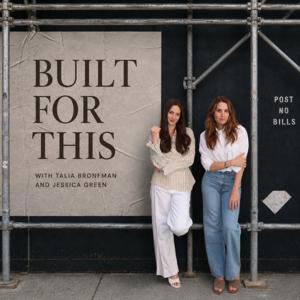
Built For This is a Canadian podcast about the business of womanhood—the invisible work behind ambition, caregiving, leadership, relationships, reinvention, identity, money, resilience, and modern life.
Hosted by Talia Bronfman and Jessica Green, the show features candid conversations with women who have built something real: companies, careers, families, communities, second acts, healing journeys, and new versions of themselves.
We talk about what success costs privately, the emotional reality behind ambition, motherhood, burnout, grief, illness, rebuilding, power, money, identity, and relationships.
Some guests are founders and executives. Others are creatives, therapists, mothers, teachers, doctors, and women rebuilding their lives.
The common thread: women building life differently and saying the quiet parts out loud.Welcome to Built For This.
From the publisher's feed