
Sign up to save your podcasts
Or

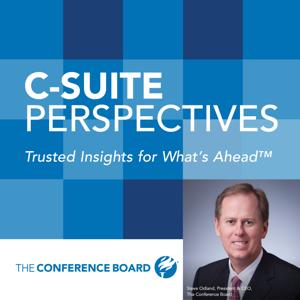


The era of corporate climate pledges is giving way to the harder work of execution. As 2030 deadlines approach and AI drives demand for energy and infrastructure, companies are confronting difficult questions about which emissions they can control, what they can afford, and how their goals may need to evolve.
In this episode of C-Suite Perspectives, Steve Odland, President and CEO of The Conference Board, is joined by Dr. Andrew Jones, Principal Researcher at the Governance & Sustainability Center of The Conference Board, to examine how companies set climate goals and the progress they are making across scope one, scope two, and scope three emissions.
Together, they discuss why companies have made the greatest progress on emissions from purchased electricity, the financial and operational challenges putting climate commitments at risk, how AI is reshaping energy demand and corporate emissions—and why revising a target does not necessarily represent a retreat.
Reward is moving out of the HR back office and into the heart of business strategy. From improving frontline productivity to navigating AI and pay transparency, decisions about how employees are rewarded increasingly shape organizational performance, workforce trust, and a company's ability to compete.
In this episode of C-Suite Perspectives, Sara Murray, Managing Director, International at The Conference Board, is joined by John Beadle, Senior Research Fellow and Corporate Reward and Global Mobility Council Director at The Conference Board, to explore insights from the Future: Reward Europe 2026 event and what they reveal about the changing role of reward leaders.
They discuss why successful reward redesign begins with diagnosing the business problem, how global benefit standards are challenging traditional market-based approaches, and whether AI will make reward functions more effective or simply reduce head count. They also examine the unfinished work of EU pay transparency, differences between US and European compensation, the more disciplined use of ESG measures in incentive plans, and the emerging issues that should be on reward leaders' agendas for the year ahead.
More from The Conference Board:
What Employers Need to Know About EU's Pay Transparency Law
The New Reward Agenda: Strategy, AI, Transparency, and Trust
EU Workforce Regulation Outlook 2026: 5 CHRO Priorities
AI and the Workforce: Governing Risk, Opportunity, and Access
A strong culture can help an organization navigate disruption—but the same beliefs and behaviors that drove success in the past can become barriers when the world changes. With AI accelerating uncertainty, how can leaders tell whether their culture is helping their organization adapt or holding it back?
In this episode of C-Suite Perspectives, Steve Odland, President and CEO of The Conference Board, is joined by Erka Amursi, Principal Researcher in the Human Capital Center, to explore what makes an organizational culture strong, healthy, adaptable, and consistent, and how leaders can determine where their own culture needs work.
They discuss a new four-dimension framework for understanding and measuring culture; why trust and psychological safety are especially important during periods of rapid change; and how leaders' actions, incentives, and communication shape the behaviors that take hold across an organization. They also examine how AI is challenging traditional approaches to change management and why transparency becomes even more important when leaders cannot offer employees certainty about what comes next
Could the Federal Reserve raise interest rates in September?
Yelena Shulyatyeva, Senior US Economist for The Conference Board, analyzes Fed Chair Kevin Warsh's latest remarks and discusses with Erik Lundh, Senior Global Economist for The Conference Board, why markets interpreted Warsh's message as increasingly hawkish. Shulyatyeva examines what Warsh revealed about the Fed's approach to inflation, why the speed of progress toward its 2% target matters, and what his comments suggest about the underlying strength of the economy and labor market.
The conversation also explores the market reaction to the speech, the economic data the Fed will consider before its September meeting, and why The Conference Board is not yet changing its forecast of no rate hikes this year.
FNB grew from a small bank into a major regional institution without abandoning the culture, communities, or risk discipline that helped make its expansion possible. In this episode of C-Suite Perspectives, David Young, President of The CEO Center at The Conference Board, speaks with Vincent Delie Jr., Chairman, President, and CEO of FNB Corporation and First National Bank, and a 2026 Distinguished Leadership Awards honoree, about the leadership decisions behind that transformation.
Together, they explore how FNB has combined strategic growth with disciplined risk management; why decisiveness, collaboration, and a low-bureaucracy culture create competitive advantage; and how investments in AI, digital banking, and underserved communities are shaping the bank's next chapter.
This episode is part of the Leadership in Challenging Times series from the CEO Center at The Conference Board. The series features discussions with the business leaders who are recipients of the Distinguished Leadership Awards.
Consumer confidence edged lower in August as expectations weakened, even as consumers' assessment of current conditions improved. Yelena Shulyatyeva, Senior US Economist, The Conference Board and Allen Li, Associate Economist, The Conference Board examine what the latest data reveal about jobs, inflation, and recession concerns.
They also preview Jackson Hole and discuss what Fed Chair Kevin Warsh's address could mean for interest rates, Treasury yields, and monetary policy.
For more from The Conference Board:
Organizations have long relied on surveys, forecasts, and expert analysis to anticipate future risks and opportunities. Could prediction markets offer business leaders a new—and in some cases more accurate—way to forecast economic conditions, manage risk, and improve decision making?
In this episode of C-Suite Perspectives, Steve Odland, President and CEO of The Conference Board, is joined by PJ Tabit, Principal Economic Policy Analyst at The Conference Board's CEO Center, to explore the growing role of prediction markets in business and public policy.
Together, they examine how prediction markets work and why they are gaining credibility as forecasting tools; discuss how companies can use them to strengthen risk management and business planning; and explore the governance, compliance, and reputational considerations executives should understand as these markets continue to evolve.
More from The Conference Board:
· Making Predictions Is Hard, Especially About the Future—Or It Used to Be
· AI and the C-Suite: Implications for CEO Strategy in 2026
· EU Digital Markets Act Developments Impact US Tech Firms
· Government Actions Attempt to Address AI Cybersecurity Risks
Organizations are racing to prepare their people for AI—but many may already be training them for yesterday's technology. As AI advances, knowing how to prompt a chatbot isn't enough. The bigger challenge is building the business acumen, adaptability, and organizational capabilities employees will need to put AI to work effectively.
In this episode of C-Suite Perspectives, Diana Scott, Human Capital Center Leader at The Conference Board, is joined by Matt Rosenbaum, Principal Researcher in the Human Capital Center at The Conference Board, to explore how organizations can build an AI-ready workforce that delivers lasting business value.
Together, they discuss why AI literacy alone is no longer enough; examine how CHROs can prepare employees for rapid advances in AI and workforce transformation; and explore the leadership, culture, learning ecosystems, and talent strategies needed to develop future-ready capabilities, support large-scale reskilling, and turn AI into a sustained competitive advantage.
Explore Related Insights:
· Navigating for AI: Critical Factors for Navigating AI Disruption
· Reinventing the Talent Pipeline in the AI Era
· Job Satisfaction 2026: Record High Marks 16 Years of Gains
· Organizational Culture: What Really Matters?
Organizations invest heavily in technology and business continuity—but are they investing enough in the resilience of their people? As employee expectations evolve and disruption becomes more frequent, workforce resilience is emerging as a strategic advantage rather than simply a human resources priority.
In this episode of C-Suite Perspectives, Rita Meyerson, Principal Researcher in the Human Capital Center at The Conference Board, is joined by Matt Pierce, CEO of E4E Relief, to discuss how employee relief programs can help organizations build a more resilient workforce.
Together, they examine how employee financial resilience, organizational culture, and crisis preparedness influence business performance; explore the changing expectations of today's workforce; and explain why helping employees recover quickly from personal crises can strengthen engagement, agility, and long-term organizational resilience.
More from The Conference Board:
· Strategic Integration of HR & Corporate Citizenship: Insights for the C-Suite
· Winning Partnership: HR & Corporate Citizenship
· Organizational Culture: What Really Matters?
· Reinventing the Talent Pipeline in the AI Era
As the US marks its 250th anniversary, what will it take to strengthen the institutions, leadership, and civic trust needed for the next 250 years?
In this episode of C-Suite Perspectives, David Young, President of The Conference Board's CEO Center, is joined by former US Senator Joe Manchin to reflect on America's 250th anniversary and the leadership challenges shaping its future.
Together, they explore the importance of bipartisanship, civic trust, and democratic resilience; discuss the growing influence of political polarization and AI; and consider why compromise, accountability, and common sense remain essential to strengthening American democracy and creating long-term prosperity.
More from The Conference Board:
From the publisher's feed

32,046 Listeners

30,701 Listeners

43,359 Listeners

8,731 Listeners

1,384 Listeners
1,712 Listeners
150 Listeners

5,441 Listeners

56,447 Listeners
3,979 Listeners

9,537 Listeners
9,070 Listeners

53 Listeners
334 Listeners
4,208 Listeners