
Sign up to save your podcasts
Or

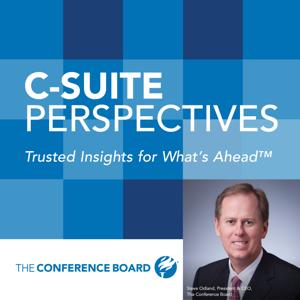


No CEO can personally master every technological, geopolitical, and economic challenge confronting a modern organization. The leadership advantage now comes from building a system that draws on the knowledge of the entire team—and enables the business to keep transforming without depending on one person for every answer.
In this episode of C-Suite Perspectives, Steve Odland, President and CEO of The Conference Board, speaks with Constantine Alexandrakis, CEO of Russell Reynolds Associates and author of The Catalyst CEO, about why the traditional command-and-control model is no longer enough.
Together, they explore why effective CEOs lead from the center of the organization rather than the top; how empowerment differs from abdication; and why humility, adaptability, resilience, and self-awareness are becoming essential leadership capabilities. They also discuss the board's role in transformation, how AI is changing jobs and workflows, and why CEOs must build cultures and leadership systems capable of continuous change.
More from The Conference Board:
· What Does It Really Take to Succeed in the C-Suite?
· A Framework for Agentic AI and Work Redesign
· Transforming Organizations for AI: Critical Factors for AI Success
· Shedding Light on Culture: A Framework for Board Insights
US salary increase budgets are projected to remain at 3.5% in 2027, unchanged from 2026. But stability in the headline number does not mean the workforce—or the way companies allocate compensation—is standing still.
In this episode of C-Suite Perspectives, Steve Odland, President and CEO of The Conference Board, speaks with Diana Scott, US Human Capital Center Leader at The Conference Board, about findings from the 41st annual US Salary Increase Budgets 2026–2027 study and what they mean for business and human capital leaders.
Together, they discuss why the average merit budget of 3.1% should reward performance rather than compensate for inflation; how companies can target limited pay dollars toward promotions, critical skills, retention, and equity; and why AI capabilities should be rewarded only when they create measurable business value. They also explore how automation is changing the mix of work even when overall headcount remains stable, the expanding role of CHROs in workforce transformation, and why transparency and a broader total rewards story are essential to maintaining employee trust.
More from The Conference Board:
· US Salary Increase Budgets 2026–2027
· The Evolving Role of the CHRO in the Boardroom
· A Framework for Agentic AI and Work Redesign
· Skilling for AI: Critical Factors for Navigating AI Disruption
Strategic errors rarely begin as obviously bad decisions but emerge when a strategy outlives the assumptions on which it was built—and leaders fail to recognize that disruptions or transformations have changed the game.
In this episode of C-Suite Perspectives, Sara Murray, Managing Director, International at The Conference Board, speaks with Vincent Giolito, Professor of Strategy and Organization at emlyon business school and Senior Fellow at The Conference Board, about how boards can identify strategic errors before they threaten the future of the company.
They discuss why boards must continually test strategic assumptions, recognize weak signals, and understand transformation as an ongoing process rather than a single event. They also explore the competencies boards need beyond financial expertise, why directors require "progressive lenses" that let them examine both operational details and the wider business landscape, and how ruthless empathy can help boards support CEOs while still challenging them when necessary.
More from The Conference Board:
Board Readiness in 2026
Corporate Governance in an Era of Sustained Disruption
Modernizing Board Governance for Today's Risk Environment
AI Policy and Regulation in the EU: What Companies Need to Know
US Consumer Confidence fell to 81.9 in September, marking a third consecutive monthly decline. In this episode of C-Suite Perspectives, The Conference Board's Eric Lundh and Allen Li examine what is driving greater consumer caution — from financial well-being and inflation concerns to signs of softer discretionary spending.
They also discuss The Conference Board's latest global economic forecast: how energy disruptions and trade uncertainty are weighing on growth; how AI investment and semiconductor demand are supporting parts of the global economy; and what to expect in the US, Asia, the Gulf region, and Europe through 2027.
What changes when employees are not only part of a company but its owners? At Graybar, employee ownership has fostered a long-term approach to leadership—one that places trust, resilience, shared accountability, and responsibility to future generations alongside financial performance.
In this episode of C-Suite Perspectives, David Young, President of The CEO Center at The Conference Board, speaks with Kathy Mazzarella, Chairman, President, and CEO of Graybar. Mazzarella reflects on joining the company at 19, rising through roles to become CEO, and the defining experiences that prepared her to lead one of North America's largest employee-owned companies.
Together, they explore why leadership is an act of stewardship, how Graybar's ownership culture strengthens engagement and customer loyalty, and why resilience can matter more than an uninterrupted path to the top. They also discuss how leaders can use AI to improve productivity without sacrificing human judgment and trust, why the right decision for employees can also produce stronger business results, and what it means to leave both a company and its people better positioned for the future.
This episode is part of the Leadership in Challenging Times series from The CEO Center at The Conference Board. The series features discussions with the business leaders who are recipients of the Distinguished Leadership Awards.
Leading a global organization does not mean making every decision yourself. It means creating enough strategic clarity for people to act, understanding the context behind difficult choices, and knowing when to step in—or step back.
In this episode of C-Suite Perspectives, David Young, President of The CEO Center at The Conference Board, is joined by Antoinette Gawin, President and CEO of Terumo Blood and Cell Technologies and a recipient of a 2026 Distinguished Leadership Award, to explore the experiences that shaped her leadership and how she empowers people to act across a complex global organization.
Together, they discuss why leaders have an obligation to speak when invited to the table, how strategic alignment can give teams greater operational autonomy, and why empathy is an underrated leadership attribute. They also examine the potential of blood and cell therapies, the role of AI and data in accelerating medical discovery, the need to expand access to innovation, the fragility of the global blood supply, and how regulation can protect patients without unnecessarily slowing progress.
This episode is part of the Leadership in Challenging Times series from The CEO Center at The Conference Board. The series features discussions with the business leaders who are recipients of the Distinguished Leadership Awards.
The US has no shortage of people who want careers in health care—or employers eager to hire them. Yet tens of thousands of qualified nursing and medical-school applicants are turned away each year, revealing a constrained pipeline with too few classroom seats, faculty members, and clinical placements to train the workforce the country needs.
In this episode of C-Suite Perspectives, David Young, President of The CEO Center at The Conference Board, is joined by Steve Beard, Chairman and CEO of Covista, to examine why the health care workforce shortage begins long before employers try to fill open positions—and what it will take to build a larger, stronger, and more sustainable talent pipeline.
Together, they discuss how educational institutions can expand access without sacrificing quality; how employer-educator partnerships can connect tuition assistance, clinical training, and employment; and why reducing administrative burdens is essential to retaining clinicians. They also explore how AI can personalize health care education and give clinicians more time with patients, the policy changes needed to increase training capacity and remove barriers to practice, and the leadership required to drive continuous change at scale.
Few industries have survived as many waves of disruption as music—from vinyl and MTV to streaming, AI, and now virtual artists. The performers who endure do more than react: they anticipate the next curve, reinvent without losing their identity, and keep experimenting before a crisis forces them to change.
In this episode of C-Suite Perspectives, Sara Murray, Managing Director, International at The Conference Board, is joined by Peter Corijn, Founder and CEO of VUCASTAR Consulting, Senior Fellow at The Conference Board, author, and recording artist under the name Paul Numi, to explore what business leaders can learn from the music industry about disruption and reinvention.
Together, they examine seven strategies for responding to a game changer; how artists including David Bowie, U2, Madonna, and Prince remained relevant; and why curiosity, resilience, diverse teams, and continuous experimentation underpin lasting success. They also discuss how leaders can innovate without abandoning their core identity, which capabilities organizations should develop before the next crisis, and whether generative AI can replicate the creativity and emotional experience that remain distinctly human.
More from The Conference Board:
Beyond AI Pilots: Building Future-Ready Companies
AI Is Transforming Organizations. How Will Yours Change?
C-Suite Outlook 2026: Uncertainty and Opportunity
Health care systems face a widening capacity challenge: an aging population and rising rates of chronic illness are increasing demand for care, while persistent workforce shortages limit how many patients clinicians can serve. AI could help close that gap—not by replacing health care workers but by reducing administrative burdens, improving workflows, and enabling the existing workforce to deliver more and better care.
In this episode of C-Suite Perspectives, Steve Odland, President and CEO of The Conference Board, is joined by Erka Amursi, Principal Researcher in the Human Capital Center at The Conference Board, to explore how AI can help health care organizations alleviate workforce shortages, increase productivity, and improve the delivery of care.
Together, they discuss how AI is already supporting diagnosis, documentation, patient monitoring, and administrative work; why the greatest gains will come from redesigning workflows and operating models; and which new skills health care workers will need. They also examine the risks of overreliance, bias, privacy violations, and unclear accountability—and why effective governance should treat AI as a copilot for clinicians rather than an autopilot for patient care.
Leadership does not get easier—leaders get better at doing hard things. For Kristin Peck, navigating uncertainty requires discipline, a growth mindset, and the mental resilience to move forward without having all the answers.
In this episode of C-Suite Perspectives, David Young, President of The CEO Center of The Conference Board, is joined by Kristin Peck, CEO of Zoetis, to explore how she leads the world's largest animal health company through rapid change.
Together, they discuss how purpose and curiosity have shaped Peck's career, why culture is a competitive advantage, and how Zoetis uses innovation to address emerging needs in animal health. They also examine the connection between healthy animals, food security, and economic opportunity—and why empathy and "frustrated optimism" are essential qualities for today's business leaders.
This episode is part of the Leadership in Challenging Times series from The CEO Center at The Conference Board. The series features discussions with the business leaders who are recipients of the Distinguished Leadership Awards.
From the publisher's feed

32,046 Listeners

30,701 Listeners

43,359 Listeners

8,731 Listeners

1,384 Listeners

1,712 Listeners
150 Listeners

5,441 Listeners

56,447 Listeners
3,979 Listeners

9,537 Listeners
9,070 Listeners

53 Listeners
334 Listeners
4,208 Listeners