
Sign up to save your podcasts
Or

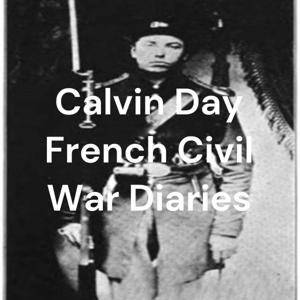


Calvin’s 43rd Regiment of nearly 2,000 solders joined with the Union Army of the Mississippi to prepare for a battle at Island No. 10 at a bend on the Mississippi River near New Madrid, Missouri. This is the 1st of 42 battles that Calvin’s 43rd Regiment participated in during the Civil War. The Army of the Mississippi would eventually grow to nearly 25,000 soldiers. The battle at Island No. 10 became the most impactful battle at this time in the Civil War. By defeating the Confederates at New Madrid and Island No. 10, the Mississippi River was open for the transportation of Union troops and supplies both north and south with little or no resistance from the Confederates.
Preparations for the attack on the Confederates at New Madrid and Island No. 10 began on February 23, 1862, with Major General Pope being placed in command of the Union Army of the Mississippi, assembling at Commerce, Missouri. Pope soon had his army numbering 10,000 men arriving at New Madrid early in March 1862, and in preparation for a siege, Pope requested that his army be supplied with heavy artillery, which arrived on March 12, 1862.
The iron clad flotilla of six gunboats under Flag Officer Andrew H. Foote were sent down from Cairo, Missouri on March 14, 1862. The Union fleet was augmented by the addition of 14 mortar rafts each mounted with single 13-inch mortars.
On March 4th, 5th, and 6th the commander of the Army of the Mississippi, Major General Pope, ordered a reconnaissance in force on the Confederate positions near New Madrid. Then on March 7th a general demonstration against the Confederate works was ordered. General Stanley's Division was ordered to move on Fort Thompson and Colonel Worthington's Brigade was to move on Fort Bankhead and occupy the trenches. The Confederate's discovered the deception and the Confederate gunboats opened up on Worthington's men. Now, caught in crossfire between the Confederate gunboats and heavy guns in the forts, the Union force of approximately 7,000 withdrew from New Madrid without engaging the enemy. Pop and his Division commanders agreed that an all-out frontal assault would be suicide and decided to surround the Confederates. He telegraphed for siege guns and kept his command well distanced from the Confederates to await the big guns arrival. Pope also continued with other strategies. On March 6th Brigadier General Plummer 's Division was ordered five miles downriver to Point Pleasant, Missouri. To set up batteries on the river to cut off Confederate supply boats from reaching New Madrid and No. 10. Plummer's men dug in along the riverbank; although the Rebel gunboats attempted to dislodge the Federals with their wooden fleet of gunboats, they failed. Plummer's men riddled the boats with small arms fire and scored several direct hits from their field pieces. The Confederate fleet proved it had little offensive value.
The Union siege guns, three 24-pounders and one 8-inch Howitzer, arrived on March 12 and were planted in front of Fort Thompson that night. On the morning of the 13th the Union began returning the Confederate artillery fire in earnest. A daylong artillery battle ensued, and although not terribly bloody, the losses on both sides in excess of 100 killed and wounded. The Union showed themselves to be good marksmen, dismounting two heavy guns in Fort Thompson and scoring several direct hits on the gunboats. The Confederates, not to be outdone, placed an 8-inch ball directly into the muzzle of one of the 24 pounders. Pope ordered an infantry assault on Fort Bankhead by Palmer's Division; however, the Confederates discovered the plan and trained the big guns on the Union solders.
March 13, 1862, the Confederates evacuated their forts at Island No. 10 and New Madrid.
Calvin left Washington Township, OH in mid-September and traveled by foot or horseback nearly 60 miles to Camp Chase located 4 miles south of Columbus. Camp Chase comprised 160 acres and was a Union mustering Camp that serviced nearly 150,000 Union soldiers from 1861 through 1865. Camp Chase was also a Confederate prison for nearly 25,000 officers and sympathizers. The camp, now closed, was converted into a cemetery for the 2,500 prisoners who died there. Camp Chase was used as a staging area for Union soldiers for issuing their clothing, muskets, and packs and training in marching drills and guard duties. Once the 43rd Regiment of 1,931 soldiers received their clothing and equipment they left Camp Chase on November 6, 1861 and traveled by train and river boat for Camp Andrews in Mount Vernon, OH 50 miles northeast of Columbus. Camp Andrews was established for just the 43rd Regiment for training prior to engaging in the Civil War. Calvin remained at Camp Andrews for 104 days before leaving for New Madrid, Missouri on February 21, 1862.
Calvin arrives at Camp Chase on Saturday, September 28, 1861 and gets ready to depart for Mt. Vernon on Tuesday, November 5, 1861
During the reading of Calvin's diaries, he refers to different Civil War terms and words. This episode explains to you in advance to the reading of his diaries this information so that you will understand the whole of his daily life.
Calvin enlisted in the 43rd O.V.I. on September 14, 1861. His regiment consisted of 2,904 soldiers under the command of Colonel Joseph L. Kirby Smith, a West Point Military Academy graduate. They called him "Our Kirby".
Calvin grew up in Ohio after leaving New York at the age of five. Calvin was his mother's constant companion. In 1857 when he was 15, his father had built a two story frame house allowing the family of 8 to leave their one room log house.
1861 was an impactful life for Calvin. Both of his parents died and the Confederates fired on Fort Sumpter which was the beginning of the American Civil War.
President Lincoln called for troop and Calvin and two of his brothers enlisted in the Union Army.
During the summer of 1847, when I was five years old, my father told us that we were going to move from New York to Ohio. He told us this would be a nice place to live where he could do farming and raise crops and animals. My father told us that he had visited this new town and had made arrangements with a man from the new town to buy a log house for our family. I did not know a lot about log houses. The only log houses I knew about were those lived in by my friends here in New York. They were always cold in the winter and hot in the summer and had very few windows. My father told us that the town where we were moving to was Washington Township, Ohio.
My name is Calvin Kirk French and I live in Pittsburgh, Pennsylvania. I obtained my great grandfather’s diaries several years ago and just recently transcribed them into a Word document.
Calvin Day French, the youngest of thirteen children, was born May 4th, 1842, at the small hamlet of Decatur, Otsego County, New York. His father, Samson French, was born in Cambridge, Massachusetts January 7, 1796 and died April 11, 1861. His mother, Elizabeth Seaward, was born in Decatur, New York February 7, 1798 and died August 24, 1861, just 4 months after the death of her husband.
We will begin with Calvin telling you of his early life growing up in New York and the move his family made when he was five years old to Ohio and up to his date of enlistment. These real stories will capture your imagination.
From the publisher's feed