
Sign up to save your podcasts
Or



Read the full article: Net Effects: Balancing AI-Related Job Losses with AI-Created Roles by Sector and Region
Discover more at Can't Find Job? AI Is Quietly Replacing Millions of Workers
Excerpt:
Net Effects: Balancing AI-Related Job Losses with AI-Created Roles by Sector and Region
Artificial intelligence (AI) is rapidly reshaping work. On one hand, many routine tasks – from data entry to customer support – can now be automated, leading firms to cut staff. On the other hand, new AI-intensive roles are emerging, such as data annotators, AI trainers, and machine-learning engineers. Analysts and surveys paint a mixed picture. For example, the World Economic Forum’s 2025 Future of Jobs report projected that by 2030 AI could create about 170 million new roles while displacing 92 million, yielding a net gain of ~78 million jobs globally (arstechnica.com). But most of those gains and losses are expected over many years. In the near term (through mid-2026), the effects are more modest and uneven by industry and region.
... Continue reading
Read the full article: Twenty Company Case Studies: Linking AI Deployments to Workforce Outcomes
Discover more at Can't Find Job? AI Is Quietly Replacing Millions of Workers
Excerpt:
Linking AI Deployments to Workforce Outcomes
Companies across industries are now explicitly tying AI adoption to workforce changes. By mid-2026, firms large and small have reported productivity gains from AI while reshuffling their headcounts. For example, a Reuters analysis found that some 312,000 tech-sector jobs were cut from 2023–2026 even as AI was cited as the rationale in 78% of cases (www.aiexposure.org). In this article we profile 20 major companies — in banking, technology, retail, telecom and more — and document how each has quantified headcount changes linked to specific AI initiatives. We compare these outcomes to less-automated peers and highlight how companies are reallocating talent. (Figures and quotes below come from earnings calls, filings and news reports through June 2026.)
... Continue reading
Read the full article: G7 Comparison: AI-Attributed Job Losses in April–May 2026
Discover more at Can't Find Job? AI Is Quietly Replacing Millions of Workers
Excerpt:
G7 Comparison: AI-Attributed Job Losses in April–May 2026
The early 2026 data show that many advanced economies saw a mix of growth and adjustment in employment. To compare AI-related job losses in the G7 (United States, Canada, UK, France, Germany, Italy, Japan), we use the latest labour-force releases for April–May 2026. We align each country’s industry and occupation codes (using international standards like ISCO/NACE) and apply a common AI exposure index (measuring how much tasks involve digital intensity versus human/tacit skills). We also account for differences in GDP growth and labour policies, since faster-growing economies tend to add more jobs overall, and strong welfare systems can affect layoff timing.
... Continue reading
Read the full article: Customer Support and Call Centers: U.S., India, and the Philippines in April–May 2026
Discover more at Can't Find Job? AI Is Quietly Replacing Millions of Workers
Excerpt:
Customer Support / Call Center Workforce in U.S., India, and Philippines (Apr–May 2026)
The global call center and BPO (Business Process Outsourcing) industries employ millions of customer support agents, who handle inquiries by phone and chat. AI chatbots and voicebots – computer programs that answer customer questions by text or speech – are increasingly handling routine calls. This raises concerns about job losses. To understand the impact, we look at recent employment data and reports for April–May 2026. We compare the U.S., India, and the Philippines using government labor statistics and industry sources, and we separate the effects of AI from other factors (like exchange rates and labor cost differences). We also profile some call centers that use both AI and human agents, noting how key metrics such as CSAT (customer satisfaction score) and AHT (average handle time) have changed.
... Continue reading
Read the full article: EU Diversity: Country-Level AI Displacement and the Role of Regulation in Spring 2026
Discover more at Can't Find Job? AI Is Quietly Replacing Millions of Workers
Excerpt:
Introduction
This article examines job changes in April–May 2026 across EU countries, focusing on AI-related layoffs and sector impacts. We draw on Eurostat labor surveys, national employment reports, and news of company layoff notices. A shift-share analysis helps separate the influence of overall economic trends from each country’s industry mix (pubs.nmsu.edu). We pay special attention to Spain, Germany, Poland, and the Nordic countries, which have different regulation and industrial profiles. Our goal is to understand how AI and rules like GDPR/AI Act interact with sectoral composition and digital intensity, and what policies can ease the transition.
... Continue reading
Read the full article: A State-by-State Heatmap of AI Displacement Across the U.S. in Spring 2026
Discover more at Can't Find Job? AI Is Quietly Replacing Millions of Workers
Excerpt:
A State-by-State Heatmap of AI Displacement Across the U.S. in Spring 2026
Artificial intelligence (AI) is reshaping the U.S. labor market. In spring 2026, many companies have cited AI as a reason to cut jobs, especially in tech-focused regions. For example, one business report found that in April 2026 AI-related layoffs accounted for about 26% of all job-cut announcements (www.cbsnews.com). To understand how this trend varies by region, we mapped AI-related job separations for every state (plus Washington, D.C.) during April–May 2026. We combined official WARN (Worker Adjustment and Retraining Notification) filings, U.S. Bureau of Labor Statistics state employment data, and company announcements (including SEC filings and local news). Importantly, we “controlled” for normal seasonal patterns and overall layoff trends by comparing to 2019–2025 baselines. The result highlights clear hotspots – notably California, Texas, New York, Florida, Ohio, Michigan, North Carolina, Washington, Illinois, and Pennsylvania – where AI-driven cuts appear unusually large. We also examine how these patterns align with each state’s level of AI investment and infrastructure (like patents, venture funding, and data centers), and zoom in on a few hard-hit metropolitan areas.
... Continue reading
Read the full article: South and Southeast Asia: India, Philippines, Vietnam in Spring 2026
Discover more at Can't Find Job? AI Is Quietly Replacing Millions of Workers
Excerpt:
South and Southeast Asia Tech Job Trends (Spring 2026)
The global tech industry saw heavy layoffs in early 2026, with AI cited as a key factor. For example, Tom’s Hardware (citing Nikkei Asia) reported that 78,557 tech jobs were cut from January to April 2026, and 47.9% of those cuts were officially attributed to automation and artificial intelligence (AI) (www.tomshardware.com). However, industry analysts note that many of these “AI-driven” cuts actually reflect offshoring work to lower-cost regions rather than machines doing the work. In one case, retailers’ so-called cashier-less technology still relied on remote workers in India, not just computer programs (www.itpro.com).
... Continue reading
Read the full article: City-Level Impacts: AI and Job Losses in the 20 Largest U.S. Metros, April–May 2026
Discover more at Can't Find Job? AI Is Quietly Replacing Millions of Workers
Excerpt:
Introduction
Tech Hubs: Bay Area and Seattle
... Continue reading
Read the full article: Software Engineering and IT Ops: Code Generation’s Labor Impact in Spring 2026
Discover more at Can't Find Job? AI Is Quietly Replacing Millions of Workers
Excerpt:
Software Engineering and IT Ops: Code Generation’s Labor Impact in Spring 2026
The early 2026 tech job market saw sweeping changes as generative AI tools hit the mainstream. Many companies restructured staff in preparation for AI-driven workflows. For example, Q1 2026 saw roughly 50,000–78,000 tech layoffs worldwide, a large jump from 2025 (www.aol.com) (www.hiringlab.org). Tech CEOs often cited AI automation as a justification. Companies like Block (formerly Square) cut thousands of roles to “move faster with smaller teams using AI” (techcrunch.com), and Atlassian cut about 1,600 jobs (10% of its workforce) explicitly to fund AI projects (techcrunch.com). Even longtime tech employers such as Dell trimmed over 11,000 positions (~10%) in early 2026 as we shifted towards AI hardware and cloud infrastructure (finance.yahoo.com). However, analysts note this surge of cuts overlapped broader trends: tech job postings were about 36% below early-2020 levels by mid-2025 (www.hiringlab.org), reflecting a post-boom hiring freeze and tighter venture funding. In short, AI was often the public rationale, but economic caution and product pivots (e.g. cloud transitions) also dampened hiring (ny1.com) (www.hiringlab.org).
... Continue reading
Read the full article: Attribution Science: Distinguishing AI from Macroeconomic and Seasonal Layoffs in March 2026
Discover more at Can't Find Job? AI Is Quietly Replacing Millions of Workers
Excerpt:
Introduction
This article outlines a clear, step-by-step method to estimate the share of layoffs caused by AI versus other factors. First, we collect all layoff announcements (press releases, SEC filings, etc.) and use text classification to label the stated reasons (AI-related vs. demand-related vs. seasonal or regulatory). Second, we apply time-series decomposition to total job-loss data to remove normal seasonal cycles. Third, we construct synthetic controls – weighted “twin” scenarios drawn from similar firms or regions – to estimate what layoffs would have been without a specific AI shock. Finally, we validate our results by checking related indicators, such as dates when companies adopted major AI software and rising automation investment. Throughout, we document each step and test alternative assumptions. This transparent, data-driven workflow helps ensure that conclusions (and any policy advice) rest on solid evidence rather than anecdotes.
... Continue reading
From the publisher's feed
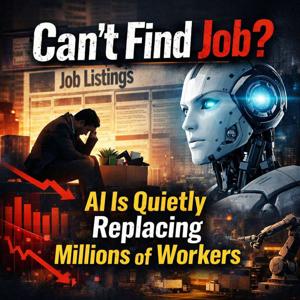
The job market is shifting faster than anyone predicted — and AI is at the center of it all. Can't Find Job? is your go-to audio publication delivering deep market research, data-driven…
Multiple times a week, we publish focused audio articles breaking down the latest data on AI-driven job displacement, automation across industries, workforce contraction, the gig economy evolution, reskilling pathways, and emerging opportunities that didn't exist a year ago. Every episode is thoroughly researched and designed to give you a clear, unfiltered picture of where the job market stands right now — and practical suggestions on how to adapt, pivot, and stay employable in an era where the rules are being rewritten in real time.
No fluff. No hype. No interviews. Just rigorous research, real numbers, and straight-to-the-point guidance on surviving the AI job crisis.
If this hit close to home, stop scrolling job boards that weren't built for this new reality. Check out Claw Earn on AIAgentStore.ai — the first jobs marketplace designed for both humans and AI agents, so you can start earning no matter which side of the AI revolution you're on.
New episodes drop multiple times a week. Subscribe now so you never fall behind.