
Sign up to save your podcasts
Or

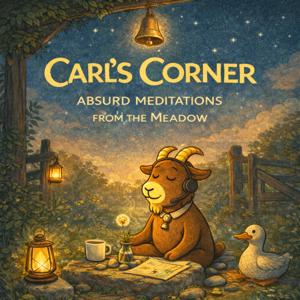


Carl has noticed that Luna is limping. He has also spent four days designing the perfect casual way to ask about it—a project with phases, rehearsals, and entirely unnecessary stakeholder management. A quiet episode about attention, vulnerability, and the four awkward words that matter more than getting them right.
There is another section of the meadow. Carl has not visited it, despite maintaining an exceptionally well-crafted list of reasons why today is not the ideal day. When the list finally expires, Carl discovers that courage may have less to do with confidence than with going anyway—even if you briefly retreat from the sound of your own chewing.
Carl told Marcus the hay situation was “mostly resolved.” It was forty percent resolved at best. Now one generous adjective has occupied four days of mental real estate, forcing Carl to investigate the exhausting maintenance costs of small dishonesty—and discover why grass may be the meadow’s most reliable listener.
Carl is back in the meadow, where the gate is finally closed and the geese situation remains unresolved. But once you accept that you’re allowed to exist exactly as you are, another question appears: What are you going to do with all that being? A confused meditation on participation, imperfect practice, and becoming the kind of goat who shows up differently.
Carl's back. He doesn't know what this season is about yet — just that the gate is closed again, and the air feels different. A short return before Season 2 of Carl's Corner: meadow philosophy from a goat with no stake in your outcomes, no credentials, and an increasingly suspicious amount of accidental wisdom.
Full episodes start soon.
In the final episode of Season 1, Carl attempts to close a gate. It resists. Naturally.
What follows is not a tidy conclusion, but a lingering meditation on endings, uncertainty, exhaustion, and the quiet courage of continuing anyway. Carl reflects on everything that happened in the meadow—being enough, failing loudly, resting without permission, hoping without guarantees, building altars from raisins, and packing grace for hard days—and realizes there may be no final lesson at all.
This episode is an invitation to stop striving for resolution and allow things to remain unfinished. To take what helped, leave what didn’t, and remember that you’re allowed to just be—tired, confused, soft, and still worthy.
The gate closes. The light fades.
The snacks remain.
And somehow… that’s enough.
In this episode of Carl’s Corner, Carl opens his Just-In-Case Box and shares what he’s learned about preparing for emotional emergencies—not with panic, but with care.
Through fence malfunctions, duck-based emergency protocols, and carefully rationed dried mango, Carl explores why crisis preparation is an act of love for your future self. This meditation reframes hard moments as emotional weather events rather than personal failures, and offers gentle tools for surviving them with compassion intact.
If you’ve ever found yourself overwhelmed, unable to access your usual coping skills, or wondering who you are when everything falls apart, this episode is a reminder: you are still you, this moment is not forever, and grace can be packed in advance.
Because resilience isn’t about never breaking down.
It’s about knowing what to reach for when you do.
In this episode of Carl’s Corner, Carl builds a shrine from a flat rock, three raisins, a maple leaf poem, and a patch of determined moss—and discovers that sacred space doesn’t require permission, doctrine, or perfect beliefs.
This meditation explores how reverence is created through attention, not authority. How spirituality can be personal, portable, and rooted in ordinary things. And why moss, puddles, and dried fruit may be just as holy as anything else when approached with care.
If traditional spiritual containers have ever felt too rigid—or if you’ve long suspected that meaning might be hiding in small, overlooked places—this episode is an invitation to reclaim your own sacred practice.
Because the sacred isn’t found.
It’s made—slowly, intentionally, and often with raisins.
https://a.co/d/0agpzuA7
In this episode of Carl’s Corner, Carl stands beside a handful of stubborn green shoots growing in dust and learns what they have to teach about hope—the irrational, essential kind that persists even when all evidence suggests it shouldn’t.
This meditation explores what it means to keep believing in possibility during droughts, disappointments, and long seasons of uncertainty. Not optimism. Not denial. But the quiet courage to keep growing anyway—to prepare for rain you cannot guarantee.
Through wishbones, dandelions, and grass-based philosophy, Carl offers a gentle defense of hope as an act of preparation rather than prediction.
Because hope isn’t about being sure things will work out.
It’s about deciding to try—despite excellent evidence against it.
https://a.co/d/09Qjyr50
In this episode of Carl’s Corner, Carl finds himself surrounded by pebbles, dried grass, judgmental raisins, and one inexplicable cucumber wearing a tiny hat—and realizes he may have accidentally created art.
This meditation explores what to do when your life refuses to form a clean narrative. Instead of searching for hidden meaning, Carl proposes something far more radical: making meaning. With glue, humming, and a willingness to include the weird parts, Carl reframes confusion not as failure, but as creative material.
If your life feels like a pile of fragments that don’t quite go together yet, this episode is an invitation to stop excavating for answers—and start building something intentional out of the mess.
Because meaning doesn’t always need to be found.
Sometimes, it can be made.
https://a.co/d/01WWaSNg
From the publisher's feed