CARTA - Anthropogeny (Video)

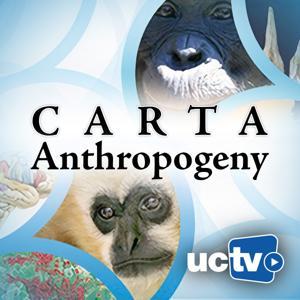
CARTA - Anthropogeny (Video)

Download on the App Store

CARTA - Anthropogeny (Video) episodes

  • CARTA: Human-Climate Interactions and Evolution: Past and Future: Ajit Varki Welcome Remarks
    Co-Director of The Center for Advanced Research and Training in Anthropogen, Ajit Varki, welcomes guests and partcipants to this symposium which presents varied perspectives from earth scientists, ecologists, and paleoanthropologists on how climate may have shaped human evolution, as well as the prospects for the future of world climate, ecosystems, and our species. Series: "CARTA - Center for Academic Research and Training in Anthropogeny" [Science] [Show ID: 29686]

    6 min
  • CARTA: Human-Climate Interactions and Evolution: Past and Future – African Climate Change and Human Evolution; The Climatic Framework of Neandertal Evolution; Climate Instability and the Evolution of Human Adaptability
    This symposium presents varied perspectives from earth scientists, ecologists, and paleoanthropologists on how climate may have shaped human evolution, as well as the prospects for the future of world climate, ecosystems, and our species with Peter deMenocal on African Climate Change and Human Evolution, followed by Jean-Jacques Hublin on The Climatic Framework of Neandertal Evolution, and Rick Potts on Climate Instability and the Evolution of Human Adaptability. Series: "CARTA - Center for Academic Research and Training in Anthropogeny" [Science] [Show ID: 29683]
    57 min
  • CARTA: How Language Evolves: David Perlmutter: Combinatoriality within the Word: Sign Language Evidence
    In human languages, spoken and signed, words or signs are products of combinatorial systems that combine meaningless smaller units in different ways to yield different words or signs with different meanings. In spoken languages, those smaller units are the sounds of speech (phonemes). In sign languages, they are handshapes, movements, and the places on the body where signs are made. In this talk David Perlmutter of UC San Diego suggests that the evolutionary path for signs of iconic origin could provide an appropriate working model of the parallel evolution of non-iconic signs in sign languages and of the spoken words of spoken languages. Series: "CARTA - Center for Academic Research and Training in Anthropogeny" [Humanities] [Science] [Show ID: 29401]
    22 min
  • CARTA: Is the Human Mind Unique? – Merlin Donald: Skilled Performance and Artistry
    Merlin Donald (Queen’s Univ) opines that if one crucial adaptation had to be singled out as the signature move that started the human journey, he would nominate “mimesis,” or body artistry, which is the platform on which all complex skilled performance, including language, has evolved. A capacity for refining skill started to evolve very early in the emergence of hominids, as testified by the existence of very ancient stone tools that predate the appearance of our species. Such tools cannot be made without a capacity to rehearse systematically and an ability to imagine an idealized performance. Series: "CARTA - Center for Academic Research and Training in Anthropogeny" [Science] [Show ID: 24984]
    18 min
  • CARTA: Behaviorally Modern Humans: The Origin of Us – Michael Hammer: Interbreeding with Archaic Humans in Africa
    CARTA: Behaviorally Modern Humans: The Origin of Us – Michael Hammer: Interbreeding with Archaic Humans in Africa
    Today there is an abundance of DNA sequence data from the entire genome of contemporary human populations, as well as from ancient DNA recovered from extinct forms of humans. Michael Hammer (Univ of Arizona) discusses how analyses of these data, with increasingly sophisticated computational tools, are yielding new insights into human evolutionary history. Series: "CARTA - Center for Academic Research and Training in Anthropogeny" [Show ID: 25394]
    20 min
  • CARTA: Is the Human Mind Unique? – V.S. Ramachandran: Inter-Modular Interactions Metaphor and the Great Leap
    V.S. Ramachandran (UC San Diego) argues that human mental uniqueness emerged from the fortuitous co-emergence of certain novel anatomical structures and functions and equally fortuitous synergistic interactions between them. These include structures involved in inter-sensory abstraction (IPL and its uniquely human subdivisions; supra-marginal gyrus and angular gyrus; certain frontal structures, Wernicke’s area, etc.) and sensorimotor abstraction (mirror neurons). He contends that these were then adapted for higher-level abstractions such as metaphor. Series: "CARTA - Center for Academic Research and Training in Anthropogeny" [Science] [Show ID: 24986]
    24 min
  • CARTA: Mind Reading: Human Origins and Theory of Mind: Juliane Kaminski: Comparing Apes and Dogs
    A key feature of human social interactions is the ability to make inferences about other individuals’ mental states (e.g. others’ knowledge, beliefs and desires). Juliane Kaminski (Univ of Portsmouth, UK) reviews studies which investigate whether the cognitive capacities underlying these skills are uniquely human or shared, at least to some degree, with other species. Series: "CARTA - Center for Academic Research and Training in Anthropogeny" [Science] [Show ID: 26077]
    18 min
  • CARTA: How Language Evolves: Language in The Brain
    This CARTA symposium addresses the question of how human language came to have the kind of structure it has today, focusing on three sources of evidence. One source, which is discussed in these three talks, concerns neuroscientific investigations of functional specialization for language in the human brain and its dependence on the linguistic input the language learner gets during cognitive development. Evelina Fedorenko (Massachusetts General Hospital) begins with an examination of Specialization for Language in the Human Brain, followed by Rachel Mayberry (UC San Diego) on How the Environment Shapes Language in the Brain, and Edward Chang (UC San Francisco) on Neuroscience of Speech Perception and Speech Production. Series: "CARTA - Center for Academic Research and Training in Anthropogeny" [Humanities] [Science] [Show ID: 29395]
    59 min
  • CARTA: How Language Evolves: Welcome and Introduction
    Pascal Gagneux, associate director of CARTA, introduces this symposium which addresses the question of how human language came to have the kind of structure it has today. Series: "CARTA - Center for Academic Research and Training in Anthropogeny" [Humanities] [Science] [Show ID: 29396]
    6 min
  • CARTA: How Language Evolves: Edward Chang: Neuroscience of Speech Perception and Speech Production
    Edward Chang of UC San Francisco is interested in determining the basic mechanisms that underlie our ability to perceive and produce speech. While much of this processing has been localized to the peri-sylvian cortex, including Broca’s and Wernicke’s areas, the fundamental organizational principles of the neural circuits within these areas are completely unknown. To address this, his laboratory applies a variety of experimental approaches to examine both local circuitry and global network dynamics spanning multiple cortical and sub-cortical regions with unparalleled spatial and temporal resolution in humans. Series: "CARTA - Center for Academic Research and Training in Anthropogeny" [Humanities] [Science] [Show ID: 29405]
    21 min

About CARTA - Anthropogeny (Video)

From the publisher's feed

Multidisciplinary researchers explore the origins of humanity and the many facets of what makes us human.

More shows like CARTA - Anthropogeny (Video)

Wellbeing (Audio) by UCTV

Wellbeing (Audio)

1 Listeners

Nobel Laureates (Audio) by UCTV

Nobel Laureates (Audio)

5 Listeners

Oceanography (Audio) by UCTV

Oceanography (Audio)

38 Listeners

Mental Health and Psychiatry (Audio) by UCTV

Mental Health and Psychiatry (Audio)

60 Listeners

Mental Health and Psychiatry (Video) by UCTV

Mental Health and Psychiatry (Video)

17 Listeners

CARTA - Anthropogeny (Audio) by UCTV

CARTA - Anthropogeny (Audio)

7 Listeners

Library Channel (Audio) by UCTV

Library Channel (Audio)

3 Listeners

Robert Reich by UCTV

Robert Reich

34 Listeners

Health and Medicine (Audio) by UCTV

Health and Medicine (Audio)

22 Listeners

Cardiology (Video) by UCTV

Cardiology (Video)

0 Listeners