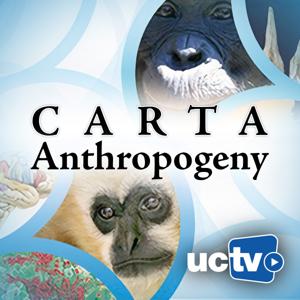
CARTA - Anthropogeny (Video)

CARTA - Anthropogeny (Video)

Download on the App Store

CARTA - Anthropogeny (Video) episodes

  • CARTA: Culture-Gene Interactions in Human Origins: Alison Brooks – Origins of Modern Human Behavior
    What constitutes the essential behavior of our species is contentious. Evolutionary scenarios leading to both the capacity for and practice of these essential behaviors are even more debated. Genetics, cognitive and evolutionary psychology, morphology, reconstructions of climate variation, and the archaeology of human behavior all provide pathways to explore these questions. This presentation by Alison Brooks, George Washington University, will review the evidence for the accumulation of distinctive human behaviors in a comparative framework. Series: "CARTA - Center for Academic Research and Training in Anthropogeny" [Science] [Show ID: 24107]

    22 min
  • CARTA: The Upright Ape: Bipedalism and Human Origins – Dan Lieberman: The Evolution and Relevance of Human Running
    The fastest humans sprint slowly and for very limited durations compared to most quadrupedal mammals, but even average humans have superlative long distance running capabilities in terms of speed and distance compared to other mammals, especially in the heat. Dan Lieberman (Harvard University) posits that these abilities raise the question of how to evaluate when and how adaptations for running evolved in hominins, and what effect such selection had on the evolution of the human body. Series: "CARTA - Center for Academic Research and Training in Anthropogeny" [Science] [Show ID: 23669]
    21 min
  • CARTA: The Evolution of Human Nutrition - Archaic Human Diets Current Hunter-Gatherer Diets and Diets and Microbes in Primates
    Tracing the evolution of the human diet from our earliest ancestors can lead to a better understanding of human adaptation in the past. It may also offer clues to the origin of many health problems we currently face, such as obesity and chronic disease. This fascinating series of talks focuses on the changing diets of our ancestors and what role these dietary transitions played in the evolution of humans. Here Mary C. Stiner (Univ of Arizona) discusses Archaic Human Diets followed by Alyssa Crittenden (Univ of Nevada, Las Vegas) on Current Hunter-Gatherer Diets and Steven Leigh (Univ of Illinois at Urbana-Champaign) on Diets and Microbes in Primates. Series: "CARTA - Center for Academic Research and Training in Anthropogeny" [Health and Medicine] [Science] [Show ID: 24806]
    57 min
  • CARTA: The Evolution of Human Nutrition - Diets and Microbes in Primates Australopith Diets and Neanderthal Diets
    Tracing the evolution of the human diet from our earliest ancestors can lead to a better understanding of human adaptation in the past. It may also offer clues to the origin of many health problems we currently face, such as obesity and chronic disease. This fascinating series of talks focuses on the changing diets of our ancestors and what role these dietary transitions played in the evolution of humans. Here Steven Leigh (Univ of Illinois at Urbana-Champaign) discusses Diets and Microbes in Primates, followed by Peter Ungar (Univ of Arkansas) on Australopith Diets, and Alison S. Brooks (George Washington Univ) and Margaret J. Schoeninger (UC San Diego) on Neanderthal Diets. Series: "CARTA - Center for Academic Research and Training in Anthropogeny" [Health and Medicine] [Science] [Show ID: 23436]
    59 min
  • CARTA: Human Origins: Lessons from Autism Spectrum Disorders - Andrew Meltzhoff: The Like-Me Theory for Connecting Self and Others
    Andrew Meltzoff (Univ of Washington) describes new research on the origins of ‘social cognition’ -- the mechanisms by which infants come to understand other people and interpret their actions and intentions before language -- and its implications for understanding children with autism spectrum disorders. Series: "CARTA - Center for Academic Research and Training in Anthropogeny" [Science] [Show ID: 24820]
    21 min
  • CARTA: Human Origins: Lessons from Autism Spectrum Disorders - Daniel Geschwind: Systems Biology of Autism Spectrum Disorders
    Daniel Geschwind (UCLA) and his colleagues have been working to identify autism risk genes and understand how these might lead to autism spectrum disorders (ASD). Many genes with distinct functions have been identified as ASD susceptibility genes. In this lecture, he indicates how systems biology approaches demonstrate that pathways necessary for normal brain development and function are altered in ASD. Identification of these pathways is the first step toward developing treatments of ASD. Series: "CARTA - Center for Academic Research and Training in Anthropogeny" [Science] [Show ID: 24823]
    19 min
  • CARTA: Human Origins: Lessons from Autism Spectrum Disorders - Jonathan Sebat: Genetic Etiology
    In this presentation, Jonathan Sebat (UC San Diego) points out that the biggest known risk factors for autism are genes. However, the mutations that have been firmly implicated in autism are unlike the genetic variants that explain common late-onset diseases such as heart disease and diabetes. Most of the genes or genomic regions that are known to contribute to autism are “mutation hotspots”. Series: "CARTA - Center for Academic Research and Training in Anthropogeny" [Science] [Show ID: 24818]
    18 min
  • CARTA: Human Origins: Lessons from Autism Spectrum Disorders - V.S. Ramachandran: Mirror Neuron Dysfunction in Neurology
    V.S. Ramachandran (UC San Diego) explains how his interest in Autism Spectrum Disorders (ASD) stems from an earlier, and broader, interest in mirror neurons and their dysfunction (and restitution of function) in neurology. He begins with a brief survey of the mirror neuron system (MNS) and then makes specific predictions of what to expect from their dysfunction in neurological populations with stroke or phantom limbs, as well as neurotypical populations who overlap with ASD. Series: "CARTA - Center for Academic Research and Training in Anthropogeny" [Science] [Show ID: 24826]
    19 min
  • CARTA: Human Origins: Lessons from Autism Spectrum Disorders - Bernard Crespi: Evolutionary Biology of Autism Risk
    Bernard Crespi (Simon Fraser University) describes a simple model, based in evolutionary biology, neurodevelopment, and genetics, for understanding how the primary features of autism are related to the major neuroanatomical and cognitive traits that are highly-developed or unique to the human lineage. Series: "CARTA - Center for Academic Research and Training in Anthropogeny" [Science] [Show ID: 24824]
    20 min

About CARTA - Anthropogeny (Video)

From the publisher's feed

Multidisciplinary researchers explore the origins of humanity and the many facets of what makes us human.

More shows like CARTA - Anthropogeny (Video)

Wellbeing (Audio) by UCTV

Wellbeing (Audio)

1 Listeners

Nobel Laureates (Audio) by UCTV

Nobel Laureates (Audio)

5 Listeners

Oceanography (Audio) by UCTV

Oceanography (Audio)

38 Listeners

Mental Health and Psychiatry (Audio) by UCTV

Mental Health and Psychiatry (Audio)

60 Listeners

Mental Health and Psychiatry (Video) by UCTV

Mental Health and Psychiatry (Video)

17 Listeners

CARTA - Anthropogeny (Audio) by UCTV

CARTA - Anthropogeny (Audio)

7 Listeners

Library Channel (Audio) by UCTV

Library Channel (Audio)

3 Listeners

Robert Reich by UCTV

Robert Reich

34 Listeners

Health and Medicine (Audio) by UCTV

Health and Medicine (Audio)

22 Listeners

Cardiology (Video) by UCTV

Cardiology (Video)

0 Listeners