
Sign up to save your podcasts
Or

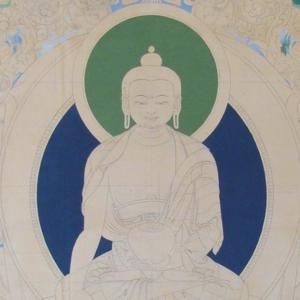


Muso Soseki (1275-1351) was a towering figure of Japanese Zen. He was a teacher, painter, calligrapher, gardener, and poet. For him, none of these things were idle pastimes. They were vital means of expressing what cannot be expressed.
In this talk, we meet Muso and follow him from childhood into the monastery, from the monastery into the mountains, and from the mountains into the most important temple in Japan, Nanzen-ji. We’ll listen to some of his verses and consider how sharing the dharma is always a creative enterprise, and always surprising - not by design, but by necessity.
In this talk we meet Muso Soseki, the great Zen teacher, painter, calligrapher, gardener and poet of 12-13th Century Japan. Muso was a deeply humble and solitary figure who found himself installed in one of the greatest temples in Kyoto, Nanzen-ji. In this talk we take up one of his poems to see what it shows us about genuine practice in the “haze and mist” of ordinary life. This talk was given on day two of the Castlemaine Zen Spring Zazenkai 2026.
Zen practitioners have always enjoyed wandering in the mountains. On one occasion, the great Changsha, who was revered for his unorthodox teaching methods, returned to the temple to discover the Head Monk waiting for him at the gate. The words they exchanged have had a lasting impact on Zen lore and the way we celebrate a Zen life. This talk was given on day one of the Castlemaine Zen Spring Zazenkai 2026.
From the very beginning, Zen has acknowledged poetry as the clearest and most generous form of dharma expression. Rather than cut the dharma into parts, poetry pays obeisance to the whole. In this talk we track some of the major developments and poets in our tradition, reaching right into our present day.
We’re living in a time of great transition. It can sometimes feel like we’re stepping out of an old world into a new one. Before Dogen moved his assembly from Kyoto to Echizen, he wrote “The Bodhisattva’s Four Methods Of Guidance”, which clarifies the most important practices in times of fundamental change.
When we sit in the early morning we sit with all of the ancestors in our tradition, reaching all the way back to Shakyamuni Buddha himself.
This talk was given at the conclusion of 108 days of morning practice, in honour of the morning star and our capacity to wake up together with all beings.
In this talk, we explore the spectre of AI with the help of Nanquan Puyuan (748-835), who popularised the saying, “Ordinary mind is the Way.”
There’s no question that AI is extraordinary. But can it be ordinary in the sense that Nanquan offers? What are we missing if we remain dazzled in the glare of screens and processed information? Might we be blind to what is right before our eyes?
On one occasion, Nanquan bent over, pointed to a small flower plant, and said, “People of the present day see this flower as though living in a dream.” Zen practice has always committed itself to waking up from this small dream of separation into the great dream of shared presence. You might even say that it is forever breaking through artificial forms of intelligence to reveal genuinely embodied forms of intelligence.
So let’s sit with Nanquan’s flower to see what it has to say. Have you ever seen Nanquan’s flower? What’s it like? Has it ever seen you? If so, you’ll know that there is nothing artificial about it, and that it holds more wisdom than any data centre could dream of.
Zen was forged in the fire of change. In 10th Century China, the old teacher Fengxue asked, “When Buddhism was destroyed during the Huichang persecution (9th Century), where did all the dharma protecting deities go?” He wanted to know why so many monks and nuns were forced from their temples into the burning streets. Who – or what – was looking after them then?
The Venerable Guanghui Zhen responded, “The world protecting deities were in the marketplace the whole time, only no one saw them.” Zen practice isn’t protected by supernatural forces: it’s protected by you and me. We are the ones who embody it fully, whether at home or in the marketplace, quietly nourishing what is most important. So how do we protect our practice? How do we share it with others? And how will you extend your realisation to future generations?
Each morning at sesshin we chant the verse of the rakusu: “I wear the robe of liberation / the formless field of benefaction / the teachings of the Tathagata / saving the many beings.” What is this about? What is it pointing to? And what might this mean in our contemporary world? This talk was given on the fourth night of the winter sesshin in Hobart 2026.
In this talk, we explore what it means to journey with a “genjokoan”, and how Layman Pang merrily blurred the boundaries between east and west, inside and outside, ordinary and holy, difficult and easy. This talk was given on the third night of the winter sesshin in Hobart 2026.
From the publisher's feed
A selection of emerging dharma talks from Kynan Sutherland Roshi and Castlemaine Zen