
Sign up to save your podcasts
Or

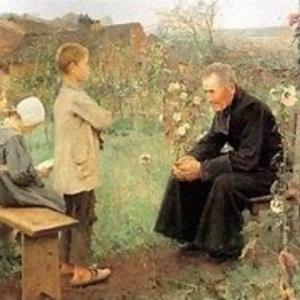


The word believe does not mean to think, to suppose, to be of opinion: but as the Sacred Scriptures teach, it expresses the deepest conviction, by which the mind gives a firm and unhesitating assent to God revealing His mysterious truths. As far, therefore as regards the use of the word here, he who firmly without hesitation is convinced of anything is said to believe.- Catechism of the Council of Trent
Speech is a gift given to humans but basically denied to all the rest of the natural world. It is the tangible part of us that is also common among the spirit beings. (Angels, devils, and all heavenly beings.)
Present studies report we all say about 16,000 words in a day, some more and some less. Regardless, we do take talking for granted, it comes so natural. The question is not whether or not we talk, the question is if we communicate.
A wedding day does not cure human nature. Often times the first offenses begin innocently. What is normal in one family is very different from what is normal in another family. After a while and after enough hurts, it is easy for couples to slip into a frustrated mode of reacting from a hurt with a hurt. When sharp words are said, sharp words are returned. Rebukes meet retorts. Anger may turn into wrath. Sometimes men learn their superior strength can be used to force their will on a weaker woman. The woman may learn how to push her man over the edge through a nagging tongue.
Is there any hope for a marriage that has jagged tears through its fabric? Some failures go deep causing lifetime consequences. Forgiveness means one chooses to be okay with broken dreams, the consequences of another’s sin and all the reaping they are forced to endure. This is impossible for human nature on its own.
God’s plan for the wife in the home is that the wife is to take a subordinate role in leadership issues and/or when decisions need to be made. This is a general principle and each couple needs to find their way in working with the personality and gifts of both husband and wife. When we find ourselves fitting into the plan our Creator has for us, we will have the greatest fulfillment possible for any created being.
The greatest Bible commands arise out of our most common human needs. As strange as it sounds to courting couples, husbands failing to treasure their wives is the most common problem of marriages. Sadly, as too many a married woman learns, the opposite of love is not always hate; sometimes it is simply neglect.
Every married person needs to come to that place in his life; the place where he or she realizes that God has created their spouse especially for each other. This will give them the vision to fill his or her place in the marriage relationship. In the first marriage, the Sacred record is careful to note, “And God blessed them...” There was a Divine Being who superintended Adam and Eve’s marriage. There is a Divine Being who superintends our marriages today as well. We are not alone needing to grope for answers. We have a God who made us, led us together and blesses us for His glory even when we do not fully understand what we are going through.
What is the Sacrament of Holy Matrimony? What does this Sacrament do?
First we must define what is a sacrament. A Sacrament is an outward sign of inward grace, instituted by Christ for our sanctification. Or in other words, A Sacrament, in this case Marriage by a man and a woman who have been sacramentaly baptized, is an outward sign of inward grace, (grace being God's enabling power to live out the sacrament of Marriage), instituted by Christ for our sanctification ( the two being set apart to grow in grace and in charity toward each other).
St. Paul, an apostle, wrote vividly about the Real Presence of Christ in the Eucharist.
Paul talks about the Eucharist in 1 Corinthians 10:16-21 and 1 Corinthians 11:27-30. These passages show that Paul was Catholic in his belief.
Do you believe that Jesus can transform bread and wine into His Body and Blood? To answer this question, we must turn to chapter six in the Gospel of John. In John 6 we encounter Jesus’ famous Bread of Life Discourse, where He firmly establishes His teaching on the Eucharist. But in order to understand this teaching we first have to look at the two passages that precede the discourse. These two passages serve as the interpretive key for the Bread of Life Discourse, because in them Jesus manifests a power over nature and an ability to feed God’s people that is greater than Moses.
Jesus asks a number of different questions in the Gospels, but one in particular always stood out to me, “Believe ye that I am able to do this?”(Mathew 9:28). Originally posed to two blind men, this question like all of Scripture, transcends its initial audience and can be applied to us as well. For this reason, I often propose this question about the Eucharist – do you believe that Jesus can transform bread and wine into His Body and Blood? To answer this question, we must turn to chapter six in the Gospel of John. In John 6 we encounter Jesus’ famous Bread of Life Discourse, where He firmly establishes His teaching on the Eucharist. But in order to understand this teaching we first have to look at the two passages that precede the discourse. These two passages serve as the interpretive key for the Bread of Life Discourse,
From the publisher's feed
Catechizing with a fresh perspective. Using the Holy Scriptures and the Catechism of the Council of Trent as foundational bases.