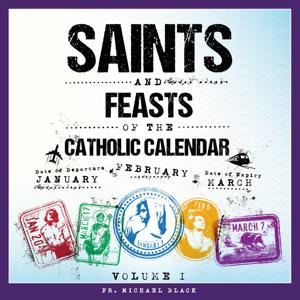
Catholic Saints & Feasts

Catholic Saints & Feasts

Download on the App Store

Catholic Saints & Feasts episodes

  • January 21: Saint Agnes, Virgin & Martyr
    January 21: Saint Agnes, Virgin and Martyr
    c. 291–c. 304
    Memorial; Liturgical Color: Red or White
    Patron Saint of young girls, rape victims, and chastity

    A child knows that God is a person who deserves to be loved

    The names of only the earliest saints and martyrs are embedded in the Roman Canon, Eucharistic Prayer I. Saint Agnes is among those listed (Felicity, Perpetua, Agatha, Lucy, Agnes, Cecilia, Anastasia, etc.). Devotion to Agnes as both Virgin and Martyr is of ancient origin and is specifically mentioned by fourth-century writers, including Pope Damasus. A basilica was built as early as the reign of Constantine over the catacombs where Saint Agnes’ relics were deposited. A later structure, with an ancient mosaic showing Saint Agnes, is still an active church on that exact same site today. The mobs of tourists and pilgrims who crowd the eternal city, and who shuffle through Piazza Navona today, may not realize that they are walking by the very site where Agnes was martyred. The beautiful Baroque Church of Saint Agnes on Piazza Navona reminds the discerning pilgrim that our saint met her death at that exact spot.

    Agnes was of a tender age when she was killed. She was just a girl. Tradition says that she was beautiful and wanted to dedicate her virginity to the Lord, despite numerous suitors desirous of her beauty. She was killed, then, both for her faith and for her steadfastness in refusing to violate her vow of chastity. It was a double martyrdom, made all the sweeter because of her youth. With poetic license and rhetorical power, Saint Ambrose imagines Saint Agnes’ final moments: “You could see fear in the eyes of the executioner, as if he were the one condemned; his right hand trembled; his face grew pale as he saw the girl’s peril; while she had no fear for herself. One victim but a twin martyrdom to modesty and to religion. Agnes preserved her virginity and gained a martyr’s crown.”

    When making solemn vows at his ordination, a man marries the Church so that he can make her fruitful. But a woman’s religious vows make her a spouse of Christ Himself. A man marries the Church; a woman marries Christ. This beautiful bridal imagery speaks the human language of love and commitment. God is a person, not just a prime mover or a higher power. So He loves us like a person, and we love Him back like a person. Part of this love is jealousy. God is a jealous spouse. He wants total commitment from those who have dedicated their lives to Him. He demands total fidelity. In extreme cases, even to the point of death. Little Saint Agnes understood all of this with girlish simplicity united to a will of iron. Innocence alongside maturity. Chastity alongside toughness. Beauty holding hands with death.

    Saint Agnes, help all young people commit themselves to Christ when young, giving Him the most fruitful years of their lives. Inspire them to say “Yes” to God and not just “No” to the world. Help all to see that although life is a gift, there are greater things than life, such as God in His glory.
    5 min
  • January 20: Saint Sebastian, Martyr
    January 20: Saint Sebastian, Martyr
    Late Third Century
    Optional Memorial; Liturgical Color: Red
    Patron Saint of athletes, soldiers, and victims of the plague

    A Roman soldier makes a rugged convert and stoic martyr

    The Crucifixion of Jesus Christ and the Annunciation of the Archangel Gabriel to the Virgin Mary are the most universally depicted scenes in Christian art. There is perhaps not a Catholic church the world over which does not house one or the other image, and often both. But today’s saint, Sebastian, follows close behind in terms of popularity and ubiquity. The iconic presentation of the wounded Sebastian shows his hands and arms bound to a post, his head tilted, and his almost naked body filled with arrows.

    It is a powerfully evocative image. It suggests that the archers took their time. They were not rushed. They did not act in the heat of anger. Criminal psychologists have observed that killers only cover the faces of victims who they know. Otherwise, killers don’t mind watching their victims suffer and die. It seems that with Sebastian there was no hooded executioner. No anonymous hangman. The men in Sebastian’s firing squad must have gazed right into his eyes before they unleashed the tension in their bows. And when their arrows buried themselves in Sebastian’s torso, the archers must have heard his low moans. Perhaps there was an element of recrimination in all of this. Perhaps it was personal.

    Sebastian was a soldier in the higher echelons of the Roman army. After his conversion to Catholicism, he went to Rome, around the year 300, likely seeking martyrdom. We can imagine that his fellow soldiers understood his conversion as betrayal or disloyalty to the empire and that this explains the unique manner of the assassination attempt. But, in the end, the attempt was a failure. Saint Sebastian, a rugged soldier, survived the arrows, was nursed back to health by Saint Irene, and later earned the martyr’s crown after being clubbed to death.

    By the year 300 A.D., the Roman Emperors’ attempts to eradicate Christianity were too little too late. Nobles, senators, slaves, cobblers, carpenters, men, women, foreigners, and natives had all converted. They were men and women of every class and occupation. By 300 A.D., Christians comprised a significant portion of people at every level of society, up and down and around every Roman road. When high-placed soldiers such as Saint Sebastian were willing to die for Christ, it was a sign there was no going back to Rome’s pagan roots. All that was needed was a Christian Emperor to solidify the change. That would come soon enough in the person of Constantine. Sebastian’s heroic death was a harbinger of a world about to change. Saint Sebastian’s martyrdom was so widely known that he was honored through the construction of a Church on the Appian Way just outside of Rome. The church is still visited by pilgrims today, along with the Christian catacombs beneath it. His legacy carries on!

    Saint Sebastian, we ask your intercession to fortify all those who are weak in their faith. You gave heroic witness in leaving a high station to accept a near martyrdom and then returned to suffer and die once and for all. Give us the grace to face our enemies when our weak nature wants to run the other way.
    5 min
  • January 20: Saint Fabian, Pope and Martyr
    January 20: Saint Fabian, Pope and Martyr
    c. 200–250
    Optional Memorial; Liturgical Color: Red
    Patron Saint of Rome

    The popes of the third century knew how to die

    In the present-day suburbs of Rome, tour buses navigate winding, narrow, tree-lined roads to carry modern pilgrims to the Catacombs of St. Callixtus. The pilgrims descend a steep staircase until they find themselves in a vast, dark, underground space. The pilgrims slowly walk by early Christian graffiti blanketing the walls to their right and to their left. Marble scraps of early Christian tombstones have etched upon them Greek and Latin epigraphs briefly describing whom they honor. In 1850 an archaeologist working in the St. Callixtus Catacombs discovered, incredibly, just such a small chunk of marble with the following simple epitaph: “Fabian, Bishop, Martyr.” The epitaph confirmed the tradition that Fabian’s lifeless body was carried in procession to these Catacombs shortly after his death in 250 A.D. In the early 1700s, Pope Fabian’s relics were transferred to the nearby Church of Saint Sebastian, where they can be found today.

    According to Eusebius of Caesarea, who wrote a detailed history of the Church about fifty years after Pope Fabian’s time, Fabian was a layman who went to Rome after the death of the previous pope. He was elected Bishop of Rome due to a miraculous sign. In other words, Fabian did not strive to his high office. He did not seek to be important. He accepted his role in the full knowledge that it could lead to big trouble for him. And that trouble eventually found him.

    A third-century letter of Saint Cyprian to the deacons and priests of Rome confirms the virtuous life and courageous death of Pope Fabian. Fabian reigned as Pope for fourteen years before being martyred in 250 A.D. The Roman Emperor Decius was his killer. Decius’ persecution was vicious but not universal. He tried to kill the body of the Church by cutting off the head, and so sought the Pope’s blood. But Decius’ ambitious project was never realized. About sixty-five years later, one of Decius’ successors, Constantine, would legalize Christianity, bringing to an end almost three hundred years of on-again, off-again persecution.

    We can only imagine what it would be like today if the Pope were to be imprisoned and killed by the Prime Minister of Italy. Imagine the outcry! A secular power actively persecuting a religious leader! Yet perhaps such events are not so unimaginable. Pope Saint John Paul II was shot, and almost killed, in 1981, probably due to dark communist forces rooted in Eastern Europe. Assassins still exist, and popes are still their targets.

    Pope Fabian’s martyrdom shows why the Church survived its early and vicious persecutions—it had leaders who knew how to die. Great deaths don’t follow shallow lives. The early popes didn’t give up or give in. They didn’t renounce the faith. They were fearless. They felt the cold, sharp metal of a knife against their neck and stood firm. A religious society with such models of courage in its highest ranks had to survive. And it did survive. We are living proof of that.

    Saint Fabian, your papal death proved to the faithful that their leaders personally accepted what they demanded of others. Slaves, prisoners, women, outcasts, and popes all died for the faith. Help us, Fabian, to be further links in the Church’s long chain of Christian witnesses.
    5 min
  • January 17: Saint Anthony of the Desert, Abbot
    January 17: Saint Anthony of the Desert, Abbot
    251–356
    Memorial; Liturgical Color: White
    Patron Saint of butchers, skin diseases, gravediggers, and swine

    A solitary monk trades the world for the desert sands

    Many extraordinary people who live heroic, path-breaking lives remain unknown to posterity for one simple reason—no one writes their biography. How many other saints, heroes, and martyrs would be known to mankind if just one witness to their actions had put pen to paper! Just one author is needed to introduce a great man to subsequent generations. Today’s saint may have been forgotten forever—and may have wanted to remain unknown. But a talented and famous contemporary of his wrote what he knew. Saint Athanasius, the provocative champion of orthodoxy at the Council of Nicea, wrote a short biography of his fellow Egyptian, The Life of Saint Anthony the Great. Saint Athanasius’ work was so widely shared, and so often translated, that it was never lost to history. It has preserved Saint Anthony’s memory down to the present.

    The first three centuries of the Church saw sporadic persecutions of Christianity, which at times turned vicious. These spasms of violence against Christians produced a large class of martyrs, many of whose last words and sufferings were recorded in official Roman judicial documents or in the written testimonies of witnesses. As Christianity was legalized at the start of the fourth century, martyrdom ceased to be the primary form of Christian witness. A new form of radical Christian discipleship emerged—the witness of total isolation, fasting, prayer, and penance of the desert fathers. These monks retreated into remote places to lead solitary lives of dedication to Christ. Foremost among these desert fathers was Saint Anthony of the Desert. He was not the first ascetic, but he was one of the first to take the radical decision to retreat into the desert.

    Saint Anthony had money and property as a young man. But upon hearing at Mass the words of Christ to the rich young man to “...go, sell what you have and give to the poor, and you will have treasures in heaven," Anthony decided to seek not silver or bronze but pure gold. He sold his goods, he removed himself from all temptation except those intrinsic to human nature, he battled the devil, he fasted, he prayed, and he even actively sought martyrdom. He became famous for being holy. Saint Anthony preceded Saint Benedict by two hundred years. He offers us an example of being a monk outside of a community of fellow monks in a monastery. He sought Christ alone while living alone. Alone in the desert, without family, community, or money, listening to the howling winds at night. Alone to the world, he clung to the only person who truly mattered—God Himself.

    Saint Anthony’s path of holiness is both radical and refined. It is for few people to walk. But he was the first to walk it so well. Anthony shows us that being alone, stripped of all worldly concerns, is a sort of rehearsal for death, where we will meet God alone, every last thread tying us to the world having been cut.

    Saint Anthony, we ask your intercession to help us cling to God alone. Help us to strip ourselves of those needs and concerns which stuff our lives from morning to night. Help us not to be distracted from the one thing, the only thing, the last thing—God Himself.

    5 min
  • January 13: Saint Hilary, Bishop and Doctor
    January 13: Saint Hilary, Bishop and Doctor
    c. 310–c. 367
    Optional Memorial; Liturgical Color: White
    Patron Saint of lawyers

    A pagan discovers Christ, converts, and then suffers for Him

    Today’s saint was born a pagan, to pagans, in a pagan city. But his broad and deep education brought him into contact with Holy Scripture, where he found the truth he did not know he was seeking. He became a Catholic through reading. He was to then spend his adult life defending Catholic truth with his pen. The convert converted others and preserved the orthodoxy of the Nicene Creed against the Arian heresy. Saint Athanasius called Saint Hilary a “trumpet” of orthodoxy against theological error.

    Saint Hilary was elected the Bishop of Poitiers, France, about 350. His learning and intelligence placed him at the center of the violent theological battles of the fourth century. The Council of Nicea in 325 had left some theological definitions open to incorrect interpretation. A man named Arius caused immense confusion by just such misinterpretation. Arius argued that the words of the Nicene Creed meant that Jesus was less than God the Father, that Jesus had a beginning in time, and that Jesus was of like substance to the Father, not of the same substance. Saint Hilary was the first theologian from the West, as opposed to the more theologically mature theologians from Egypt, Asia Minor, and the Middle East, to see what a grave threat Arianism was.

    Saint Hilary spent the better part of his adult life studying, writing, and arguing to ensure that the Nicene Creed was understood and adhered to throughout the Church. He was even sent into exile by the Emperor for not conforming his views to Arian teachings. But he used his time in exile to read and write extensively, eventually becoming such a thorn in the side of the Emperor that he restored Hilary to his diocese. Saint Hilary went on to attend various synods of bishops in an effort to maintain the truth of the Nicene Creed against determined opposition at the highest levels.

    Hilary’s life proves that good theology matters. Bad theology easily leads to bad worship, bad morality, and the decline of true Christian community. To disrupt or correct bad theology is to disrupt or correct bad community. And it is sometimes the obligation of the Church to break up false ideas of the church, of marriage, of family, of government, etc. When certain things are built up, their opposites inevitably are broken up. Saint Hilary knew all of this. He knew that bad theology was not just bad in and of itself but that it also had negative repercussions in the lived reality of the Church. When Saint Hilary defended theological truth, he defended many other truths as well.

    Saint Hilary, through reading and study, you came to love the truths of the Catholic faith. Your love then showed itself in your willingness to suffer for that truth. Help us to know, love, and serve God by knowing, loving, and serving the instrument of His truth on earth—the Catholic Church.
    5 min
  • The Baptism of the Lord
    The Baptism of the Lord
    First Century; Sunday after January 6 or the Monday after the Epiphany
    Feast; Liturgical Color: White/Gold

    He humbly bowed His head as an example, not because He was imperfect Who would not want a doctor who, before he cuts, lifts his shirt a little, shows his own scar, and says to the patient, “I had the same. It’s going to be alright!” What soldier would not be just a little braver, stand a little taller, seeing medals for valor on his commander’s uniform? We want our heroes, our leaders, and our guides to lead through personal example. To have been there. To have done that. And we want our Savior to do the same. To empathize. To participate. To identify. To accompany. Actions resonate more than words.

    Our sinless God “became” sin, in the words of Saint Paul. Jesus identifies with sin but never sinned. Jesus carries sin but is not a sinner. Why? Because to become sin is to become man. In order for God to enter into human reality, He had to identify with all that sin entails. God wanted to stand with us shoulder to shoulder. He did not fake becoming man but really became man. And if God came to forgive sins and sinners, and to shed His blood for them on the cross, He had to bear the burden they bore yet retain His perfection.
    This is why our sinless God was baptized on today’s feast. God lays to the side His perfection and dignity and bows His head in the dirty waters of the Jordan River. He lined up with sinners to receive in humility what He did not need, to attend a school whose subjects He had mastered. Our God knew the value of empathy. He knew the power of example. And He knew that His ministry to mankind had to start not on a golden throne but in the mud with other men just trying to start again and again and again.

    The fullness of the Holy Trinity, first revealed subtly at the Annunciation, is present and spoken for at the Lord’s baptism. The Holy Spirit, in the form of a dove, hovers. The voice of God the Father intones His favor over His Son. And the Son enters into the essential Christian pact with man—I will become like you so that you can become like me. Sins will be taken away through water and blood. I will suffer for your benefit. This is the promise. And the Church’s priests will carry on the baptizing, forgiving, and consecrating until the sun sets for the last time. God comes to us most intensely through the Sacraments. Jesus’ actions prove this.

    O Lord, You are not remote. You know sin but are not a sinner. Help us to renew our baptism through a frequent reception of confession and the Holy Eucharist. By receiving one, we strengthen the others. By receiving You, we receive God Himself.
    4 min
  • January 7: Saint Raymond of Peñafort, Priest
    January 7: Saint Raymond of Peñafort, Priest
    c. 1175–1275
    Optional Memorial; Liturgical Color: White
    Patron Saint of canon lawyers and medical record librarians

    He wove scripture and the law into a harmonious tapestry

    Today’s saint lived numerous lives inside of his one hundred years on earth. He was an intellectual prodigy who was teaching university-level philosophy by the age of twenty and who took degrees in civil and canon law from the premier law university of the time—Bologna. While in Bologna, he likely came to know the founder of a new religious Order who had also moved there and who would later die there—Saint Dominic de Guzman. The example of the Dominicans led Father Raymond to exchange the diocesan priesthood for the Dominicans.

    Saint Raymond’s abilities and holiness were such that everyone seemed to want him in their service. Kings and Popes and Bishops and Orders all had plans on how to utilize him best. He was called to the Pope’s service to make the great contribution for which he is still known today, the organization of a huge compendium of Church law which served as the basic reference for canon lawyers until the early twentieth century. Exhausted by his three years of effort on this project, he returned in middle age to his native Barcelona.

    But his life of quiet and prayer did not last long. He was shocked to learn from Dominicans sent to him from Bologna that he had been elected the second successor to Saint Dominic as the Master General of the Dominican Order. He served his Order well and dutifully as Master General but not long. He resigned due to old age when he was 65. But there was still a lot of life left to live. Saint Raymond’s activities in his old age included efforts to try to convert the Muslims then occupying Spain, his rejection of an episcopal appointment, the establishment of theology and language schools dedicated to converting Muslims, and his probable personal encouragement of the young Thomas Aquinas to write an apologetic work directed at non-Catholics, the Summa contra Gentiles.

    Saint Raymond’s life shows an admirable synthesis of traditional piety and devotion, service to the Church, obedience to his superiors, love of theology, dedication to his Order, and respect and love for the law.

    To know, love, and follow the law is not contrary to charity. When kept, the law promotes charity and protects the weak, the poor, and the ignorant from being taken advantage of. It takes very smart and holy people to protect simple people and bad people from themselves. Saint Raymond was smart and holy. He laid his gifts at the altar of God, and God used those gifts splendidly.

    Saint Raymond, teach us to see the law of God and the law of the Church as one harmonious law meant to foster true communion among men and true communion between God and men. May God’s law be our law. And may the law never be an obstacle to true love and devotion.
    5 min
  • January 6: Saint André Bessette, Religious (Canada; U.S.A.)
    January 6: Saint André Bessette, Religious (Canada; U.S.A.)
    1845–1937
    Optional Memorial (Canada & U.S.A.); Liturgical Color: White
    Patron Saint of family caregivers

    He loved the Word of God, though he could not read

    Saint Paul teaches in his letter to the Romans that faith comes by hearing. It’s a good thing it doesn’t come only by reading. Until modern times, a relatively small percentage of the population has been able to read. Today’s saint had faith enough to move mountains, yet if he looked at the page of an open book, he saw only impenetrable symbols. André Bessette was functionally illiterate. His faith did not come by reading or study. It came by hearing, by watching, by praying, by listening, and by reflecting.

    As Catholics, we are not a people of the Book. We are a people of the Word. And that Word is an idea and a person long before it is a script. “In the beginning was the Word...and the Word became flesh,” Saint John’s Gospel begins. Our faith would live and thrive even if the Bible had never been compiled. The Church is a living Word. Saint André’s life witnesses to the primacy of the living Word over the written Word.

    Saint André was the eighth child born into a large and desperately poor family from Quebec, Canada. Alfred was his baptismal name. His father died in a logging accident and his mother of tuberculosis by the time he was 12. The many children had to be dispersed to friends and relatives. Our saint then spent the next thirteen years doing manual labor, including factory and farm work, throughout the Northeastern United States. After he had wandered enough, he wandered back home by age 25. His perceptive parish priest noted his generosity of spirit and deep faith. He recommended the young man to the Congregation of the Holy Cross in Montreal, sending Alfred to them with an almost unbelievably prophetic note stating: “I am sending you a saint.”

    Alfred took the name of this same parish priest, André, and after much difficulty was allowed to join the Congregation as a brother. He was given the unremarkable task of minding the door of a boys’ school, where he welcomed guests, delivered mail, and ran errands. But then something happened. And happened again. And then still again. Sick people who came to visit him were cured by his touch and his prayers. Brother André insisted it was God and Saint Joseph.
    Thus began a many decades-long ministry to the sick of Canada who sought out his healing touch.

    The lines of sick people became so long that he could no longer do his job at the school door. He attended to people all day long. He became famous for all the right reasons. He built a modest shrine to Saint Joseph on a hill. The shrine became very popular and grew until it became, and still is today, the most dominant structure in all of Montreal. Our saint did not live to see it completed. But he lived so long and so well that one million people filed past his casket when he died. He edified people not by his learning but by his healing and by the warm humanity that animated it.

    Saint André, you healed the sick and found time to attend to all who came to you. You encouraged those who sought you to confess their sins and to go to Mass. Intercede for all believers so that we see in Jesus our divine physician, healer of soul and body. Amen.
    5 min
  • January 5: Saint John Neumann, Religious (U.S.A.)
    January 5: Saint John Neumann, Religious (U.S.A.)
    1811–1860
    Memorial; Liturgical Color: White
    Patron Saint of Catholic education

    He gave of himself until there was nothing left to give

    Today’s saint worked like a mule. He studied, he wrote, he prayed, he preached, he traveled, he built, he founded, he guided, he taught. And then one day, carrying construction plans for his Cathedral in Philadelphia to an office, he died in the street. He had worked himself to death. He was forty-eight years old.

    Saint John Neumann was born in Central Europe in what is today the Czech Republic. Like many people born in small countries, he had to learn more than his native tongue in order to become a success. But Saint John outdid himself. He learned seven languages in addition to his native Czech. He had a gift. Yet he found it hard to find a bishop to ordain him after he had completed his theological studies. He wrote to numerous bishops throughout Europe and to one on the other side of an ocean he had never seen. The other-side-of-the-ocean bishop wrote back: If you can get here, I’ll ordain you. Saint John got there and was ordained in 1836 by Bishop John Dubois of New York, himself a transplant from Paris, France.

    He was assigned to rural areas in Upstate New York and was outstanding in his zeal for souls. But the isolation was a burden, and he felt the need for priestly community. So he joined the Redemptorist Order and began many years of priestly service in Maryland. His intelligence, ability to preach and hear confessions in multiple languages, extraordinary work ethic, life of poverty, good nature, and general holiness were traits that all observed and all admired. He was named the fourth Bishop of Philadelphia in 1852. The city’s growth was exploding, especially its Catholic population of immigrants. Saint John threw himself into his work with no concern for his own well-being. He was a tornado of apostolic activity. He was everywhere and did everything. The Church benefitted and grew at an extraordinary pace. But Saint John’s only gear was overdrive, and he did not personally benefit. Zeal for His house consumed him, and zeal for His house killed him. Yet that is probably the way he wanted it.

    Saint John was buried in a Redemptorist Church in Philadelphia, and his reputation for holiness quickly spread after his death. The faithful asked. The faithful received. The miracles were documented, and Philadelphia had its saint. Saint John Neumann was canonized by Pope Saint Paul VI in 1977, an immigrant who was the first male American citizen to be raised to the altars.

    Saint John, you left home and family to toil in the remote regions of the United States for the sake of the Gospel. Your tireless dedication to the needs of the Church is an inspiration to all, especially priests. Enkindle in the hearts of all priests the same fire of love that burned in your own.
    5 min
  • The Epiphany of the Lord: January 6 or 1st Sunday after January 1
    January 6: The Epiphany of the Lord
    January 6 or the first Sunday after January 1 where this feast is not a Holy Day of Obligation
    Solemnity; Liturgical Color: White/Gold

    Catholicism did multiculturalism before anyone else

    The Feast of the Epiphany has traditionally been considered more theologically important than almost any other Feast Day, including Christmas. The early Christians had only Scripture, not the wealth of tradition we have today, to guide them in marking the great events of the life of Christ. So Holy Week and Easter, the Baptism of the Lord, Pentecost, and the Epiphany jumped off the pages of Scripture as great events which merited celebration. These few dates became fixed points on the calendar and were later surrounded over the centuries with numerous other feasts and saints’ days.

    Two lessons from the visit of the Magi are worth considering. The first is that the wise men’s gifts were given after Christmas. Many Catholic cultures preserve the ancient tradition of giving gifts on the Epiphany, not on Christmas itself. This tradition separates the birth of Christ from gift giving. When these two things—the birth of Christ and the giving of gifts—are collapsed into the same day, it causes some confusion of priorities, and the birth of Christ never wins. Waiting to exchange gifts until January 6 lets the Child God have the stage to Himself for a day. It makes people, especially children, wait—a rarity in the modern Western world. Postponing gift-giving until January 6 makes for a long, leisurely Christmas season and has the benefit of tradition and good theology as well.

    Another great lesson from the Magi is more theological—that a true religion must be true for everyone, not just for some people. Truth is not geographical. It climbs over borders. Truth by its nature conquers untruth. The Magi are the first non-Jews, or Gentiles, to worship Christ. They tell us that the mission field of Christ is the whole world, not just the Holy Land. The Church is forever bound, then, to teach, preach, and sanctify the world over.

    The Magi crack everything open. The true God and His Church must light a fire in Chinese souls, Arab souls, African souls, and South American souls. This may take until the end of time, but Christianity has time on its side. The Magi give personal testimony to the universality of the Church, one of its four marks. The Epiphany is the start of the multi-cultural, multi-lingual, multi-ethnic, and faith-united society that the Catholic Church envisions as the only source of true human unity. Catholicism started multiculturalism and diversity without sacrificing unity and truth.

    Balthasar, Caspar, and Melchior, your minds were prepared to receive a greater truth. You give an example of holy curiosity, of pilgrimage by light to light. When you discovered your treasure, you laid down your gifts in homage. May our search also find. May our pilgrimage also end in truth.
    4 min

About Catholic Saints & Feasts

From the publisher's feed

"Catholic Saints & Feasts" offers a dramatic reflection on each saint and feast day of the General Calendar of the Catholic Church. The reflections are taken from the four volume book series:…