
Sign up to save your podcasts
Or



Send us Fan Mail
What does it take to see the future before everyone else—and prepare your people for it?
In Episode 72 of Chatting with Slava the Jordanian, Dr. Slava and co-host Dr. Ihab explore the extraordinary life and legacy of Dorothy Vaughan, the pioneering mathematician and leader whose work helped shape America's journey into space.
Vaughan was part of an extraordinary generation of Black women mathematicians who worked as “human computers,” performing complex calculations essential to American aviation and space exploration.
Working at NACA before it became NASA, Vaughan rose to lead the segregated West Area Computing Unit. But her legacy extends far beyond mathematics. As electronic computers began transforming the workplace, she recognized what was coming, learned FORTRAN programming, and helped position herself and the women around her for the technological future.
Dr. Slava and Dr. Ihab also explore the broader legacy of the women known as the Hidden Figures, including Katherine Johnson, Mary Jackson, and Dr. Christine Darden.
The conversation examines segregation, HBCUs, education, workplace discrimination, leadership, cultural expectations, and the enormous pressure placed on Black women who were expected to demonstrate extraordinary excellence while navigating systems that restricted their opportunities.
Dr. Slava also shares reflections from her experiences growing up as a non-Saudi resident in Saudi Arabia, opening a broader conversation about social hierarchy, gender restrictions, discrimination, opportunity, and belonging across cultures.
Dorothy Vaughan's story carries a powerful message for today's rapidly changing world:
Don't wait for change to make you obsolete. Learn. Adapt. Lead. And bring others forward with you.
Support the show
Stay Connected and Join the Conversation!
We want to hear from you! Connect with Dr. Slava Al-Nabulsi and be part of the Chatting with Slava the Jordanian community:
📸 Follow Slava: @slava_como for personal insights, stories, and inspiration.
💼 Support Empowerment: @jordanian.women.entrepreneurs – celebrating and uplifting ambitious women.
🦷 Smile with Us: @greenwooddentalpartners – bringing bright smiles to every face.
👉 Engage with us by:
💬 Sharing your thoughts on the episode in the comments or DMs.
📲 Tagging us in your posts and stories.
🔗 Sharing the podcast with your friends and family.
Let’s grow, inspire, and empower together! 🌟 #ChattingWithSlava
Send us Fan Mail
Menopause changes the body—but it doesn’t mean women have to surrender their strength, energy, or quality of life.
In Episode 71 of Chatting with Slava the Jordanian, Dr. Slava welcomes back health and fitness expert Michael Wilkke, owner of Aspire Health and Fitness, for a practical conversation about what happens to a woman’s body during perimenopause, menopause, and post-menopause—and why the fitness strategies that worked years ago may no longer deliver the same results.
Michael breaks down the impact of declining estrogen on muscle mass, bone density, metabolism, sleep, and abdominal fat. He explains why walking, yoga, and Pilates can be valuable parts of a healthy lifestyle, but why progressive resistance training becomes increasingly important as women age.
They also tackle one of the biggest fears surrounding strength training: “Will lifting heavy weights make me bulky?”
The conversation goes deeper into restrictive dieting, excessive cardio, protein, hydration, stress, sleep, changing food tolerances, supplements, and the importance of measuring progress by more than the number on the scale.
Dr. Slava and Michael also discuss GLP-1 medications such as Ozempic, including their role in blood-sugar management and the importance of protecting muscle through appropriate nutrition and resistance training when weight loss occurs.
If you’re navigating your 40s, 50s, menopause, or life beyond it, this episode is about understanding your changing body and building sustainable habits that support strength, mobility, energy, and long-term health.
Disclaimer: This episode is for general educational and informational purposes only and is not a substitute for individualized medical advice, diagnosis, or treatment. Always consult an appropriate healthcare professional regarding medications, symptoms, nutrition, exercise, or changes to your health plan.
Support the show
Stay Connected and Join the Conversation!
We want to hear from you! Connect with Dr. Slava Al-Nabulsi and be part of the Chatting with Slava the Jordanian community:
📸 Follow Slava: @slava_como for personal insights, stories, and inspiration.
💼 Support Empowerment: @jordanian.women.entrepreneurs – celebrating and uplifting ambitious women.
🦷 Smile with Us: @greenwooddentalpartners – bringing bright smiles to every face.
👉 Engage with us by:
💬 Sharing your thoughts on the episode in the comments or DMs.
📲 Tagging us in your posts and stories.
🔗 Sharing the podcast with your friends and family.
Let’s grow, inspire, and empower together! 🌟 #ChattingWithSlava
Send us Fan Mail
What happens when ancient prophecy meets modern uncertainty?
In Episode 70 of Chatting with Slava the Jordanian, host Dr. Slava is joined by her cohost, Dr. Ihab Abdraeim, for a compelling exploration of end-times beliefs across Islamic and Christian traditions.
Sparked by Dr. Ihab’s discovery of online discussions from YouTuber Mark Gagnon, the conversation examines the similarities and differences between Christianity and Islam regarding prophecy, spiritual deception, the end of earthly life, and humanity’s responsibility to remain spiritually aware.
The discussion explores major end-times figures and themes, including the Mahdi, the Antichrist, or al-Dajjal, the return of Jesus—known as Isa in the Islamic tradition—and Gog and Magog, also known as Yajooj and Majooj.
But this episode goes far beyond simply comparing prophecy.
At the center of the conversation is the theme of deception.
Both Islamic and Christian traditions contain warnings about false messiahs, spiritual trials, persuasive leaders, moral confusion, and evil appearing in forms that may initially look righteous, powerful, or even promising.
Dr. Slava and Dr. Ihab also examine how these ancient warnings resonate within a modern world shaped by geopolitical instability, conflict in the Middle East, international tensions, social media saturation, constant exposure to global suffering, and rapidly developing Artificial Intelligence.
The discussion raises important questions about human vulnerability, moral judgment, faith, fear, and our ability to maintain independent thought when information is coming at us from every direction.
Rather than attempting to predict when the world will end, Episode 70 explores a deeper question:
How do we maintain spiritual discernment, integrity, and personal responsibility when truth and deception become increasingly difficult to separate?
This episode invites listeners to consider prophecy not simply as a prediction of future events but as a warning about human behavior, faith, morality, discernment, and the choices we make during uncertain times.
Support the show
Stay Connected and Join the Conversation!
We want to hear from you! Connect with Dr. Slava Al-Nabulsi and be part of the Chatting with Slava the Jordanian community:
📸 Follow Slava: @slava_como for personal insights, stories, and inspiration.
💼 Support Empowerment: @jordanian.women.entrepreneurs – celebrating and uplifting ambitious women.
🦷 Smile with Us: @greenwooddentalpartners – bringing bright smiles to every face.
👉 Engage with us by:
💬 Sharing your thoughts on the episode in the comments or DMs.
📲 Tagging us in your posts and stories.
🔗 Sharing the podcast with your friends and family.
Let’s grow, inspire, and empower together! 🌟 #ChattingWithSlava
Send us Fan Mail
What if some of the beliefs holding you back aren't actually yours?
In Episode 69 of Chatting with Slava the Jordanian, Dr. Slava sits down with hypnotherapist, mindset coach, keynote speaker, and special educator Dr. Daryll Wharton for a powerful conversation about the subconscious mind, limiting beliefs, trauma, anxiety, and the hidden power of hypnotherapy.
Dr. Daryll pulls back the curtain on hypnosis and challenges the misconceptions that have caused many people to misunderstand this therapeutic practice. She explains how hypnosis is a natural state of focused attention and how working with the subconscious can help uncover patterns that influence our fears, habits, behaviors, and beliefs.
The conversation takes a deeply personal turn as Dr. Daryll shares her extraordinary transformation after reaching a peak weight of 674 pounds and ultimately losing more than 400 pounds. She discusses how hypnosis helped her confront unhealthy patterns, rebuild self-love, and change the internal beliefs shaping her life.
Dr. Slava and Dr. Daryll also explore how childhood experiences, family conditioning, culture, and learned behaviors can continue influencing us well into adulthood—even when we consciously believe we have moved beyond them.
From mindfulness and breathing to affirmations, stillness, supportive relationships, and creating a personal “bag of accomplishments,” this conversation offers practical ways to begin changing your relationship with yourself.
The question isn't simply, “Can you change?” It may be: What does your subconscious believe about who you're allowed to become?
CONNECT WITH DR. DARYLL
Visit Dr. Daryll:
drdaryll.com
Free Resource — Limiting Belief Assessment:
Take the Limiting Belief Assessment
Support the show
Stay Connected and Join the Conversation!
We want to hear from you! Connect with Dr. Slava Al-Nabulsi and be part of the Chatting with Slava the Jordanian community:
📸 Follow Slava: @slava_como for personal insights, stories, and inspiration.
💼 Support Empowerment: @jordanian.women.entrepreneurs – celebrating and uplifting ambitious women.
🦷 Smile with Us: @greenwooddentalpartners – bringing bright smiles to every face.
👉 Engage with us by:
💬 Sharing your thoughts on the episode in the comments or DMs.
📲 Tagging us in your posts and stories.
🔗 Sharing the podcast with your friends and family.
Let’s grow, inspire, and empower together! 🌟 #ChattingWithSlava
Send us Fan Mail
What separates a technically skilled dentist from a successful dental practice owner?
In Episode 68 of Chatting with Slava the Jordanian, Dr. Slava Al Nubulsi sits down with Eric Vickery, business strategist, coach, and practice-management expert with All-Star Dental Academy, for a candid conversation about what it really takes to build and lead a thriving practice.
With more than 25 years of experience and hundreds of dental practices coached across North America, Eric brings a business-first perspective to an industry where clinical expertise alone is not enough.
The conversation explores the systems behind successful practices, the difference between managing processes and leading people, and why emotional intelligence may be one of a business owner's most valuable competitive advantages.
Eric and Slava unpack the four dimensions of emotional intelligence—self-awareness, social awareness, self-management, and relationship management—and examine how they directly influence communication, accountability, culture, employee engagement, and business performance.
They also tackle one of today's biggest leadership challenges: managing and developing Millennial and Gen Z employees. Eric explains why leaders increasingly need to communicate the "why" before the "what" and how influence can produce stronger results than fear-based management.
The conversation goes deeper into DISC personality styles, relational selling versus pressure selling, patient communication, toxic workplace dynamics, and the evolving role of artificial intelligence in coaching and dentistry.
Eric also shares practical advice for young dentists considering purchasing their first practice—including why opportunity may exist outside highly saturated metropolitan markets and why the right mentors and strategic advisors can dramatically change the trajectory of a new business owner.
While the conversation begins with dentistry, the leadership principles extend far beyond the dental chair. Entrepreneurs, executives, managers, coaches, and emerging leaders will find powerful lessons about building businesses through people, systems, relationships, and intentional leadership.
In This Episode:
• Why clinical excellence alone doesn't create a successful practice
• Leadership versus management
• Building systems that support sustainable growth
• Emotional intelligence as a leadership advantage
• Self-awareness and relationship management
• Creating accountability without leading through fear
• Managing Millennial and Gen Z employees
• Using DISC to improve workplace communication
• Relational selling versus pressure selling
• Creating stronger patient relationships
• AI's evolving role in coaching and dentistry
• Strategic advice for dentists buying their first practice
• Why mentors and trusted advisors matter in entrepreneurship
Connect with Eric Vickery
All-Star Dental Academy: allstardentalacademy.com
Podcast: Dental Allstars
Email: [email protected]
Support the show
Stay Connected and Join the Conversation!
We want to hear from you! Connect with Dr. Slava Al-Nabulsi and be part of the Chatting with Slava the Jordanian community:
📸 Follow Slava: @slava_como for personal insights, stories, and inspiration.
💼 Support Empowerment: @jordanian.women.entrepreneurs – celebrating and uplifting ambitious women.
🦷 Smile with Us: @greenwooddentalpartners – bringing bright smiles to every face.
👉 Engage with us by:
💬 Sharing your thoughts on the episode in the comments or DMs.
📲 Tagging us in your posts and stories.
🔗 Sharing the podcast with your friends and family.
Let’s grow, inspire, and empower together! 🌟 #ChattingWithSlava
Send us Fan Mail
When immigrants leave home, they may leave behind a country, familiar streets, extended family, language, and everyday traditions—but somehow, the food follows.
In Episode 67 of Chatting with Slava the Jordanian, Dr. Slava Al Nubulsi and Dr. Ihab explore why ethnic food can become one of the most enduring connections immigrants maintain with their culture.
Drawing on social research, psychology, migration experiences, and their own Middle Eastern backgrounds, Slava and Ihab unpack how food becomes much more than something we eat. It can carry memory, identity, family history, belonging, comfort, grief, and even the feeling of home itself.
Dr. Ihab reflects on growing up with Egyptian roots while being surrounded by American fast-food culture. As a child, he resisted many of the Arabic foods served at home and wanted McDonald's, Burger King, and KFC instead. Years later, his palate—and his relationship with his heritage—changed. Foods such as kushari, kofta, and other traditional dishes became part of reconnecting with his cultural identity, particularly following his adult travels to Egypt.
Slava shares a different immigrant experience. Growing up in Saudi Arabia in a Palestinian-Jordanian household meant traditional food was simply part of everyday life. She remembers dishes such as stuffed grape leaves and maqluba not only because of their taste, but because preparing them brought people together.
That distinction becomes central to this conversation:
Sometimes what we miss isn't actually the food. We miss who we were with when we ate it.
After leaving home at 19, Slava discovered how food could fill part of the emotional void created by distance and loneliness. A familiar meal could reconnect her to family, childhood, heritage, and the tribal sense of belonging that migration can disrupt.
The conversation also examines a fascinating question: Why can immigrants assimilate in language, clothing, work, and lifestyle while holding tightly to the food of their homeland?
And what happens when the children of immigrants initially reject those foods—only to rediscover them later in life?
Episode 67 is a thoughtful exploration of immigration through something almost everyone understands: the taste, smell, people, and memories that remind us of home.
Because sometimes home isn't a place you can return to. Sometimes, home is a meal.
Support the show
Stay Connected and Join the Conversation!
We want to hear from you! Connect with Dr. Slava Al-Nabulsi and be part of the Chatting with Slava the Jordanian community:
📸 Follow Slava: @slava_como for personal insights, stories, and inspiration.
💼 Support Empowerment: @jordanian.women.entrepreneurs – celebrating and uplifting ambitious women.
🦷 Smile with Us: @greenwooddentalpartners – bringing bright smiles to every face.
👉 Engage with us by:
💬 Sharing your thoughts on the episode in the comments or DMs.
📲 Tagging us in your posts and stories.
🔗 Sharing the podcast with your friends and family.
Let’s grow, inspire, and empower together! 🌟 #ChattingWithSlava
Send us Fan Mail
What if anxiety isn't the enemy?
In Episode 66 of Chatting with Slava the Jordanian, Dr. Slava Al Nubulsi welcomes back Licensed Marriage and Family Therapist Elizabeth Shahid for a deeply personal exploration of anxiety, culture, immigration, family expectations, and generational change.
Rather than asking, “How do we get rid of anxiety?” Slava and Elizabeth challenge us to ask a different question:
What is our anxiety trying to tell us?
Drawing from their Middle Eastern and Palestinian cultural experiences, they examine why anxiety and other emotional struggles can be difficult to name within traditional, family-centered cultures. Emotional distress may be minimized, expressed through physical symptoms, hidden to avoid appearing weak, or pushed aside in the name of family responsibility.
Elizabeth reframes anxiety through both a psychological and physiological lens. Anxiety is not simply something malfunctioning inside us—it is connected to the body's survival system and can function like an internal alarm telling us that something requires our attention.
The conversation also examines the immigrant experience: leaving familiar communities, navigating multiple cultural identities, carrying pressure to succeed, and sometimes feeling that questioning inherited beliefs means rejecting one's family or culture.
Slava gets personal, sharing experiences from growing up in Saudi Arabia and Jordan and exploring how guilt, belonging, expectations, family loyalty, and generational differences can shape the way people process emotional distress.
They also explore parenting and what can change when parents stop immediately dismissing a child's anxiety and instead become curious about what the child is experiencing.
This isn't a conversation about blaming culture or previous generations.
It's about understanding what we inherited—and deciding what still serves us.
From generational cycles and parenting to immigration, identity, uncertainty, and emotional regulation, this episode offers a culturally nuanced conversation about developing a healthier relationship with anxiety.
Maybe the goal isn't to never feel anxious. Maybe the goal is to understand what anxiety is communicating—and learn how to respond differently.
Support the show
Stay Connected and Join the Conversation!
We want to hear from you! Connect with Dr. Slava Al-Nabulsi and be part of the Chatting with Slava the Jordanian community:
📸 Follow Slava: @slava_como for personal insights, stories, and inspiration.
💼 Support Empowerment: @jordanian.women.entrepreneurs – celebrating and uplifting ambitious women.
🦷 Smile with Us: @greenwooddentalpartners – bringing bright smiles to every face.
👉 Engage with us by:
💬 Sharing your thoughts on the episode in the comments or DMs.
📲 Tagging us in your posts and stories.
🔗 Sharing the podcast with your friends and family.
Let’s grow, inspire, and empower together! 🌟 #ChattingWithSlava
Send us Fan Mail
What does it mean to spend your life holding space for other people—and still make room to remain connected to yourself?
In this deeply personal episode of Chatting with Slava the Jordanian, Dr. Slava welcomes her friend Abby Vickery, a licensed clinical social worker, therapeutic coach, and leadership consultant, for a conversation that moves beyond professional titles and into the human experiences behind the work.
At the heart of their conversation is a powerful idea: healing isn’t about becoming someone else. It’s about returning to who you are.
Abby reflects on her journey through social work, child protective services, adoption, motherhood, medical social work, coaching, and leadership consulting. She shares how these experiences shaped the way she understands people, relationships, resilience, and the emotional weight carried by those whose work centers on helping others.
Dr. Slava and Abby also explore strength-based leadership and the importance of recognizing what is already strong within us rather than constantly approaching growth from the perspective of what needs to be “fixed.”
Their conversation expands into family communication, changing values, identity, motherhood, career transitions, and the increasingly complicated role technology plays in our relationships. Technology gives us unprecedented access to one another, yet that access does not necessarily create genuine human connection.
They also discuss emotional regulation, grief, gratitude, slowing down, and the practices that allow people in helping professions to continue serving others without completely losing themselves in the process.
This episode is ultimately about the work behind the work—the internal reflection, emotional awareness, relationships, experiences, and humanity that shape how we show up for others.
Because sometimes growth isn’t about becoming more.
Sometimes it’s about returning home to yourself.
Connect With Abby Vickery
Abby works primarily through word-of-mouth and personal referrals rather than maintaining a traditional website.
For professional inquiries or to connect with Abby:
Email: [email protected]
Support the show
Stay Connected and Join the Conversation!
We want to hear from you! Connect with Dr. Slava Al-Nabulsi and be part of the Chatting with Slava the Jordanian community:
📸 Follow Slava: @slava_como for personal insights, stories, and inspiration.
💼 Support Empowerment: @jordanian.women.entrepreneurs – celebrating and uplifting ambitious women.
🦷 Smile with Us: @greenwooddentalpartners – bringing bright smiles to every face.
👉 Engage with us by:
💬 Sharing your thoughts on the episode in the comments or DMs.
📲 Tagging us in your posts and stories.
🔗 Sharing the podcast with your friends and family.
Let’s grow, inspire, and empower together! 🌟 #ChattingWithSlava
Send us Fan Mail
Every time you use an algorithm, solve an equation, follow a step-by-step process, or interact with modern technology, you are touching a legacy that stretches back more than a thousand years.
In Episode 64 of Chatting with Slava the Jordanian, Dr. Slava and Dr. Ihab travel back to 9th-century Baghdad to explore the extraordinary contributions of Muhammad ibn Musa al-Khwarizmi, one of history’s most influential mathematical thinkers.
Working during the Islamic Golden Age and associated with Baghdad’s legendary House of Wisdom, Al-Khwarizmi helped establish systematic approaches to algebra and mathematical problem-solving. His work would ultimately influence mathematics, science, commerce, and the logic behind modern computing.
But this conversation goes beyond mathematics.
Dr. Slava and Dr. Ihab examine how mathematical processes were developed to solve practical problems involving inheritance, taxation, commerce, agreements, and the distribution of resources. They connect those early step-by-step methods to the algorithms, decision trees, flowcharts, and “if-then” logic that power our digital world today.
The episode also raises a bigger question: How many people who transformed human knowledge have been left out of the history we were taught?
From Arab and Muslim scholars to women and other historically underrepresented innovators, this conversation challenges us to look beyond a narrow version of scientific history and rediscover the thinkers whose ideas continue to shape our lives.
Sometimes understanding where we are going begins with discovering who helped get us here.
IN THIS EPISODE
• Who was Al-Khwarizmi, and why does his work still matter?
• The House of Wisdom and Baghdad’s role as a global center of learning
• How algebra emerged as a practical problem-solving system
• The historical roots of the modern algorithm
• Using mathematical processes for inheritance, taxation, trade, and resource allocation
• How step-by-step mathematical reasoning connects to computer programming
• The relationship between early algorithms and modern “if-then” logic
• Why scientific history is bigger than the version many of us learned in school
• The overlooked contributions of Arab, Muslim, female, minority, and non-European thinkers
• Why recovering marginalized intellectual history matters today
Support the show
Stay Connected and Join the Conversation!
We want to hear from you! Connect with Dr. Slava Al-Nabulsi and be part of the Chatting with Slava the Jordanian community:
📸 Follow Slava: @slava_como for personal insights, stories, and inspiration.
💼 Support Empowerment: @jordanian.women.entrepreneurs – celebrating and uplifting ambitious women.
🦷 Smile with Us: @greenwooddentalpartners – bringing bright smiles to every face.
👉 Engage with us by:
💬 Sharing your thoughts on the episode in the comments or DMs.
📲 Tagging us in your posts and stories.
🔗 Sharing the podcast with your friends and family.
Let’s grow, inspire, and empower together! 🌟 #ChattingWithSlava
Send us Fan Mail
Conversations about mental health within Arab immigrant communities have often been surrounded by silence, stigma, and misunderstanding. In this powerful episode of Chatting with Slava the Jordanian, Dr. Slava welcomes licensed Marriage and Family Therapist Tiffany Totah for an honest conversation about healing across cultures, generations, and identities.
Drawing on more than 20 years of clinical experience working with Middle Eastern families, Tiffany explores how migration, displacement, family expectations, and cultural traditions shape emotional well-being. Together, they discuss why emotional expression has historically been difficult in many Arab households, how survival-based parenting impacts future generations, and why healing begins with creating safe spaces for honest conversations.
This episode also explores the difference between cultural traditions and faith, navigating dual identities, breaking generational trauma, upgrading cultural values without abandoning heritage, and building emotionally healthy families that honor both culture and personal growth.
Whether you are part of the Arab diaspora, an immigrant family, or someone seeking a deeper understanding of intergenerational healing, this conversation offers practical wisdom, compassion, and hope.
In this episode we discuss:
• Tiffany's personal journey into family therapy
• Mental health stigma within Arab communities
• Cultural identity and emotional intelligence
• Emotional suppression and its long-term effects
• Faith versus cultural traditions
• Intergenerational trauma and displacement
• Healing family relationships
• Supporting healthier future generations
• Finding belonging between two cultures
• Building emotionally resilient communities
🌐 Website: https://www.tiffanytotahmft.com
📸 Instagram: @TiffanyTotahMFT
🎵 TikTok: @TiffanyTotahMFT
📘 Facebook: Tiffany Totah MFT
▶️ YouTube: Tiffany Totah MFT
📅 Join Tiffany every Wednesday for Wad Wednesday, her weekly Mental Health & Wellness Live at 8:00 AM Pacific Time.
Support the show
Stay Connected and Join the Conversation!
We want to hear from you! Connect with Dr. Slava Al-Nabulsi and be part of the Chatting with Slava the Jordanian community:
📸 Follow Slava: @slava_como for personal insights, stories, and inspiration.
💼 Support Empowerment: @jordanian.women.entrepreneurs – celebrating and uplifting ambitious women.
🦷 Smile with Us: @greenwooddentalpartners – bringing bright smiles to every face.
👉 Engage with us by:
💬 Sharing your thoughts on the episode in the comments or DMs.
📲 Tagging us in your posts and stories.
🔗 Sharing the podcast with your friends and family.
Let’s grow, inspire, and empower together! 🌟 #ChattingWithSlava
From the publisher's feed
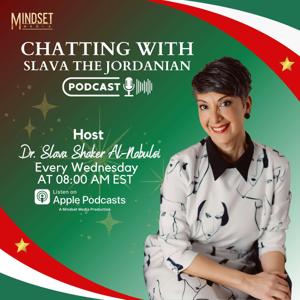
Welcome to Chatting with Slava the Jordanian! This podcast dives into the fascinating world of immigrant entrepreneurship. Each week, Dr. Slava Shaker Al-Nabulsi, an immigrant entrepreneur…
Join us as we uncover the mindset that empowers immigrants to overcome barriers, break limiting beliefs, and achieve their dreams. Featuring captivating interviews with immigrant entrepreneurs and expert advice, this podcast is your go-to resource for navigating challenges and thriving in new environments.
Tune in for insightful discussions, practical tips, and motivational stories that celebrate the diversity and strength of immigrant experiences.
Join us weekly to Master an Unlimited Mindset by Eliminating Limited Beliefs.
241 Listeners