
Sign up to save your podcasts
Or



Andrea Cooper is Chief People Officer of Talkspace. She grew up in a small town in Kentucky, one of five children in a family without much money, where nobody talked about work and the words "human resources" were never said out loud.
She started at Walmart at 19, a full-time student at the University of Kentucky on her way to becoming a social worker, supervising cashiers for about $5.25 an hour. Her store manager asked what she would earn out of college. Seventeen thousand, she said. He told her the management training programme would pay thirty. She called her mother, who said she would support whatever Andrea chose, and also that in her experience we adjust our lifestyle to match our income. Andrea quit school and became an assistant manager trainee.
The next few years were muzzleloaders out of sporting goods, mixing paint and unloading trucks overnight. Then a leadership training session in the back room of her own store, where she watched the trainer work and thought: I want that guy's job. That was the first time she could see a path.
She stayed at Walmart twenty years, leaving as Senior Director of HR. Along the way she ran HR for the health and wellness division of more than 50,000 people, built a global sourcing function across roughly 25 countries that had not existed before, and finished in diversity and inclusion. Then an Amazon subsidiary in Madison, three and a half years working for herself, and a talent leadership role at a Madison financial services firm.
The recruiter's message arrived on LinkedIn. Talkspace was a full circle she did not expect: the 19-year-old social work major, now leading the people function for a mental health company. She joined in 2022, shortly after the company went public, into a declining stock price and a reduction in force inside her first two months. Talkspace was acquired by Universal Health Services in August 2026.
In this episode, Andrea tells Tiffany Pham what her mother said about money, what losing the fear of being fired actually did for her, why she can no longer zip up her corporate suit, and the advice she gives anyone who wants her job.
Chapters:
Quotes:
Bala Sathyanarayanan is Chief Human Resources Officer of Greif, and a Mogul Top 100 People Leader of 2026. He was born and raised in Madras, now Chennai, and started his career as a graduate engineer trainee at Otis, part of United Technologies.
A technology transfer posting took him to Kuala Lumpur, to work on what was then the world's tallest building. He says the machine was the easy part: it is the same machine wherever you are. The human dimension was the hard part, and that is what pulled him toward management and leadership. Back in India to train people on the new technology, the head of management development watched him teach and saw something Bala had not seen in himself. That became safety and training officer, then management development, then human resources, then Coca-Cola India as operations training manager.
When his wife's company moved her to the United States, he followed and started again from scratch: Polaris, Avaya, Hewlett Packard, then Xerox as executive vice president and head of business transformation, and for the last eight years, Chief Human Resources Officer of Greif.
He is clear about who put him on this path. A school teacher, Mr. Victor, who ran the scouting program and pushed him into the sciences. His wife, who believed he would have more opportunity in America before he believed it himself. And at Hewlett Packard, his boss Susan Kelliher, who told him to think bigger than his current role, then spent years creating the exposure to make it real. He still stays in touch with her.
At Greif, colleague engagement went from the bottom quartile to the top decile on Gallup over eight years. The company's net promoter score is 72, the highest for a B2B company in the packaging space, and the 149-year-old company has had the best stock performance in its history.
In this episode, Bala tells Tiffany Pham why leaders are asking the wrong question about AI, what he built when he made a digital twin of himself for his own colleagues, how a name he was told was unpronounceable shaped what he thought was possible, and the two-word answer he gives anyone one seat below the chief officer role.
Chapters:
Quotes:
Janis Hoyt is Chief Human Resources Officer of Primal Pet Group, and a Mogul Top 100 People Leader of 2026. She grew up in the San Francisco Bay Area, studied sociology at UC Berkeley, and says that is where her interest in people started, because sociology is the study of how people tick.
She began in retail, on Macy's executive training programme, learning gross margin and operations and managing a staff of thirty while she was still young. A rotational assignment took her into human resources and she never left. Then healthcare at Aetna, where she became an HR business partner, and then Clorox, the company she says shaped who she is both personally and professionally.
At Clorox her boss, Bill Dixey, offered her something she had not asked for and was not sure she could do: head of HR for Latin America and a small business in London. She told him she did not even speak Spanish. He told her he believed she could do the job. She calls that her first believer, and it is the thread running through the whole conversation. It happened again at Blue Shield of California with Mary O'Hara, and again when Nick Vlahos called her to become Chief People Officer of The Honest Company, five years into its life and on its way to a 2021 IPO.
Today she is at Primal Pet Group, recruited by another former Clorox colleague, CEO Jon Balousek. Her contribution to that leadership team, she says, is being the one willing to ask the uncomfortable question in the room: do we have the capacity, with the talent we have, to do all of the initiatives we have?
In this episode, Janis tells Tiffany Pham what a first believer actually does, the difference between a mentor who cheers for you and a mentor who champions you when you are not in the room, why she spent years afraid of feedback and what changed, how she thinks about infusing AI at the speed a particular culture can absorb, and the one question she thinks every leadership team is avoiding.
Chapters:
00:00 Welcome
01:15 Before the chief officer seat
01:40 UC Berkeley, sociology, and an interest in how people tick
02:58 Macy's executive training programme, and learning the business
04:16 Be open to change, and the lifelong learner
04:38 Into healthcare: Aetna and becoming an HR business partner
06:25 Clorox, and moving from healthcare into CPG
07:49 The role that was outside her comfort zone
08:09 Bill Dixey, her first believer
09:08 "I believe you can do this job"
10:10 What an international role actually teaches you
12:59 Blue Shield of California, and Mary O'Hara
14:07 The cheerleader versus the champion in the room
14:39 The Honest Company, and the call from Nick Vlahos
17:46 Trust, clear expectations, and the courage to ask for feedback
18:36 Why she feared feedback, and what changed
20:36 Where she was when the call came
21:55 Taking Honest public, and what came after
23:44 Primal Pet Group, and Jon Balousek
25:36 "Do we have the capacity?"
26:16 The critical few, not the critical many
26:47 What she is proudest of: reading the culture before infusing the tools
28:01 Capability planning, not human capital planning
30:52 Advice for the next chief officer
32:55 If you want feedback, ask your kids
Quotes:
"They were my champion in the room when I wasn't even there."
"I said, Bill, I don't even know how to speak Spanish. And he said, I believe you can do this job."
"That's the first time I really stepped back and I thought, wow, someone is believing in me."
"Do we have the capacity as an organization, with the talent we have, to do all of the initiatives we have?"
"It's really about finding the critical few things as opposed to the critical many things that are often on our plates."
"It's no longer a human capital planning process. It's really a capability planning process."
"If you want to get feedback, ask your kids. They have no problem telling you what's true."
"I have my own personal board of directors."
Andy Doyle is Chief People and Agent Officer of Kantar. He was born in London, studied economics at Loughborough University of Technology, spent a couple of years working in Texas, and has built a career on international roles run out of UK headquarters.
His first chief officer job was, in his words, a baby one. It was 2001, the dot-com boom, an online retailer with an HR team about ten strong, and he was recruited in from a much larger corporate role. The business failed. He still counts it as one of the most valuable jobs he has had, because it taught him what it is to sit with a board and run a company that is running out of cash. Then came a number-two divisional role, and then ITV, where he joined as deputy to a leader who had been there twenty-five years. She went part-time, then left. He was given six months as interim, and he decided on day one to stop behaving like an interim.
He got the job. He also got the financial crisis, and had to take forty percent out of his own function. Today, at Kantar, he leads roughly twelve thousand people and about seventeen thousand agents, with over ninety percent of colleagues using AI every day.
In this episode, Andy tells Tiffany Pham why he never tried to be his predecessor, what actually changes when you go from divisional leader to the top job, why the promotion call is always an anticlimax, what he is proudest of, and the one habit he thinks separates the people who get the seat from the people who wait for it.
Chapters:
00:00 Welcome
00:49 London, Loughborough, and a couple of years in Texas
02:26 The first chief officer role, in the dot-com boom
03:14 Why small companies recruit the top HR job from outside
04:48 The company failed, and it was worth it
05:13 ITV, and joining as the number two
06:28 Six months as interim
07:16 “I couldn't be her. I had to be me.”
08:04 Act as though you already have the job
09:36 What actually changes when you take the top seat
10:21 The promotion call is an anticlimax
11:32 Taking the job in a financial crisis, and cutting the function by 40%
12:35 Chief People and Agent Officer: people plus agents
12:59 What he is proudest of: giving people a chance
14:22 The future of work, and why control is the real question
16:42 Building 17,000 agents, and a culture that lets people fail
18:58 Advice for the next chief officer: think like a member of the board
Quotes:
“The advice I'd give people is think like a member of the board.”
“I said, I can't pretend I don't want this job and I have to act like I'm going to have this job and I'm going to succeed, and not wait until the end and see what happens.”
“One thing that was very obvious to me was I couldn't be her. I had to be me.”
“I now have people in my team that my children are older than.”
“People always surprise me how capable they really are.”
Mark Miller found his career before he found his degree. Growing up in Toronto as the youngest of three in a working-class family, he took a high school course that let students work at a company for credit if they could land the job themselves. He cold-called The Second City, hoping to write comedy. They turned him down, told him they liked him anyway, and phoned a small Canadian national ad agency on his behalf. He interned there as a copywriter, was offered a full-time job before he had finished school, and went to university instead because his parents would not hear otherwise. The same agency hired him the day he graduated.
From there he moved to a large global agency in Toronto, then was recruited to Los Angeles as a senior strategist at Rubin Postaer and Associates, where the strategy team sat overlooking the Third Street Promenade. He joined Team One as a director, became executive director, and was passed over for the chief strategy officer seat twice before a new business pitch he led and won finally made the case. The first people he called were his mom and dad.
In this episode, Mark tells Tiffany Pham what it is like to be handed budget approvals you do not yet know the rules for, why he wanted longevity rather than the next title, the body of work he is proudest of (the Global Affluent Collective, the Moonshot speaker series and the Legacy Lab), and the advice he would give anyone one seat below: be a little more like Waze.
Chapters:
00:00 Welcome
01:21 Toronto, and the high school course that paid in credit
02:34 Cold-calling The Second City
04:29 “You should do that”: the referral that started an advertising career
05:18 A full-time offer at seventeen, and why his parents said university first
06:49 From a small Canadian national to a large global agency
08:38 Recruited to Los Angeles: Rubin Postaer and Associates
10:53 Joining Team One, where business thinking drives creative thinking
12:04 Passed over for CSO, twice
13:52 The pitch he led, and won
15:08 Who made the call
16:17 The first people he told: his mom and dad
18:06 The first week, and a summons from the CFO
19:40 What he is proudest of: work that outlasts him
21:14 Alumni now at IDEO, Amazon and Meta
22:29 Advice for the next chief officer: be a little more like Waze
Quotes:
“I guess I would say be a little bit more like Waze. Strategic and flexible.”
“You need to know where you're starting and you need to know where you're going. With those two pieces of information, you can constantly route and reroute to get you there in the most efficient way.”
“I wasn't interested in just the next job, and I wasn't interested in just the next title. I knew that I wanted to do something that was meaningful in the industry.”
“Being a CSO is more than just being exceptional at your craft. There's the ability to inspire and move people and lead an organization forward.”
Betty Larson has been a chief officer four times. She fell in love with HR before she had a career in it, in an industrial and organizational psychology class at the University of Illinois, and she has spent more than thirty years in healthcare ever since. She started at Baxter and stayed sixteen years. Then a mentor gave her name to the COO of C.R. Bard, and she moved her young family to New Jersey for her first CHRO seat. Two and a half years later Bard was acquired by Becton Dickinson, she was asked to lead HR for the combined company, and she stayed eight years. A call from a former Baxter colleague took her to GE HealthCare, where she was CHRO and built an HR function from scratch for a company being spun out of GE. Today she is Chief Human Resources Officer of Merck.
In this episode, Betty tells Tiffany Pham why she never set out with the chief officer seat as a destination, what actually changes when you stop working in a function and start leading one, why the first several weeks in any chief officer role are humbling no matter how many times you have done it, and the accomplishment she is proudest of: ten or eleven former direct reports who are now CHROs themselves, every one of whom she is still in contact with.
Chapters:
00:00 Welcome
00:22 Four times a chief officer: where the journey started
01:12 Falling in love with HR at the University of Illinois
02:42 Sixteen years at Baxter
03:05 The call about a CHRO job at C.R. Bard
04:16 The mentor who put her name forward
05:20 Becton Dickinson acquires C.R. Bard, and she gets the combined seat
06:58 A call out of left field: standing up HR at GE HealthCare
08:11 Why she left GE HealthCare for Merck
09:44 The first people she called
11:38 "What's the market cap?"
13:04 AI, future capabilities, and culture change at Merck
15:08 Why the first several weeks are humbling
16:40 A day in the life, from R&D reviews to a feedlot in Amarillo
18:07 What she is proudest of: ten or eleven former reports, now CHROs
19:16 Advice for the next chief officer
Quotes:
"I'm not necessarily sure I ever set out with the chief officer role as a destination or an aspiration. I drove my career more around what are the bigger problems I can solve."
"I think the count is up to 10 or 11 at this point, former direct reports who are now CHROs themselves. And what I'm proudest about is that I'm in contact with all of them."
"If you're not failing, you're probably not ambitious enough in your goal."
"You do have to make a conscious change between being in the function to leading the function. It's not doing more of the same. You really have to change how you think and how you operate."
"Your relationship with a CEO is different than any other manager and subordinate relationship you've had."
Ira Bindra has lived in four countries and eight cities and, by her own count, "God knows how many roles." She grew up in India, studied at Lady Shri Ram College in Delhi, took her MBA at Maastricht School of Management, and joined GE as an intern, a company she stayed with for twenty years. In her late twenties she was sitting on the interview panel for GE India's top HR role when the president of GE India pulled her aside and told her they were putting her on the slate. She got the job. In December 2024 she became President, People & Talent at Reliance Industries, a $125 billion group spanning hydrocarbons, new energy, telecom, retail and media.
In this episode, Ira tells Tiffany Pham about the leaders who took a chance on her before she was ready, what she learned from being the youngest person in a room full of people who had wanted her job, the week she started at Reliance while her father was in surgery, and why she believes the people who tell you the truth are worth more than the people who tell you you're right.
Chapters:
00:38 Four countries, eight cities: from Delhi to GE to Reliance
03:50 Meeting Mukesh Ambani, and the moment the role became real
05:49 The first chief officer seat, in her late twenties
06:36 "With all due respect, I think you've lost your mind"
07:22 Meritocracy, and taking risks on raw potential
08:29 The first person she called
10:05 The leaders and peers who lifted her up
12:03 Getting past self-doubt, and inheriting a team that wanted your job
14:44 Being surrounded by people who tell you the truth
16:22 Her first week: a new company, a new country, and her father's surgery
19:09 The future of work: a tipping point in history
20:20 Building something that outlives you
21:46 Advice for the person one step below the chief officer seat
Quotes:
"You have to take risks on people where you see the talent, where you see the raw potential. Providing those opportunities is how you lift people up."
"A lot of people have had confidence in me even when I didn't have confidence in myself."
"Have people around you who will not just tell you what you want to hear, but what you need to hear."
"Build something that outlives you and outlives the role that you're in. That's the legacy you want to leave."
"If you're doing it only for the title, I think that would run out very quickly."
Mahvish Zaman is Chief People Officer at Liquid I.V. She got there by way of a rare leadership run of brands: she grew up at Nike, led teams at Walmart and Sam's Club, and helped advance Ferragamo, the Italian heritage house, before moving to CPG. Taking this seat meant moving from New York to Los Angeles.
In this conversation with Mogul CEO Tiffany Pham, Mahvish walks through her path to the Chief Officer seat: the four years into Nike when she realized this was the craft she wanted, the mentors who kept her curious, the daughter who advised her on the move west and was the first person she told, and what she had to believe about herself to say yes.
She is also passionately direct about why the People function earns its place at the table: culture is not the soft counterpart to commercial performance. It is commercial performance. And she thinks the current moment belongs to HR: not a technology problem, she argues, but a design problem, about how work itself gets rebuilt.
Special Quote: "Culture is not just a nice thing to have. Culture is actually business."
Chapters
00:25 Newly Chief People Officer at Liquid I.V.
01:35 Growing up at Nike
02:01 Walmart and Sam's Club
02:25 Ferragamo, and modernizing a heritage house
03:32 Culture is actually business
05:02 When she knew the seat was the goal
08:02 The mentors who kept her curious
09:01 Who she told first
09:36 What she had to believe about herself
10:17 The decision she is proudest of
11:28 HR's moment
13:22 One framework a month
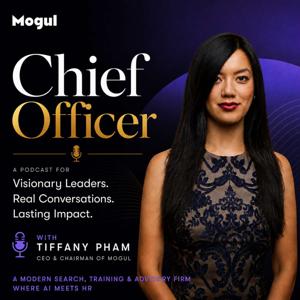
"Chief Officer" is hosted by Tiffany Pham, CEO and Chairman of Mogul.
Tim Massa is Chief Associate Experience Officer at Kroger, one of the largest employers in America with 400,000 associates across 3,000 stores. He got there after 21 years at Procter & Gamble, 18 different roles, and then 16 years at Kroger.
In this conversation with Mogul CEO Tiffany Pham, Tim walks through the path to the Chief Officer seat: the mentor who planned her own succession four years out, the day he found out he'd be next, the first week on a company plane to Houston, and the March morning in 2020 when the company sent hundreds of thousands of people home without a playbook.
He also describes something Kroger is doing now that few companies are: an "AI driver's license" issued to every associate, certified to their specific role, so a data scientist, a category manager and a cashier are each trained for the AI their own job actually requires.
Special Quote: "Asking for help is a sign of strength. No one person has all the answers."
Chapters
00:40 Growing up in Cincinnati, the youngest of five
02:37 Midnight Massa, and 21 years at Procter & Gamble
03:45 Turning down Singapore
04:31 Joining Kroger under Katy Barclay
06:32 Taking the top chair
07:16 Bloom where you're planted
10:41 On the cover of HR Executive
13:39 The first week
15:31 COVID, with no playbook
17:59 The biggest little company in America
20:12 Collaboration as the new currency
21:53 The AI driver's license
24:19 Values that haven't changed in 50 years
Chief Officer is hosted by Tiffany Pham, CEO and Chairman of Mogul.
Hosted by Tiffany Pham, CEO & Chairman of Mogul, Chief Officer brings you candid conversations with the leaders shaping the future of work and human potential, redefining what modern leadership looks like.
Each episode is a conversation with today’s most visionary leaders and most recognized Chief Officers in the world, and we converse about how they first reached their Chief Officer role: the journeys, the dreams, the negotiations, and the leadership lessons behind the title.
Season One premieres September 1, 2026. Follow now so you don't miss the first conversation.
From the publisher's feed