
Sign up to save your podcasts
Or



AI R&D Tax Credit Tools vs. Defensible Studies: 5 Questions to Ask Before You File (Form 6765)
The episode explains that R&D tax credit software and AI tools can quickly organize financial data and produce a rough estimate, but often fail to justify why costs qualify or to provide the documentation the IRS increasingly expects, especially with evolving business-component-level reporting on Form 6765. It contrasts a simple software output with a holistic credit study that includes forms, a credit summary, methodology memo, and narratives tying costs to specific projects, uncertainties, experimentation, and source records. Using contract spend as an example, it highlights pitfalls like the 65% contractor adjustment, offshore labor hidden behind a US invoice, and customer-funded work affecting rights and risk.
Does Your Software Work Qualify for the R&D Tax Credit? Use the Count/Review/Cut Buckets
This episode explains that the question “Does our work qualify for the R&D tax credit?” is too vague and should be replaced by sorting work and spend into three buckets: count, review, and cut. Using a US software team example, he emphasizes qualifying is based on activities tied to specific business components (projects) involving technical uncertainty and experimentation—not job titles—so engineering payroll starts in review until activities are clarified. He highlights review areas that require fact analysis, including contractors (often limited to 65% and dependent on contract terms), cloud/computer rental tied to development, and separating US vs offshore work (offshore generally excluded). He recommends cutting routine maintenance, “peanut butter” percentage estimates, offshore costs, and customer-funded work where the customer bears risk/owns rights, and suggests documenting business components and technical issues throughout the year.
Section 174 vs. Section 41: The 4 “Lanes” to Plan Your 2025 R&D Tax Credit (and Section G + Payroll Election)
The episode explains that recent changes to Section 174 (deduction timing for research expenditures) are often confused with Section 41 (the R&D tax credit), causing missed tax planning and cash flow issues. It outlines four “lanes” for the 2025 filing season: (1) Section 174 deductions—domestic R&E is currently deductible again for tax years beginning after Dec. 31, 2024 (2025), while foreign research remains on slower amortization with transition complexity; (2) Section 41 credit qualification still depends on the four-part test; (3) Form 6765 Section G increases required business-component-level detail, optional in 2025 but mandatory for most in 2026 with exceptions; and (4) the payroll tax election for qualified small businesses, which can materially improve startup cash flow if timely elected. It stresses separating U.S. vs foreign work.
7 R&D Tax Credit Red Flags to Check Before You File (Plus 1 Bonus Most Miss)
The biggest risk with the R&D tax credit is not claiming it, but being able to support it, and provides a one-page checklist of seven red flags plus a bonus issue. I describe a case where a company received a clean-looking R&D form but never filed it properly for the payroll offset, leaving about $200,000 unclaimed. Key flags include failing to map business components separately for the four-part test, incorrectly estimating qualifying wage percentages beyond just engineers, and mishandling contract research, offshore work, and funded/customer-paid work based on contract terms, rights, and risk. The bonus flag warns against an even split of direct research versus supervision/support, referencing Little Sandy Coal and aiming for about 80% direct research. He also highlights Section G readiness on Form 6765 and the need for a substantiation support package, urging review if multiple flags are triggered.
The 3-Folder R&D Tax Credit Documentation System (Built for IRS Audits + Form 6765 Section G)
The episode explains why many R&D tax credit studies fail audit scrutiny because they produce only a form number without substantiating documentation or coordination with the company CPA, using a pre-revenue tech company example where a $50,000 “study” delivered $0 benefit and missed a true ~$150,000 credit by understating qualified wages. It introduces a simple three-folder (or tag) system built from documentation companies already have—Jira, architecture docs, Slack, emails—to meet the IRS four-part test: (1) conceptualization/design for permitted purpose, (2) technical challenges for technical uncertainty and process of experimentation, and (3) testing/validation to close the loop. It also previews tax year 2026 Form 6765 changes adding Section G requirements (project disclosures, supervision/support breakdowns, and expense category detail), outlines what an audit/IDR process looks like, and stresses that proper contemporaneous documentation reduces risk, interest, and penalties.
R&D Tax Credit for Small Engineering Teams: The 4-Part Test, 3 Layers, and Top Disqualifiers
The episode explains how founders with 5–10 person engineering teams often miss six-figure R&D tax credits by using their own definition of R&D instead of the IRS’s four-part test: permitted purpose, technological in nature, technical uncertainty, and process of experimentation. It recommends auditing the top five engineering projects with a short write-up to see which qualify, then estimating the credit using three layers of qualification: direct R&D, direct supervision (e.g., CTO/tech founders), and qualified support roles. It contrasts W-2 vs 1099 contractor treatment, noting contractors face a 35% reduction and no “substantially all” rule. It highlights key disqualifiers: mostly offshore engineering, failing the risk-and-rights test for client work, or being too early with no payroll, and provides a probable yes/maybe/no self-triage.
Pre-Revenue Founders: Don’t Wait—Claim the R&D Tax Credit as a Payroll Tax Refund (5-5-5 Rule)
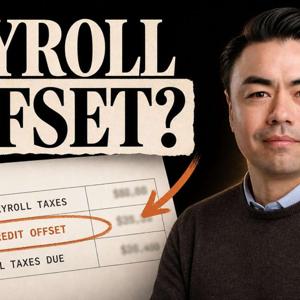
The episode explains why pre-revenue startups with small US engineering teams should consider claiming the R&D tax credit now instead of waiting for profitability. It describes a special election that allows qualifying startups to apply the credit against payroll (FICA) taxes for the first five years, turning it into a quarterly refund rather than an income-tax-only benefit. It introduces the “5-5-5 rule”: under $5M in gross receipts for the year, within five years of first gross receipts, and usable for up to five years total, with up to $500,000 per year in payroll tax offset. A real example shows a pre-revenue company receiving about $180,000 in payroll tax offsets. The script stresses timing: the payroll offset election must be made on a timely filed original return and cannot be added later via amendment, though the credit itself can be amended and carried forward up to 20 years.
How to Claim the R&D Tax Credit for Your Startup in 2026 (Step-by-Step + Avoid Costly Mistakes)
The episode explains how an early-stage engineering startup can claim the R&D tax credit in 2026 and set up a repeatable process to capture it every year. It emphasizes starting by understanding the business and mapping day-to-day work to the IRS definition, then listing projects in plain English, reviewing the team (W-2 vs contractors, U.S. location rules, and supplies), and pulling basic financial data like W-2 Box 1 wages and rosters. The study itself involves a technical interview to apply the IRS four-part test (technical purpose, uncertainty, experimentation, and improvement) plus calculating the credit, often 7–10% of qualified spend. A space tech example shows how proper CPA coordination led to $187k federal and $100k state benefits. The script warns the payroll tax election window is only the first five years and urges ongoing quarterly documentation.
New IRS Form 6765 (Section G): How to Build an Audit-Ready R&D Tax Credit Claim
This episode explains the IRS’s upcoming changes to Form 6765 for claiming the R&D tax credit, focusing on the new Section G and what examiners already request in audits. The episode outlines how the IRS now expects a clear nexus tying expenses to specific projects and qualifying activities, including reporting projects that make up 80% of qualified research expenditures and listing up to 50 projects with descriptions. It highlights increased scrutiny on supervision and support costs, especially high-compensation executives, and stresses building contemporaneous documentation using existing tools like Jira, Confluence, or GitHub. The episode recommends quarterly check-ins between finance, CPA, and engineering to capture documentation throughout the year and offers an R&D credit snapshot or call to assess gaps and build an audit-ready study.
R&D Tax Credit for Startups: How Pre-Revenue Companies Can Offset Payroll Taxes (Up to $500K)
The episode explains that startups don’t need to be profitable to benefit from the R&D tax credit because eligible pre-revenue, pre-taxable companies can apply the credit to offset payroll taxes, now up to $500,000 per year. It outlines why the credit exists and how the mid-2010s change allowed startups to use it immediately. The video breaks down the IRS four-part “and” test—permitted purpose, technological in nature (hard sciences), elimination of uncertainty, and process of experimentation—and clarifies what activities typically qualify (design, architecture, development, testing, some support) versus what generally doesn’t (cosmetic updates, routine maintenance, many bug fixes). It emphasizes using a CPA or specialist to build documentation from tools like Jira or GitHub, describes the typical evaluation and interview process.
From the publisher's feed
The R&D tax credit is one of the most misunderstood areas of tax for growing companies. Many businesses have heard of it, but are still unsure what qualifies, how it works, or what it takes to…