
Sign up to save your podcasts
Or



There is a strong belief that recycled plastic is always good for the environment, and is safe to use. But increasing, increasing evidence shows that recycled plastic should be used with caution. Toxics Link, a Delhi based environmental research and advocacy organisation conducted a research to assess the toxic contaminants in recycled plastic products that were recycled in Delhi. As part of this study, 15 samples of recycled plastic products, including food contact materials and toys were tested.
In this episode, Suno India’s Sneha Richhariya spoke to Priti Mahesh from Toxics Link who has authored this study. She talks about several issues related to recycling of plastic. Some of these issues are:
See sunoindia.in/privacy-policy for privacy information.
As part of an aggressive push on solar, there is a strong emphasis on establishing “solar cities” in Uttar Pradesh. Ayodhya is being developed as a model solar city under the Solar City program in Uttar Pradesh.
How far is Ayodhya from becoming a Solar city? How will the Solar City initiative change Ayodhya and the lives of its people? Where do people stand in Ayodhya’s Solar city dreams? Suno India’s Sneha Richhariya travelled to energy poor areas of Uttar Pradesh to find out what the solar schemes like PM Suryaghar Muft Bijli Yojna and other policies on solar mean to the people. In this episode, the focus is on Ayodhya as it is being planned as a “solar city”
See sunoindia.in/privacy-policy for privacy information.
Connecting more and more people with solar energy has become an election plank for the ruling Bharatiya Janata Party. Under the PM Surya Ghar Muft Bijli Yojana, announced by Prime Minister Narendra Modi after the Ram Mandir was consecrated in Ayodhya on January 22, 2024, 10 million poor and middle-class households in India are supposed to get residential rooftop solar.
In this series, Suno India’s Sneha Richhariya investigates what a scheme like this means to the people. In May 2024, she travelled to some energy-poor areas of north India.
Where do the poor and the middle people fit into this policy framework? In this episode, Sneha tries to find out whether the scheme is accessible to the people it is intended to benefit.
This is the first episode in Suno India’s ‘Indian Solar Dream’ series. Reporting for this series was supported by Earth Journalism Network.
See sunoindia.in/privacy-policy for privacy information.
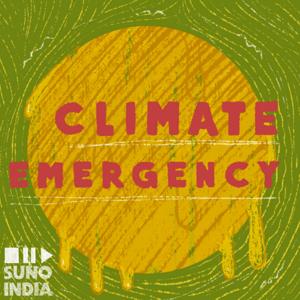
On April 6, 2024, the Supreme Court gave a landmark judgement bringing the right to be free from adverse effects of climate change within the ambit of fundamental rights. Indian jurisprudence had earlier held that people had a right to clean air and a clean environment. The right to be free from adverse effects of climate change is a new addition. This flows naturally from the right to life, and the right to equality guaranteed in the Constitution under Article 21 and 14 respectively.
But what are the implications of this ruling for climate litigation in India? How will this help in India’s fight against climate change? Suno India’s Sneha Richhariya explains in this episode of Climate Emergency.
See sunoindia.in/privacy-policy for privacy information.
The cooling industry contributes significantly to global CO2 emissions. As pressure mounts to address climate impacts, there's a crucial need for the industry to overhaul its manufacturing and disposal practices of appliances. But how are your cooling appliances making the climate worse? What exactly is energy efficiency and what makes an appliance energy-efficient? What role can the consumers play? What do they do with their refrigerant-filled equipment once they are done using them?
Suno India’s Sneha Richhariya spoke to Bishal Thapa, senior director at CLASP, an international nonprofit organisation which provides technical and policy support to governments worldwide and works to implement energy efficiency standards and labels for appliances.
See sunoindia.in/privacy-policy for privacy information.
On 17th March 2024, the Aam Aadmi Party (AAP) government in the Capital notified the new Delhi Solar Policy, 2024, rolling out larger incentives and subsidies for people to install solar power systems at their homes and businesses. The vision is to make solar energy accessible and affordable for all consumers in Delhi.
In the past months, the government has repeatedly promoted the policy that appears less like an environmental step taken to reduce emissions, but more like a policy to push subsidies and reduce electricity bills. Notably, the policy is being sold to all middle and working-class people. But is it really inclusive? Is it really consumer friendly as the government says? Will the middle class who have access to conventional forms of electricity switch to solar energy? Suno India’s Sneha Richhariya spoke to people in Delhi to understand the complexities of residential rooftop solar adoption.
See sunoindia.in/privacy-policy for privacy information.
In early March 2024, the India Meteorological Department (IMD) predicted a hot summer this year, with above-normal temperatures and an above-normal number of heatwave days from March to May.
On 5th March 2024, the World Meteorological Organisation (WMO), a specialised agency of the UN, said in a media release that the 2023-24 El Niño, one of the five strongest on record, has peaked and is gradually weakening — but it will continue to impact climate around the world in the coming months.
We’re playing an episode from last year where Sneha Richhariya explained what El-Nino is, what impact it causes and what is its relation to climate change.
See sunoindia.in/privacy-policy for privacy information.
We're seeing what is being called one of the worst droughts in recent years in Karnataka. Bangalore has become unliveable. Bangalore has access to only half the amount of water that it needs on a daily basis. There's no water in many high and mid-rise buildings, gated colonies. The government is rationing out water tankers, construction using the adjacent Kaveri river is banned, new bore wells are being dug and so on.
In this episode of Climate Emergency, Suno India’s Sneha Richhariya speaks to Shreya Nath, who heads the urban water program at Well Labs, which is an environmental research organisation based in Bengaluru. Last year, Well Labs conducted a study on ‘How water flows through Bengaluru?’ to understand where is Bengaluru's water, how much of it is there and in what condition.
See sunoindia.in/privacy-policy for privacy information.
Access to clean cooking has been on the radar of policymakers for several decades. With over half of rural households still using traditional, polluting cooking methods, the need for cleaner alternatives is more pressing than ever.
In this episode of Climate Emergency, Suno India’s Sneha Richhariya speaks to Noble Varghese, who has studied India’s transition to e-cooking. Why should we think about transitioning to cleaner cooking options, more specifically e-cooking? How are India’s villages going to see this transition? Is e-cooking more polluting than LPG? Can India make e-cooking a reliable cooking option? This episode attempts to find out.
See sunoindia.in/privacy-policy for privacy information.
More than 500 people lost their lives in human-wildlife conflict between January 2000 to December 2023, as per the data gathered by the forest department. In 2023 alone, more than 20 persons died of conflict with leopards in the state. The state’s Living with Leopards programme is trying to mitigate these conflicts. The programme that originated in Mumbai’s Sanjay Gandhi National Park kicked off around 2016 when several non-profits such as Titli Trust, Wildlife Conservation India along with the forest officials sat down and discussed the problem. The programme that was piloted in three clusters in Pauri, Tehri and Almora districts depends on the co-operation of villagers. It is a behavioural change program that teaches people how to live peacefully with leopards. Instead of conflict, the focus here is on coexistence which takes place through sensitization and involvement of various stakeholders.
Sudeshna Chowdhury tails forest officials to find out how they are co-opting villagers into this programme and trying to reduce human-animal conflict. She also speaks with Sanjay Sondhi, Trustee of Titli Trust, NGO, Dr. Koko Rose, deputy project director with Jyca project in Dehradun, Dhananjai Mohan, Principal Chief Conservator of Forests, Uttarakhand, Dharam Singh Meena, Uttarakhand’s Additional Secretary Forest and Environment, and Diksha Bijlan Bhatt, range officer, Maniknath range.
See sunoindia.in/privacy-policy for privacy information.
From the publisher's feed

6 Listeners

13 Listeners

0 Listeners

9 Listeners
0 Listeners

10 Listeners
0 Listeners

2 Listeners

1 Listeners

3 Listeners
0 Listeners

5 Listeners

0 Listeners
0 Listeners
1 Listeners

1 Listeners

0 Listeners