
Sign up to save your podcasts
Or

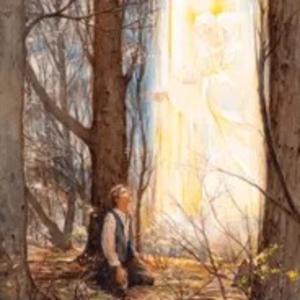


Revelation given through Joseph Smith the Prophet, at Hiram, Ohio, November 11, 1831. The compilation of revelations intended for early publication had been passed upon at the special conference of November 1–2. On November 3, the revelation herein appearing as section 133, later called the Appendix, was added. Oliver Cowdery had previously been appointed to carry the manuscript of the compiled revelations and commandments to Independence, Missouri, for printing. He was also to take with him money that had been contributed for the building up of the Church in Missouri. This revelation instructs John Whitmer to accompany Oliver Cowdery and also directs Whitmer to travel and collect historical material in his calling as Church historian and recorder.
Revelation given through Joseph Smith the Prophet, at Hiram, Ohio, November 1, 1831, in response to prayer that the mind of the Lord be made known concerning Orson Hyde, Luke S. Johnson, Lyman E. Johnson, and William E. McLellin. Although part of this revelation was directed toward these four men, much of the content pertains to the whole Church. This revelation was expanded under Joseph Smith’s direction when it was published in the 1835 edition of the Doctrine and Covenants.
Revelation given through Joseph Smith the Prophet, at Hiram, Ohio, early November 1831. The occasion was that of a special conference, and the publication of the revelations already received from the Lord through the Prophet was considered and acted upon (see the heading to section 1). William W. Phelps had recently established the Church printing press in Independence, Missouri. The conference decided to publish the revelations in the Book of Commandments and to print 10,000 copies (which because of unforeseen difficulties was later reduced to 3,000 copies). Many of the brethren bore solemn testimony that the revelations then compiled for publication were verily true, as was witnessed by the Holy Ghost shed forth upon them. Joseph Smith’s history records that after the revelation known as section 1 had been received, some conversation was had concerning the language used in the revelations. The present revelation followed.
Doctrine and Covenants 67–70
From 1828 to 1831, the Prophet Joseph Smith received many revelations from the Lord, including divine counsel for individuals, instructions on governing the Church, visions of the latter days, and many inspiring truths of eternity. But many of the Saints hadn’t read them. The revelations weren’t yet published, and the few available copies were handwritten on loose sheets that were circulated among members and carried around by missionaries.
Then, in November 1831, Joseph called a council of Church leaders to discuss publishing the revelations. After seeking the Lord’s will, these leaders made plans to publish the Book of Commandments—the precursor to today’s Doctrine and Covenants. Soon everyone would be able to read for themselves the word of God revealed through a living prophet, vivid evidence that “the keys of the mysteries of the kingdom of our Savior are again entrusted to man.” For these and many other reasons, Saints then and now consider these revelations to be “worth … the riches of the whole Earth” (Doctrine and Covenants 70, section heading).
See Saints, 1:140–43.
Elder Dale G. Renlund shares insights about Doctrine and Covenants 64:33–34. See Lesson 25 in Come, Follow Me—For Home and Church: Doctrine and Covenants 2025.
Revelation given through Joseph Smith the Prophet, at Hiram, Ohio, October 29, 1831. William E. McLellin had petitioned the Lord in secret to make known through the Prophet the answer to five questions, which were unknown to Joseph Smith. At McLellin’s request, the Prophet inquired of the Lord and received this revelation.
Revelation on prayer given through Joseph Smith the Prophet, at Hiram, Ohio, October 30, 1831.
Revelation given through Joseph Smith the Prophet to the elders of the Church, at Kirtland, Ohio, September 11, 1831. The Prophet was preparing to move to Hiram, Ohio, to renew his work on the translation of the Bible, which had been laid aside while he had been in Missouri. A company of brethren who had been commanded to journey to Zion (Missouri) was earnestly engaged in making preparations to leave in October. At this busy time, the revelation was received.
Doctrine and Covenants 64–66
In the miserable heat of August 1831, several elders were traveling back to Kirtland from the land of Zion in Missouri. The travelers were hot and weary, and tensions soon turned into quarrels. It may have seemed like building Zion, a city of love, unity, and peace, was going to take a long time.
Fortunately, building Zion—in Missouri in 1831 or in our hearts, families, and wards today—doesn’t require us to be perfect. Instead, “of you it is required to forgive,” the Lord said (Doctrine and Covenants 64:10). He requires “the heart and a willing mind” (verse 34). And He requires patience and diligence, for Zion is built on the foundation of “small things,” accomplished by those who do not become “weary in well-doing” (verse 33).
See also Saints, 1:133–34, 136–37.
Revelation given through Joseph Smith the Prophet, at Kirtland, Ohio, August 30, 1831. The Prophet, Sidney Rigdon, and Oliver Cowdery had arrived in Kirtland on August 27 from their visit to Missouri. Joseph Smith’s history describes this revelation: “In these infant days of the Church, there was a great anxiety to obtain the word of the Lord upon every subject that in any way concerned our salvation; and as the land of Zion was now the most important temporal object in view, I enquired of the Lord for further information upon the gathering of the Saints, and the purchase of the land, and other matters.”
From the publisher's feed