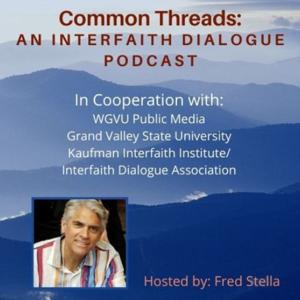
Common Threads: An Interfaith Dialogue

Common Threads: An Interfaith Dialogue

By Fred Stella, Kaufman Interfaith Institute, WGVU-FM, Interfaith Dialogue Association, Grand Valley State UniversitySociety & CultureNewsReligion & SpiritualityNews CommentaryPhilosophyReligion
Download on the App Store

Common Threads: An Interfaith Dialogue episodes

  • Oracle's Daughter Parts 1 & 2
    On a cool fall night in 1999, twenty-six-year-old Sarah Green crept out of her house, retrieved a backpack from its hiding place, and ran for her life. She was escaping not just the Aggressive Christianity Missions Training Corps, a paramilitary religious cult based in the New Mexico desert, but also the cruelty of the cult’s leader—her mother, Deborah. In his book ‘The Oracle's Daughter’ Harrison Hill traces the “extraordinary” twists and turns of the group’s development, from its early days as an outgrowth of the 1960s counterculture, through its descent into conspiracy-fueled abuse, to the explosive trial that would lead to its downfall.
    Fred Stella engages with Harrison Hill, discussing this specific organization and the social and psychological dynamics that make such destructive cults appealing to a wide variety of people. Theme music "Nigal."
    55 min
  • Christian Zionism Parts 1 & 2
    Christian Zionism is a movement dedicated to reconstituting the Israel of antiquity. To be clear, the purpose of this effort has little to do with love or sympathy for Jews, but to hasten the return of Jesus. The social and political challenges this presents to world stability are manifold.
    And while radical Evangelicals have owned the narrative of this plan for over a century, there is now a counter movement led by Christians who maintain that this idea is nonsense. For 99% of the last 2,000 years, this was not a thing.
    Fred Stella is joined by journalist Connor Echols who has been following developments in this saga for an up-to-date conversation. Connor recently wrote an article titled, Inside the growing religious revolt against Christian Zionism for Responsible Statecraft. Theme music "Nigal."
    56 min
  • God Bless the Pill Parts 1 & 2
    Most people today understand contraception as central to women’s liberation, and when the birth control pill arrived in 1960, the media thought it would usher in a sexual revolution. But a surprising number of religious Americans in the mid-twentieth century also saw contraception as part of God’s plan, a tool to create happy, prosperous American families in the post–World War II era.
    In this episode, Fred Stella speaks with author Samira Mehta about her book "God Bless the Pill," which traces the remarkable story of how mid-twentieth-century Catholic, Protestant, and Jewish voices promoted the use of birth control and made it more accessible for many Americans. They hoped birth control methods would curb divorce rates by encouraging sexually dynamic marriages and families unstrained by “too many” children—thereby creating a postwar upwardly mobile middle class. Religious leaders also promoted this understanding of the family as tied to Cold War capitalism and encouraged neither racial nor gender equity.
    But then came the backlash, both from the Right—which failed to anticipate the feminist potential of contraception—and from the Left, where women, particularly women of color, sought to ensure that birth control was a tool of liberation rather than one rooted in patriarchal and racial oppression. Ultimately, Mehta offers compelling new insights into the way religion accommodates itself to social, technological, and medical change.
    Samira K. Mehta is an Associate Professor of Women and Gender Studies and the Director of Jewish Studies at the University of Colorado Boulder. Theme music "Nigal."

    57 min
  • Mediating God Parts 1 & 2
    On this episode of Common Threads, Fred Stella interviews author Arthur Zarate about his biography of the Egyptian Muslim theologian, scholar, and activist, Muhammad al-Ghazali (1917–1996), which provides the most comprehensive study to date of one of the most influential Sunni Muslim writers of the 20th century. Al-Ghazali shaped the views of multiple generations of Muslim activists and was a one-time leading intellectual of Egypt's Muslim Brotherhood. Mediating God charts his rise as a leading theologian in the Brotherhood during the 1940s, his subsequent clash and expulsion from the group in 1953, and his extensive post-Brotherhood career during the Nasser years. To tell this story, it excavates a massive collection of writings by Brotherhood members and their affiliates, many of which have never before been utilized in secondary scholarship.
    Through an analysis of this collection, Mediating God provides the 1st in-depth view at the richly cosmopolitan and eclectic intellectual milieu of the Brotherhood and its affiliates from the 1930s through the 1960s.
    It focuses particular attention on the underexamined, though voluminous, writings al-Ghazali and his colleagues dedicated to charting God as real and meaningful presence in all arenas of human life, from the mundane realms of daily life to political struggles and scientific enterprises. Theme music "Nigal."
    58 min
  • Girl in a Box parts 1 & 2
    In these episodes, Fred Stella speaks with Paldrom Catherine Collins, the author of ‘Girl in a Box: Seeking Enlightenment as a Tibetan Buddhist Nun.’ It’s a memoir of spiritual longing and the search for an end to suffering.
    As a wide-eyed spiritual seeker from Oklahoma, Paldrom believed enlightenment would free her from the messiness of being human, that she could somehow rest in a cloud of bliss. So she took monastic vows, shaved her head, changed her name, and agreed to forgo worldly pleasures.
    She recounts her effort to become a stellar nun, at least as she imagined one should be. Her 5-year immersion in the paradigm-altering world of a traditional Tibetan Buddhist monastery and retreat center revealed the depth of her commitment. But the path was not what she’d expected. Both the transcendent experiences and the shattering disillusion continue to lead her to a deeper understanding that she was never lost, already home.
    Theme music "Nigal."
    54 min
  • The Bhagavad Gita with Guest (not host!) Fred Stella
    This is very fun. We have here an episode from 1996, when I was not host, but guest. I didn't take over the hosting duties until the following year, but I was still active in other ways supporting Common Threads.
    Featured here is host Marc Evan Jackson, who has made quite a name for himself in Hollywood.
    I don't need to say much here, as I've provided a detailed introduction in the episode. Enjoy! Theme music "Nigal."
    52 min
  • Oasis of Peace Parts 1 & 2
    I can hardly believe that I am STILL finding cassette tapes with old episodes on them These 2 were recorded, I believe, in 2001. Oasis of Peace is a community in Israel where Jews & Palestinians live and thrive together. I can only imagine the heartbreak they must be feeling now after a horrendous war is and has been raging for the past few years. But please take a listen. It is a great example of just what can happen when peacemakers work together. Theme music "Nigal."
    58 min
  • Palmistry: Science? Pseudo-Science? You Decide Parts 1 & 2
    OK Kids, I'm really hesitant to share this with you, but I do want to upload as many episodes as I can. If you've been around for a while you know that every once in a while I find an old cassette tape or CD of shows we did decades ago. And the sound quality is not always great. Well, this is an example of that. I just found this in the basement after cleaning it out due to a flood. For those of you who can handle real lo-fi, you might enjoy these 2 examples of really, really early Common Threads. I can't even hazard a guess as to when we had Dr. BK Parmar in the studio to talk about palmistry, astrology and such. I'm guessing that it could have been in the late 1990s. Early 00s at best.
    Anyway, I'm putting up this version today and hoping I might find a way to clean it up a bit and repost. Theme music "Nigal."
    58 min
  • Beyond Wellness Parts 1 & 2
    In the chaos of today’s world, we’re all searching for meaning. The wellness industry has sold us a promise that we can find it if we just buy the right products, attend the right retreats, and follow the right celebrity gurus. But is this true? Or are we picking and choosing from a self-care salad bar in ways that satisfy our hunger but don’t truly nourish us?When we approach practices like yoga and ayahuasca as fitness routines and life hacks, we miss out on the sacred wisdom they have to offer us. But by digging into the real and often ancient religious traditions behind these practices, from Buddhism to Christianity and beyond, we can make them more meaningful, ethical, and effective—without the often unpleasant baggage of joining an organized religion.
    In this engaging and deeply personal book, award-winning scholar and writer Liz Bucar embarks on a quest to get to the heart of “spiritual but not religious” activities from detox diets to sound baths. As she tries out each practice for herself, she asks how we can get more out of it by tuning out the hype and taking the religious meaning behind it seriously—with emotionally profound and often surprising results. Whether it’s as simple as setting an intention for a yoga asana or as complex as reevaluating what a “higher power” is, it’s time to understand, experience, and simply get more out of our spiritual practices. It’s time to dig deeper with Beyond Wellness. Theme music "Nigal."
    1 hr
  • Coptic Christianity: The Challenges in Both Egypt and the USA Parts 1 & 2
    Coptic Christians, the largest Christian minority in Egypt, have maintained a distinct religious and cultural identity for centuries, but they often face challenges living as a minority in a predominantly Muslim society. They frequently encounter social discrimination, periodic outbreaks of sectarian violence, and economic or political marginalization, especially in rural areas. Despite constitutional protections, bureaucratic hurdles, such as difficulties obtaining permits to build or repair churches, continue to affect daily religious life. Yet the Coptic community remains resilient, playing a significant role in Egypt’s history, culture, and professional life while working to preserve its traditions and secure equal participation in public life. And at the same time, those Coptics who are able to migrate to the U.S. have faced a significant amount of discrimination, as many Arab Christians (along with Indian Hindus, Sikhs, etc.) are taken for Muslims. In these episodes Fred Stella speaks to Dr. Candace Lukasik from Mississippi State University to continue to talk about her documentation of this issue in the book Martyrs and Migrants. Theme music "Nigal."
    57 min

About Common Threads: An Interfaith Dialogue

From the publisher's feed

Rated as the #1 podcast on all matters interfaith by Feedspot (https://blog.feedspot.com/interfaith_podcasts/), this is a weekly program that airs on Michigan NPR affiliates WGVU and WGVK. These 2 stations cover the entire western portion of the state. The show is hosted by Fred Stella, President of Interfaith Dialogue Association, an affiliate of Kaufman Interfaith Institute, which operates out of Grand Valley State University, the license holder of both stations.