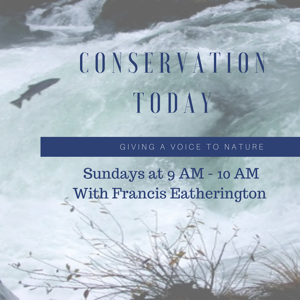
Conservation Today

Conservation Today

By Francis EatheringtonScienceEarth Sciences
Download on the App Store

Conservation Today episodes

  • Dr. John Telberth, Center for Sustainable Economy and Citizens at the Douglas County Rally
    Dr. John Telberth talks about Oregon's Clean Energy Jobs Bill, and other bills, describing what additional protections are needed to fully meet Oregon's climate goals. Dr. Telberth also describes the carbon impacts from Oregon's logging industry and the unfair tax subsides they receive.
    Later (beginning at 31:06), I talked with Douglas County citizens at the "Rally for Transparency" on February 19 at the county courthouse. Lately there has been a rash of complaints against the county commissioners, including the logging at Whistlers Bend Park, the permitting of the Pacific Connector Pipeline that was found illegal, the closing of rural dump sites, the closing of Reedsport services, the closing of county libraries, waiving dump fees for the rich, approving a quarry in a Glide neighborhood over the objections of the citizens and the Planning Commission. Some citizens also asked for transparency on Canyonville's water problem. Canyonville citizens now have to boil their water due to "turbidity". Did it come from logging? We need transparency so the cost of clean-up is not bourn by by the citizens. Over 70 people attended this rally, and a few of them will speak us in this podcast.
    Finally, don't miss the Public Interest Environmental Law Conference (PIELC) in Eugene February 28 through March 1. One of the biggest environmental conferences in the world, and it's free and close.
    PIELC schedule of events: pielc.org
    Items referenced in Dr. Talberth's interview:
    https://sustainable-economy.org
    https://sustainable-economy.org/beyond-cap-and-trade-towards-a-new-green-deal-for-oregon/
    58 min
  • Clean Energy Jobs Bill and Whistlers Bend County Park
    Stuart Leibowitz speaks about the Clean Energy Jobs Bill in the first half our show. Later we talk about the logging at Whistlers Bend Park currently ongoing.
    Stuart encourages us to join the Lobby Day in Salem on February 6 to help pass Oregon's Clean Energy Jobs Bill (sometimes known as a Cap and Pay bill). Stuart explains the concept behind the bill: 25,000 metric tons of carbon pollution allowed, and then the polluter has to pay for more. Stuart talks about how this would apply to the Jordan Cove project where the Liquefied Natural Gas (LNG) terminal in Coos Bay would emit 1.8 million metric tons of carbon. The passing of this bill will make it expensive for a high-polluter to operate in Oregon. Stuart explains where the money the polluters pay will go, why the .16 increase at the gas tank is a false fear, and in what ways industry is trying to water down the bill.
    To carpool to Lobby Day, call Stuart at 51-672-9819, and meet at the Library parking lot at 7:15, February 6.
    In the second half of the show, people talk about the Whistlers Bend County Park logging, and why the Disk Golf community is very upset. We found that none of the trees to be cut were marked by the county. Instead, they let the logger decide what to cut. The County failed to submit the required Notice of Operations to the state, further hiding the logging. When they filed the notice, late, after we complained, the county refused to comply with the 15-day waiting period. Then ODF told the county they had to do a written plan for the trees on the banks of the North Umpqua River and an Osprey nest in the area. But the logger had already cut down some of the trees this applied to. We complain about these, and other problems with the unannounced logging of a beloved park and a world-renounced disk-golf course.
    57 min
  • Jordan Cove public hearing in Canyonville
    This week we hear from dozens of Douglas County residents about the Jordan Cove export terminal, and the Pacific Connector Pipeline, projects of a Canadian corporation, Pembina. Pembina is asking the state of Oregon for a removal-fill permit to dig a 3' deep trench through 450 waterways in southern Oregon to lay their 230-mile gas-pipeline to bring fracked natural gas to Coos Bay. The state of Oregon (Department of State Lands) also has to permit (or not) the dredging of the bay of Coos Bay so massive ocean tankers can take this gas to Asia, via a liquefaction terminal Pembina wants to build in Coos Bay (yes, on top of the subduction zone earthquake fault).
    On January 9, 2019, the state of Oregon held a public meeting to hear what we had to say about this. I interview people waiting to get into the meeting, and later record some of the testimony given to the state. It is a sad tail of landowners threatened with eminent domain, expensive fish-restoration projects being destroyed, endangered species harmed. One person talked about the huge, old madrone trees on her property she would loose. Another of his cattle ranch being degraded, and another talked of his tree-farm being permanently lost.
    The sound quality leaves something to be desired, but turn up the volumn. One of these days KQUA radio might buy me a real microphone.
    For more information, see https://www.nolngexports.org/. Then, click on http://nolngexports.good.do/DSL/DSLComments/ to submit your own comments to the state before February 3.
    1 hr
  • Becky McRay, The North Umpqua Foundation president
    Today we have a conversation with Becky McRae, President of the North Umpqua Foundation. Becky describes the programs of the NUF: restoration work in the North Umpqua watershed, scholarship programs, Fish Watch to protect steelhead fish in Steamboat Creek, and community education. Becky talks about favorite places to visit on the North Umpqua, "the most beautiful river in the world". The North Umpqua Foundation is also a patent holder on a unique new tool to extract DNA from fish with no harm to the fish, by collecting fish slime as it passes by a WIFI enabled monitoring station.
    For more information, see: https://northumpqua.org/
    and: https://www.pacificrivers.org/run-wild-run-free.html
    52 min
  • James Caplan talks about his many projects in the Umpqua
    Jim "Cap" Caplan tells us a bit of his history with the forest service, including the time he worked at the Bridger-Teton National Forest while the famous Yellowstone wildland fire broke out in 1988.
    Jim is currently the COO of the Environmental Dispute Resolution USA, and teaches a class on the subject at UCC. Jim is also a founding member of the Umpqua Forestry Coalition and talks about their role in forest management.
    Jim was the Forest Supervisor of the Umpqua National Forest starting in 2002, while I was working with Umpqua Watersheds. We were pleased that Jim turned the forest toward more thinning in the managed plantations.
    Finally, Jim talks about his time with the Red Cross, the Roseburg Downtown association, and Cycle Umpqua. For more information, see:
    https://p.facebook.com/umpquaforestry1/
    http://www.environdispute.com/Home_Page.html
    https://www.cycleumpqua.com/
    1 hr
  • Stanley Petrowski talks ecosystems on the South Umpqua River
    Stanley Petrowski, founder of the South Umpqua Rural Community Project talks with us today. Stan gives us a history of the fish abundance in the South Umpqua River, and the alarming low numbers this year. Both Coho and spring chinook seem to be on the brink of extension in the south Umpqua, following summer steelhead that are already extent.
    Restoration activities include putting large wood in streams, because Oregon law required large wood to be removed from steams to protect bridges and other infrastructure. Thus, all the fish habitat created by large wood was removed, and now needs to be replaced.
    Beavers can help put wood in streams, but beavers were almost extirpated in Oregon and also need some restoration help. There is a 2019 Beaver Conference in Canyonville. See link below for that.
    Stan also talks about logging practices damaging to fish, herbicide use damaging to all wildlife, and which fire-management practices are good and which are not.
    For more information, see:
    http://surcp.org/
    South Umpqua Rural Community Partnership
    and
    http://stateofthebeaver.org/
    2019 Beaver Conference, Canyonville Oregon.

    58 min
  • Steven Cole documents old growth forests saved by Umpqua Watersheds
    Steve Cole is a cartographer and photographer of old growth forests. He has been documenting public land timber sales on the Umpqua, mostly sales stopped by Umpqua Watersheds in the late 90's and early 2000's. Steve has a remarkable website documenting this work: umpquaLSOGproject.org. Steve's site is a celebration of what good work we all did back then, including the brave activists that sat in trees to protect them. I recently rode with Steve as he visited two of those sales, the Snog sale (1999, on the Diamond Lake RD), and the White Castle sale (2014, Roseburg BLM). We also visited BLM's Sugar Pine sale (1997, near Tiller), and a newer project where we failed to save the old growth: Lone Rock Timber's new road through a BLM forest near Susan Creek. I recorded Steve's impressions as we drove, so there is a different sound to this interview.
    Steve also details how he uses a drone to take videos and other photographic techniques, as well as how he made the carbon maps on his web site.
    The website where it is all at is: umpquaLSOGproject.org. Until Steve gets it all up on his website, other pictures of the timber sales we visited are here:
    Snog: https://flic.kr/s/aHskeBcu3e
    White Castle:https://flic.kr/s/aHsmqZvGNJ
    Lone Rock Timber logging BLM old growth: https://flic.kr/s/aHskvJ7H4Q
    Older footage of the White Castle tree sit: https://www.youtube.com/watch?v=VukPXLzSACg
    57 min
  • Chris Rush, botanist and member of South Umpqua Rural Community Partnership
    Chris describes the work of the South Umpqua Rural Community Partnership in the area of Tiller Oregon, such as Oak habitat and fish habitat restoration. Chris describes some of the reasons there were only 30 Coho salmon returning up the South Umpqua this year. Only 30 South Umpqua Coho left!
    One problem is the industrial private land logging in the watershed, with too many roads and too small riparian buffers. Chris describes the problems with aerial herbicide spraying on industry land, with examples of over-spraying. Chris gives a list of alternative ways to treat invasive and noxious weeds.
    Chris was the first woman ever to work work in the field in the Tiller Ranger District of the Umpqua National Forest. Chris was even the tree-planting director and inspector for an all-woman's Hoedad contract in 1980 that I worked on in Tiller, when I first met Chris.
    Finally, Chris reports that the health of the Tallest Sugar Pine Tree in the world is good, and how the Forest Service saved it from an act of vandalism in 1998, and how it is protected from forest fires today.
    For more information on the work of the South Umpqua Rural Community Partnership, see SURC.org.
    59 min
  • Stuart Leibowitz talks about the recent UN Report on Climate Change
    Stuart Leibowitz, from Douglas County Global Warming Coalition, discusses the just-released UN Climate Report. It says we have to reduce fossil fuel use by 45% by 2030 or 2040. Stuart discusses the differences between our climate rising 1.5 vs. 2.0 degrees (it is currently 1.0 degrees hotter). Stuart also discusses current Oregon efforts to pass cap-and-trade legislation that will make polluters pay for carbon release, and redistribute that money to invest in low-income communities.
    You can find out more about Douglas County Global Warming Coalition here: http://www.douglascountyglobalwarmingcoalition.com/
    Two upcoming events sponsored by theCoalition are on October 23 and November 8, both at the Holiday Inn conference room at 6:30 p.m.
    Tuesday October 23, Dr. Edward Brook, Collage of Earth, Ocean and Atmospheric Sciences at OSU, will talk on the Future of Climate Change.
    Thursday November 8, we will learn about: "Rising Seas and the Oregon Coast". Featuring Dr. Kristina Dahl, Senior Climate Scientist for the Union of Concerned Scientists, and Dr. Scott Bridgham, Professor of Environmental Studies at the University of Oregon.
    59 min

About Conservation Today

From the publisher's feed

We interview people in Oregon about our environment. Interviews are played every other Saturday and Sunday morning on the Umpqua Watersheds community radio, KQUA.