
Sign up to save your podcasts
Or

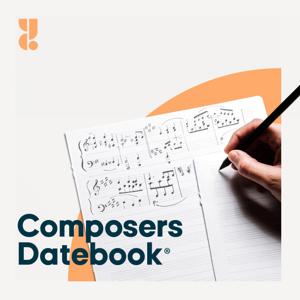

On today’s date in 1967, Aaron Copland’s final orchestra work, titled Inscape, was premiered by Leonard Bernstein and the New York Philharmonic at the University of Michigan in Ann Arbor.
Copland said the work’s title Inscape was borrowed from the 19th century English poet Gerard Manley Hopkins. Its compositional technique was borrowed from the serial or 12-tone models of Arnold Schoenberg and the some of the late works of one of Copland’s favorite composers, Igor Stravinsky. Bernstein himself was no great fan of 12-tone music, but he exclaimed to Copland following the premiere, “Aaron, it’s amazing how, even when you compose in a completely foreign idiom, the music STILL comes out sounding like you!”
Beyond the technical challenge involved, Inscapes, said Copland, reflected what he called “the tenseness of the times in which we live.”
Copland’s experiments with 12-tone pieces like Inscape didn’t impress the avant-garde composers of the day, and only baffled audiences who expected him to produce more works in the style of his popular ballet scores of the 1930s and 40s.
By 1970, Copland stopped composing altogether, and claimed not to miss it very much. “I must have expressed myself sufficiently,” he said.
Aaron Copland (1900 - 1990) Inscape New York Philharmonic; Leonard Bernstein, cond. Sony 47236
 View all episodes
 By American Public Media

4.7
176176 ratings
On today’s date in 1967, Aaron Copland’s final orchestra work, titled Inscape, was premiered by Leonard Bernstein and the New York Philharmonic at the University of Michigan in Ann Arbor.
Copland said the work’s title Inscape was borrowed from the 19th century English poet Gerard Manley Hopkins. Its compositional technique was borrowed from the serial or 12-tone models of Arnold Schoenberg and the some of the late works of one of Copland’s favorite composers, Igor Stravinsky. Bernstein himself was no great fan of 12-tone music, but he exclaimed to Copland following the premiere, “Aaron, it’s amazing how, even when you compose in a completely foreign idiom, the music STILL comes out sounding like you!”
Beyond the technical challenge involved, Inscapes, said Copland, reflected what he called “the tenseness of the times in which we live.”
Copland’s experiments with 12-tone pieces like Inscape didn’t impress the avant-garde composers of the day, and only baffled audiences who expected him to produce more works in the style of his popular ballet scores of the 1930s and 40s.
By 1970, Copland stopped composing altogether, and claimed not to miss it very much. “I must have expressed myself sufficiently,” he said.
Aaron Copland (1900 - 1990) Inscape New York Philharmonic; Leonard Bernstein, cond. Sony 47236

6,776 Listeners

38,874 Listeners

8,769 Listeners

9,215 Listeners

5,776 Listeners

930 Listeners

1,389 Listeners

1,288 Listeners

3,155 Listeners

1,975 Listeners

523 Listeners
183 Listeners
13,766 Listeners

3,080 Listeners

248 Listeners
28,114 Listeners

431 Listeners

5,469 Listeners
2,195 Listeners

14,150 Listeners

6,416 Listeners
2,513 Listeners

4,841 Listeners

575 Listeners

243 Listeners