
Sign up to save your podcasts
Or

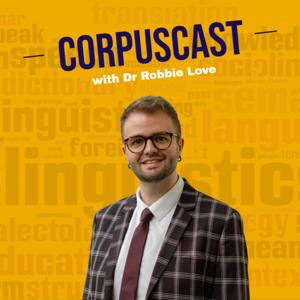


Welcome to a one off special!
No CorpusCast isn't returning but Robbie has recorded a one-off special episode with 'Writing Wrongs' the True Crime Forensic Linguistics podcast from the Aston Institute for Forensic Linguistics.
Please take a listen to the Writing Wrongs back catalogue here or anywhere else you listen to podcasts.
-----
Here are the 'Writing Wrongs' show notes
for this episode:
Welcome Wrong’uns to this special episode of Writing Wrongs in conjunction with another Aston Originals podcast: CorpusCast with Dr Robbie Love!
Nicci, Tim, and Robbie revisit some of Writing Wrongs’ bestclips involving corpus linguistics. Take a trip down memory lane as our hosts call back to S1E3, S1E7, S2E1&2, and S2E6&7, and grill Dr Love about the ins and outs of the use of corpus tools in forensic linguistics.
Erratum: Robbie's upcoming performance of We Will Rock You is at the Alexandra Theatre, not the Hippodrome as Nicci mistakenly says. Tickets available here.
VOTE FOR US IN THE TRUE CRIME AWARDS 2026!
For a list of our sources and more informationabout this case, please visit https://www.aston.ac.uk/writing-wrongs
Have a question for Nicci or Tim? Email us at [email protected]and we may answer it during an upcoming episode!
Check out the official AIFL blog for more forensic linguistic goodies here: https://medium.com/@AIFLblog
If you have been affected by any of the themes in this week’s episode, please contact one of these free sources:
https://www.samaritans.org/how-we-can-help/contact-samaritan/
https://www.helpguide.org/find-help
Production Team: Mark Round, Jordan Robertson,Neus Alberich Buera, Karolina Placzynta
Sound: Mark Round
Visual design: George Grant
Additional Voices: Prof Malcolm Coulthard, Dr Issy Clarke, Dr Andrea Nini
With our thanks to Dr Robbie Love
Professor Tim Grant’s home page: Tim Grant- Aston Research Explorer
Dr Nicci MacLeod’s home page: NicciMacLeod - Aston Research Explorer
Dr Robbie Love's home page: Robbie Love - Aston Research Explorer
In this episode of CorpusCast, host Dr Robbie Love is joined by Dr Guyanne Wilson, Quirk Lecturer in English Linguistics at University College London, to explore the fascinating role of corpus linguistics in studying World Englishes.
With experience in compiling corpora from Trinidad and Tobago to Uganda, Dr Wilson unpacks the development of these English varieties and the social, linguistic, and historical contexts in which they thrive.
From her academic journey, starting in Trinidad and Tobago, to her current position at UCL as the Quirk Lecturer in English Linguistics, Dr Wilson shares insights into the importance of documenting diverse Englishes, emphasising the value of corpus linguistics in social justice.
The episode looks into the challenges of building corpora, working with historical language data and the evolving norms in English usage around the world.
In this episode of CorpusCast, host Dr Robbie Love welcomes Professor Shelley Staples from the University of Arizona to dive deep into the fascinating world of learner corpora and how they can revolutionise the way we approach academic writing, especially for students writing in English as a second language.
In this episode of CorpusCast, Dr Robbie Love is joined by Professor Vaclav Brezina from Lancaster University to discuss #LancsBox, a corpus tool developed to assist researchers in visualizing and analysing linguistic data.
Welcome to another episode of CorpusCast, the podcast from Aston University dedicated to exploring corpus linguistics and its impact on society.
In this episode, Robbie chats to Professor Dan McIntyre, from Uppsala University, about the world of corpus stylistics.
Welcome back to CorpusCast, the podcast from Aston University delving into corpus linguistics and its impact on society. I'm your host, Dr Robbie Love, and in today's episode, we're diving deep into a crucial aspect of corpus linguistics: representativeness. To truly make sense of corpus research, we must ensure that our corpora accurately represent the language we're studying. But how do we distinguish a well-designed corpus from a poorly designed one? What considerations should researchers keep in mind when creating or utilising existing corpora?
From the publisher's feed