
Sign up to save your podcasts
Or

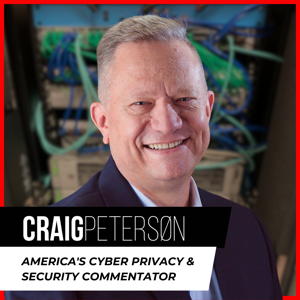


Good morning everybody!
I was on WGAN this morning with Matt Gagnon and started this morning talking about Cloud Jacking what it is and how it is done. Then we discussed how to prevent it and that is by having good strong passwords that are different for each site you visit. We discussed password managers. Then we got into how the Government is getting around laws on tracking you -- they are buying data from Data aggregators. Here we go with Matt.
And more tech tips, news, and updates visit - CraigPeterson.com.
---
Automated Machine Generated Transcript:
Craig Peterson: Hey, good morning, everybody. Craig Peterson here. I've got my early morning voice on this morning. It's a little cloggy. I was on this morning with Mr. Matt Gagnon. We talked about a few different things, including the new Chrome and Edge browser. Features and why Microsoft edge picked it up.
[00:00:20] Also, the military intelligence is buying data on you. Where are they getting it? Why are they getting it? What's with cloud jacking and the rise of cloud jacking. Here we go with Mr. Matt Gagnon.
[00:00:35] Matt Gagnon: It's all things. Technology tech talk with Craig Peterson right now on news radio 98, five FM and am five 60 WGAN seven 36 Wednesday morning.
[00:00:49]Craig Peterson joining us as always on this time at this day, Craig, how are you this morning? Hey,
[00:00:55] Craig Peterson: I'm here now. I'm ready to go.
[00:00:59]Matt Gagnon: Well, let's get going on the topics of the day, if you don't mind. So you need to explain to probably the audience and myself, what cloud jacking is.
[00:01:07] Why don't we start there?
[00:01:08] Craig Peterson: Sure. This is a whole new problem. The cloud is just another word for somebody else's computer that you have no control over. It just amazed me how many companies thought, we'll just rush to the cloud. We'll use these cloud services and there's a lot of them out there now, and we don't have to worry about anything anymore. In reality, you do.
[00:01:33] Microsoft does not guarantee that if you're using their windows, their Microsoft three 65 and their licenses and their email. They don't guarantee that data is not going to be lost or deleted accidentally. In fact, there was a huge problem with Microsoft dropping all of the conversations in Microsoft teams for one of these fortune 100 companies and just shrugging their shoulders.
[00:01:58]The other problem has to do with security. You cannot assume that these cloud services are secure. Most of the businesses nowadays, and this is just no end of frustration to me, on trying to be first to market, they're not worrying about the longevity, the backups, the security, or anything that, really, they shouldn't be caring about. They're just worrying about having a product that mostly works and it's almost always in the cloud.
[00:02:30]That brings up this cloud jacking problem, even though we've got all of this great cloud computing and it's going to save the world. The bottom line is the hackers are going after it.
[00:02:43]They're going after it in a very big way. They're taking over business accounts that are up in the cloud. Remember, what about passwords, Matt? We've talked about it before, people are not using good passwords are not using password managers. I have a friend who he's in his seventies now. He drives for grub hub. That's how he makes a little bit extra money. So he has his online cloud account with grub hub. This is true for so many things. I'm just using this as an example. He noticed that he was due 700 and change payment. This was his wonderful paycheck coming in from delivering groceries in his seventies.
[00:03:25] He's climbing stairs, he's bringing stuff around, he's working hard for it. What had happened is someone went ahead used the email address that they found in one of these dumps from one of these hacks. Used his password that they found in one of these dumps from one of these apps and hijacked his account.
[00:03:46]There goes $700 of hard labor. It went right into the account or the bad guys, and he's kinda clamoring and I helped him out. I go ahead and go in with one password. You got to use a password manager.
[00:04:01]The bad guys have now access to over 1 billion accounts with email addresses and passwords. They are all online people. Check them out. You can go to a website called, have I been poned pwn ed check there. Put in your email address. It'll tell you if the bad guys know your password.
[00:04:26] They're just stuffing them in, Matt, and their cloud jackin. They're taking over your cloud account because if it had been on his computers, his business computers, or had been on Grubhubs computers, it would have been harder for people to break into. But because it's just on the web, I was just like, "I'm going to use, why I have three passwords that I use across the internet." It drives me crazy.
[00:04:50]Matt Gagnon: We're speaking with Craig Peterson, our tech guru, who joins us on Wednesdays at this time.
[00:04:54]Speaking of passwords, if you're having trouble with those passwords generating a good one, remembering them, et cetera. There is perhaps a solution with Google Chrome and Edge.
[00:05:04] Craig Peterson: Yeah, there are a lot, a lot of companies that are trying to help us here with this problem, because this is a very big problem. Microsoft and Google both have a goal of completely eliminating passwords and not a bad idea, but we're nowhere near that right now.
[00:05:21] So remember Microsoft Edge browser, isn't really Microsoft Edge. It is actually now Chrome under the hood. And both of them now, because Chrome has added it so guess what Microsoft gets it for free. They've added a nice little feature that tracks your passwords, what you're using, and also now helps you generate new passwords, safe ones, secure ones, and Google has gone an extra step, and I've got to praise them a bit for this. If you are saving your passwords using Google Chrome, it keeps an eye on the websites that are hacked and it keeps your an eye on your password and will let you know if your account has been effectively exposed with a username and password.
[00:06:13]Using this new password generator, I think is a good step. If you're not going to get a real password manager again, get one password or last pass. Chrome and Edge are going to come to the rescue, give you this password generator with passwords that are hard to guess.
[00:06:31]By the way, the current thinking on good passwords has nothing to do with an uppercase character, a lowercase, a special symbol, and number. Now a days the best passwords are little phrases that are joined together. You might have three words, problem challenge, solution, all separated by like the number two or a dash. That's one of the best passwords you can get.
[00:06:56] This is great built in strong password generator. It could save you your paycheck and it would have saved the paycheck of my buddy.
[00:07:06] Matt Gagnon: We're speaking with Craig Peterson, our tech guru, who joins us this time every Wednesday to go over what's happening in the world of technology.
[00:07:12] You can also hear him on Saturdays at one o'clock for many of these very same topics in more depth. Finally Craig, the military intelligence buying location data, instead of getting warrants, according to a recent memo here. Tell me more about this story.
[00:07:26] Craig Peterson: Ooh, this is something I've been warning about for a long time, right? If it's free, your probably the product. That's very, very true because so many of these free little apps are doing things in the background you may not be aware of including keeping track of where you are.
[00:07:44] So Homeland security and now military intelligence agency, the defense intelligence agency have both been caught, if you will ,going to the data aggregators that are taking all of the data from all of these little apps that you have. That are they fun, they're free.
[00:08:04] You know, the I have a hundred apps on my phone and I only use six of them, which is pretty common, by the way, those other apps are leaking information about you. Even some of the ones that you are using are leaking it. So this is a very, very big problem.
[00:08:19] In the United States, they cannot monitor you , or your location without a warrant with some exceptions, but this is allowing them now to get full access to you where you are, where you're going. Thats sort of what Homeland security has been using it for.
[00:08:37]Now it turns out that's what the defense intelligence agency has been using it for as well. This is a big fat loophole. That they are driving massive trucks through. It's just incredible. Oh, and by the way, there are all the license plate scanners out there. You might not be aware of it, but in some areas, if you get tickets, they will issue a warrant for your car after a period of time.
[00:09:04]There's tow truck operators driving around that have license plates scanners on your cars and they'll drive to a parking structure or through a mall. They'll find cars that they can go ahead and tow and make some money on all of that license plate data. It Is also being set into this and many of the cities and towns that have license plate capture cameras or also selling it.
[00:09:29]Your data is out there and we've got to take this back, Matt, we've got to stop allowing them to collect all this data on us. Apple's taken a very good step towards that. Now in the app store, they're the first to show you everything that any app is collecting on you right there in the app store.
[00:09:49] Matt Gagnon: All right. That's Craig Peterson, our tech guru. Joining us at this time every Wednesday to go over the world of technology. Thank you as always, Craig, appreciate you joining us here and we will talk to you again next week, sir.
[00:09:59] Craig Peterson: Thanks again, Matt.
[00:10:00] Matt Gagnon: You bet. All right, so coming up next, we're gonna take a quick break here.
[00:10:03] Craig Peterson: I got some good news too on this course. Oh my gosh. It's been a labor of love. But this improving windows security course, it's almost done. Been busy recording. 21 different modules are covering every aspect of windows and security. We're probably going to do some other stuff too, as part of this on VPNs and firewalls and stuff too.
[00:10:29] Cause I think that's all needed. We may be a little longer than I had hoped, but I want a really, really great course when we're done with this. It's not going to take us much longer.
[00:10:40] All right. Everybody, have a great rest of the week and we'll be back on the weekend.
---
More stories and tech updates at:
www.craigpeterson.com
Don't miss an episode from Craig. Subscribe and give us a rating:
www.craigpeterson.com/itunes
Follow me on Twitter for the latest in tech at:
www.twitter.com/craigpeterson
For questions, call or text:
855-385-5553
Welcome!
Good morning, everybody. I was on WTAG this morning with Jim Polito. We had an interesting discussion about North Korea and their extensive hacking efforts, who is supporting them, and why. Then we got into Social Media censorship and Birdwatching and how the left has succeeded in shutting down conservative opinion. Here we go with Jim
For more tech tips, news, and updates, visit - CraigPeterson.com.
---
Automated Machine Generated Transcript:
Craig Peterson: [00:00:00] Good morning, everybody. Craig Peterson here this morning, we talked about Canada being a big hacker nation and the other big one, there's really top three if you will. So that's what we got into today. A lot of people just weren't expecting what's happening. It's crazy. So we get into why Mr. IL is out there hacking and it was a surprise to Jim, anyway.,
Hopefully, you got my email this morning. I got another one Thursday. We've got some little training things coming up that I want you to pay attention to all part of this launch of the finally the improving windows security course.
No, we had a name. We had like working names, everything else, you know how that goes, but the whole idea behind the course is how to improve your windows security to that next level. All right, everybody, take care. And here we go.
Jim Polito: [00:00:59] Craig Peterson, the Tech-Talk guru and our good friend who joins us every Tuesday at this time.
Good morning, sir.
Craig Peterson: [00:01:06] Good morning.
Jim Polito: [00:01:08] Hey, we're going to get some Some of your, Canada like weather, just a little bit, little snow. Hey, a little snow.
Craig Peterson: [00:01:17] Have you seen this? A Northwest territory's Buffalo airways show. They have it on the weather channel at times at night, sometimes. They're up in the Northwest territory up in Yellowknife. They're flying to places, Calgary, Edmonton, red deer, that's south to them. I never moved this far North as those guys. Yeah.
Jim Polito: [00:01:39] You might as well be in Alaska seriously.
Craig Peterson: [00:01:43] Yeah. Yeah, exactly.
Jim Polito: [00:01:48] Here's something I want to talk about still more about social media and censorship and everything else that's going on, but I do want to ask you about. The country in the world that is probably the least high tech or one of the least high tech. You see a satellite picture of this country at night and there aren't many lights on, and yet they couldn't be one of the best hacking units in the world.
I think I'm giving it away as to who it is, Craig, but I'll let you, yeah.
Craig Peterson: [00:02:25] Yeah. It's Canada.
Jim Polito: [00:02:27] No, that was pretty good because if you get, if you see a picture of the Northwest territories at night, there aren't any lights up the other than the Northern lights.
Craig Peterson: [00:02:41] The Northern half of Canada has a total of just over a hundred thousand people that said something like two-thirds of the population lives within a hundred miles of the US border.
But no, that's not it here. We're talking about cybersecurity and cybersecurity has become a real problem. In fact, Rhode Island. Now you can call 211 to report cybercrime in Rhode Island. In Mass, there is a 211 is you probably could, but Rhode Island has been really leading this somewhat and setting this up.
For cybercrimes and includes cyber-stalking, identity theft, financial fraud, cyberbullying. They've been trying to stay ahead of this game. So what we're talking about right now is this state-sponsored hacking.
Now countries, if you look at Russia, you look at China, they're hacking us as part of what kind of world war three right.
What's the easiest way for us to attack the United States. It's via cyber. We've seen power outages in some of these countries, including Iran lately. There's a lot of speculation that it's us doing that to them.
Although Iran says the reason that they've had power outages is that too many people are trying to mine Bitcoin cyber currencies. They use too much electricity and we didn't allot for that then. They shut down 1600 cyber mining facilities within Iran.
There are countries like Iran that want the cash and North Korea, believe it or not, is one of the leaders out there because they want their hands on money. They have a number of different groups out there. There's a Lazarus group, which is probably the best known, Hidden Cobra is another one of them. They do all kinds of extortion and ransom and just general online so that they can get their hands on money.
There's an estimated of I've seen various numbers, about three to 6,000 people in North Korea that are very advanced technologically. They have gone to foreign universities.
Look at current leader of North Korea. He went to school over in England, and it's just amazing. Some of the things we let these other countries do.
Now they have what Kim Jong himself calls an all-purpose sword that guarantees North Korea military capability to strike relentlessly. The main reason they're doing this is getting their hands on hard currency.
Jim Polito: [00:05:32] That makes sense. We're talking with Craig Peterson, our tech talk guru. So Craig, the expression if only you had used your powers and skills and talents for good. This type of high-tech hacking, that requires smart people requires some hardware, requires software, all of this, they're doing it just to steal, so that they can fund them, shall we say, hermit nation. As I said, you take a satellite picture of the nation at night and there's hardly any lights on because there's just, the people are living in a primitive society. So that's their motivation.
When you look at Yosef Stalin when he first became a communist, this was before they had over three around the czar, he was a bank robber, robbing banks for money, for the Bolsheviks, for the revolution.
Isn't that basically what they're doing here in North Korea, although they've already had their communist revolution.
Craig Peterson: [00:06:40] Yeah, they are. That is what they're doing. They're trying to fund this so that they can feed their people. Remember people are starving in North Korea. These are defectors their medical conditions are just insane, crazy.
They're also directly tied into China. So even though they're obviously playing not even second fiddle there they're way in the back in a different auditorium, from China.
China is a huge cyber threat and frankly. Russia and China and then North Korea is right behind them. China is actually providing them with some of this technology to do the hacking as well, which is absolutely fascinating to me. China is continuing to support North Korea, but it's doing it by giving them technology, giving them training, allowing North Koreans into their universities. Specifically, so that they can learn how to hack computers in the United States, as well as other countries, and fund themselves. So they don't have to keep coming back to China for more money and grain and oil and everything else for free at the very least they'll be able to pay for it.
It's like the kid in the basement you're trying to get rid of, and not everyone can get on that hermit out of the basement and put them into the white house.
Jim Polito: [00:08:01] Wow. We're talking with Craig Peterson tech talk. We will tell you how you can get in touch with him at the end of this segment.
But Craig, we just got a few more minutes here. Anything new in social media? I heard Twitter invented, what is it? Bird something or bird catcher or whatever. This system that's supposed to identify tweets that are inappropriate. Does this really mean anything?
Craig Peterson: [00:08:34] Yeah, they've been doing it for quite a while. It's called birdwatch and this is a community-based. Here's what's really been going on and no one, I don't understand why, but I haven't heard anyone else talk about this. Jim.
This is a first in the media, but the problem we have out there is that Twitter and Facebook, they don't have the time. They don't have the resources, even the artificial intelligence to be able to monitor all of the tweets and catch the bad ones.
The way they find the tweet that they want to shut down is they get people reporting them. So now they've made this more formal by calling this community, birdwatch and doing all of this stuff. Here's what happens, you post something online that is maybe slightly questionable, especially if you'd take it the wrong way. There are people who are sitting there again in the basement I'm running for president, or maybe they've never gotten a job, or maybe it's both. They're watching a few social media accounts.
They think of these hacking communities overseas, where you have all of these people. Pretending to be someone else. As they're pretending to be someone else there, they're posting and trying to change our opinion, right? So much of these bots, et cetera, we're not going to get into that right now. The reason Twitter shuts things down is that somebody reports.
Now you or I, we looked at a tweet and say that guy's an idiot and we move on. But the people on the left, particularly the far left, all see a tweet and they will say, okay, we can get them on this one. They then have a few hundred of their fellow community members report that person, tweet to Twitter. Twitter then has to respond based on his community standards because so many people were complaining. You got a 24-hour ban or demonetization. That's the big secret behind all of this?
It's these kids, bad guys obviously not all of them are young kids who are sitting there watching certain accounts reporting on mass. People w via different people and different bonds. That this is really offensive to them and now Twitter has something to fall back on.
Jim Polito: [00:11:09] Yeah. And you know what? They destroy a lot of conservatives and I've had it. I've had it happen to me. That's why everything I write on Twitter, anywhere else, is something that I would not be afraid to say to a priest, my late mother, when she was alive, anyone like that is.
I have my political opinions, but the way in which I convey them, I do it in a way that's not offensive, but even doing that, they keep reporting.
You can get hurt and that's scary. That is scary. Craig.
If folks want to get more information from you what do they do?
Craig Peterson: [00:11:52] I sent out this morning, in fact, a video to everyone that's on my email list, and I've got another email going up Thursday. I've got some more training coming out. This is all training stuff, people, and you can get on that list.
Just go to Craig peterson.com. You can subscribe right there. Craig Peterson.com/subscribe. If you'd like. All of my podcasts are up there. You can get copies of these special reports. Like the one, I released today and much, much more just Craig peterson.com.
Jim Polito: [00:12:25] All right, Craig. Thanks so much, great information. We'll catch up with you.
Craig Peterson: [00:12:30] Take care. Thanks. Jim.
Jim Polito: [00:12:32] Thanks. Bye-bye, all a final word. When we return.
---
More stories and tech updates at:
www.craigpeterson.com
Don't miss an episode from Craig. Subscribe and give us a rating:
www.craigpeterson.com/itunes
Follow me on Twitter for the latest in tech at:
www.twitter.com/craigpeterson
For questions, call or text:
855-385-5553
Welcome!
Good morning, everybody. I was on WTAG this morning with Jim Polito. We had an interesting discussion about North Korea and their extensive hacking efforts, who is supporting them, and why. Then we got into Social Media censorship and Birdwatching and how the left has succeeded in shutting down conservative opinion. Here we go with Jim
For more tech tips, news, and updates, visit - CraigPeterson.com.
---
Automated Machine Generated Transcript:
Craig Peterson: [00:00:00] Good morning, everybody. Craig Peterson here this morning, we talked about Canada being a big hacker nation and the other big one, there's really top three if you will. So that's what we got into today. A lot of people just weren't expecting what's happening. It's crazy. So we get into why Mr. IL is out there hacking and it was a surprise to Jim, anyway.,
Hopefully, you got my email this morning. I got another one Thursday. We've got some little training things coming up that I want you to pay attention to all part of this launch of the finally the improving windows security course.
No, we had a name. We had like working names, everything else, you know how that goes, but the whole idea behind the course is how to improve your windows security to that next level. All right, everybody, take care. And here we go.
Jim Polito: [00:00:59] Craig Peterson, the Tech-Talk guru and our good friend who joins us every Tuesday at this time.
Good morning, sir.
Craig Peterson: [00:01:06] Good morning.
Jim Polito: [00:01:08] Hey, we're going to get some Some of your, Canada like weather, just a little bit, little snow. Hey, a little snow.
Craig Peterson: [00:01:17] Have you seen this? A Northwest territory's Buffalo airways show. They have it on the weather channel at times at night, sometimes. They're up in the Northwest territory up in Yellowknife. They're flying to places, Calgary, Edmonton, red deer, that's south to them. I never moved this far North as those guys. Yeah.
Jim Polito: [00:01:39] You might as well be in Alaska seriously.
Craig Peterson: [00:01:43] Yeah. Yeah, exactly.
Jim Polito: [00:01:48] Here's something I want to talk about still more about social media and censorship and everything else that's going on, but I do want to ask you about. The country in the world that is probably the least high tech or one of the least high tech. You see a satellite picture of this country at night and there aren't many lights on, and yet they couldn't be one of the best hacking units in the world.
I think I'm giving it away as to who it is, Craig, but I'll let you, yeah.
Craig Peterson: [00:02:25] Yeah. It's Canada.
Jim Polito: [00:02:27] No, that was pretty good because if you get, if you see a picture of the Northwest territories at night, there aren't any lights up the other than the Northern lights.
Craig Peterson: [00:02:41] The Northern half of Canada has a total of just over a hundred thousand people that said something like two-thirds of the population lives within a hundred miles of the US border.
But no, that's not it here. We're talking about cybersecurity and cybersecurity has become a real problem. In fact, Rhode Island. Now you can call 211 to report cybercrime in Rhode Island. In Mass, there is a 211 is you probably could, but Rhode Island has been really leading this somewhat and setting this up.
For cybercrimes and includes cyber-stalking, identity theft, financial fraud, cyberbullying. They've been trying to stay ahead of this game. So what we're talking about right now is this state-sponsored hacking.
Now countries, if you look at Russia, you look at China, they're hacking us as part of what kind of world war three right.
What's the easiest way for us to attack the United States. It's via cyber. We've seen power outages in some of these countries, including Iran lately. There's a lot of speculation that it's us doing that to them.
Although Iran says the reason that they've had power outages is that too many people are trying to mine Bitcoin cyber currencies. They use too much electricity and we didn't allot for that then. They shut down 1600 cyber mining facilities within Iran.
There are countries like Iran that want the cash and North Korea, believe it or not, is one of the leaders out there because they want their hands on money. They have a number of different groups out there. There's a Lazarus group, which is probably the best known, Hidden Cobra is another one of them. They do all kinds of extortion and ransom and just general online so that they can get their hands on money.
There's an estimated of I've seen various numbers, about three to 6,000 people in North Korea that are very advanced technologically. They have gone to foreign universities.
Look at current leader of North Korea. He went to school over in England, and it's just amazing. Some of the things we let these other countries do.
Now they have what Kim Jong himself calls an all-purpose sword that guarantees North Korea military capability to strike relentlessly. The main reason they're doing this is getting their hands on hard currency.
Jim Polito: [00:05:32] That makes sense. We're talking with Craig Peterson, our tech talk guru. So Craig, the expression if only you had used your powers and skills and talents for good. This type of high-tech hacking, that requires smart people requires some hardware, requires software, all of this, they're doing it just to steal, so that they can fund them, shall we say, hermit nation. As I said, you take a satellite picture of the nation at night and there's hardly any lights on because there's just, the people are living in a primitive society. So that's their motivation.
When you look at Yosef Stalin when he first became a communist, this was before they had over three around the czar, he was a bank robber, robbing banks for money, for the Bolsheviks, for the revolution.
Isn't that basically what they're doing here in North Korea, although they've already had their communist revolution.
Craig Peterson: [00:06:40] Yeah, they are. That is what they're doing. They're trying to fund this so that they can feed their people. Remember people are starving in North Korea. These are defectors their medical conditions are just insane, crazy.
They're also directly tied into China. So even though they're obviously playing not even second fiddle there they're way in the back in a different auditorium, from China.
China is a huge cyber threat and frankly. Russia and China and then North Korea is right behind them. China is actually providing them with some of this technology to do the hacking as well, which is absolutely fascinating to me. China is continuing to support North Korea, but it's doing it by giving them technology, giving them training, allowing North Koreans into their universities. Specifically, so that they can learn how to hack computers in the United States, as well as other countries, and fund themselves. So they don't have to keep coming back to China for more money and grain and oil and everything else for free at the very least they'll be able to pay for it.
It's like the kid in the basement you're trying to get rid of, and not everyone can get on that hermit out of the basement and put them into the white house.
Jim Polito: [00:08:01] Wow. We're talking with Craig Peterson tech talk. We will tell you how you can get in touch with him at the end of this segment.
But Craig, we just got a few more minutes here. Anything new in social media? I heard Twitter invented, what is it? Bird something or bird catcher or whatever. This system that's supposed to identify tweets that are inappropriate. Does this really mean anything?
Craig Peterson: [00:08:34] Yeah, they've been doing it for quite a while. It's called birdwatch and this is a community-based. Here's what's really been going on and no one, I don't understand why, but I haven't heard anyone else talk about this. Jim.
This is a first in the media, but the problem we have out there is that Twitter and Facebook, they don't have the time. They don't have the resources, even the artificial intelligence to be able to monitor all of the tweets and catch the bad ones.
The way they find the tweet that they want to shut down is they get people reporting them. So now they've made this more formal by calling this community, birdwatch and doing all of this stuff. Here's what happens, you post something online that is maybe slightly questionable, especially if you'd take it the wrong way. There are people who are sitting there again in the basement I'm running for president, or maybe they've never gotten a job, or maybe it's both. They're watching a few social media accounts.
They think of these hacking communities overseas, where you have all of these people. Pretending to be someone else. As they're pretending to be someone else there, they're posting and trying to change our opinion, right? So much of these bots, et cetera, we're not going to get into that right now. The reason Twitter shuts things down is that somebody reports.
Now you or I, we looked at a tweet and say that guy's an idiot and we move on. But the people on the left, particularly the far left, all see a tweet and they will say, okay, we can get them on this one. They then have a few hundred of their fellow community members report that person, tweet to Twitter. Twitter then has to respond based on his community standards because so many people were complaining. You got a 24-hour ban or demonetization. That's the big secret behind all of this?
It's these kids, bad guys obviously not all of them are young kids who are sitting there watching certain accounts reporting on mass. People w via different people and different bonds. That this is really offensive to them and now Twitter has something to fall back on.
Jim Polito: [00:11:09] Yeah. And you know what? They destroy a lot of conservatives and I've had it. I've had it happen to me. That's why everything I write on Twitter, anywhere else, is something that I would not be afraid to say to a priest, my late mother, when she was alive, anyone like that is.
I have my political opinions, but the way in which I convey them, I do it in a way that's not offensive, but even doing that, they keep reporting.
You can get hurt and that's scary. That is scary. Craig.
If folks want to get more information from you what do they do?
Craig Peterson: [00:11:52] I sent out this morning, in fact, a video to everyone that's on my email list, and I've got another email going up Thursday. I've got some more training coming out. This is all training stuff, people, and you can get on that list.
Just go to Craig peterson.com. You can subscribe right there. Craig Peterson.com/subscribe. If you'd like. All of my podcasts are up there. You can get copies of these special reports. Like the one, I released today and much, much more just Craig peterson.com.
Jim Polito: [00:12:25] All right, Craig. Thanks so much, great information. We'll catch up with you.
Craig Peterson: [00:12:30] Take care. Thanks. Jim.
Jim Polito: [00:12:32] Thanks. Bye-bye, all a final word. When we return.
---
More stories and tech updates at:
www.craigpeterson.com
Don't miss an episode from Craig. Subscribe and give us a rating:
www.craigpeterson.com/itunes
Follow me on Twitter for the latest in tech at:
www.twitter.com/craigpeterson
For questions, call or text:
855-385-5553
Welcome,
Craig Peterson here. I was on with Chris Ryan on NH Today. We talked about how you can stay secure and private while using the Cloud and then we talked about Contact Tracing, privacy, compliance, and government tracking. Here we go with Chris.
These and more tech tips, news, and updates visit.
- CraigPeterson.com
---
Automated Machine Generated Transcript:
Craig Peterson: [00:00:00] This morning, I was on with the new host of New Hampshire today, Mr. Chris Ryan. I like the way he does interviews a little different than most of the interviews I do. He really drives to get involved. He understands the stuff I send him. It's kind of fun. Actually, it makes me look good. Anyhow, here we go this morning, of course, talking about the latest in tech security. In fact, right where he went. When I was just editing it, I noticed they had a bit of a running joke going on this morning. I think you'd probably figure it out. It has to do with traffic here. There is no traffic here, frankly. Well, okay, a couple of days out of the year, but that's it.
Chris Ryan: [00:00:41] Joining us right now on the program. Craig Peterson from tech talk here on WGIR. I can hear it. 1130 on Saturdays. He joins us right now on the program. Craig, how are you?
Craig Peterson: [00:00:50] Hey, speaking of tyranny, doing pretty good.
Chris Ryan: [00:00:52] Good for the show. One to talk to you a little bit about your thoughts on where things are headed with cybersecurity at this point in time, particularly as we're utilizing clouds more. We're putting our pictures up on the cloud, we're putting information up on the cloud. It's a great way to share information with relatives and things of that nature. But when you're putting it out there, the question is - how secure is it? Particularly for individuals that are not quite sure exactly how to utilize the cloud and to keep it safe.
Craig Peterson: [00:01:24] Yeah. And that extends frankly, over to our businesses our bigger ones, our smaller ones. People are looking for just an easier way to do things. You've got your pictures you've taken of the kids. You've got the videos from the holidays and you just stick them up there in the cloud and keep your fingers crossed.
When it comes to businesses, they look at the cloud and say, Oh, isn't this wonderful because I don't have to do anything.
They don't have to have a server anymore. I don't have to worry about backing up. None of that is true in either case. We've seen many, many times, including recently, for instance, Microsoft teams lost all of the conversations from one of the major corporations out there.
Chris Ryan: [00:02:07] Justin, we should talk to Tim about this, and cancel our promotions meeting today. On Microsoft teams so we don't have to do that.
Justin McIssac: [00:02:13] I like the canceling the promotions aspect of this.
Chris Ryan: [00:02:15] No, but you're right. We're utilizing, using these platforms, whether it's zoom, whether it's Microsoft teams, and we don't know how safe they are. Are there ways do you utilize the platform? Let's say zoom, as an example, everybody used that, Microsoft teams, people use that.
Is there ways to make sure that those conversations are safe because a lot of times if they're even being recorded and people don't know it.
Craig Peterson: [00:02:37] Yeah. In the case of Zoom, it's been routed through China and Chinese servers are out of the country, it seems to happen a lot with zoom. Zoom has been caught absolutely lying to us.
Talking about fake news, they say, it's secure end to end. We have end-to-end encryption. They did not have it. We're not actually sure they have it right now, either. They're saying that they finally do, after years of saying their conversations were secure.
Going back to, how do you have secure conversations? How do you know your data is securing the cloud? Well, there are some platforms that have been certified as being secure. When you're talking about teams, there's only one and that's WebEx teams. Microsoft is not there. Zoom is not there. WebEx allows you to have secure conversations end to end, but let's just talk about the simple stuff.
If you want to have your stuff be secure or not lost, at the very least back up your cloud services. Don't just trust the phone calls that you've recorded or your pictures or your home videos or your business documents or your emails. Don't trust that they're not going to get lost, which is probably going to be most people's biggest problem because they do get lost.
These big guys say, well, we're not responsible for that. I don't care if it was 10 years of all of your important emails. Back them up from the cloud.
Use some of these tools that are out there, like Signal. If you want to have a small meeting with a few people with friends. Signal is what the big-time experts on security use. It is secure end to end.
It comes right down to this, Chris, you just can't trust the providers because they're trying to sell what they have. They're not trying to develop what exactly we need for security, safety, and making sure that stuff we care about doesn't get lost.
Chris Ryan: [00:04:37] I want to talk a little bit about big tech and government. There was a conversation back in the start of the pandemic between Dr. Fauci and I believe it was Rolling Stone that I read. He was talking about South Korea versus the United States and how South Korea was able to get control of the pandemic because of the fact that the government could spy on its citizens. Basically, and determine who had COVID when and where they were, who they're with and tie all these things together. He said the government can't do that here and frankly doesn't have the capability of doing that but if we were to work with big tech, then the potential exists for there to be real contact tracing versus, the type of contact tracing that's discussed right now.
In your view, how often does the government work with big tech on these types of endeavors? Is there some sort of legal minutia or middle ground where the government can work with big tech in order to provide information to them where the government itself cannot quote-unquote spy on you in certain circumstances,
Craig Peterson: [00:05:44] Oh, that's got to be difficult. Bottom line. The government has been worked with big tech a lot.
We've seen tens of thousands of cases where the government has issued blanket warrants for a location. So for instance, what happened on the sixth down in Washington, DC. They can, they do, and they have sent a warrant off to Google being their favorite target because their information is gathered from all kinds of devices. They say, who was in this area? They get this blanket warrant and tada, Big tech will produce that information, but that's when they have a warrant.
We found now that various parts of government, including the military. Homeland Security has been doing this as well. They go to big tech and say, Hey, I want to know where this person is, where they've been and big tech tells them that, without a warrant, because what they're doing is harvesting your data.
You know, that free app that you have, Justin. That app isn't as free as it seems to be. Because they are.
Chris Ryan: [00:06:51] What do you know about Justin, that I don't know?
Craig Peterson: [00:06:53] Yeah. Well,
Justin McIssac: [00:06:54] Which app you talking about?
Craig Peterson: [00:06:56] The traffic one that you're using.
Chris Ryan: [00:06:58] Oh, the traffic one. Yeah, that's it. Justin, we need, we'll get back to that. After. I'll handle that myself. I don't need your help, Craig.
Craig Peterson: [00:07:10] They're not providing you with a free service. They are charging you and they're charging you by getting your information. Government and military intelligence and other agencies, go to these data aggregators that are taking all of this data and putting it together.
Now there's the next step when you're talking about, well, let's making sure that we got the social distancing going on. And what if I came in contact with someone that had some form of a terrible disease. The type of tracking that's done by our phones is not accurate enough for the government to go in and say, where are you within six feet of this person that came down with whatever it might be.
Chris Ryan: [00:07:49] They can tell you the same place, but they can't tell if you are within even, a hundred yards of the individual. You could have been in the same shopping mall. It could have been the same restaurant, but you don't know exactly the proximity.
Craig Peterson: [00:08:00] Yeah, exactly. Right. Because once you get inside now they've lost all of the resolutions and even outside there's a reflection and other things that cause problems. Ever tried to use GPS and downtown, well, Manchester is a little different but Boston, New York, some of these bigger cities, it just doesn't work.
So the type of tracking that's used for this contact tracing is different. It requires an app on your phone. That app basically uses Bluetooth to see if there's any other phones around that it's compatible with or even any other phones around.
When you get into South Korea. If you get it, certainly in China. They will push an app to your phone, they have control over it in many cases. Therefore they can force the app onto your phone. People tend to be a little more compliant in South Korea than they are in the US.
I don't know if you've noticed that or not, but they'll download these phones themselves, will keep tabs on, who's close to whom and that will help with our contact tracing. Even in the best of cases, they've only found that there's usually about 50% compliance.
If it's done by the government saying, Hey people, just go ahead and download an app so we can all be safer. The only place where we have very high compliance are places like China.
Chris Ryan: [00:09:19] Craig as always appreciate you joining us for the show.
Craig Peterson: [00:09:22] All right. Hey, thanks.
By the way, for those of you, who've been asking Karen and I are getting really close to having this Intro to Windows Security course done and out. Yeah, and we've already caught another three or four together.
This is going to be life-changing. I really do think so for so many people, because you've been trying to solve some of these problems. You're worried about what's positive to do, what's negative to do because some of the things that these vendors, advertisers are trying to get you to buy will actually make you less secure.
So keep your eyes on your mailboxes, cause that's coming soon. Take care. We'll be back tomorrow.
---
More stories and tech updates at:
www.craigpeterson.com
Don't miss an episode from Craig. Subscribe and give us a rating:
www.craigpeterson.com/itunes
Follow me on Twitter for the latest in tech at:
www.twitter.com/craigpeterson
For questions, call or text:
855-385-5553
Welcome,
Craig Peterson here. I was on with Chris Ryan on NH Today. We talked about how you can stay secure and private while using the Cloud and then we talked about Contact Tracing, privacy, compliance, and government tracking. Here we go with Chris.
These and more tech tips, news, and updates visit.
- CraigPeterson.com
---
Automated Machine Generated Transcript:
Craig Peterson: [00:00:00] This morning, I was on with the new host of New Hampshire today, Mr. Chris Ryan. I like the way he does interviews a little different than most of the interviews I do. He really drives to get involved. He understands the stuff I send him. It's kind of fun. Actually, it makes me look good. Anyhow, here we go this morning, of course, talking about the latest in tech security. In fact, right where he went. When I was just editing it, I noticed they had a bit of a running joke going on this morning. I think you'd probably figure it out. It has to do with traffic here. There is no traffic here, frankly. Well, okay, a couple of days out of the year, but that's it.
Chris Ryan: [00:00:41] Joining us right now on the program. Craig Peterson from tech talk here on WGIR. I can hear it. 1130 on Saturdays. He joins us right now on the program. Craig, how are you?
Craig Peterson: [00:00:50] Hey, speaking of tyranny, doing pretty good.
Chris Ryan: [00:00:52] Good for the show. One to talk to you a little bit about your thoughts on where things are headed with cybersecurity at this point in time, particularly as we're utilizing clouds more. We're putting our pictures up on the cloud, we're putting information up on the cloud. It's a great way to share information with relatives and things of that nature. But when you're putting it out there, the question is - how secure is it? Particularly for individuals that are not quite sure exactly how to utilize the cloud and to keep it safe.
Craig Peterson: [00:01:24] Yeah. And that extends frankly, over to our businesses our bigger ones, our smaller ones. People are looking for just an easier way to do things. You've got your pictures you've taken of the kids. You've got the videos from the holidays and you just stick them up there in the cloud and keep your fingers crossed.
When it comes to businesses, they look at the cloud and say, Oh, isn't this wonderful because I don't have to do anything.
They don't have to have a server anymore. I don't have to worry about backing up. None of that is true in either case. We've seen many, many times, including recently, for instance, Microsoft teams lost all of the conversations from one of the major corporations out there.
Chris Ryan: [00:02:07] Justin, we should talk to Tim about this, and cancel our promotions meeting today. On Microsoft teams so we don't have to do that.
Justin McIssac: [00:02:13] I like the canceling the promotions aspect of this.
Chris Ryan: [00:02:15] No, but you're right. We're utilizing, using these platforms, whether it's zoom, whether it's Microsoft teams, and we don't know how safe they are. Are there ways do you utilize the platform? Let's say zoom, as an example, everybody used that, Microsoft teams, people use that.
Is there ways to make sure that those conversations are safe because a lot of times if they're even being recorded and people don't know it.
Craig Peterson: [00:02:37] Yeah. In the case of Zoom, it's been routed through China and Chinese servers are out of the country, it seems to happen a lot with zoom. Zoom has been caught absolutely lying to us.
Talking about fake news, they say, it's secure end to end. We have end-to-end encryption. They did not have it. We're not actually sure they have it right now, either. They're saying that they finally do, after years of saying their conversations were secure.
Going back to, how do you have secure conversations? How do you know your data is securing the cloud? Well, there are some platforms that have been certified as being secure. When you're talking about teams, there's only one and that's WebEx teams. Microsoft is not there. Zoom is not there. WebEx allows you to have secure conversations end to end, but let's just talk about the simple stuff.
If you want to have your stuff be secure or not lost, at the very least back up your cloud services. Don't just trust the phone calls that you've recorded or your pictures or your home videos or your business documents or your emails. Don't trust that they're not going to get lost, which is probably going to be most people's biggest problem because they do get lost.
These big guys say, well, we're not responsible for that. I don't care if it was 10 years of all of your important emails. Back them up from the cloud.
Use some of these tools that are out there, like Signal. If you want to have a small meeting with a few people with friends. Signal is what the big-time experts on security use. It is secure end to end.
It comes right down to this, Chris, you just can't trust the providers because they're trying to sell what they have. They're not trying to develop what exactly we need for security, safety, and making sure that stuff we care about doesn't get lost.
Chris Ryan: [00:04:37] I want to talk a little bit about big tech and government. There was a conversation back in the start of the pandemic between Dr. Fauci and I believe it was Rolling Stone that I read. He was talking about South Korea versus the United States and how South Korea was able to get control of the pandemic because of the fact that the government could spy on its citizens. Basically, and determine who had COVID when and where they were, who they're with and tie all these things together. He said the government can't do that here and frankly doesn't have the capability of doing that but if we were to work with big tech, then the potential exists for there to be real contact tracing versus, the type of contact tracing that's discussed right now.
In your view, how often does the government work with big tech on these types of endeavors? Is there some sort of legal minutia or middle ground where the government can work with big tech in order to provide information to them where the government itself cannot quote-unquote spy on you in certain circumstances,
Craig Peterson: [00:05:44] Oh, that's got to be difficult. Bottom line. The government has been worked with big tech a lot.
We've seen tens of thousands of cases where the government has issued blanket warrants for a location. So for instance, what happened on the sixth down in Washington, DC. They can, they do, and they have sent a warrant off to Google being their favorite target because their information is gathered from all kinds of devices. They say, who was in this area? They get this blanket warrant and tada, Big tech will produce that information, but that's when they have a warrant.
We found now that various parts of government, including the military. Homeland Security has been doing this as well. They go to big tech and say, Hey, I want to know where this person is, where they've been and big tech tells them that, without a warrant, because what they're doing is harvesting your data.
You know, that free app that you have, Justin. That app isn't as free as it seems to be. Because they are.
Chris Ryan: [00:06:51] What do you know about Justin, that I don't know?
Craig Peterson: [00:06:53] Yeah. Well,
Justin McIssac: [00:06:54] Which app you talking about?
Craig Peterson: [00:06:56] The traffic one that you're using.
Chris Ryan: [00:06:58] Oh, the traffic one. Yeah, that's it. Justin, we need, we'll get back to that. After. I'll handle that myself. I don't need your help, Craig.
Craig Peterson: [00:07:10] They're not providing you with a free service. They are charging you and they're charging you by getting your information. Government and military intelligence and other agencies, go to these data aggregators that are taking all of this data and putting it together.
Now there's the next step when you're talking about, well, let's making sure that we got the social distancing going on. And what if I came in contact with someone that had some form of a terrible disease. The type of tracking that's done by our phones is not accurate enough for the government to go in and say, where are you within six feet of this person that came down with whatever it might be.
Chris Ryan: [00:07:49] They can tell you the same place, but they can't tell if you are within even, a hundred yards of the individual. You could have been in the same shopping mall. It could have been the same restaurant, but you don't know exactly the proximity.
Craig Peterson: [00:08:00] Yeah, exactly. Right. Because once you get inside now they've lost all of the resolutions and even outside there's a reflection and other things that cause problems. Ever tried to use GPS and downtown, well, Manchester is a little different but Boston, New York, some of these bigger cities, it just doesn't work.
So the type of tracking that's used for this contact tracing is different. It requires an app on your phone. That app basically uses Bluetooth to see if there's any other phones around that it's compatible with or even any other phones around.
When you get into South Korea. If you get it, certainly in China. They will push an app to your phone, they have control over it in many cases. Therefore they can force the app onto your phone. People tend to be a little more compliant in South Korea than they are in the US.
I don't know if you've noticed that or not, but they'll download these phones themselves, will keep tabs on, who's close to whom and that will help with our contact tracing. Even in the best of cases, they've only found that there's usually about 50% compliance.
If it's done by the government saying, Hey people, just go ahead and download an app so we can all be safer. The only place where we have very high compliance are places like China.
Chris Ryan: [00:09:19] Craig as always appreciate you joining us for the show.
Craig Peterson: [00:09:22] All right. Hey, thanks.
By the way, for those of you, who've been asking Karen and I are getting really close to having this Intro to Windows Security course done and out. Yeah, and we've already caught another three or four together.
This is going to be life-changing. I really do think so for so many people, because you've been trying to solve some of these problems. You're worried about what's positive to do, what's negative to do because some of the things that these vendors, advertisers are trying to get you to buy will actually make you less secure.
So keep your eyes on your mailboxes, cause that's coming soon. Take care. We'll be back tomorrow.
---
More stories and tech updates at:
www.craigpeterson.com
Don't miss an episode from Craig. Subscribe and give us a rating:
www.craigpeterson.com/itunes
Follow me on Twitter for the latest in tech at:
www.twitter.com/craigpeterson
For questions, call or text:
855-385-5553
Welcome!
A lot has gone on this week with the installation of new US leadership and the ramp-up of security theater by the Democrats. That aside we have lots to talk about on the technology front. We will begin with the NSA and their warning to businesses in relation to DNS resolvers. Then we will talk about Law Enforcement and Smart Phone encryption, New safety regulations for automated vehicles, WhatsApp and Facebook, Signal secure messaging, Warren Buffett's thoughts on cryptocurrency, and More so be sure to Listen in.
For more tech tips, news, and updates, visit - CraigPeterson.com.
---
Tech Articles Craig Thinks You Should Read:
The NSA warns enterprises to beware of third-party DNS resolvers
How Law Enforcement Gets Around Your Smartphone's Encryption
Trump team modernizes car safety regulations for the driverless era
WhatsApp clarifies it's not giving all your data to Facebook after surge in Signal and Telegram users
Signal recovers from a day-long service outage
Warren Buffett blasted Bitcoin as a worthless delusion and 'rat poison squared.'
The Guy Who Built The World Wide Web Is Building A 'New Internet', Where You Control Your Data
Superfast 5G in the US still a work in progress
---
Automated Machine-Generated Transcript:
Craig Peterson: [00:00:00] We all want to have a little privacy. So what should you be using? What are the apps that you can trust? We're going to talk about that. WhatsApp, Signal. iMessage, messenger, all of that stuff. That's our focus for today.
We have really gone around the bend here.
Just as far back as the federal government has been trying to get access to encrypted communications. This has been going on forever. Look at our constitution. Look at the amendments to the constitution, also known as a bill of rights. Trying to protect us. We're supposed to be secure in our papers among other things.
So what does that mean? Why was that put into the constitution? It was because an authoritarian government is always trying to look over our shoulders and at the time that authoritarian government was their British monarchy and frankly parliament as well. And they just waltz in, they would break in a door if they had to.
And they would start grabbing papers, trying to find someone that was an insurrectionist who was going to overturn the government. And of course, it didn't stop there. That's just one example here in America of what happened to us when we had a boot on our neck is what it's called. And so we established part as part of our country here in the constitution.
Prime right to privacy, the absolute right to privacy. And over the years, we've had all kinds of invasions of our privacy. Of course, you know what happened with Wiki leaks and leaking of Hillary Clinton's emails, at least to some of them. I'm not sure we saw all of them. We saw the break into the NSA and the leaking of the tools that the national security agency had, that they were using to spy on us.
You might even remember the Church commission back in the early seventies. And they found that the federal government had been given a direct pipeline, this massive pipeline since I think it was the late forties.
But after the second world war ended, they had a direct pipeline from A T and T directly to our intelligence agencies. They had access to all of these conversations that were going on and who knows what they were doing with it. And so that's what the Church commission found out, frankly. I think we need another church commissioned to look into this.
You remember J Edgar Hoover and what was happening with the FBI where he was using it to spy on people he perceived as enemies. I think he was even spying on mistresses and things, too, trying to figure out who was sleeping with whom and how might that be used in order to gain control over someone, to extort them. This has gone on again and again, and now we have the findings that came out of the house. From a subcommittee where the house Republicans released the findings on this Russia probe and that Russia probe ended up showing a: Hey, nothing happened. There was no collusion between Trump and Russia.
In fact, The collusion existed on the left, on the Hillary Clinton campaign, which was basically something she had put together in order to use it against some other people. It wasn't originally intended to be used against Trump apparently. So now we fast forward to bill Clinton, the next, really big thing that happened.
And that was, he was pushing our government to force people who made devices that use encryption to use something called the Clipper chip. And this Clipper chip was going to guarantee security guarantee privacy. And the idea was, by the way, there's a backdoor in there and we could not inspect the source code for this chip.
We could not inspect its innards if you would. We had no idea what was going on, but it did come out. Yes, indeed. There was a back door, the back door was only there for law enforcement. Don't worry about it. People it's not, it's not going to be misused, but any time there is a back door, there's a hacker trying to get access to that back door, correct?
Yeah. Yeah. Very correct. It happens all of the time. Our information that we are sharing with anybody just isn't safe. Look at the federal agencies that have been breached almost every one of them, including the federal agency that maintains all of the employee records for all the people that work and worked overtime for the federal government that was hacked. China apparently stole that. And that was the records of, for everybody, including their background check information, you name it. And of course, when the FBI is doing a real background check, they really dig. So what information did they get from that?
Our information is not secure. And with this Clipper chip that was being pushed. I don't want to blame bill Clinton here. I'm not pointing a finger at Bill Clinton. Okay. Get me, right guys. But. W what happened was, again, the government's obsession with gaining access to our private materials.
I'm not trying to hide something. I just don't have anything I want to share. I love that saying and it is so true. I am not trying to hide anything.
Now, there are people that are trying to hide something. So what do you do about those people? That's always the argument, isn't it. And has been for. Ever, frankly, I'm sure it goes way back to the first community of two caveman families, right?
Trust yet verify and verify means sneak in, look through the iPad, the iPhones, right? Look through anything they want to. Now I've got some information on that too, coming up. So that was the next, really big thing. Here was the Clipper chip and we're all gonna use the Clipper chip. Fast forward.
We had, of course, the terrible incident in New York City on September 11th. I remember it. I had the news on, I could not believe my eyes watched it happen in real-time. Live. It was just shocking what had happened. And so in response, we pass something that we called the Patriot act and that Patriot act was there to protect us, but it gave these agencies more and more power.
And we found out later on, they had been collecting all kinds of information on US citizens illegally. Illegally, not just unconstitutionally, which is, bad, very bad, but against the laws that were in place, the rules or regulations. They started ignoring them. So we just put it into, we codified it in law with the Patriot act, right?
They can spy on us because heaven forbid, we talked to someone in another country without it being monitored. Now I want to make it clear. I am not against monitoring someone if you have a court order. And it's a legitimate court order, not one of these kangaroo courts where you don't get to represent yourself.
No one in fact represents you. And as it turns out, lies are told. This whole Russian collusion thing where they started spying on the Trump Administration now that the transcripts are out from shifts committee, where he came out every day and bald-faced lie to everybody about how they had found all of this stuff on Trump and how terrible it was and how a lot of people were going to prison.
Looking at the transcripts, now we see he was absolutely lying and knew he was lying and he still he's still in Congress. Oh, two cycles later. I don't understand these people, but they had testified to these FBI officials and others that if they had known then what they know now, they would never have signed off on having this.
Kangaroo court effectively, this court that has minimal oversight, they would never have signed off on these applications to the court. In order to track the movements of the Trump campaign, what they said, what they did, everything you might remember. Soon after Trump came into office, he was informed that he was being spied on that he has his offices were tapped, et cetera.
Do you remember that? And they had set up a skiff there for him, which is one of these secure Faraday cage things where you can't monitor electronically through this thing. So they had to set it up. And then they told the president that other agencies were spying on him. Continuing to spy on him nothing was ever found.
When you can read transcripts now that came out of that committee and yet somehow they managed to impeach him anyway. Completely political process. It's just. It's insane where we have gotten. And so I am concerned because how many times are we going to say I have nothing to hide. I don't care if they have access to this information because a lot of this information could be used against us.
And if the government has it or the government can collect it. The bad guys can too. That's what I was just saying that the federal government, I think pretty much every agency, certainly, all of the major ones have been hacked. So if they have our information, it's now in the hands of the bad guys, it's in the hands of China.
We know that. Our backgrounds are out there. Even the people that got secret clearances and higher, it's all out there now. So how can we make sure our data has a modicum of success and being secure in private because privacy is guaranteed to us in the constitution.
You're listening to Craig Peterson.
The right of the people to be secure in their persons, houses, papers, and effects against unreasonable searches and seizures shall not be violated and no warrants shall issue, but upon probable cause, the rest.
We're taking a little time to talk about privacy and security. What kind of rights do we actually have when it comes to privacy and security? And what does it ultimately mean to all of us? It's getting crazy out there.
I just read a little bit from the fourth amendment and we talked in the last segment. About what does this mean? Why were we trying to protect ourselves? And of course, things have changed a whole lot since those days. You had people who might break in the government, might steal, sneak a peek, et cetera.
We know from some of these hearings we've had in Congress that all envelopes were steamed open and their contents examined. Okay. We had people who were being examined by the FBI for no reason. Other than that, their political views. It gets very difficult over time in history. After nine 11, they started spying on us even more and they started collecting more and more information about us.
And part of what they set up was this secret court where they could get a court order. Too spying on you. And it was a secret order. You wouldn't know. No one would know, and they are spying on you. Now it's supposedly the FBI or whoever it is who's presenting this case to the court is supposed to represent your interest as well.
They're supposed to present evidence that might show that you, in fact, are not guilty. You couldn't be guilty of what they're accusing you of. But we now know how that went. At least in some of these cases, it didn't go well. And in fact, people were charged and considered effectively guilty and warrants were issued without anybody knowing now.
Oftentimes warrants are issued without people knowing anyway, whether or not it has to do with terrorism, whether or not you're a US citizen. Obviously, you're going to find out that there's some sort of a warrant and then you'll have a right to defend yourself. No, unfortunately, you probably don't have the resources that the federal government has in trying to defend.
Defend yourself. The federal government effectively has unlimited money. The same thing's true for state government. They can spend $10 million investigating you. Look at what they did with the Russia hoax, where they spent $35 million investigating, just investigating President Trump and his team.
Not finding any. Evidence of Russian collusion and it came out with, what was it, two indictments, neither of which had anything to do with Russian collusion. It basically trapped that were set up. We have less right. To be secure in our papers. Then we had not too many years ago and certainly not since when I grew up, but we do have the technology today.
And that's where there is a bit of a win. You know that I have continually said, don't use Android if your phone is lost or stolen, but that phone can probably be pretty easily hacked into depends on how old it is and what version of the software you're running. But we're now. When our computers and our phones adding something called a TPM.
And I discussed those in some detail in one of my more advanced security courses. But this module is designed in hardware to help protect. Everything on that computer. So it isn't just an encrypted desk. So the machine starts to boot up, asks you for the password, and now it can finish booting off of that encrypted desk and keep your data relatively safe.
As long as it computer's turned off. If the computer is on that data is accessible and hackers can still get into your computer remotely and get it all to that data. So there's the whole thing of data at rest. Then data in flight that we deal with all of the time in the business community. And frankly, we have that same problem as individuals, but most of us can't do anything about it.
So these manufacturers have included in their higher-end computers, these TPMS, and they're not that expensive when you order a computer. If you're buying it from Dell or some of these other places, you're going to pay less than $30 for this little module. If you buy an Apple computer, It's already there.
It's been built in for quite some time into Apple models, but most of the stuff, if you're buying it from a big box, retailer is not going to have this module, but this modules designed to keep the secrets, like your secret keys, et cetera, in the module and that module. Cannot be broken into physically or electronically.
The hackers cannot get into it. That is a very good thing. And the same, thing's true with some of our cell phones. So if it's an Apple phone, Yeah, it's built-in, if it's an Android phone, it depends, right? Android, isn't Android, isn't an Android, right? They all use different hardware. They may use the same central processor, but they also have controllers and then device drivers for those controllers, et cetera.
So it's out of Google's hands as to how secure your phone is going to be. And then you're lucky. Consider yourself lucky if you get actual updates for your Android phone. For security problems, because most people cannot get them, even if they wanted to get them, it says serious problem. So you are now more likely to be able to have the hardware.
That's going to keep things safe for, and you see some evidence of this with the thumbprint readers nowadays, you've got the facial recognition technologies, again, depending on the tech, you're using a lot of the Android devices, easy to fake the thumbprint thing on also on a lot of Android devices, easy to fake the facial records.
Ignition much harder on some of these others, but some of these TBMs, some of these security hardware modules have been hacked, and that is now true of Apple equipment. If they can get your hand, their hand on that equipment, they may be able to break the way into it. Now Apple's continually improving the equipment, you go to a country and let's say you go to China and you are trying to get something manufactured there.
You have your intellectual property from your company in the us. Some of it's there on your laptop. And you're thinking you're safe. There have been numerous documented instances where China gets their hands on your laptop or your phone. Whether you know it or not, sometimes they sneak in fact there's a whole security term just based on the evil maids.
But they'll get into your room and then they will hack into your computer and they'll steal your intellectual property it's being done even in the United States. Look at what's happened here. Representative stall wall out in California has been carrying on a long-term relationship. Physical relationship with a female Chinese spy.
We had both senators from California, who we had senators, Feinstein and Boxer, both had Chinese spies on their payroll, including one who was her driver for 20 years, was listening in on her conversations and relaying them back to China. Stonewall, believe it or not, is still not only in Congress, but it is on a secretive committee.
If you can believe this. I'm, my mind is I'm rubbing my head here. I had to go to explode. And in this improving windows security course, I have and in fact, a slide when I had in duct tape so that it just doesn't explode because it's just unbelievable to me. So Apple is equipment, some of the newer, slightly older equipment.
Is hackable. If they can get their hands on it. So what should you be doing? I want to get into, cause we're going to lose some of our listeners here. So when we come back, I'm going to get into WhatsApp and signal and I message and messages. I go into a great deal of depth in the improving windows security course, make sure you're on my email list. Craig peterson.com. So you get all of this training.
So I think we've established the government spying on us means they're collecting data anywhere. There's data. You're going to find bad guys trying to get at it. And that means our data gets exposed when there is the inevitable government hack.
I have been talking here about really constitutional rights.
Should the government be able to spy on us? When do they have the right to examine our papers? Our homes, our persons, our effect as is under the fourth amendment, I'll leave that to a legal show, but we do have that right. And it is guaranteed to us. For very good reason. So ultimately, what can we do to stay safe?
Because it isn't the government. That's a big worry, frankly. The big worry is the bad guys. It's the hackers. This is like a really good friend of mine. He just turned 76 right now. In fact, this last week. And he makes money by drugs, driving for Uber eats. And I think he does one other as well, but that's how he makes money.
And he came to me with a problem because of his last paycheck. Which I believe was about $700 for one week. That's a lot of work, right? That's a pretty big paycheck. His last paycheck did not end up in his bank account. So he did some investigation. I did some investigation. He called up the company. He was doing some of this work for, and.
It found out that the money that he had earned had gone into a hacker's bank account. Yeah. So there he is working really hard. He gets this paycheck and it doesn't show up and it's in the hands of a bad guy. The money has been transferred. They couldn't scrape it back. And here he is stuck. Now in his case, the problem was that he was not using secure passwords.
So I set him up with one password, which is a password manager and we used it to generate. Passwords for his bank account. And also for these apps, he was using in order to get the orders for the food, et cetera. So we locked them down and I helped him on the phone when he called up the company because the bad guy had also grabbed his email account.
So anytime you try and do an account reset the reset. Code was sent to the email that he no longer had access to an email he had for better than 20 years, a Hotmail email address, something I told him also should get rid of. So we had to play those games and then. And we went to Google and he didn't have a secondary reset ability here because his Google email account was tied into his Hotmail.
So any reset for Google went to Hotmail. He didn't have access to the Hotmail account. And so he lost access to the Google account. See the problem here that was created all because he knows, we can tell he was using the same password on a bunch of different accounts. One of those businesses that he was using had been hacked.
And that information was then used to break into his email account. And they found from his email account that he was delivering food on the sidewall, heck he's retired his only way to generate any extra income. And so they then took over his account. They changed his bank account number. In the Uber eats app and they changed it to one of theirs.
And the account number was for one of these places that will issue you a debit card. No questions asked. And once the money hits that debit card, they pulled it out and moved it overseas. It's it is a bad thing to have to happen. And by having that information, they were able to take over his identity, at least in this case, and start receiving his paychecks.
This is happening every day. What do we do? Already, I tell you, you got to use a password manager. It's just so important. And we go into that and I talk about them in my improving windows security course, because you've got to do it. You got to understand how to do all of that sort of stuff.
But there are other ways that you can be spied on. For instance, sending text messages, we're seeing more and more a technique that's been used by police for years now being used by bad guys, they've set up something that's generically now. Called a stingray device. It's actually a device made by one company.
There's multiple these types of devices, but it pretends it's a cell tower. It doesn't have to be up on a tower or anything. It just pretends it's a cell tower. So anybody's cell phone in the area is going to try and relay through them and they do literally let you relay through. So it goes from your phone to this fake cell tower.
And then from the stage. Fake cell tower. It forwards it to the real cell tower. So now they have access to information about who you're calling, but they also now have access to your text messages, your SMS messages, and they're using that to commit scams. What do you do really? These prescriptions I'm giving here are pretty darn straightforward.
They're not that difficult to do, but I understand they, they can be difficult to figure out. So that's why I'm doing these courses. I have these free courses, these emails I send out pretty much every week also had this free information in them. And then I had the more advanced courses too, but If you're using an end-to-end encrypted did messaging app.
These stingray devices cannot pick you up at all. Okay. Yeah. Okay. They're going to see there's data being transferred, but they're not going to be able to get their hands on the actual messages they'll just see some data. So what do I recommend you use? I'm going to make this quick because we are almost out of time here on some of these stations, but here's what I use, but let's just leave it at that for now.
We're going to get into more detail a little later on. If you get cut off of the show gets kinda off, make sure you go to Craig peterson.com. You can see the podcast there. You can listen to the whole thing. But what I use is an app called signal and. That's Signal. If the police have a warrant and they're coming for you, it's not going to really stop them.
And in many cases, okay. There's other ways to get access to your data, but it is going to stop the bad guys, which is who we are really trying to stop here. We want to stop the casual viewing of our person's paper's effect. From the federal government and state and local governments, because unless they have a valid warrant, They have no right to monitor us.
Okay. So it's going to stop that, but it's probably not going to stop them if they have a warrant, which is fine, because if they have a legit warrant, that's all well, and good. I am not against that at all, but it is going to stop. 99.99, nine, 9% of the bad guys, because they don't have the technology. They don't have the ability to decrypt or to put special malware on your phone or other things.
So signal, it's an app that had an outage. We're going to be talking about that this last week because so many people started using it after Elon Musk advised people to start using it. So how's that for something right. It's just absolutely amazing. It's worth doing, let me tell you in the course, I go into some more detail on how to set it up and what to do and why it is the best option.
Make sure you are on my newsletter that I send out pretty much every week. Craig peterson.com/subscribe.
What are our options when it comes to some of these messaging apps? So we're going to talk right now about how they work. What's the bottom line SMS versus some of these apps. What should you look at? What should you use? You know what I use.
I use something called signal, which is an app that's been out there for a little while. Moxie Marlinspike is the name of the guy that put it together and designed really the most secure messaging interface earlier. I mentioned how you can with some, something like a stingray. Intercept cell phones and cell phone signals.
And one of the things that you can intercept is what's called SMS, which is a simple messaging system. Now to my surprise, in the course of the window, improving windows security that I have, I go into some detail about how SMS came about and where it is, but for now, let's just talk about the basics of SMS.
It is obviously. Text message. That's what we call it. Very typically it's a very small message limited in the number of characters that you can send. In fact, that's what Twitter did. Twitter's a limit of the number of messages is based on the length of these SMS messages. Okay. I get that. And Assa mass was just designed as an afterthought as part of the new cellular technology.
It really wasn't an integral part and they were smart to say, Hey, wait a minute, we've got a little bit more bandwidth here. And so they took that bandwidth and used it for messaging apps. When you send a. Text message from your cell phone, your sending it in the clear, which means that anyone can intercepted and that's no surprise.
Anyone can pretty much intercept anything. But your message is not encrypted at all. So if your message is being intercepted, it is at that point now completely vulnerable to being read so bad guys that decide they're going to set up a sting raid type device can now listen into your conversations, frankly, they can inject things into it.
The other thing about it is the. Phone company is also listening in. So remember how much I've complained about people, businesses, government agencies that collect our data. And one of the reasons I complain about it is they've got the data, that means they are going to be targets of the bad guys.
Think about Sutton, right? Robbing banks. Why did he Rob banks? And the answer of course is supposed to be that because that's where the money is. Why would you Rob a bank? If there was no money, it doesn't make much sense. So why would they not go then and try and break into telephone companies or other places that have your messages stored?
Remember? How my friend here just a couple of weeks ago, had his paychecks deposited into a hacker's account. If they can gain access to your text messages, they now have the ability. To potentially use that to recover an account. Now recover an account. Isn't really what they're doing. They're recovering your account.
They're pretending they are you. So when you get that two factor authentication message coming in from whatever website it is out there that you've been using that two factor authentication messenger message is. Yeah, going to them because they can see it. So it really is that easy. I hope that's not too confusing.
So you send a message to somebody using SMS using regular text message. It can be seen. It can be read. It is stored by everybody in that route. And they can include bad guys that are sitting there watching what you're sending. Then when it gets to the other side is still in the clear and that person goes ahead and reads it.
So that's the basics of messaging, right? That's your very basic, your bottom line text message. If you move upscale a little bit. You now have some apps that can be used for messaging. And I don't want you to confuse Facebook messenger here because Facebook messenger of course, is used by Facebook.
They are watching what's going on and what you're saying, and it's not a secure platform. I was going to say at all, it is secure, but it's not really secure enough for messages you want to send back and forth to friends. And it's definitely not good for account recovery because most of the account recovery stuff, and two factor authentication.
Is not two factor authentication. So make sure you keep an eye out for my improving windows security course, which should be released and knock on wood in about another week or so I had said January, and I think we'll make the January deadline here of having it out there. Yeah. But in that I explained two factor authentication.
Why you don't want to use SMS or text messages for it. And also some workarounds, including a free workaround that you can use. So that's all in the course, but let's stay basic here right now. Messages from Facebook or not considered secure what's happened is something that about 2 billion people in the world that is pretty dramatic.
Yeah. And it is designed as an end to end encrypted. Did communications channel. It can be used for little short text messages, longer messages. You can have voice calls on it. You can have video calls on it, et cetera. We use at the office, a WebEx phone system. It's made by Cisco. It is encrypted. It is what on the president of the United States desk right there.
Although he has a net, an extra encryption module on it. Just really cool. Plus he can turn off physically disconnect the microphones and things makes a whole lot of sense to be able to do that, but it set up so we can have secure communications. We have one that's called compliant and we use it inside the business and it has cameras on the phones and displays and stuff.
It's really quite cool and ties into the computers. So that's probably not something you guys are going to be able to have. So a lot of people use WhatsApp. And the WhatsApp app has been known to be quite secure. It is also using that algorithm, that software that was developed by Moxie Marlin spike. So it is end to end encrypted.
So when you send a message from your smartphone using WhatsApp, It's encrypted on your phone and then it is transmitted over the regular internet. So that internet connection may be coming from the phone company. It may be over, a 5g or 4g or 10 G in the future, whatever it might. Be over their network and then against to the other side, by bouncing around in a whole bunch of networks, remember internet is interconnected networks.
It's a whole bunch of them. So it'll bounce around. It'll get to the other side. And once it's on the other side, it will be decrypted and there are. Session keys. There are. When you're using signal, there are keys specifically for individual conversations, individual users, and even individual packets.
It's really quite involved. You might have noticed about. Two weeks ago, as I did that, WhatsApp came up with a message and you read that message. And to me, it was scary because it looked like Facebook who bought WhatsApp for what was it? A couple of billion dollars. It was over a billion, I think about eight, nine years ago.
They bought it. And they gave people until 2016 to opt out of having Facebook take copies of all of their WhatsApp contact. So the message you got from WhatsApp via, or from Facebook via WhatsApp here a couple of weeks ago said okay. So we are going to be basically gathering information about you.
Now that really worried about a lot of people, myself included. So I made sure I had signal set up with everybody that I'm planning on talking to. Because signal is much more secure than what's happened. Some of these others. Don't know, a lot of people jumped ship. The stats that are out there right now are saying that we had millions of people sign up for signal.
They left WhatsApp because of the, what Facebook is calling confusion over this message they sent out. And Facebook is saying, Hey we're not breaking encryption. We're not going to watch what you're saying, but we are going to keep track of information about you and about your contacts and who knows how far they're going to go with it.
Odds are that they'll start pushing in. Advertising into your stream and other things, which also really concerns me because all they need is a bug and that bug could potentially allow bad guys offers to get into your machine into the app. When I say offers, it There could be a bug in the advertising interface that allows now access to private messages.
So I would be cautious about it. And a lot of people have apparently about 25 million people over the course of just three days signed up for signal. On the app store, which is just amazing. Oh no, excuse me. That was telegram, which is another secure communications piece of software. I'm not a big fan of telegram, much bigger fan of signal.
That's the only one I really trust out there. Hopefully this was clear enough for you. I do go into this and I have some diagrams and other things in my improving windows security course. Put together that helps you, of course improve security on your windows, computer. But because windows computers now are also tied in with surface tablets, which are people are using.
And I understand why if you're stuck in the windows world, why you'd get a surface tablet and those surface tablets have built into them cell modems. I had to go and do the two factor authentication, more and messaging and how that all go. So hopefully understand all of that. Make sure you are on my newsletter list.
So you get all of the latest above the courses that are going on. I've been trying to put. A little bit of training. I bought a three minute training into the emails over the course of the last couple of months. Really? And it's easy. All you have to do is go to Craig peterson.com and sign up when you get there.
Craig peterson.com/subscribe. We'll take you there.
The internet phone book, if you will, or address book is beyond repair right now. It's not beyond repair. There are some things going on right now to make you more secure. We're going to talk about that. So stick around.
When we go online, use something known as a URL, right?
You're familiar with that. That's that part of the bar up at the top of your browser, it's got the name of a site. It might have a slash and. Slash subscribe, like when you subscribed to my [email protected] slash subscribe. That first part of that URL, the Craig Peter sawn.com known as the left-hand side.
And it's the part that comes right after the HTTPS colon slash. So that's the domain name? Craig peterson.com. Easy enough to just type that in. How do you end up at my website? DNS is something that's been a mystery of black box for a lot of people, but it has been hitting the tech news lately because of some problems, basic problems. One of them is that requests, that DNS requests, they request your turn. Craig peterson.com into an internet address is transmitted in the clear. The other problem is many times our ISP are taking that DNS request and fulfilling it themselves. Those are both problems. So the first problem where we have our ISP PS intercepting, our DNS requests means that they know what we're looking for, where we're going online.
So your ISP, it could be Comcast or Verizon, or who knows who, depending on where you live. Your ISP sees that DNS requests and those Oh, okay. He's going to Craig peterson.com or Google or TD bank or whatever might be. They know it. Okay. That's some problem enough. The other problem I mentioned is it's in the clear, because it's sent in the clear your ISP can intercept it.
No problem. Some RSPs are not only intercepting them. They are changing things and they're giving you different results. Which to me is very frustrating. So if you're trying to do a search, for instance, instead of sending it to duck, duck could go or whatever your favorite search engine is. Your ISP is going to grab it and fulfill it itself and give you advertising different advertising as part of the search results.
And in some cases as well, if you try and go to a website that does not exist rather than telling you. Oh, Craig Peterson without an O a doesn't exist. It will send you to their own webpage that has advertising on it. So all of those things are rather annoying. Bad guys can also mess around with your DNS settings.
Most small businesses and home users have a router at the edge of the network that handles a protocol called DHCP. It's DHCP is a protocol that hands out IP addresses. So for instance, if you look at the IP address for your machine, the odds are pretty good. It saying the one nine two.one six, eight.one dot something range.
That's the most common address on the internet is called a non round-table address and they use nav at the network edge and stuff. But that server that is sitting in your router slash firewall is. Providing data to your computer or your other devices like your television, the Roku, et cetera.
It's providing information to your devices, telling it which DHCP server to use. So if you're on your web browser and you type in Craig peterson.com, it knows your web browser, your computer knows what the IP address is too. Resolve that name, the DNS server it should be using. So another thing bad guys have been doing is they break into your router slash firewall at the network edge.
And then they change the DHCP servers address in your router slash firewall. So you can imagine what happens now, if you're trying to go to a website, the bad guys can send you wherever they want. And in some cases, they are sending you to their own version of your bank's website, or they're sending you to their own version of Google three.
They are completely hijacking your computer by just changing these DNS settings in your Rotter and firewall at the edge of the network. That's all they have to do. So yet another reason to make sure your router firewall has the latest firmware in it. Hopefully it doesn't have security problems. They're going to nail you.
I have this in my course as well, more advanced networking course on what to do, how to do it, et cetera. How do you solve these problems? Some of these companies and organizations have decided they're going to use their own protocol, their own way of doing it. So instead of sending out the name request to the standard DHCP server that your computer was told, when it was powered on to use it, you're going to use theirs.
And here's how they're doing it. They have in Mozilla, for instance, Firefox product. If you're using the Firefox browser, it is ignoring the DNS settings that are on your computer. And it's opening an encrypted session to a DHCP server that Firefox knows and loves. That can be a problem. It's not necessarily a problem.
It's probably a better thing to do than what most people are doing in their homes right now, which is just leaving everything at the default and letting their ISP kind of decide which DNS server to use and how to use it and everything else. So I'm not going to blame them for that. I think from that aspect, it's a pretty good idea.
But because it's encrypted, it's called deal H by the way, which is short for DNS over TLS, which is meaning it's encrypted. And DNS traffic is sensitive traffic. So why not encrypt it because they. The default protocol doesn't have encryption. So they now send the request directly from your browser to one of these cloud services that are out there.
One of the common ones is one.one.one.one. Which is a very common nowadays site that you might see CloudFlare. There are some others as well. So the, your ISP cannot see the DHCP request. The bad guys can change the settings on your firewall. All they want. They're not going to be able to redirect your you via DHCP.
And they cannot spy on where you are going online. All very good, right from that aspect. So for regular people using this inside of Firefox great idea very easy, very simple. The other nice thing about this system, because CloudFlare is looking at the records of DNS records and identifying potentially.
Banned websites you don't want to go to it can, and it does filter them out. So you have that extra layer of protection. If there's a website, that's a bad site. It is getting filtered out. When you're trying to go there. However it doesn't do any good to a cause it can't filter applications that you're running.
If there's malware on your computer, trying to phone home, not going to help with any of that. I do cover all of this, by the way, in the introduction to windows security course, that's coming out here. Of course you can sign [email protected] and I'll let you know what's going on with it. But I do cover that.
And how do you do it? However, here's the problem. If you are a business that is trying to stay secure, this is going to make you less secure because a business like mine or my clients that have information, that's valuable, they have bank accounts, they have intellectual property that they don't want to have stolen.
So their information is valuable. They want to intercept. These DHCP requests, because you don't necessarily want your random user inside your business network. The sales guy or gal going to the dark areas of the web and you know what those are, where there's a whole lot of bad stuff without your knowledge, because you don't know.
If they try and type in playboy.com and it gives them the IP address and they can get their you're none, the wiser. Because that request is encrypted. So one of the best things to do in a business network is to use something like Cisco's umbrella that we explained in the introduction to windows security course.
And we also explained some free versions that you can get and you can use. So this is actually. Dangerous in some situations, DOH, it is much more or secure another situations, but I think there are better ways to deal with this and we covered in the course. So make sure you keep your eye out for the introduction to windows security course.
That is coming your way very soon. And if you are on my newsletter list, you'll find out about it as well as weekly. Little micro trainings that we're doing. Craig peterson.com.
The internet phone book, if you will, or address book is beyond repair right now. It's not beyond repair. There are some things going on right now to make you more secure. We're going to talk about that. So stick around.
hello everybody. Craig Peter Sohn here. You're listening to us on news radio five 60 am and 98.5 FM w G a N. And you can listen also on your Google home device. Just say, Hey, Google play. W G a N. And it'll take care of the rest for you. It makes it easy. We, when we go online, use something known as a URL, right?
You're familiar with that. That's that part of the bar up at the top of your browser, it's got the name of a site. It might have a slash and. Slash subscribe, like when you subscribed to my [email protected] slash subscribe. That first part of that URL, the Craig Peter sawn.com known as the left-hand side.
And it's the part that comes right after the HTTPS colon slash. So that's the domain name? Craig peterson.com. Easy enough to just type that in. How do you end up at my website? DNS is something that's been a mystery of black box for a lot of people, but it has been hitting the tech news lately because of some problems, basic problems. One of them is that requests, that DNS requests, they request your turn. Craig peterson.com into an internet address is transmitted in the clear. The other problem is many times our ISP are taking that DNS request and fulfilling it themselves. Those are both problems. So the first problem where we have our ISP PS intercepting, our DNS requests means that they know what we're looking for, where we're going online.
So your ISP, it could be Comcast or Verizon, or who knows who, depending on where you live. Your ISP sees that DNS requests and those Oh, okay. He's going to Craig peterson.com or Google or TD bank or whatever might be. They know it. Okay. That's some problem enough. The other problem I mentioned is it's in the clear, because it's sent in the clear your ISP can intercept it.
No problem. Some RSPs are not only intercepting them. They are changing things and they're giving you different results. Which to me is very frustrating. So if you're trying to do a search, for instance, instead of sending it to duck, duck could go or whatever your favorite search engine is. Your ISP is going to grab it and fulfill it itself and give you advertising different advertising as part of the search results.
And in some cases as well, if you try and go to a website that does not exist rather than telling you. Oh, Craig Peterson without an O a doesn't exist. It will send you to their own webpage that has advertising on it. So all of those things are rather annoying. Bad guys can also mess around with your DNS settings.
Most small businesses and home users have a router at the edge of the network that handles a protocol called DHCP. It's DHCP is a protocol that hands out IP addresses. So for instance, if you look at the IP address for your machine, the odds are pretty good. It saying the one nine two.one six, eight.one dot something range.
That's the most common address on the internet is called a non round-table address and they use nav at the network edge and stuff. But that server that is sitting in your router slash firewall is. Providing data to your computer or your other devices like your television, the Roku, et cetera.
It's providing information to your devices, telling it which DHCP server to use. So if you're on your web browser and you type in Craig peterson.com, it knows your web browser, your computer knows what the IP address is too. Resolve that name, the DNS server it should be using. So another thing bad guys have been doing is they break into your router slash firewall at the network edge.
And then they change the DHCP servers address in your router slash firewall. So you can imagine what happens now, if you're trying to go to a website, the bad guys can send you wherever they want. And in some cases, they are sending you to their own version of your bank's website, or they're sending you to their own version of Google three.
They are completely hijacking your computer by just changing these DNS settings in your Rotter and firewall at the edge of the network. That's all they have to do. So yet another reason to make sure your router firewall has the latest firmware in it. Hopefully it doesn't have security problems. They're going to nail you.
I have this in my course as well, more advanced networking course on what to do, how to do it, et cetera. How do you solve these problems? Some of these companies and organizations have decided they're going to use their own protocol, their own way of doing it. So instead of sending out the name request to the standard DHCP server that your computer was told, when it was powered on to use it, you're going to use theirs.
And here's how they're doing it. They have in Mozilla, for instance, Firefox product. If you're using the Firefox browser, it is ignoring the DNS settings that are on your computer. And it's opening an encrypted session to a DHCP server that Firefox knows and loves. That can be a problem. It's not necessarily a problem.
It's probably a better thing to do than what most people are doing in their homes right now, which is just leaving everything at the default and letting their ISP kind of decide which DNS server to use and how to use it and everything else. So I'm not going to blame them for that. I think from that aspect, it's a pretty good idea.
But because it's encrypted, it's called deal H by the way, which is short for DNS over TLS, which is meaning it's encrypted. And DNS traffic is sensitive traffic. So why not encrypt it because they. The default protocol doesn't have encryption. So they now send the request directly from your browser to one of these cloud services that are out there.
One of the common ones is one.one.one.one. Which is a very common nowadays site that you might see CloudFlare. There are some others as well. So the, your ISP cannot see the DHCP request. The bad guys can change the settings on your firewall. All they want. They're not going to be able to redirect your you via DHCP.
And they cannot spy on where you are going online. All very good, right from that aspect. So for regular people using this inside of Firefox great idea very easy, very simple. The other nice thing about this system, because CloudFlare is looking at the records of DNS records and identifying potentially.
Banned websites you don't want to go to it can, and it does filter them out. So you have that extra layer of protection. If there's a website, that's a bad site. It is getting filtered out. When you're trying to go there. However, it doesn't do any good to a cause it can't filter applications that you're running.
If there's malware on your computer, trying to phone home, not going to help with any of that. I do cover all of this, by the way, in the introduction to windows security course, that's coming out here. Of course you can sign [email protected] and I'll let you know what's going on with it. But I do cover that.
And how do you do it? However, here's the problem. If you are a business that is trying to stay secure, this is going to make you less secure because a business like mine or my clients that have information, that's valuable, they have bank accounts, they have intellectual property that they don't want to have stolen.
So their information is valuable. They want to intercept. These DHCP requests, because you don't necessarily want your random user inside your business network. The sales guy or gal going to the dark areas of the web and you know what those are, where there's a whole lot of bad stuff without your knowledge because you don't know.
If they try and type in playboy.com and it gives them the IP address and they can get there you're none, the wiser. Because that request is encrypted. So one of the best things to do in a business network is to use something like Cisco's umbrella that we explained in the introduction to windows security course.
And we also explained some free versions that you can get and you can use. So this is actually. Dangerous in some situations, DOH, it is much more or secures other situations, but I think there are better ways to deal with this and we covered in the course. So make sure you keep your eye out for the introduction to windows security course.
That is coming your way very soon. And if you are on my newsletter list, you'll find out about it as well as weekly. Little micro training that we're doing. Craig peterson.com. Make sure you follow along there.
Before he left President Trump made sure that the rules for our electric vehicles were overhauled because the federal government safety regulations were based on 1910 type of technology. We're going to talk about that.
The Trump administration has done a lot with regulations and just before he left office, we saw a number of things, hit that they'd been working on for years.
And until just the last week, really the federal government's car safety regulations were based on assumptions that came out of the 19 hundreds here. 19 zero, zero, they assumed that a vehicle had people inside and they also made a big assumption that one of those people will be the driver.
That is not necessarily what's going to happen in the future. We've all had these beautiful dreams of what these autonomous vehicles are going to be like, where we're cruising down the road. Just sitting there reading a book or heaven forbid scrolling through social media or something. And the car's driving itself.
There may or may not be a steering wheel. So in fact, that's one of the problems let's say there is a steering wheel. Who's the driver. Because you might want to have it so that you've got the driver and the passenger and they're looking forward and there you are doing a little bit of something else and all of a sudden they notice something, the cars misbehave, or maybe that last mile.
As were, when you get off the highway and we're doing some parking and it's a little confusing for the car. W why not have the passenger takeover? Okay. Why have a steering wheel, why not have a joystick that either the passenger or the driver could control? Why not just have something that the passenger complaint and the car can sense the finger and where the fingers pointing and that's where the car goes.
There are a lot of options that just are not. Built into our transportation code, federal or state. That's a very big deal. There are a number of vehicles out there that are designed for hauling cargo. You might've seen some of them deliver pizzas and beers on campuses of universities and they drive around by themselves.
They avoid obstacles and they're really cool. And then when they get to the right person, Or at least to the right building, it sends a little text message off to the person that ordered it. They come down, they punch in a code, it opens up and there's their pizza and beer for the night. Okay. I can see that.
But in that case, those vehicles are on a sidewalk. They're not covered by the same rules as vehicles that are on public roads. How about some of these vehicles? Like the neuro. And you are, Oh, I assume I'm pronouncing that right. This thing is very cool. It's almost like a little bigger brick, right?
But it's fairly rectangular in shape and it has a couple of compartments inside. It has a refrigerated area. It has an area for general groceries and it is designed to haul cargo and go on the roads. It doesn't have any people inside. So why does it need to abide by the regulations that are based around people?
It doesn't have a driver. There's no driver's seat. There's no steering wheel. There's no need for a windshield because the whole thing is enclosed. This is really a very big deal. And this is all part of the federal motor vehicle safety standard that requires every car have seat belts, airbags, his steering wheel, a brake accelerator, even a driver's seat.
It has minimum standards for everything from not just the fact, you have to have a windshield, but what the strength of that windshield is how it's supposed to break crash, test performance, all of those sorts of things. But the whole, all of those assumptions are already frankly, out of date. And they're going to get more and more out of date.
Remember how I said regulation, strangled technology. They strangle innovation, no matter what, whether it's technology or otherwise because they make assumptions based on old things. So the rules and regulations always tend to follow technology. But in some cases, they really squelch technology. Look at the nuclear regulations.
There they're locked into the nuclear power plant designs of the 1950s. That's something President Trump tried to straighten out and had some success at. And now we're talking about regulations for motor vehicles that almost applied to the 1890s. When the first vehicles hit the roads out there. So one of the things the Trump administration did before it came to a close is it had the national highway traffic safety administration publish a new version of these vehicles, safety standards that recognize that some cars don't have drivers and some vehicles don't have.
Any people inside at all. So thank goodness for again. So many regulations were updated under the Trump administration and a number of them. I mean like thousands that were useless, it didn't add anything. We're completely gotten rid of written off the bucks, but neuro is one of these companies that's really going to benefit from this.
This is a startup, a very cool little delivery robot. You can look them up. Bond line and you are, Oh, they're designed to operate on-street rather than the beer and pizza robots that are operating in the universities on sidewalks. So very cool ARS Technica has a good article on this and the Herald.
Neuro excuse me, neuro hailed. This new regulation is a quote, significant advancement that will help neuro commercialize our self-driving delivery vehicles. How's that for corporate speak. So it's actually very good. These requirements that were in these vehicles, safety standards make things worse in some case for delivery vehicles and are completely useless and make the vehicle heavier.
Now, remember a heavier vehicle. Is potential if it's in an accident going to cause more damage, right? So requiring airbags requiring seat belts requiring a driver's seat just makes things worse for a vehicle that has no passengers makes things worse for everyone, including a pedestrian or a cyclist that might get here.
We saw that just terrible accident that occurred here or a year or two ago. So we've got to be careful. Late last year, they asked for special exemptions for some of the rules because they don't have windshields. They don't have the right passengers, et cetera, et cetera. And the traffic safety administration waived the requirements.
And also by the way, w way rules about the design of door locks and seats. These vehicles don't have to meet crash worthiness standards since they're already gonna have. Pizza or groceries on board. Very interesting. You're going to have classes of vehicles that are little delivery vehicles. You're going to have them that have passengers on board and you can have big trucks.
They all require different standards. Glad Trump did this before he got out of there. I hope that this continues. Okay. Hope it continues. And we don't get a repeat of what happened in Tempe, Arizona. Back in 2018, when a new Burr self-driving cars, truck, a cyclist stick around.
The lockdown has changed a lot of things, including some of these restaurants, why even have a physical restaurant, if everybody is ordering Uber eats or some sort of delivery mechanism, why. Just like that restaurant has been hard. Hit it just a terrible thing. I remember I went to get my shoes fixed. I went to a cobbler.
I took a shoe in it. He fixed it for me. And yeah, I'm one of those guys, who knows where the cobbler is. And I went to pick it up my shoes up. And right next door was an older restaurant and this restaurant was really, in a little bit of a rundown area of town. Where else could a cobbler be nowadays?
There's not as though it's a high-volume or high-profit business. And. He was, this guy was opening a bar and it was an Irish-themed bar and it was going to open on St. Patrick's day 2020. So think about that for a minute. St. Patrick's day in 2020 was not, I would say the best day to open. Up a bar.
So let me see. Last year, 2020 St. Patrick's day was Tuesday, March 17. Do you remember what happened the day before? On March 16th. That's when the lockdowns started going into effect. That is not a good thing, frankly, because that lockdown meant that this poor guy who was, he was in there, he was by himself.
He was painting repainting and stuff like that. The headline they're all green out in front of the bar and getting everything set up inside all of the taps for the beers and everything already. So he had put, I don't know, what does it cost at least a hundred grand open a restaurant. And most of them failed as like any other business.
So I would imagine he's out of business and out of luck he'd been saving. He was a younger guy, probably his mid-thirties, maybe late thirties. And he'd been saving up to put this restaurant together. That's just one story. There's many stories of other restaurants that have been family restaurants in some cases for generations that just could not.
Survive and you and I obviously with the lockdown we're not going to these restaurants like we used to, and I really miss it. I've never been a big restaurant guy. I usually make meals at home or my wife feeds me at home and right. I get taken care of that way. It's been a wonderful life.
Let me put it that way. Okay. But I do enjoy going out to a restaurant and talking with my buddies and just enjoying it, talking with my wife, going out with the kids, which we've done for many years and was a bit of a surprise sometimes when there'd be 10 of us, which is generally considered a large party.
But no, that was just my wife and I and our yeah. Kids. People I'm going to sit down in restaurants at least right now. And with 20 to 50% of restaurants maybe never coming back. Where are we going to end up Pat? So there's been a whole new type of business. That's sprung up from this. And I had noticed this years ago, at least something similar to this where you would go into a restaurant and you'd find that they had in fact been sharing a kitchen.
So that's very true in a lot of smaller hotels. You go to some of these little niches, hotels, and room services, really the restaurant next door. So you order something and it comes from that restaurant. That whole concept has just grown like crazy. And there's a great article in Forbes magazine about what are called ghost kitchens.
A ghost kitchen is a kitchen that doesn't really have a restaurant attached to it. Very cool. And what I think coolish about it too. Maybe the coolest part about it is that these ghost restaurant might be making Chinese food and Thai food and Mexican food and American food all in one kitchen.
And all you have to do is just start one of these. As you have a kitchen, let's say you're an existing restaurant, and you're trying to figure out how to stay in business. You get some of this software like Nimbus, and I M B U S. And Nimbus's just an example. I'm not recommending them, but an example of one of these companies that has software to allow you to.
Really run these things. So now you put up a website saying in my town USA is this wonderful Mexican restaurant. And you've got all of the wonderful things about it and the testimonials and the menu, and people can go there and order whatever Mexican food they want. Very nice. I like that. But you also have a menu up for your Chinese food and it's a different website obviously, and it's got Chinese food and it's again, testimonials about how great Chinese food is.
And you've got your Chinese menu there where you can select a little of this and a little of that. And you might have another w. Or another restaurant, quote, unquote selling Japanese food, whatever it might be. They're not even related in most of these cases. That is absolutely fascinating because it has altered a whole industry.
Now you can have pizza in there too. So if you've got a kitchen, you could now set up a website for a number of different cuisines and you now have just one place. It's just a kitchen and you keep it busy. How's that for simple. All right. Do your chefs hopefully know how to make all these different types of foods, right?
You gotta make sure the food's right, but you don't have to worry about seeding. You don't have to worry about all of the cleanings you'd have to do of the seating areas. You don't have to have someone out front greeting people as they come in. And the Uber food or whatever might be drivers, just show up at the door, they pick up the food and they deliver it.
So that's a whole new type of business. It's called ghost kitchen. You'll see them out there. There are other things like Total food, this Nimbus thing, which is a hybrid breed between the traditional commissary kitchen and a ghost kitchen that got some bells and whistles on them. But this is fascinating.
It is something you might want to look into if you own a restaurant or a bar because now most States are allowing the delivery of mixed drinks in these vehicles. It could be a savior for you. Okay. Oh, I absolutely love it. I think it's a great idea. Obviously. It's not going to replace everything a traditional restaurant's going to do.
You're not going to be able to sit down with your buddies at a ghost, titch your kitchen. And at that ghost kitchen. Be able to very simply just have your meal, right? Cause it's, it doesn't really exist. The restaurant doesn't exist. The kitchen, obviously. That's so very cool. Very cool. Fran posts is another one, FRA, N P O S, which gives ghosts kiss kitchens, the power to monitor, manage their individual locations while removing all of the administrative burdens associated with running the kitchen.
They have really made this a lot easier. So keep an eye out for that Fran posts again, by the way, it also consolidates multiple menus, automatically reports, revenues owed to each brand associated with the kitchen. I'm not sure if any of these. Ghost kitchens are franchise operations with brands, right?
Could you do a taco bell in a ghost kitchen? I guess you could, but I would imagine that the contract you have with taco bell has a number of different restrictions on it. So we'll see. And with the lockdowns raging in so many. Date's still absolutely insane by the way. This is something that may save some, at least of the restaurant business stick around.
When we get back, I got to tell you what Warren Buffett's been saying about Bitcoin Warren buffet. Of course, the investor that everybody watches, because he's really made a lot of money.
Have you been a Bitcoin investor? Have you been wondering about it? I'm going to let you know right now what Warren Buffett has to say about it. We'll explain a little bit about Bitcoin. That is something I had some interest in early on, but I just dropped out of it. I had other things to do.
Bitcoin has been a commodity. If you will. It's not even a commodity, is there's nothing physical about Bitcoin.
Is only supported by the willingness, the faith of the people that buy and sell Bitcoin. I was talking to a friend of mine and he had his wife in vast. What was it? I think she bought one Bitcoin. It was at about. $8,000. I think it was last year sometime. And they decided when it hit $42,000, that it was time to sell it.
So that's a pretty darn good profit margin, frankly. And it's, anyway, long story on my part, but he. Found something out and that is, he had a very hard time trying to sell it. In fact, he still has not been able to sell his Bitcoin. He has his Bitcoin wallet. He has his. Password, unlike that guy that had lost $250 million worth of Bitcoin.
Cause he can't remember the key to his little vault and the tragic that one, but he's been trying to figure out, okay how do I sell this thing? And he's been going to the exchanges and the exchanges have been making it very difficult for him. To sell that Bitcoin. Now, the reason Bitcoin has value is because people will pay that much money for Bitcoin.
And of course, it's dropped away down from its high and it's continuing to go down and then it goes up, it goes down and it goes up. And so originally Bitcoin was. Driven up by these guys that started it through artificial means. In other words, they cheated and they cheated in the very, very big way to get Bitcoin up to the point where it was worth about a thousand dollars.
They were trading Bitcoins with each other and paying more and more for it each time so that this worthless Bitcoin would have some value. And then Bitcoin. Because it's using blockchain technology and that blockchain technology is difficult to trace who the person who owns it is. So it became very prominent in the Cracker, a Hijacker hacker community.
So these bad guys that were holding your computer ransom. Used Bitcoin, you had to buy Bitcoin and then send it to them. You're buying a limited commodity. The price is going to go up, right? It's just the way it goes. How much money is chasing a limited commodity or limited number of Bitcoin in this case?
So it drove up the price and the value of Bitcoin paralleled very closely. The number of ransomware attacks that were underway at the time. So I looked at all of that in five. It's just not worth getting into Bitcoin. I did not have any money that I could really put at risk and I would rather spend the money on the family or remember money is time.
I'd rather spend the time with the family. I'd rather spend some time relaxing. Then I would. Putting money into something that might just totally collapse. Warren Buffett, it turns out, agrees with me. Okay. Business Insider has a great article. I love this headline Warren buffet, blasted Bitcoin as a worthless delusion and rat poison squared.
All right. He has repeatedly criticized Bitcoin and other cryptocurrencies as risky and worthless. You might remember that Facebook was coming out with their own blockchain cryptocurrency as they call it. There are many others out there. Bitcoin isn't the only one it's just the most prominent, most popular quote.
I can say almost to a certainty that they will come to a bad. Ending, although Bitcoin skyrocketed as much as 350% in the past year to record highs, he still doesn't like it. Okay. I agree with him on so many things here, a quote from February 2020. I'm Warren Buffett. Again, cryptocurrency is basically have no value and they don't produce anything.
They don't reproduce you can't, they can't mail you a check. They can't do anything. And what you hope is that somebody else comes along and pays you more money for them later on. But then that person's got the problem in terms of value zero. Now, many people argue a federal reserve note has no value either.
Remember, we used to be on the gold standard. And then we slipped to the silver standard. We had both at play and we had gold notes and silver notes. And then during the next administration, we completely detached from the hard currencies and the dollar became worth what we said it was and what other people would pay for a dollar.
But ultimately a dollar does have value, unlike Bitcoin, because it is accepted worldwide, generally accepted. Some people are saying yeah, obviously eventually, but Colin's going to be universally accepted well, NABI, but remember too, that these governments all over the world, aren't going to want to have all of these cryptocurrencies floating around.
It's pretty darn hard to tax them pretty hard. Darn hard to track. Down people who are committing crimes, serious crimes in some cases, and are using the cryptocurrencies to pay for it. So it's a Mirage. It's definitely not a currency. He doesn't own a Warren buffet. Any Bitcoin, any cryptocurrency? He says he never will.
He says, ah, I may start a warn currency. Maybe I can create one and say, there's only going to be 21 million of them. You can have it after I die, but you can't do anything with it except sell it to somebody else. That's the bottom line. Isn't it. That's what really what's going on with Bitcoin. So obviously I am not a financial advisor.
I am not your financial advisor, but I'm telling you what I do. And I'm telling you also what Mr. Warren buffet does. And that is both cases we have avoided. Coin and other cryptocurrencies because there's no inherent value, man. I had such an argument with this one lady once I can remember it now is probably about three years ago and she had come up with their own Bitcoin or it wasn't Bitcoin.
It was a cryptocurrency. And how cryptocurrencies were going to take over the world. And I was full for not wanting to invest in it. And I spoke out at the conference. We were at. Where she was promoting the cryptocurrency. And I spoke on and said, listen, this isn't legit. It is just not legit. And it's not a valid currency.
And she got really upset with me, very upset. It was a little surprising with me, but she was confident was going to take off. Of course, her cryptocurrency just completely crashed and went away a long time ago now. So frankly, that's where it's at. Hey, speaking of crashing, how about that? 5g 5g is now in most new phones.
What is it what's going on? There are a number of different 5g networks that are out there right now. And the marketing pitches that you're seeing on television and held swear are. Absolutely bullish. They're talking about the superfast 5g telecom networks, but in reality, it's not reality yet. You've got companies like T-Mobile and Sprint who are now one team mobile has the widest 5g network coverage.
In the United States, it is in most places, they are using a lower frequency than Verizon or anybody else. In fact, and there have been lawsuits over that because they want some of T-Mobile's frequency spectrum. And so far they haven't been successful at taking it. And we'll see what happens with the next administration, but anyhow rise and can say.
They have higher speeds than T-Mobile, which is true because they're using a higher frequency. They have more bandwidth, therefore they can provide more data and provide it faster. But the problem with higher frequencies is. They don't go as far. So you have to have more antennas or more cell towers at those higher frequencies like Verizon's using.
And you also have a harder time with your signal penetrating inside of business. Some of these frequencies glass will stop it. It's just incredible when you get right down to it, you guys probably know if you've listened for a while. I have an advanced amateur radio license. And so I know a little bit about this stuff and a bit about propagation.
I've had to study in order to pass some of these exams, but veraison is out there. They have 5g. But it is extremely limited. It works great if you are in certain neighborhoods in certain cities. In fact, these cities that they've deployed it in are only big cities and they're having problems with getting around corners.
So of course they are right. You've got these big buildings that are made of steel. Deal. That's the main structure, superstructure inside and concrete with rebar, which is steel and glass, et cetera. So if they put a cell site for five G on one street, this perpendicular to it is not going to get much of a signal.
So there you go. This is a real problem. We'll see what happens. I'm glad T-Mobile is ahead of the game here. 5g. Doesn't just provide higher speeds. It provides access for. More devices, smaller devices, and nationwide coverage with 5g. It's expected to add maybe one and a half trillion dollars to our gross domestic product over the next five years.
Okay. Very cool. But it's very fragmented. There's a whole maze of local regulations and agencies that these telecon comm companies have to navigate across all 50 States. This is tough. It is very tough and they need a lot more sites sell sites for these little sites, because now the five G site, they just fit in a box.
It can hang on the side of a building, but they need a lot of them for those higher frequencies. So there you go. Oh, pretty easy. Pretty cool. Thanks for joining me today. Make sure you join me in my Improving windows security course got to keep an eye out for that and read my emails. Cause every week I'm giving you some tips on how to stay safe.
---
More stories and tech updates at:
www.craigpeterson.com
Don't miss an episode from Craig. Subscribe and give us a rating:
www.craigpeterson.com/itunes
Follow me on Twitter for the latest in tech at:
www.twitter.com/craigpeterson
For questions, call or text:
855-385-5553
Welcome!
A lot has gone on this week with the installation of new US leadership and the ramp-up of security theater by the Democrats. That aside we have lots to talk about on the technology front. We will begin with the NSA and their warning to businesses in relation to DNS resolvers. Then we will talk about Law Enforcement and Smart Phone encryption, New safety regulations for automated vehicles, WhatsApp and Facebook, Signal secure messaging, Warren Buffett's thoughts on cryptocurrency, and More so be sure to Listen in.
For more tech tips, news, and updates, visit - CraigPeterson.com.
---
Tech Articles Craig Thinks You Should Read:
The NSA warns enterprises to beware of third-party DNS resolvers
How Law Enforcement Gets Around Your Smartphone's Encryption
Trump team modernizes car safety regulations for the driverless era
WhatsApp clarifies it’s not giving all your data to Facebook after surge in Signal and Telegram users
Signal recovers from a day-long service outage
Warren Buffett blasted Bitcoin as a worthless delusion and 'rat poison squared.'
The Guy Who Built The World Wide Web Is Building A 'New Internet', Where You Control Your Data
Superfast 5G in the US still a work in progress
---
Automated Machine-Generated Transcript:
Craig Peterson: [00:00:00] We all want to have a little privacy. So what should you be using? What are the apps that you can trust? We're going to talk about that. WhatsApp, Signal. iMessage, messenger, all of that stuff. That's our focus for today.
We have really gone around the bend here.
Just as far back as the federal government has been trying to get access to encrypted communications. This has been going on forever. Look at our constitution. Look at the amendments to the constitution, also known as a bill of rights. Trying to protect us. We're supposed to be secure in our papers among other things.
So what does that mean? Why was that put into the constitution? It was because an authoritarian government is always trying to look over our shoulders and at the time that authoritarian government was their British monarchy and frankly parliament as well. And they just waltz in, they would break in a door if they had to.
And they would start grabbing papers, trying to find someone that was an insurrectionist who was going to overturn the government. And of course, it didn't stop there. That's just one example here in America of what happened to us when we had a boot on our neck is what it's called. And so we established part as part of our country here in the constitution.
Prime right to privacy, the absolute right to privacy. And over the years, we've had all kinds of invasions of our privacy. Of course, you know what happened with Wiki leaks and leaking of Hillary Clinton's emails, at least to some of them. I'm not sure we saw all of them. We saw the break into the NSA and the leaking of the tools that the national security agency had, that they were using to spy on us.
You might even remember the Church commission back in the early seventies. And they found that the federal government had been given a direct pipeline, this massive pipeline since I think it was the late forties.
But after the second world war ended, they had a direct pipeline from A T and T directly to our intelligence agencies. They had access to all of these conversations that were going on and who knows what they were doing with it. And so that's what the Church commission found out, frankly. I think we need another church commissioned to look into this.
You remember J Edgar Hoover and what was happening with the FBI where he was using it to spy on people he perceived as enemies. I think he was even spying on mistresses and things, too, trying to figure out who was sleeping with whom and how might that be used in order to gain control over someone, to extort them. This has gone on again and again, and now we have the findings that came out of the house. From a subcommittee where the house Republicans released the findings on this Russia probe and that Russia probe ended up showing a: Hey, nothing happened. There was no collusion between Trump and Russia.
In fact, The collusion existed on the left, on the Hillary Clinton campaign, which was basically something she had put together in order to use it against some other people. It wasn't originally intended to be used against Trump apparently. So now we fast forward to bill Clinton, the next, really big thing that happened.
And that was, he was pushing our government to force people who made devices that use encryption to use something called the Clipper chip. And this Clipper chip was going to guarantee security guarantee privacy. And the idea was, by the way, there's a backdoor in there and we could not inspect the source code for this chip.
We could not inspect its innards if you would. We had no idea what was going on, but it did come out. Yes, indeed. There was a back door, the back door was only there for law enforcement. Don't worry about it. People it's not, it's not going to be misused, but any time there is a back door, there's a hacker trying to get access to that back door, correct?
Yeah. Yeah. Very correct. It happens all of the time. Our information that we are sharing with anybody just isn't safe. Look at the federal agencies that have been breached almost every one of them, including the federal agency that maintains all of the employee records for all the people that work and worked overtime for the federal government that was hacked. China apparently stole that. And that was the records of, for everybody, including their background check information, you name it. And of course, when the FBI is doing a real background check, they really dig. So what information did they get from that?
Our information is not secure. And with this Clipper chip that was being pushed. I don't want to blame bill Clinton here. I'm not pointing a finger at Bill Clinton. Okay. Get me, right guys. But. W what happened was, again, the government's obsession with gaining access to our private materials.
I'm not trying to hide something. I just don't have anything I want to share. I love that saying and it is so true. I am not trying to hide anything.
Now, there are people that are trying to hide something. So what do you do about those people? That's always the argument, isn't it. And has been for. Ever, frankly, I'm sure it goes way back to the first community of two caveman families, right?
Trust yet verify and verify means sneak in, look through the iPad, the iPhones, right? Look through anything they want to. Now I've got some information on that too, coming up. So that was the next, really big thing. Here was the Clipper chip and we're all gonna use the Clipper chip. Fast forward.
We had, of course, the terrible incident in New York City on September 11th. I remember it. I had the news on, I could not believe my eyes watched it happen in real-time. Live. It was just shocking what had happened. And so in response, we pass something that we called the Patriot act and that Patriot act was there to protect us, but it gave these agencies more and more power.
And we found out later on, they had been collecting all kinds of information on US citizens illegally. Illegally, not just unconstitutionally, which is, bad, very bad, but against the laws that were in place, the rules or regulations. They started ignoring them. So we just put it into, we codified it in law with the Patriot act, right?
They can spy on us because heaven forbid, we talked to someone in another country without it being monitored. Now I want to make it clear. I am not against monitoring someone if you have a court order. And it's a legitimate court order, not one of these kangaroo courts where you don't get to represent yourself.
No one in fact represents you. And as it turns out, lies are told. This whole Russian collusion thing where they started spying on the Trump Administration now that the transcripts are out from shifts committee, where he came out every day and bald-faced lie to everybody about how they had found all of this stuff on Trump and how terrible it was and how a lot of people were going to prison.
Looking at the transcripts, now we see he was absolutely lying and knew he was lying and he still he's still in Congress. Oh, two cycles later. I don't understand these people, but they had testified to these FBI officials and others that if they had known then what they know now, they would never have signed off on having this.
Kangaroo court effectively, this court that has minimal oversight, they would never have signed off on these applications to the court. In order to track the movements of the Trump campaign, what they said, what they did, everything you might remember. Soon after Trump came into office, he was informed that he was being spied on that he has his offices were tapped, et cetera.
Do you remember that? And they had set up a skiff there for him, which is one of these secure Faraday cage things where you can't monitor electronically through this thing. So they had to set it up. And then they told the president that other agencies were spying on him. Continuing to spy on him nothing was ever found.
When you can read transcripts now that came out of that committee and yet somehow they managed to impeach him anyway. Completely political process. It's just. It's insane where we have gotten. And so I am concerned because how many times are we going to say I have nothing to hide. I don't care if they have access to this information because a lot of this information could be used against us.
And if the government has it or the government can collect it. The bad guys can too. That's what I was just saying that the federal government, I think pretty much every agency, certainly, all of the major ones have been hacked. So if they have our information, it's now in the hands of the bad guys, it's in the hands of China.
We know that. Our backgrounds are out there. Even the people that got secret clearances and higher, it's all out there now. So how can we make sure our data has a modicum of success and being secure in private because privacy is guaranteed to us in the constitution.
You're listening to Craig Peterson.
The right of the people to be secure in their persons, houses, papers, and effects against unreasonable searches and seizures shall not be violated and no warrants shall issue, but upon probable cause, the rest.
We're taking a little time to talk about privacy and security. What kind of rights do we actually have when it comes to privacy and security? And what does it ultimately mean to all of us? It's getting crazy out there.
I just read a little bit from the fourth amendment and we talked in the last segment. About what does this mean? Why were we trying to protect ourselves? And of course, things have changed a whole lot since those days. You had people who might break in the government, might steal, sneak a peek, et cetera.
We know from some of these hearings we've had in Congress that all envelopes were steamed open and their contents examined. Okay. We had people who were being examined by the FBI for no reason. Other than that, their political views. It gets very difficult over time in history. After nine 11, they started spying on us even more and they started collecting more and more information about us.
And part of what they set up was this secret court where they could get a court order. Too spying on you. And it was a secret order. You wouldn't know. No one would know, and they are spying on you. Now it's supposedly the FBI or whoever it is who's presenting this case to the court is supposed to represent your interest as well.
They're supposed to present evidence that might show that you, in fact, are not guilty. You couldn't be guilty of what they're accusing you of. But we now know how that went. At least in some of these cases, it didn't go well. And in fact, people were charged and considered effectively guilty and warrants were issued without anybody knowing now.
Oftentimes warrants are issued without people knowing anyway, whether or not it has to do with terrorism, whether or not you're a US citizen. Obviously, you're going to find out that there's some sort of a warrant and then you'll have a right to defend yourself. No, unfortunately, you probably don't have the resources that the federal government has in trying to defend.
Defend yourself. The federal government effectively has unlimited money. The same thing's true for state government. They can spend $10 million investigating you. Look at what they did with the Russia hoax, where they spent $35 million investigating, just investigating President Trump and his team.
Not finding any. Evidence of Russian collusion and it came out with, what was it, two indictments, neither of which had anything to do with Russian collusion. It basically trapped that were set up. We have less right. To be secure in our papers. Then we had not too many years ago and certainly not since when I grew up, but we do have the technology today.
And that's where there is a bit of a win. You know that I have continually said, don't use Android if your phone is lost or stolen, but that phone can probably be pretty easily hacked into depends on how old it is and what version of the software you're running. But we're now. When our computers and our phones adding something called a TPM.
And I discussed those in some detail in one of my more advanced security courses. But this module is designed in hardware to help protect. Everything on that computer. So it isn't just an encrypted desk. So the machine starts to boot up, asks you for the password, and now it can finish booting off of that encrypted desk and keep your data relatively safe.
As long as it computer's turned off. If the computer is on that data is accessible and hackers can still get into your computer remotely and get it all to that data. So there's the whole thing of data at rest. Then data in flight that we deal with all of the time in the business community. And frankly, we have that same problem as individuals, but most of us can't do anything about it.
So these manufacturers have included in their higher-end computers, these TPMS, and they're not that expensive when you order a computer. If you're buying it from Dell or some of these other places, you're going to pay less than $30 for this little module. If you buy an Apple computer, It's already there.
It's been built in for quite some time into Apple models, but most of the stuff, if you're buying it from a big box, retailer is not going to have this module, but this modules designed to keep the secrets, like your secret keys, et cetera, in the module and that module. Cannot be broken into physically or electronically.
The hackers cannot get into it. That is a very good thing. And the same, thing's true with some of our cell phones. So if it's an Apple phone, Yeah, it's built-in, if it's an Android phone, it depends, right? Android, isn't Android, isn't an Android, right? They all use different hardware. They may use the same central processor, but they also have controllers and then device drivers for those controllers, et cetera.
So it's out of Google's hands as to how secure your phone is going to be. And then you're lucky. Consider yourself lucky if you get actual updates for your Android phone. For security problems, because most people cannot get them, even if they wanted to get them, it says serious problem. So you are now more likely to be able to have the hardware.
That's going to keep things safe for, and you see some evidence of this with the thumbprint readers nowadays, you've got the facial recognition technologies, again, depending on the tech, you're using a lot of the Android devices, easy to fake the thumbprint thing on also on a lot of Android devices, easy to fake the facial records.
Ignition much harder on some of these others, but some of these TBMs, some of these security hardware modules have been hacked, and that is now true of Apple equipment. If they can get your hand, their hand on that equipment, they may be able to break the way into it. Now Apple's continually improving the equipment, you go to a country and let's say you go to China and you are trying to get something manufactured there.
You have your intellectual property from your company in the us. Some of it's there on your laptop. And you're thinking you're safe. There have been numerous documented instances where China gets their hands on your laptop or your phone. Whether you know it or not, sometimes they sneak in fact there's a whole security term just based on the evil maids.
But they'll get into your room and then they will hack into your computer and they'll steal your intellectual property it's being done even in the United States. Look at what's happened here. Representative stall wall out in California has been carrying on a long-term relationship. Physical relationship with a female Chinese spy.
We had both senators from California, who we had senators, Feinstein and Boxer, both had Chinese spies on their payroll, including one who was her driver for 20 years, was listening in on her conversations and relaying them back to China. Stonewall, believe it or not, is still not only in Congress, but it is on a secretive committee.
If you can believe this. I'm, my mind is I'm rubbing my head here. I had to go to explode. And in this improving windows security course, I have and in fact, a slide when I had in duct tape so that it just doesn't explode because it's just unbelievable to me. So Apple is equipment, some of the newer, slightly older equipment.
Is hackable. If they can get their hands on it. So what should you be doing? I want to get into, cause we're going to lose some of our listeners here. So when we come back, I'm going to get into WhatsApp and signal and I message and messages. I go into a great deal of depth in the improving windows security course, make sure you're on my email list. Craig peterson.com. So you get all of this training.
So I think we've established the government spying on us means they're collecting data anywhere. There's data. You're going to find bad guys trying to get at it. And that means our data gets exposed when there is the inevitable government hack.
I have been talking here about really constitutional rights.
Should the government be able to spy on us? When do they have the right to examine our papers? Our homes, our persons, our effect as is under the fourth amendment, I'll leave that to a legal show, but we do have that right. And it is guaranteed to us. For very good reason. So ultimately, what can we do to stay safe?
Because it isn't the government. That's a big worry, frankly. The big worry is the bad guys. It's the hackers. This is like a really good friend of mine. He just turned 76 right now. In fact, this last week. And he makes money by drugs, driving for Uber eats. And I think he does one other as well, but that's how he makes money.
And he came to me with a problem because of his last paycheck. Which I believe was about $700 for one week. That's a lot of work, right? That's a pretty big paycheck. His last paycheck did not end up in his bank account. So he did some investigation. I did some investigation. He called up the company. He was doing some of this work for, and.
It found out that the money that he had earned had gone into a hacker's bank account. Yeah. So there he is working really hard. He gets this paycheck and it doesn't show up and it's in the hands of a bad guy. The money has been transferred. They couldn't scrape it back. And here he is stuck. Now in his case, the problem was that he was not using secure passwords.
So I set him up with one password, which is a password manager and we used it to generate. Passwords for his bank account. And also for these apps, he was using in order to get the orders for the food, et cetera. So we locked them down and I helped him on the phone when he called up the company because the bad guy had also grabbed his email account.
So anytime you try and do an account reset the reset. Code was sent to the email that he no longer had access to an email he had for better than 20 years, a Hotmail email address, something I told him also should get rid of. So we had to play those games and then. And we went to Google and he didn't have a secondary reset ability here because his Google email account was tied into his Hotmail.
So any reset for Google went to Hotmail. He didn't have access to the Hotmail account. And so he lost access to the Google account. See the problem here that was created all because he knows, we can tell he was using the same password on a bunch of different accounts. One of those businesses that he was using had been hacked.
And that information was then used to break into his email account. And they found from his email account that he was delivering food on the sidewall, heck he's retired his only way to generate any extra income. And so they then took over his account. They changed his bank account number. In the Uber eats app and they changed it to one of theirs.
And the account number was for one of these places that will issue you a debit card. No questions asked. And once the money hits that debit card, they pulled it out and moved it overseas. It's it is a bad thing to have to happen. And by having that information, they were able to take over his identity, at least in this case, and start receiving his paychecks.
This is happening every day. What do we do? Already, I tell you, you got to use a password manager. It's just so important. And we go into that and I talk about them in my improving windows security course, because you've got to do it. You got to understand how to do all of that sort of stuff.
But there are other ways that you can be spied on. For instance, sending text messages, we're seeing more and more a technique that's been used by police for years now being used by bad guys, they've set up something that's generically now. Called a stingray device. It's actually a device made by one company.
There's multiple these types of devices, but it pretends it's a cell tower. It doesn't have to be up on a tower or anything. It just pretends it's a cell tower. So anybody's cell phone in the area is going to try and relay through them and they do literally let you relay through. So it goes from your phone to this fake cell tower.
And then from the stage. Fake cell tower. It forwards it to the real cell tower. So now they have access to information about who you're calling, but they also now have access to your text messages, your SMS messages, and they're using that to commit scams. What do you do really? These prescriptions I'm giving here are pretty darn straightforward.
They're not that difficult to do, but I understand they, they can be difficult to figure out. So that's why I'm doing these courses. I have these free courses, these emails I send out pretty much every week also had this free information in them. And then I had the more advanced courses too, but If you're using an end-to-end encrypted did messaging app.
These stingray devices cannot pick you up at all. Okay. Yeah. Okay. They're going to see there's data being transferred, but they're not going to be able to get their hands on the actual messages they'll just see some data. So what do I recommend you use? I'm going to make this quick because we are almost out of time here on some of these stations, but here's what I use, but let's just leave it at that for now.
We're going to get into more detail a little later on. If you get cut off of the show gets kinda off, make sure you go to Craig peterson.com. You can see the podcast there. You can listen to the whole thing. But what I use is an app called signal and. That's Signal. If the police have a warrant and they're coming for you, it's not going to really stop them.
And in many cases, okay. There's other ways to get access to your data, but it is going to stop the bad guys, which is who we are really trying to stop here. We want to stop the casual viewing of our person's paper's effect. From the federal government and state and local governments, because unless they have a valid warrant, They have no right to monitor us.
Okay. So it's going to stop that, but it's probably not going to stop them if they have a warrant, which is fine, because if they have a legit warrant, that's all well, and good. I am not against that at all, but it is going to stop. 99.99, nine, 9% of the bad guys, because they don't have the technology. They don't have the ability to decrypt or to put special malware on your phone or other things.
So signal, it's an app that had an outage. We're going to be talking about that this last week because so many people started using it after Elon Musk advised people to start using it. So how's that for something right. It's just absolutely amazing. It's worth doing, let me tell you in the course, I go into some more detail on how to set it up and what to do and why it is the best option.
Make sure you are on my newsletter that I send out pretty much every week. Craig peterson.com/subscribe.
What are our options when it comes to some of these messaging apps? So we're going to talk right now about how they work. What's the bottom line SMS versus some of these apps. What should you look at? What should you use? You know what I use.
I use something called signal, which is an app that's been out there for a little while. Moxie Marlinspike is the name of the guy that put it together and designed really the most secure messaging interface earlier. I mentioned how you can with some, something like a stingray. Intercept cell phones and cell phone signals.
And one of the things that you can intercept is what's called SMS, which is a simple messaging system. Now to my surprise, in the course of the window, improving windows security that I have, I go into some detail about how SMS came about and where it is, but for now, let's just talk about the basics of SMS.
It is obviously. Text message. That's what we call it. Very typically it's a very small message limited in the number of characters that you can send. In fact, that's what Twitter did. Twitter's a limit of the number of messages is based on the length of these SMS messages. Okay. I get that. And Assa mass was just designed as an afterthought as part of the new cellular technology.
It really wasn't an integral part and they were smart to say, Hey, wait a minute, we've got a little bit more bandwidth here. And so they took that bandwidth and used it for messaging apps. When you send a. Text message from your cell phone, your sending it in the clear, which means that anyone can intercepted and that's no surprise.
Anyone can pretty much intercept anything. But your message is not encrypted at all. So if your message is being intercepted, it is at that point now completely vulnerable to being read so bad guys that decide they're going to set up a sting raid type device can now listen into your conversations, frankly, they can inject things into it.
The other thing about it is the. Phone company is also listening in. So remember how much I've complained about people, businesses, government agencies that collect our data. And one of the reasons I complain about it is they've got the data, that means they are going to be targets of the bad guys.
Think about Sutton, right? Robbing banks. Why did he Rob banks? And the answer of course is supposed to be that because that's where the money is. Why would you Rob a bank? If there was no money, it doesn't make much sense. So why would they not go then and try and break into telephone companies or other places that have your messages stored?
Remember? How my friend here just a couple of weeks ago, had his paychecks deposited into a hacker's account. If they can gain access to your text messages, they now have the ability. To potentially use that to recover an account. Now recover an account. Isn't really what they're doing. They're recovering your account.
They're pretending they are you. So when you get that two factor authentication message coming in from whatever website it is out there that you've been using that two factor authentication messenger message is. Yeah, going to them because they can see it. So it really is that easy. I hope that's not too confusing.
So you send a message to somebody using SMS using regular text message. It can be seen. It can be read. It is stored by everybody in that route. And they can include bad guys that are sitting there watching what you're sending. Then when it gets to the other side is still in the clear and that person goes ahead and reads it.
So that's the basics of messaging, right? That's your very basic, your bottom line text message. If you move upscale a little bit. You now have some apps that can be used for messaging. And I don't want you to confuse Facebook messenger here because Facebook messenger of course, is used by Facebook.
They are watching what's going on and what you're saying, and it's not a secure platform. I was going to say at all, it is secure, but it's not really secure enough for messages you want to send back and forth to friends. And it's definitely not good for account recovery because most of the account recovery stuff, and two factor authentication.
Is not two factor authentication. So make sure you keep an eye out for my improving windows security course, which should be released and knock on wood in about another week or so I had said January, and I think we'll make the January deadline here of having it out there. Yeah. But in that I explained two factor authentication.
Why you don't want to use SMS or text messages for it. And also some workarounds, including a free workaround that you can use. So that's all in the course, but let's stay basic here right now. Messages from Facebook or not considered secure what's happened is something that about 2 billion people in the world that is pretty dramatic.
Yeah. And it is designed as an end to end encrypted. Did communications channel. It can be used for little short text messages, longer messages. You can have voice calls on it. You can have video calls on it, et cetera. We use at the office, a WebEx phone system. It's made by Cisco. It is encrypted. It is what on the president of the United States desk right there.
Although he has a net, an extra encryption module on it. Just really cool. Plus he can turn off physically disconnect the microphones and things makes a whole lot of sense to be able to do that, but it set up so we can have secure communications. We have one that's called compliant and we use it inside the business and it has cameras on the phones and displays and stuff.
It's really quite cool and ties into the computers. So that's probably not something you guys are going to be able to have. So a lot of people use WhatsApp. And the WhatsApp app has been known to be quite secure. It is also using that algorithm, that software that was developed by Moxie Marlin spike. So it is end to end encrypted.
So when you send a message from your smartphone using WhatsApp, It's encrypted on your phone and then it is transmitted over the regular internet. So that internet connection may be coming from the phone company. It may be over, a 5g or 4g or 10 G in the future, whatever it might. Be over their network and then against to the other side, by bouncing around in a whole bunch of networks, remember internet is interconnected networks.
It's a whole bunch of them. So it'll bounce around. It'll get to the other side. And once it's on the other side, it will be decrypted and there are. Session keys. There are. When you're using signal, there are keys specifically for individual conversations, individual users, and even individual packets.
It's really quite involved. You might have noticed about. Two weeks ago, as I did that, WhatsApp came up with a message and you read that message. And to me, it was scary because it looked like Facebook who bought WhatsApp for what was it? A couple of billion dollars. It was over a billion, I think about eight, nine years ago.
They bought it. And they gave people until 2016 to opt out of having Facebook take copies of all of their WhatsApp contact. So the message you got from WhatsApp via, or from Facebook via WhatsApp here a couple of weeks ago said okay. So we are going to be basically gathering information about you.
Now that really worried about a lot of people, myself included. So I made sure I had signal set up with everybody that I'm planning on talking to. Because signal is much more secure than what's happened. Some of these others. Don't know, a lot of people jumped ship. The stats that are out there right now are saying that we had millions of people sign up for signal.
They left WhatsApp because of the, what Facebook is calling confusion over this message they sent out. And Facebook is saying, Hey we're not breaking encryption. We're not going to watch what you're saying, but we are going to keep track of information about you and about your contacts and who knows how far they're going to go with it.
Odds are that they'll start pushing in. Advertising into your stream and other things, which also really concerns me because all they need is a bug and that bug could potentially allow bad guys offers to get into your machine into the app. When I say offers, it There could be a bug in the advertising interface that allows now access to private messages.
So I would be cautious about it. And a lot of people have apparently about 25 million people over the course of just three days signed up for signal. On the app store, which is just amazing. Oh no, excuse me. That was telegram, which is another secure communications piece of software. I'm not a big fan of telegram, much bigger fan of signal.
That's the only one I really trust out there. Hopefully this was clear enough for you. I do go into this and I have some diagrams and other things in my improving windows security course. Put together that helps you, of course improve security on your windows, computer. But because windows computers now are also tied in with surface tablets, which are people are using.
And I understand why if you're stuck in the windows world, why you'd get a surface tablet and those surface tablets have built into them cell modems. I had to go and do the two factor authentication, more and messaging and how that all go. So hopefully understand all of that. Make sure you are on my newsletter list.
So you get all of the latest above the courses that are going on. I've been trying to put. A little bit of training. I bought a three minute training into the emails over the course of the last couple of months. Really? And it's easy. All you have to do is go to Craig peterson.com and sign up when you get there.
Craig peterson.com/subscribe. We'll take you there.
The internet phone book, if you will, or address book is beyond repair right now. It's not beyond repair. There are some things going on right now to make you more secure. We're going to talk about that. So stick around.
When we go online, use something known as a URL, right?
You're familiar with that. That's that part of the bar up at the top of your browser, it's got the name of a site. It might have a slash and. Slash subscribe, like when you subscribed to my [email protected] slash subscribe. That first part of that URL, the Craig Peter sawn.com known as the left-hand side.
And it's the part that comes right after the HTTPS colon slash. So that's the domain name? Craig peterson.com. Easy enough to just type that in. How do you end up at my website? DNS is something that's been a mystery of black box for a lot of people, but it has been hitting the tech news lately because of some problems, basic problems. One of them is that requests, that DNS requests, they request your turn. Craig peterson.com into an internet address is transmitted in the clear. The other problem is many times our ISP are taking that DNS request and fulfilling it themselves. Those are both problems. So the first problem where we have our ISP PS intercepting, our DNS requests means that they know what we're looking for, where we're going online.
So your ISP, it could be Comcast or Verizon, or who knows who, depending on where you live. Your ISP sees that DNS requests and those Oh, okay. He's going to Craig peterson.com or Google or TD bank or whatever might be. They know it. Okay. That's some problem enough. The other problem I mentioned is it's in the clear, because it's sent in the clear your ISP can intercept it.
No problem. Some RSPs are not only intercepting them. They are changing things and they're giving you different results. Which to me is very frustrating. So if you're trying to do a search, for instance, instead of sending it to duck, duck could go or whatever your favorite search engine is. Your ISP is going to grab it and fulfill it itself and give you advertising different advertising as part of the search results.
And in some cases as well, if you try and go to a website that does not exist rather than telling you. Oh, Craig Peterson without an O a doesn't exist. It will send you to their own webpage that has advertising on it. So all of those things are rather annoying. Bad guys can also mess around with your DNS settings.
Most small businesses and home users have a router at the edge of the network that handles a protocol called DHCP. It's DHCP is a protocol that hands out IP addresses. So for instance, if you look at the IP address for your machine, the odds are pretty good. It saying the one nine two.one six, eight.one dot something range.
That's the most common address on the internet is called a non round-table address and they use nav at the network edge and stuff. But that server that is sitting in your router slash firewall is. Providing data to your computer or your other devices like your television, the Roku, et cetera.
It's providing information to your devices, telling it which DHCP server to use. So if you're on your web browser and you type in Craig peterson.com, it knows your web browser, your computer knows what the IP address is too. Resolve that name, the DNS server it should be using. So another thing bad guys have been doing is they break into your router slash firewall at the network edge.
And then they change the DHCP servers address in your router slash firewall. So you can imagine what happens now, if you're trying to go to a website, the bad guys can send you wherever they want. And in some cases, they are sending you to their own version of your bank's website, or they're sending you to their own version of Google three.
They are completely hijacking your computer by just changing these DNS settings in your Rotter and firewall at the edge of the network. That's all they have to do. So yet another reason to make sure your router firewall has the latest firmware in it. Hopefully it doesn't have security problems. They're going to nail you.
I have this in my course as well, more advanced networking course on what to do, how to do it, et cetera. How do you solve these problems? Some of these companies and organizations have decided they're going to use their own protocol, their own way of doing it. So instead of sending out the name request to the standard DHCP server that your computer was told, when it was powered on to use it, you're going to use theirs.
And here's how they're doing it. They have in Mozilla, for instance, Firefox product. If you're using the Firefox browser, it is ignoring the DNS settings that are on your computer. And it's opening an encrypted session to a DHCP server that Firefox knows and loves. That can be a problem. It's not necessarily a problem.
It's probably a better thing to do than what most people are doing in their homes right now, which is just leaving everything at the default and letting their ISP kind of decide which DNS server to use and how to use it and everything else. So I'm not going to blame them for that. I think from that aspect, it's a pretty good idea.
But because it's encrypted, it's called deal H by the way, which is short for DNS over TLS, which is meaning it's encrypted. And DNS traffic is sensitive traffic. So why not encrypt it because they. The default protocol doesn't have encryption. So they now send the request directly from your browser to one of these cloud services that are out there.
One of the common ones is one.one.one.one. Which is a very common nowadays site that you might see CloudFlare. There are some others as well. So the, your ISP cannot see the DHCP request. The bad guys can change the settings on your firewall. All they want. They're not going to be able to redirect your you via DHCP.
And they cannot spy on where you are going online. All very good, right from that aspect. So for regular people using this inside of Firefox great idea very easy, very simple. The other nice thing about this system, because CloudFlare is looking at the records of DNS records and identifying potentially.
Banned websites you don't want to go to it can, and it does filter them out. So you have that extra layer of protection. If there's a website, that's a bad site. It is getting filtered out. When you're trying to go there. However it doesn't do any good to a cause it can't filter applications that you're running.
If there's malware on your computer, trying to phone home, not going to help with any of that. I do cover all of this, by the way, in the introduction to windows security course, that's coming out here. Of course you can sign [email protected] and I'll let you know what's going on with it. But I do cover that.
And how do you do it? However, here's the problem. If you are a business that is trying to stay secure, this is going to make you less secure because a business like mine or my clients that have information, that's valuable, they have bank accounts, they have intellectual property that they don't want to have stolen.
So their information is valuable. They want to intercept. These DHCP requests, because you don't necessarily want your random user inside your business network. The sales guy or gal going to the dark areas of the web and you know what those are, where there's a whole lot of bad stuff without your knowledge, because you don't know.
If they try and type in playboy.com and it gives them the IP address and they can get their you're none, the wiser. Because that request is encrypted. So one of the best things to do in a business network is to use something like Cisco's umbrella that we explained in the introduction to windows security course.
And we also explained some free versions that you can get and you can use. So this is actually. Dangerous in some situations, DOH, it is much more or secure another situations, but I think there are better ways to deal with this and we covered in the course. So make sure you keep your eye out for the introduction to windows security course.
That is coming your way very soon. And if you are on my newsletter list, you'll find out about it as well as weekly. Little micro trainings that we're doing. Craig peterson.com.
The internet phone book, if you will, or address book is beyond repair right now. It's not beyond repair. There are some things going on right now to make you more secure. We're going to talk about that. So stick around.
hello everybody. Craig Peter Sohn here. You're listening to us on news radio five 60 am and 98.5 FM w G a N. And you can listen also on your Google home device. Just say, Hey, Google play. W G a N. And it'll take care of the rest for you. It makes it easy. We, when we go online, use something known as a URL, right?
You're familiar with that. That's that part of the bar up at the top of your browser, it's got the name of a site. It might have a slash and. Slash subscribe, like when you subscribed to my [email protected] slash subscribe. That first part of that URL, the Craig Peter sawn.com known as the left-hand side.
And it's the part that comes right after the HTTPS colon slash. So that's the domain name? Craig peterson.com. Easy enough to just type that in. How do you end up at my website? DNS is something that's been a mystery of black box for a lot of people, but it has been hitting the tech news lately because of some problems, basic problems. One of them is that requests, that DNS requests, they request your turn. Craig peterson.com into an internet address is transmitted in the clear. The other problem is many times our ISP are taking that DNS request and fulfilling it themselves. Those are both problems. So the first problem where we have our ISP PS intercepting, our DNS requests means that they know what we're looking for, where we're going online.
So your ISP, it could be Comcast or Verizon, or who knows who, depending on where you live. Your ISP sees that DNS requests and those Oh, okay. He's going to Craig peterson.com or Google or TD bank or whatever might be. They know it. Okay. That's some problem enough. The other problem I mentioned is it's in the clear, because it's sent in the clear your ISP can intercept it.
No problem. Some RSPs are not only intercepting them. They are changing things and they're giving you different results. Which to me is very frustrating. So if you're trying to do a search, for instance, instead of sending it to duck, duck could go or whatever your favorite search engine is. Your ISP is going to grab it and fulfill it itself and give you advertising different advertising as part of the search results.
And in some cases as well, if you try and go to a website that does not exist rather than telling you. Oh, Craig Peterson without an O a doesn't exist. It will send you to their own webpage that has advertising on it. So all of those things are rather annoying. Bad guys can also mess around with your DNS settings.
Most small businesses and home users have a router at the edge of the network that handles a protocol called DHCP. It's DHCP is a protocol that hands out IP addresses. So for instance, if you look at the IP address for your machine, the odds are pretty good. It saying the one nine two.one six, eight.one dot something range.
That's the most common address on the internet is called a non round-table address and they use nav at the network edge and stuff. But that server that is sitting in your router slash firewall is. Providing data to your computer or your other devices like your television, the Roku, et cetera.
It's providing information to your devices, telling it which DHCP server to use. So if you're on your web browser and you type in Craig peterson.com, it knows your web browser, your computer knows what the IP address is too. Resolve that name, the DNS server it should be using. So another thing bad guys have been doing is they break into your router slash firewall at the network edge.
And then they change the DHCP servers address in your router slash firewall. So you can imagine what happens now, if you're trying to go to a website, the bad guys can send you wherever they want. And in some cases, they are sending you to their own version of your bank's website, or they're sending you to their own version of Google three.
They are completely hijacking your computer by just changing these DNS settings in your Rotter and firewall at the edge of the network. That's all they have to do. So yet another reason to make sure your router firewall has the latest firmware in it. Hopefully it doesn't have security problems. They're going to nail you.
I have this in my course as well, more advanced networking course on what to do, how to do it, et cetera. How do you solve these problems? Some of these companies and organizations have decided they're going to use their own protocol, their own way of doing it. So instead of sending out the name request to the standard DHCP server that your computer was told, when it was powered on to use it, you're going to use theirs.
And here's how they're doing it. They have in Mozilla, for instance, Firefox product. If you're using the Firefox browser, it is ignoring the DNS settings that are on your computer. And it's opening an encrypted session to a DHCP server that Firefox knows and loves. That can be a problem. It's not necessarily a problem.
It's probably a better thing to do than what most people are doing in their homes right now, which is just leaving everything at the default and letting their ISP kind of decide which DNS server to use and how to use it and everything else. So I'm not going to blame them for that. I think from that aspect, it's a pretty good idea.
But because it's encrypted, it's called deal H by the way, which is short for DNS over TLS, which is meaning it's encrypted. And DNS traffic is sensitive traffic. So why not encrypt it because they. The default protocol doesn't have encryption. So they now send the request directly from your browser to one of these cloud services that are out there.
One of the common ones is one.one.one.one. Which is a very common nowadays site that you might see CloudFlare. There are some others as well. So the, your ISP cannot see the DHCP request. The bad guys can change the settings on your firewall. All they want. They're not going to be able to redirect your you via DHCP.
And they cannot spy on where you are going online. All very good, right from that aspect. So for regular people using this inside of Firefox great idea very easy, very simple. The other nice thing about this system, because CloudFlare is looking at the records of DNS records and identifying potentially.
Banned websites you don't want to go to it can, and it does filter them out. So you have that extra layer of protection. If there's a website, that's a bad site. It is getting filtered out. When you're trying to go there. However, it doesn't do any good to a cause it can't filter applications that you're running.
If there's malware on your computer, trying to phone home, not going to help with any of that. I do cover all of this, by the way, in the introduction to windows security course, that's coming out here. Of course you can sign [email protected] and I'll let you know what's going on with it. But I do cover that.
And how do you do it? However, here's the problem. If you are a business that is trying to stay secure, this is going to make you less secure because a business like mine or my clients that have information, that's valuable, they have bank accounts, they have intellectual property that they don't want to have stolen.
So their information is valuable. They want to intercept. These DHCP requests, because you don't necessarily want your random user inside your business network. The sales guy or gal going to the dark areas of the web and you know what those are, where there's a whole lot of bad stuff without your knowledge because you don't know.
If they try and type in playboy.com and it gives them the IP address and they can get there you're none, the wiser. Because that request is encrypted. So one of the best things to do in a business network is to use something like Cisco's umbrella that we explained in the introduction to windows security course.
And we also explained some free versions that you can get and you can use. So this is actually. Dangerous in some situations, DOH, it is much more or secures other situations, but I think there are better ways to deal with this and we covered in the course. So make sure you keep your eye out for the introduction to windows security course.
That is coming your way very soon. And if you are on my newsletter list, you'll find out about it as well as weekly. Little micro training that we're doing. Craig peterson.com. Make sure you follow along there.
Before he left President Trump made sure that the rules for our electric vehicles were overhauled because the federal government safety regulations were based on 1910 type of technology. We're going to talk about that.
The Trump administration has done a lot with regulations and just before he left office, we saw a number of things, hit that they'd been working on for years.
And until just the last week, really the federal government's car safety regulations were based on assumptions that came out of the 19 hundreds here. 19 zero, zero, they assumed that a vehicle had people inside and they also made a big assumption that one of those people will be the driver.
That is not necessarily what's going to happen in the future. We've all had these beautiful dreams of what these autonomous vehicles are going to be like, where we're cruising down the road. Just sitting there reading a book or heaven forbid scrolling through social media or something. And the car's driving itself.
There may or may not be a steering wheel. So in fact, that's one of the problems let's say there is a steering wheel. Who's the driver. Because you might want to have it so that you've got the driver and the passenger and they're looking forward and there you are doing a little bit of something else and all of a sudden they notice something, the cars misbehave, or maybe that last mile.
As were, when you get off the highway and we're doing some parking and it's a little confusing for the car. W why not have the passenger takeover? Okay. Why have a steering wheel, why not have a joystick that either the passenger or the driver could control? Why not just have something that the passenger complaint and the car can sense the finger and where the fingers pointing and that's where the car goes.
There are a lot of options that just are not. Built into our transportation code, federal or state. That's a very big deal. There are a number of vehicles out there that are designed for hauling cargo. You might've seen some of them deliver pizzas and beers on campuses of universities and they drive around by themselves.
They avoid obstacles and they're really cool. And then when they get to the right person, Or at least to the right building, it sends a little text message off to the person that ordered it. They come down, they punch in a code, it opens up and there's their pizza and beer for the night. Okay. I can see that.
But in that case, those vehicles are on a sidewalk. They're not covered by the same rules as vehicles that are on public roads. How about some of these vehicles? Like the neuro. And you are, Oh, I assume I'm pronouncing that right. This thing is very cool. It's almost like a little bigger brick, right?
But it's fairly rectangular in shape and it has a couple of compartments inside. It has a refrigerated area. It has an area for general groceries and it is designed to haul cargo and go on the roads. It doesn't have any people inside. So why does it need to abide by the regulations that are based around people?
It doesn't have a driver. There's no driver's seat. There's no steering wheel. There's no need for a windshield because the whole thing is enclosed. This is really a very big deal. And this is all part of the federal motor vehicle safety standard that requires every car have seat belts, airbags, his steering wheel, a brake accelerator, even a driver's seat.
It has minimum standards for everything from not just the fact, you have to have a windshield, but what the strength of that windshield is how it's supposed to break crash, test performance, all of those sorts of things. But the whole, all of those assumptions are already frankly, out of date. And they're going to get more and more out of date.
Remember how I said regulation, strangled technology. They strangle innovation, no matter what, whether it's technology or otherwise because they make assumptions based on old things. So the rules and regulations always tend to follow technology. But in some cases, they really squelch technology. Look at the nuclear regulations.
There they're locked into the nuclear power plant designs of the 1950s. That's something President Trump tried to straighten out and had some success at. And now we're talking about regulations for motor vehicles that almost applied to the 1890s. When the first vehicles hit the roads out there. So one of the things the Trump administration did before it came to a close is it had the national highway traffic safety administration publish a new version of these vehicles, safety standards that recognize that some cars don't have drivers and some vehicles don't have.
Any people inside at all. So thank goodness for again. So many regulations were updated under the Trump administration and a number of them. I mean like thousands that were useless, it didn't add anything. We're completely gotten rid of written off the bucks, but neuro is one of these companies that's really going to benefit from this.
This is a startup, a very cool little delivery robot. You can look them up. Bond line and you are, Oh, they're designed to operate on-street rather than the beer and pizza robots that are operating in the universities on sidewalks. So very cool ARS Technica has a good article on this and the Herald.
Neuro excuse me, neuro hailed. This new regulation is a quote, significant advancement that will help neuro commercialize our self-driving delivery vehicles. How's that for corporate speak. So it's actually very good. These requirements that were in these vehicles, safety standards make things worse in some case for delivery vehicles and are completely useless and make the vehicle heavier.
Now, remember a heavier vehicle. Is potential if it's in an accident going to cause more damage, right? So requiring airbags requiring seat belts requiring a driver's seat just makes things worse for a vehicle that has no passengers makes things worse for everyone, including a pedestrian or a cyclist that might get here.
We saw that just terrible accident that occurred here or a year or two ago. So we've got to be careful. Late last year, they asked for special exemptions for some of the rules because they don't have windshields. They don't have the right passengers, et cetera, et cetera. And the traffic safety administration waived the requirements.
And also by the way, w way rules about the design of door locks and seats. These vehicles don't have to meet crash worthiness standards since they're already gonna have. Pizza or groceries on board. Very interesting. You're going to have classes of vehicles that are little delivery vehicles. You're going to have them that have passengers on board and you can have big trucks.
They all require different standards. Glad Trump did this before he got out of there. I hope that this continues. Okay. Hope it continues. And we don't get a repeat of what happened in Tempe, Arizona. Back in 2018, when a new Burr self-driving cars, truck, a cyclist stick around.
The lockdown has changed a lot of things, including some of these restaurants, why even have a physical restaurant, if everybody is ordering Uber eats or some sort of delivery mechanism, why. Just like that restaurant has been hard. Hit it just a terrible thing. I remember I went to get my shoes fixed. I went to a cobbler.
I took a shoe in it. He fixed it for me. And yeah, I'm one of those guys, who knows where the cobbler is. And I went to pick it up my shoes up. And right next door was an older restaurant and this restaurant was really, in a little bit of a rundown area of town. Where else could a cobbler be nowadays?
There's not as though it's a high-volume or high-profit business. And. He was, this guy was opening a bar and it was an Irish-themed bar and it was going to open on St. Patrick's day 2020. So think about that for a minute. St. Patrick's day in 2020 was not, I would say the best day to open. Up a bar.
So let me see. Last year, 2020 St. Patrick's day was Tuesday, March 17. Do you remember what happened the day before? On March 16th. That's when the lockdowns started going into effect. That is not a good thing, frankly, because that lockdown meant that this poor guy who was, he was in there, he was by himself.
He was painting repainting and stuff like that. The headline they're all green out in front of the bar and getting everything set up inside all of the taps for the beers and everything already. So he had put, I don't know, what does it cost at least a hundred grand open a restaurant. And most of them failed as like any other business.
So I would imagine he's out of business and out of luck he'd been saving. He was a younger guy, probably his mid-thirties, maybe late thirties. And he'd been saving up to put this restaurant together. That's just one story. There's many stories of other restaurants that have been family restaurants in some cases for generations that just could not.
Survive and you and I obviously with the lockdown we're not going to these restaurants like we used to, and I really miss it. I've never been a big restaurant guy. I usually make meals at home or my wife feeds me at home and right. I get taken care of that way. It's been a wonderful life.
Let me put it that way. Okay. But I do enjoy going out to a restaurant and talking with my buddies and just enjoying it, talking with my wife, going out with the kids, which we've done for many years and was a bit of a surprise sometimes when there'd be 10 of us, which is generally considered a large party.
But no, that was just my wife and I and our yeah. Kids. People I'm going to sit down in restaurants at least right now. And with 20 to 50% of restaurants maybe never coming back. Where are we going to end up Pat? So there's been a whole new type of business. That's sprung up from this. And I had noticed this years ago, at least something similar to this where you would go into a restaurant and you'd find that they had in fact been sharing a kitchen.
So that's very true in a lot of smaller hotels. You go to some of these little niches, hotels, and room services, really the restaurant next door. So you order something and it comes from that restaurant. That whole concept has just grown like crazy. And there's a great article in Forbes magazine about what are called ghost kitchens.
A ghost kitchen is a kitchen that doesn't really have a restaurant attached to it. Very cool. And what I think coolish about it too. Maybe the coolest part about it is that these ghost restaurant might be making Chinese food and Thai food and Mexican food and American food all in one kitchen.
And all you have to do is just start one of these. As you have a kitchen, let's say you're an existing restaurant, and you're trying to figure out how to stay in business. You get some of this software like Nimbus, and I M B U S. And Nimbus's just an example. I'm not recommending them, but an example of one of these companies that has software to allow you to.
Really run these things. So now you put up a website saying in my town USA is this wonderful Mexican restaurant. And you've got all of the wonderful things about it and the testimonials and the menu, and people can go there and order whatever Mexican food they want. Very nice. I like that. But you also have a menu up for your Chinese food and it's a different website obviously, and it's got Chinese food and it's again, testimonials about how great Chinese food is.
And you've got your Chinese menu there where you can select a little of this and a little of that. And you might have another w. Or another restaurant, quote, unquote selling Japanese food, whatever it might be. They're not even related in most of these cases. That is absolutely fascinating because it has altered a whole industry.
Now you can have pizza in there too. So if you've got a kitchen, you could now set up a website for a number of different cuisines and you now have just one place. It's just a kitchen and you keep it busy. How's that for simple. All right. Do your chefs hopefully know how to make all these different types of foods, right?
You gotta make sure the food's right, but you don't have to worry about seeding. You don't have to worry about all of the cleanings you'd have to do of the seating areas. You don't have to have someone out front greeting people as they come in. And the Uber food or whatever might be drivers, just show up at the door, they pick up the food and they deliver it.
So that's a whole new type of business. It's called ghost kitchen. You'll see them out there. There are other things like Total food, this Nimbus thing, which is a hybrid breed between the traditional commissary kitchen and a ghost kitchen that got some bells and whistles on them. But this is fascinating.
It is something you might want to look into if you own a restaurant or a bar because now most States are allowing the delivery of mixed drinks in these vehicles. It could be a savior for you. Okay. Oh, I absolutely love it. I think it's a great idea. Obviously. It's not going to replace everything a traditional restaurant's going to do.
You're not going to be able to sit down with your buddies at a ghost, titch your kitchen. And at that ghost kitchen. Be able to very simply just have your meal, right? Cause it's, it doesn't really exist. The restaurant doesn't exist. The kitchen, obviously. That's so very cool. Very cool. Fran posts is another one, FRA, N P O S, which gives ghosts kiss kitchens, the power to monitor, manage their individual locations while removing all of the administrative burdens associated with running the kitchen.
They have really made this a lot easier. So keep an eye out for that Fran posts again, by the way, it also consolidates multiple menus, automatically reports, revenues owed to each brand associated with the kitchen. I'm not sure if any of these. Ghost kitchens are franchise operations with brands, right?
Could you do a taco bell in a ghost kitchen? I guess you could, but I would imagine that the contract you have with taco bell has a number of different restrictions on it. So we'll see. And with the lockdowns raging in so many. Date's still absolutely insane by the way. This is something that may save some, at least of the restaurant business stick around.
When we get back, I got to tell you what Warren Buffett's been saying about Bitcoin Warren buffet. Of course, the investor that everybody watches, because he's really made a lot of money.
Have you been a Bitcoin investor? Have you been wondering about it? I'm going to let you know right now what Warren Buffett has to say about it. We'll explain a little bit about Bitcoin. That is something I had some interest in early on, but I just dropped out of it. I had other things to do.
Bitcoin has been a commodity. If you will. It's not even a commodity, is there's nothing physical about Bitcoin.
Is only supported by the willingness, the faith of the people that buy and sell Bitcoin. I was talking to a friend of mine and he had his wife in vast. What was it? I think she bought one Bitcoin. It was at about. $8,000. I think it was last year sometime. And they decided when it hit $42,000, that it was time to sell it.
So that's a pretty darn good profit margin, frankly. And it's, anyway, long story on my part, but he. Found something out and that is, he had a very hard time trying to sell it. In fact, he still has not been able to sell his Bitcoin. He has his Bitcoin wallet. He has his. Password, unlike that guy that had lost $250 million worth of Bitcoin.
Cause he can't remember the key to his little vault and the tragic that one, but he's been trying to figure out, okay how do I sell this thing? And he's been going to the exchanges and the exchanges have been making it very difficult for him. To sell that Bitcoin. Now, the reason Bitcoin has value is because people will pay that much money for Bitcoin.
And of course, it's dropped away down from its high and it's continuing to go down and then it goes up, it goes down and it goes up. And so originally Bitcoin was. Driven up by these guys that started it through artificial means. In other words, they cheated and they cheated in the very, very big way to get Bitcoin up to the point where it was worth about a thousand dollars.
They were trading Bitcoins with each other and paying more and more for it each time so that this worthless Bitcoin would have some value. And then Bitcoin. Because it's using blockchain technology and that blockchain technology is difficult to trace who the person who owns it is. So it became very prominent in the Cracker, a Hijacker hacker community.
So these bad guys that were holding your computer ransom. Used Bitcoin, you had to buy Bitcoin and then send it to them. You're buying a limited commodity. The price is going to go up, right? It's just the way it goes. How much money is chasing a limited commodity or limited number of Bitcoin in this case?
So it drove up the price and the value of Bitcoin paralleled very closely. The number of ransomware attacks that were underway at the time. So I looked at all of that in five. It's just not worth getting into Bitcoin. I did not have any money that I could really put at risk and I would rather spend the money on the family or remember money is time.
I'd rather spend the time with the family. I'd rather spend some time relaxing. Then I would. Putting money into something that might just totally collapse. Warren Buffett, it turns out, agrees with me. Okay. Business Insider has a great article. I love this headline Warren buffet, blasted Bitcoin as a worthless delusion and rat poison squared.
All right. He has repeatedly criticized Bitcoin and other cryptocurrencies as risky and worthless. You might remember that Facebook was coming out with their own blockchain cryptocurrency as they call it. There are many others out there. Bitcoin isn't the only one it's just the most prominent, most popular quote.
I can say almost to a certainty that they will come to a bad. Ending, although Bitcoin skyrocketed as much as 350% in the past year to record highs, he still doesn't like it. Okay. I agree with him on so many things here, a quote from February 2020. I'm Warren Buffett. Again, cryptocurrency is basically have no value and they don't produce anything.
They don't reproduce you can't, they can't mail you a check. They can't do anything. And what you hope is that somebody else comes along and pays you more money for them later on. But then that person's got the problem in terms of value zero. Now, many people argue a federal reserve note has no value either.
Remember, we used to be on the gold standard. And then we slipped to the silver standard. We had both at play and we had gold notes and silver notes. And then during the next administration, we completely detached from the hard currencies and the dollar became worth what we said it was and what other people would pay for a dollar.
But ultimately a dollar does have value, unlike Bitcoin, because it is accepted worldwide, generally accepted. Some people are saying yeah, obviously eventually, but Colin's going to be universally accepted well, NABI, but remember too, that these governments all over the world, aren't going to want to have all of these cryptocurrencies floating around.
It's pretty darn hard to tax them pretty hard. Darn hard to track. Down people who are committing crimes, serious crimes in some cases, and are using the cryptocurrencies to pay for it. So it's a Mirage. It's definitely not a currency. He doesn't own a Warren buffet. Any Bitcoin, any cryptocurrency? He says he never will.
He says, ah, I may start a warn currency. Maybe I can create one and say, there's only going to be 21 million of them. You can have it after I die, but you can't do anything with it except sell it to somebody else. That's the bottom line. Isn't it. That's what really what's going on with Bitcoin. So obviously I am not a financial advisor.
I am not your financial advisor, but I'm telling you what I do. And I'm telling you also what Mr. Warren buffet does. And that is both cases we have avoided. Coin and other cryptocurrencies because there's no inherent value, man. I had such an argument with this one lady once I can remember it now is probably about three years ago and she had come up with their own Bitcoin or it wasn't Bitcoin.
It was a cryptocurrency. And how cryptocurrencies were going to take over the world. And I was full for not wanting to invest in it. And I spoke out at the conference. We were at. Where she was promoting the cryptocurrency. And I spoke on and said, listen, this isn't legit. It is just not legit. And it's not a valid currency.
And she got really upset with me, very upset. It was a little surprising with me, but she was confident was going to take off. Of course, her cryptocurrency just completely crashed and went away a long time ago now. So frankly, that's where it's at. Hey, speaking of crashing, how about that? 5g 5g is now in most new phones.
What is it what's going on? There are a number of different 5g networks that are out there right now. And the marketing pitches that you're seeing on television and held swear are. Absolutely bullish. They're talking about the superfast 5g telecom networks, but in reality, it's not reality yet. You've got companies like T-Mobile and Sprint who are now one team mobile has the widest 5g network coverage.
In the United States, it is in most places, they are using a lower frequency than Verizon or anybody else. In fact, and there have been lawsuits over that because they want some of T-Mobile's frequency spectrum. And so far they haven't been successful at taking it. And we'll see what happens with the next administration, but anyhow rise and can say.
They have higher speeds than T-Mobile, which is true because they're using a higher frequency. They have more bandwidth, therefore they can provide more data and provide it faster. But the problem with higher frequencies is. They don't go as far. So you have to have more antennas or more cell towers at those higher frequencies like Verizon's using.
And you also have a harder time with your signal penetrating inside of business. Some of these frequencies glass will stop it. It's just incredible when you get right down to it, you guys probably know if you've listened for a while. I have an advanced amateur radio license. And so I know a little bit about this stuff and a bit about propagation.
I've had to study in order to pass some of these exams, but veraison is out there. They have 5g. But it is extremely limited. It works great if you are in certain neighborhoods in certain cities. In fact, these cities that they've deployed it in are only big cities and they're having problems with getting around corners.
So of course they are right. You've got these big buildings that are made of steel. Deal. That's the main structure, superstructure inside and concrete with rebar, which is steel and glass, et cetera. So if they put a cell site for five G on one street, this perpendicular to it is not going to get much of a signal.
So there you go. This is a real problem. We'll see what happens. I'm glad T-Mobile is ahead of the game here. 5g. Doesn't just provide higher speeds. It provides access for. More devices, smaller devices, and nationwide coverage with 5g. It's expected to add maybe one and a half trillion dollars to our gross domestic product over the next five years.
Okay. Very cool. But it's very fragmented. There's a whole maze of local regulations and agencies that these telecon comm companies have to navigate across all 50 States. This is tough. It is very tough and they need a lot more sites sell sites for these little sites, because now the five G site, they just fit in a box.
It can hang on the side of a building, but they need a lot of them for those higher frequencies. So there you go. Oh, pretty easy. Pretty cool. Thanks for joining me today. Make sure you join me in my Improving windows security course got to keep an eye out for that and read my emails. Cause every week I'm giving you some tips on how to stay safe.
---
More stories and tech updates at:
www.craigpeterson.com
Don't miss an episode from Craig. Subscribe and give us a rating:
www.craigpeterson.com/itunes
Follow me on Twitter for the latest in tech at:
www.twitter.com/craigpeterson
For questions, call or text:
855-385-5553
Welcome!
Good morning, everybody. I was on WTAG this morning with Jim Polito. We had an interesting discussion about how Facebook works, their methods of making money, and how they are going about censoring everyday people on their platform by acting "in parentis" for the Federal Government. Here we go with Jim
For more tech tips, news, and updates, visit - CraigPeterson.com.
---
Automated Machine Generated Transcript:
Craig Peterson: [00:00:00] Hello everybody. Craig Peterson here. You may have noticed this as well. Jim Pollito's friends had sent him some screenshots. He had a few of them. In fact, that said, you can't post on Facebook, that they counted being temporarily suspended. We got into the reason behind this, some things he didn't know, didn't realize, and I think that might be true for you as well.
So here we go with Mr. Jim Pollito.
Jim Polito: [00:00:30] So no time, like the present to have one of our greatest resources and a great guy, by the way. Even though he's from Canada, our good friend in tech talk guru, Craig Peterson. How are you, sir?
Craig Peterson: [00:00:44] Hey, doing well when, by the way, is winter going to start
Jim Polito: [00:00:49] For you this is actually, this is bordering on summer-like weather.
This is, you're accustomed to, you know, you grew up in, well, this was basically getting ready for putting down grass seed when the temperature was like this, you know, prepare.
Craig Peterson: [00:01:06] Nice winter, I like it.
Jim Polito: [00:01:09] It has Tommy B says, one of the few times that the climate prediction center, that's part of NOAA has been correct,. They said temperature-wise, we would have a milder than normal January.
Of course, that can turn any time. Even Canada is warmer than usual. Your friends up in the old country even though that's where the jet stream has the coldest air. It's still not a very bad winter up there too.
Craig Peterson: [00:01:41] It hasn't been, it's a whole Russia thing. Russia's been just sending that cold air over the poles.
Jim Polito: [00:01:48] It's Russian collusion
Craig Peterson: [00:01:51] Yeah. Yeah, because Biden's now president. So there's no reason to send that cold weather over the north pole over there.
Jim Polito: [00:01:58] Listen, that is believable. That could show up in an article. So don't even joke about it. But speaking of articles, I sent you, a screengrab of a message that someone received who's on Facebook. I can guarantee to you that person never discusses politics, never. Uses Facebook the way people used it in the old days, pictures of family, pictures of meals, pictures of fashion, that kind of stuff. They received a message from Facebook that said, you cannot join any group or create an event on Facebook until I think it was Saturday, the 23rd at like 6:28.
I have a dear friend in Texas who received one, two, and we joked, I said, because he's typically the voice of reason, you know, when people get into political arguments on Facebook, he's like, look guys here's the deal? You know, like he's the King of compromise. He got one and we just don't get it.
Yet, Jim hasn't received one.
Craig Peterson: [00:03:03] Well, Jim's got a voice here. I think that might be part of it. Here's a big problem, Facebook was designed to do one thing and that is collect information about you. Not just on Facebook, but on every website that you go to. Then put it all into a big pot or using a form of artificial intelligence.
They know what you're going to buy sometimes before you even know what you want to buy it. It's just absolutely amazing what Facebook has been doing.
It was not set up for censorship. I think we're seeing some of the results of that problem right now. Problem the left, anyway, looking at it as a problem because they are blocking Facebook users from creating events near the White House, various State Houses, and Capitols, as well.
So your friend might've gotten caught up in something being near a State House. Are they near. Um,
Jim Polito: [00:04:07] You just gave me the answer on why. He is probably, as you said, Facebook collects information on where you go. He is in Texas, a competitive shooter. Dresses up like a cowboy and goes to these events with a six-shooter. He's not a professional, it's just a hobby. He goes to these events and competes, just like people go and compete in other things. I said, you know, most of the stuff that he posts on Facebook is just videos of that. However, he is a second amendment supporter and probably goes to websites that are supportive of the second amendment. He is not, as people would say a gun nut, but he supported like I do the second amendment. That could be it.
The woman, I don't understand it. I don't know any websites that would be controversial.
Craig Peterson: [00:05:07] Well, he physically goes to shooting ranges in order to do the cowboy shooting.
And yeah. So I remember
Facebook and many other apps are tracking you and they know where you go. You play these fun little games that you download for free, right? Who one-step pay for a game, an app to play Tetris, or whatever it is you might like to play. Nobody. I don't want the free one. Why are you charging me for this?
How would they then go to make money? Apple is actually clamped down on this, just within the last few weeks, and has got Facebook and Google and others very upset.
Here's how it works. You've got that little app there on your phone and you're playing a game and you're at the range or you are driving by the State House, running Google maps. Remember now, unfortunately, Waze is owned by Google. So it falls for Waze as well. All of that data is now stored and sold. That's how they make money for most of these free quote-unquote apps, again, your, the product.
So all of that data is there. Facebook gets their hands on it on purpose. That's what they try and do. Remember, they're trying to collect all information about PayPal. Google is trying to collect all information about everything. pulling that all together, which is exactly what Facebook does. Putting it into a pot.
Now they have information about you. If you go to the range and you have one of these apps in that app is you now have disclosed where you travel, or if you're using Google Maps, you've disclosed where you traveled. I searched and searched and searched, and I could not find anything specifically online about this, other than the fact that Facebook has been blocked in users from creating new events, near state capitals, the white house, et cetera.
But this is how it works. So I wouldn't be surprised if they've gone to that next level and use the information they have about you to put some filters in place and block people.
Jim Polito: [00:07:15] See, now here's the thing. Here's the great assumption. He travels, not this time of year, he hasn't done it as much, but he travels almost every weekend on a Saturday to do one of these events, to compete in one of these events. I mean, especially, cause you know how hot it is down in Texas, but he'll even go to Oklahoma.
He lives in the Dallas area he'll even go up to Oklahoma. It must be every time he goes to a range, they're making the assumption, that because you go to a range because you support the second amendment, you're going to be more likely to storm the Capitol than someone who doesn't. I mean, that's my assumption.
Craig Peterson: [00:08:01] Yep.
Jim Polito: [00:08:03] I knew If I went to you with this, I would get the answer. I actually said that to my friend, as this happened, I said, I'll find out on Tuesday. I said this is a great, great subject for the show. And then I heard from other people. The same problem.
Craig Peterson: [00:08:20] They've cast a very big net, Jim.
It is absolutely censorship. There's no question about it. I want to point out too when we've talked about some of this stuff before, we've mentioned the first amendment. It controls the government and its control of speech. In this case, they are acting "in parentis " where you give your child to the school system during the day, they are the parent.
They can, and they do take them into another room and drill them with anatomically correct dolls from time to time. Right. They do some terrible things to our children because they have the rights of a parent. What's happening with Facebook and Google and others, right? These big tech guys, they're acting "in parentis " on behalf of the Federal government. Free speech has always been something that is honored and respected. It's part of our society.
These people are showing the fact, I think that they have no morals, whatsoever. They're not honoring it. They are doing it on behalf of the government here because they don't want the people to show up and protest. Heaven forbid, well, unless they are a part of one of these anarchists, BLM groups.
Jim Polito: [00:09:42] Yeah.
Craig Peterson: [00:09:42] Then I think they're going to get nailed. You look at the numbers. You've seen now, some of these other social media sites as Signal, for instance, we're going to be talking about, a lot, in this little course I have on improving Windows security, but Signal is an app. It's available for every platform. It's absolutely phenomenal.
It went down over the weekend because they could not handle the volume. We're seeing tens of millions of people leaving these other platforms and moving on to Parler, which is supposed to be backed up this week.
Signal, which is the only app you can use that you can be really strongly confident that your information is staying safe and it's not being shared with anybody out there. So Signal's kind of taken off. Telegram's another one that's become very popular. People are waking up, Jim and it's going to hurt the bottom line of these tech tyrants.
Jim Polito: [00:10:44] It will. Twitter. I'm not super active on it. I had like 5,100 followers. I lost about 200, just all of a sudden. I just looked at him, said, Oh my God. Then I said, what did I tweet? Cause, I don't tweet that often. What did I tweet now? Oh no, I didn't tweet anything. These are people just bailing. I'm talking like in the course of a week, probably. I may look at something like that once a week, in the course of a week, maybe to 200 people, right away, actually 200 plus right away, gone. Interesting.
Craig Peterson: [00:11:26] That's legit. On the left, they use bots, in order to really up their numbers. You look at President Obama's account and more than half of them were suspected bots. In other words, not real people, they were just computers.
But on the conservative side, like with you, these are real people and they're deleting accounts. Yeah.
Jim Polito: [00:11:50] All right. Talk about how people can get in touch with you quickly. Obviously, about this, a great program that you're putting together.
Craig Peterson: [00:11:57] All right. Yeah. I've got this course. We're finishing it up right now.
It's about improving your Windows security. I go every part of Windows, what you should turn off, how you should use it.
Make sure you're on my email list. I've been doing training every week and just a training email going out. Go to Craig peterson.com and you'll see, you can subscribe right there.
These great little courses, right? Craig peterson.com/subscribe.
Jim Polito: [00:12:24] All right, Craig, as usual, I mean, what a great asset you are every week, but especially during these crazy times.
We really appreciate it. We'll catch up with you next week. All right.
Craig Peterson: [00:12:36] Take care. Thanks, Jim.
Jim Polito: [00:12:38] Thanks, Craig. Appreciate it. All right.
---
More stories and tech updates at:
www.craigpeterson.com
Don't miss an episode from Craig. Subscribe and give us a rating:
www.craigpeterson.com/itunes
Follow me on Twitter for the latest in tech at:
www.twitter.com/craigpeterson
For questions, call or text:
855-385-5553
Welcome!
Good morning, everybody. I was on WTAG this morning with Jim Polito. We had an interesting discussion about how Facebook works, their methods of making money, and how they are going about censoring everyday people on their platform by acting "in parentis" for the Federal Government. Here we go with Jim
For more tech tips, news, and updates, visit - CraigPeterson.com.
---
Automated Machine Generated Transcript:
Craig Peterson: [00:00:00] Hello everybody. Craig Peterson here. You may have noticed this as well. Jim Pollito's friends had sent him some screenshots. He had a few of them. In fact, that said, you can't post on Facebook, that they counted being temporarily suspended. We got into the reason behind this, some things he didn't know, didn't realize, and I think that might be true for you as well.
So here we go with Mr. Jim Pollito.
Jim Polito: [00:00:30] So no time, like the present to have one of our greatest resources and a great guy, by the way. Even though he's from Canada, our good friend in tech talk guru, Craig Peterson. How are you, sir?
Craig Peterson: [00:00:44] Hey, doing well when, by the way, is winter going to start
Jim Polito: [00:00:49] For you this is actually, this is bordering on summer-like weather.
This is, you're accustomed to, you know, you grew up in, well, this was basically getting ready for putting down grass seed when the temperature was like this, you know, prepare.
Craig Peterson: [00:01:06] Nice winter, I like it.
Jim Polito: [00:01:09] It has Tommy B says, one of the few times that the climate prediction center, that's part of NOAA has been correct,. They said temperature-wise, we would have a milder than normal January.
Of course, that can turn any time. Even Canada is warmer than usual. Your friends up in the old country even though that's where the jet stream has the coldest air. It's still not a very bad winter up there too.
Craig Peterson: [00:01:41] It hasn't been, it's a whole Russia thing. Russia's been just sending that cold air over the poles.
Jim Polito: [00:01:48] It's Russian collusion
Craig Peterson: [00:01:51] Yeah. Yeah, because Biden's now president. So there's no reason to send that cold weather over the north pole over there.
Jim Polito: [00:01:58] Listen, that is believable. That could show up in an article. So don't even joke about it. But speaking of articles, I sent you, a screengrab of a message that someone received who's on Facebook. I can guarantee to you that person never discusses politics, never. Uses Facebook the way people used it in the old days, pictures of family, pictures of meals, pictures of fashion, that kind of stuff. They received a message from Facebook that said, you cannot join any group or create an event on Facebook until I think it was Saturday, the 23rd at like 6:28.
I have a dear friend in Texas who received one, two, and we joked, I said, because he's typically the voice of reason, you know, when people get into political arguments on Facebook, he's like, look guys here's the deal? You know, like he's the King of compromise. He got one and we just don't get it.
Yet, Jim hasn't received one.
Craig Peterson: [00:03:03] Well, Jim's got a voice here. I think that might be part of it. Here's a big problem, Facebook was designed to do one thing and that is collect information about you. Not just on Facebook, but on every website that you go to. Then put it all into a big pot or using a form of artificial intelligence.
They know what you're going to buy sometimes before you even know what you want to buy it. It's just absolutely amazing what Facebook has been doing.
It was not set up for censorship. I think we're seeing some of the results of that problem right now. Problem the left, anyway, looking at it as a problem because they are blocking Facebook users from creating events near the White House, various State Houses, and Capitols, as well.
So your friend might've gotten caught up in something being near a State House. Are they near. Um,
Jim Polito: [00:04:07] You just gave me the answer on why. He is probably, as you said, Facebook collects information on where you go. He is in Texas, a competitive shooter. Dresses up like a cowboy and goes to these events with a six-shooter. He's not a professional, it's just a hobby. He goes to these events and competes, just like people go and compete in other things. I said, you know, most of the stuff that he posts on Facebook is just videos of that. However, he is a second amendment supporter and probably goes to websites that are supportive of the second amendment. He is not, as people would say a gun nut, but he supported like I do the second amendment. That could be it.
The woman, I don't understand it. I don't know any websites that would be controversial.
Craig Peterson: [00:05:07] Well, he physically goes to shooting ranges in order to do the cowboy shooting.
And yeah. So I remember
Facebook and many other apps are tracking you and they know where you go. You play these fun little games that you download for free, right? Who one-step pay for a game, an app to play Tetris, or whatever it is you might like to play. Nobody. I don't want the free one. Why are you charging me for this?
How would they then go to make money? Apple is actually clamped down on this, just within the last few weeks, and has got Facebook and Google and others very upset.
Here's how it works. You've got that little app there on your phone and you're playing a game and you're at the range or you are driving by the State House, running Google maps. Remember now, unfortunately, Waze is owned by Google. So it falls for Waze as well. All of that data is now stored and sold. That's how they make money for most of these free quote-unquote apps, again, your, the product.
So all of that data is there. Facebook gets their hands on it on purpose. That's what they try and do. Remember, they're trying to collect all information about PayPal. Google is trying to collect all information about everything. pulling that all together, which is exactly what Facebook does. Putting it into a pot.
Now they have information about you. If you go to the range and you have one of these apps in that app is you now have disclosed where you travel, or if you're using Google Maps, you've disclosed where you traveled. I searched and searched and searched, and I could not find anything specifically online about this, other than the fact that Facebook has been blocked in users from creating new events, near state capitals, the white house, et cetera.
But this is how it works. So I wouldn't be surprised if they've gone to that next level and use the information they have about you to put some filters in place and block people.
Jim Polito: [00:07:15] See, now here's the thing. Here's the great assumption. He travels, not this time of year, he hasn't done it as much, but he travels almost every weekend on a Saturday to do one of these events, to compete in one of these events. I mean, especially, cause you know how hot it is down in Texas, but he'll even go to Oklahoma.
He lives in the Dallas area he'll even go up to Oklahoma. It must be every time he goes to a range, they're making the assumption, that because you go to a range because you support the second amendment, you're going to be more likely to storm the Capitol than someone who doesn't. I mean, that's my assumption.
Craig Peterson: [00:08:01] Yep.
Jim Polito: [00:08:03] I knew If I went to you with this, I would get the answer. I actually said that to my friend, as this happened, I said, I'll find out on Tuesday. I said this is a great, great subject for the show. And then I heard from other people. The same problem.
Craig Peterson: [00:08:20] They've cast a very big net, Jim.
It is absolutely censorship. There's no question about it. I want to point out too when we've talked about some of this stuff before, we've mentioned the first amendment. It controls the government and its control of speech. In this case, they are acting "in parentis " where you give your child to the school system during the day, they are the parent.
They can, and they do take them into another room and drill them with anatomically correct dolls from time to time. Right. They do some terrible things to our children because they have the rights of a parent. What's happening with Facebook and Google and others, right? These big tech guys, they're acting "in parentis " on behalf of the Federal government. Free speech has always been something that is honored and respected. It's part of our society.
These people are showing the fact, I think that they have no morals, whatsoever. They're not honoring it. They are doing it on behalf of the government here because they don't want the people to show up and protest. Heaven forbid, well, unless they are a part of one of these anarchists, BLM groups.
Jim Polito: [00:09:42] Yeah.
Craig Peterson: [00:09:42] Then I think they're going to get nailed. You look at the numbers. You've seen now, some of these other social media sites as Signal, for instance, we're going to be talking about, a lot, in this little course I have on improving Windows security, but Signal is an app. It's available for every platform. It's absolutely phenomenal.
It went down over the weekend because they could not handle the volume. We're seeing tens of millions of people leaving these other platforms and moving on to Parler, which is supposed to be backed up this week.
Signal, which is the only app you can use that you can be really strongly confident that your information is staying safe and it's not being shared with anybody out there. So Signal's kind of taken off. Telegram's another one that's become very popular. People are waking up, Jim and it's going to hurt the bottom line of these tech tyrants.
Jim Polito: [00:10:44] It will. Twitter. I'm not super active on it. I had like 5,100 followers. I lost about 200, just all of a sudden. I just looked at him, said, Oh my God. Then I said, what did I tweet? Cause, I don't tweet that often. What did I tweet now? Oh no, I didn't tweet anything. These are people just bailing. I'm talking like in the course of a week, probably. I may look at something like that once a week, in the course of a week, maybe to 200 people, right away, actually 200 plus right away, gone. Interesting.
Craig Peterson: [00:11:26] That's legit. On the left, they use bots, in order to really up their numbers. You look at President Obama's account and more than half of them were suspected bots. In other words, not real people, they were just computers.
But on the conservative side, like with you, these are real people and they're deleting accounts. Yeah.
Jim Polito: [00:11:50] All right. Talk about how people can get in touch with you quickly. Obviously, about this, a great program that you're putting together.
Craig Peterson: [00:11:57] All right. Yeah. I've got this course. We're finishing it up right now.
It's about improving your Windows security. I go every part of Windows, what you should turn off, how you should use it.
Make sure you're on my email list. I've been doing training every week and just a training email going out. Go to Craig peterson.com and you'll see, you can subscribe right there.
These great little courses, right? Craig peterson.com/subscribe.
Jim Polito: [00:12:24] All right, Craig, as usual, I mean, what a great asset you are every week, but especially during these crazy times.
We really appreciate it. We'll catch up with you next week. All right.
Craig Peterson: [00:12:36] Take care. Thanks, Jim.
Jim Polito: [00:12:38] Thanks, Craig. Appreciate it. All right.
---
More stories and tech updates at:
www.craigpeterson.com
Don't miss an episode from Craig. Subscribe and give us a rating:
www.craigpeterson.com/itunes
Follow me on Twitter for the latest in tech at:
www.twitter.com/craigpeterson
For questions, call or text:
855-385-5553
Welcome,
Craig Peterson here. I was on with Chris Ryan on NH Today. We talked about how you can stay secure and private while being online and how Facebook works. We also discussed Gen Z's propensity for sharing everything on social media and why that is not the best idea. Here we go with Chris.
These and more tech tips, news, and updates visit.
- CraigPeterson.com
---
Automated Machine Generated Transcript:
Craig Peterson: [00:00:00] Hey, good morning. I was on with Chris Ryan this morning, the new host over at WGIR. And my gosh, I think I'm on like six different stations simulcast all over the place. Anyway, we chatted this morning about your security. How to keep your info safe, a little bit safe, from at least prying advertisers this morning.
So here we go.
Chris Ryan: [00:00:23] I've often said here on the show that we use our phones to spy on ourselves. That could be in many different circumstances, whether you are, writing things that shouldn't be written on social media. Whether it's your searches. Whether it's, you don't realize, how your searches are being detected. My phone has done way too much spying on myself, I've determined.
Welcome to the program right now. Craig Peterson, who hosts a tech talk here on news radio, 610 and 96.7.
Craig, how are you?
Craig Peterson: [00:00:50] I am doing well. Yeah. They've cut all kinds of new sensors in them, including these back hair centers. It's amazing.
Chris Ryan: [00:00:57] How does my phone know that I have back hair?
Justin McIssac: [00:00:59] How much did Chris have talk about his back hair, in order for the ad to pop up?
Craig Peterson: [00:01:03] Okay. This will never end.
Chris Ryan: [00:01:07] It's crazy. But in all honesty, we have these ads which are targeted towards us or this ad is clearly just mistargeted, obviously. We are constantly putting in information. I think a lot of times individuals don't realize how much they're putting in.
I remember back when the internet first came in back in 1995 and you had the AOL thing and you hit the button down for three seconds, and then you went finally connected to the internet. Parents always said We're not going to put anything of any significance on the internet, our credit card numbers, and social security. You're never going to do anything like that because it could have bad things to happen.
Now we're constantly putting in information. We're buying things on Amazon. Our credit cards would appear to be available on online, as well. So what are we giving away in this trade-off for more information? For more access. What fail-safes are there?
Craig Peterson: [00:01:59] This has become really something very old, I think everyone's heard by now. We are the product, right? If you're using a free app, it is not free. If you're using a free site, like Facebook, it is not free. The only thing that really is free out there, are some of these open source products. What are we giving away? Things like our credit cards, you mentioned we're putting online.
Look at what GoDaddy did with some employees last fall. They wanted to have employees stop[clicking on these phishing emails that are sent out to get you to do something that you really shouldn't be doing. So they sent a thing out to about 500 employees in emails saying, Hey guys, it's time for the annual bonus. If you click through here, you'll get the $560 bonus, you just got to fill it out.
So these people working there for GoDaddy clicked on that email and they filled it out. They gave all of this personal information, Chris, and then all of a sudden they were in trouble. Now that's evil. That is frankly evil. That was the company doing it. To them, this is a big problem.
If you look at a generation Z, they have security in mind, just so much, that they've done some studies and found the generation Z will give away personal information, like their email address and their name in exchange, for a donut.
That's all it takes, Chris.
Chris Ryan: [00:03:27] So let's take a look at, say Facebook as an example, or what is the business model for Facebook? Obviously, they have some ads that run. This is a multi-billion dollar company and, you don't see when you're going through Facebook, the mechanism by which they would be able to generate the type of revenue that they do.
So take us through what the business model is for Facebook, and how they go about having success with that model.
Craig Peterson: [00:03:57] For everyone's information, I have worked with clients who advertise on Facebook and I have set up the Facebook pixels all the way through, just the whole thing. Okay. So I do understand this.
The advertising mechanism inside Facebook tracks you, what you're saying within Facebook, and all of Facebook's properties, which by the way is why people are concerned about WhatsApp, which is a secure messaging platform that Facebook is messing with. They not only track you on their own properties, they also track you when you are on other parts of the internet.
They know where you're going. They know what you're doing on websites that aren't owned by Facebook or affiliated with Facebook.
The reason that happens is these third- party websites also want to know what your interests are. So that the marketers can now put it all into a big pot and stir it up and say, Oh he was over at this website. He was looking at this and he was looking at that and he went here, he went there.
So Facebook now gives these advertisers the ability to retarget these people that are visiting other websites.
So if you went to a website and you look to purchase something, an advertiser on Facebook can say, Oh, he was at my website earlier today. So now when you go to the website or any of the advertising properties and Facebook is helping to provide advertising on it will now show you an ad specifically for you and it's gotten so good, Chris, that people think that their phones are listening in on their conversations.
They think that somehow they've been listening on a phone call or just on the other side of the room. No, it, most of the time these ads are popping up for us because of the tracking, the mechanisms, the artificial intelligence behind it, being able to know basically everything you're doing online, putting into a pot can predict before you even want it.
Amazon is using similar mechanisms right now where they pre-ship things. They think that you, Chris Ryan, are going to buy. They shipped them to a distribution center near you. So their business model is to know everything about everyone. Be able to predict what they want to buy and then sell that information to interested advertisers.
That's how they're making billions of dollars. They really have a corner on that market.
Chris Ryan: [00:06:32] They really do. It's incredibly smart and intelligent. The algorithms are good. From an advertising standpoint. You look at just where digital advertising is at this point, what they're able to do? What they're able to focus on? It's flat out remarkable.
So let's say that I wanted to avoid being tracked, but I still want to use the same products, but I don't want back hair ads popping up in my feed. How do I go about doing that? Can I do that? Can you Google things? Cause Google is another big one, as well. Can you go and do your searches and not be inundated with ads that kind of freak you out.
Craig Peterson: [00:07:10] There are some ways to do some of this right now. Our friends over at Mozilla who make a browser called Firefox, have a special mode in their browser that kicks in automatically when it comes to Facebook. For example, So if you're using Firefox Mozilla, and there's a couple of issues with that, but generally speaking, it's a good internet browser.
It actually builds a wall around Facebook. So that Facebook can start poking around saying, what else is he doing? Okay. Where else is he going? So that's your first trick out there is to put that in place.
Apple has gone a long way now they have a special advertiser ID. Facebook and Google are really upset with Apple right now because of this release of Apple's operating system iOS, which blocks them from doing most of the tracking and tells you exactly what they're doing and will ask you if it's okay.
If Facebook is tracking you while you're looking at your favorite Zappos site shoes and whatever you might be looking at online. Firefox combined with something like Signal.
If you are trying to communicate with someone, Signal and iMessage are great ways to go. I Message is very simple its Apple-centric. Obviously, they don't track you. Apple does not make money off of you by selling your information, which is a big deal.
There's a few other things that you can do.
I do some training on some plugins that you can put into your browsers to block what is called cross-site keys. That's a big one as well.
Justin McIssac: [00:08:51] I've got some friends convinced that they've got to throw a couple of weird searches in there now, and then just to disrupt the algorithms. So they'll look up like a Scandinavian candy shop. They'll Google that now just to try and throw Bezos off, but I don't think that works.
Craig Peterson: [00:09:05] No it does actually to some extent.
Yeah, Justin, you, there is a plugin that will automatically put random searches out there into Google to do exactly what you're talking about. It does it automatically. Don't use Google use duck go, which is hard to say, that's Duck Duck Go something search engine. Yeah, and it doesn't track you. It doesn't tie into the Facebook trackers and particularly when you're using Firefox. We're being tracked everybody.
Chris Ryan: [00:09:37] Craig has always, appreciate you joining us for the show.
We shall chat again next Monday.
Craig Peterson: [00:09:41] All right. Take care. And I'll be back of course, Saturdays at 1130,
Chris Ryan: [00:09:45] 1130 tech talk here on news radio, 610 and 96.7
I am Chris Ryan.
---
More stories and tech updates at:
www.craigpeterson.com
Don't miss an episode from Craig. Subscribe and give us a rating:
www.craigpeterson.com/itunes
Follow me on Twitter for the latest in tech at:
www.twitter.com/craigpeterson
For questions, call or text:
855-385-5553
From the publisher's feed