
Sign up to save your podcasts
Or

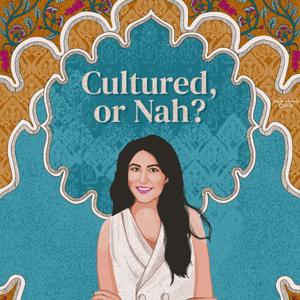


In this episode Shabnum is joined by Juanita Dudhnath of Brown Girl Magazine as both of them talk through the dark history of indentured servitude that led to Indian migration to the Caribbean, and how four to five generations onward the culture of Indo-Caribbean people has evolved. Juanita explains the term "Coolie," and how it can have both familiar and negative connotations, and she explains the hyphenated identity that Indo-Caribbeans have uniquely lived with for generations when the world is just now starting to normalize a hyphenated identity. We also talked a bit about the perception problem of other South Asian Americans not seeing Indo-Caribbeans as our own, and how the world is changing to enable more of these conversations to be had in order to drive changes in thinking.
Host: Shabnum Gulati
Guest: Juanita Dudhnath
Art: Chelsi Bhagan (@island.childd) on Instagram
Music: AnAkkiN on SoundCloud
In this episode, Shabnum interviews Jennifer Williams, Senior Foreign Editor of Vox Media on her journey with religious conversion to Islam. Jennifer grew up Southern Baptist, but through the course of her own work and research, found herself drawn to Islam. The best way to summarize Jen's journey is in her own words: "If you were to pass me on the street, you would never suspect I’m a Muslim: I don’t wear hijab. I have platinum blonde hair and blue eyes. And I am heavily tattooed. I grew up in Texas and was raised Southern Baptist. I use the word “y’all” a lot—and not ironically. But I am Muslim. I also speak Arabic and hold a Master’s degree in International Security with a focus on terrorism and the Middle East. "
Join us in this episode as Shabnum asks Jen about the effect converting religions can have on a person and their sense of identity. Was it easy to fit in after conversion? Did she feel like she was leaving something behind? How did her family take it? What were the hardest parts, and what did she learn about herself that she may not have known before?
Host: Shabnum Gulati
Guest: Jennifer Williams
Art: Hanifa Abdul Hameed
Music: AnAkkiN on SoundCloud
Is the American dream for everyone? Does the color you are on the spectrum affect your place in society? In this episode Shabnum talks to Madison Natarajan and Alex Karjeker about their experiences growing up part South Asian. Madison is half white and half Indian, Alex is mixed race with multiple South Asian and part South Asian family members. Both of them talk to us about their experiences growing up and how they came to terms with the many different fragments of their identities. Madison talks through her childhood in which there was more of a "proximity to whiteness" as her father had also struggled with race growing up in America, thus causing her to lean more into her white identity. Alex talks us through how discussions of race and identity, of the inevitable inequity of race in America were discussions his family consistently had at home and how they helped him reconcile his reality growing up.
Host: Shabnum Gulati
Guests: Madison Natarajan and Alex Karjeker
Illustration: Hanifa Abdul Hameed
Music: AnAkkiN on SoundCloud
A lot of us are first generation citizens of western countries where our parents were immigrants. Some of us have been parents for a few years while others are just now embarking on this journey; still others are a few years away. Gen X and Millennial diaspora South Asians are now having to grapple with questions of how we raise our own children: our second generation and sometimes biracial children in today's world where in many ways we have far more opportunities to provide them than ever before, but also brand new questions to tackle on race, feminism, climate change, and health. Additionally, how do we deal with the loss of our own parents and losing a bit of the culture we were raised with as it slips away? In this episode, Shabnum talks to Nikesh Shukla, author of Brown Baby - a memoir of race, family, and home. Nikesh talks us through how he's thinking about many of the questions mentioned above as he documents his thoughts in raising his two young daughters.
In this episode Shabnum sits down with Unitarian Minister Barbara Merritt, who is working on a collection of poetry from Rumi's Masnavi. She explains the persistence of Sufi poetry in our world and how and why it has survived the test of time. Sufi poetry has transcended organized religions and is widely read and used - the imagery being relatable and the lessons being easy to remember. Rumi is the most widely read poet in America, and Barbara explains why Sufi poetry which originated in the Islamic tradition has since overcome barriers of religion and been adopted by so many across the world.
Host: Shabnum Gulati
Guest: Barbara Merritt
Art: Hanifa Abdul Hameed
Music: AnAkkiN on SoundCloud
Bibliography from the show:
Doorkeepers of the Heart, Versions of Rabi’a, Charles Upton , Threshold Books
The Conference of the Birds: Attar, translated by Sholeh Wolpe, w.w. Norton & Company
The Winged Energy of Delight: Selected Translations, (Poems from Europe, Asia and the Americas), Robert Bly, HarperCollins
Bulleh Shah, J.R. Puri & T. R Shangari, Radha Soami Satsang Beas
The Essential Rumi, Translations by Coleman Barks and John Moyne, HarperSanFrancisco
Mystical Poems of Rumi, Translator, A. J Arberry , University of Chicago Press
Hafez, Translations and Interpretations of the Ghazals, Geoffrey Squires, Miami University Press
The Poems of Hafez, translations by Reza Ordoubadian, Ibex Publishers
In this episode, Shabnum interviews British standup comedian and now book author Tez Ilyas about his book "The Secret Diary of a British Muslim Aged 13 3/4." Cycling through a variety of topics, Tez and Shabnum exchange childhood stories of growing up South Asian (Tez still can't believe Shabnum would use the word "rice" to describe what she's eating for dinner instead of "chawal"). Tez talks about racism in a post-Thatcher Britain, the after effects of 9/11 and the 7/7 attacks, and the effects of American politics on the world. They of course wrap up with more on Man Like Mobeen and the inspiration for the show. You won't want to miss this fun episode that touches on some very important topics about the British South Asian narrative from the hilarious Tez Ilyas!
Host: Shabnum Gulati
Guest: Tez Ilyas
Music: AnAkkiN on SoundCloud
Originally recorded for the South Asian Film Festival of America by Product of Culture, in this episode Shabnum & Rajiv take a magnifying glass to Bollywood films throughout time. With an almost academic fervor, they explore the relationship between the Hindi film industry and the Indian government while applying that lens to the tropes we've seen in Bollywood through the 70's - 2010s. They'll talk through the way India's relationship with the USSR impacted the type of Bollywood hero we saw in the 70s-80s, the way high rates of unemployment at the time landed us with iconic characters such as the ones in Sholay, and the role of globalization going into the 90s impacting much of what we saw in films like DDLJ. They'll also talk through the way body perceptions have changed across time, and when we started seeing the objectification of the male body just as much as the female body in the late 2010's. Don't miss this episode if you're remotely interested in films!
Exec Producer & Host: Shabnum Gulati
Guest: Rajiv Menon
Art: Nainah Hussain
Music: AnAkkiN on SoundCloud
Special thank you to Product of Culture
In this episode Shabnum talks to Sabrina Lakhani and Malini Ramakumar Bartels. Sabrina is a behavioral scientist who specializes in helping people learn how best to navigate their own attachment styles in relationships. Having gone through a divorce herself, Sabrina shares the common pitfalls that South Asians may fall into due to cultural expectations and the marriages they would have observed of their own parents growing up. Malini is a 46 year old mother of two who shares more about her own journey growing up as a Gen X South Asian in the 80s and the experiences she's had with friends and family in the wake of her divorce. Both women have many insights to share about how and why divorces are more common than ever before, how they've learned from their own experiences, and why we may not have been able to recruit any men to speak on this episode. This was a fascinating episode of both science and anecdotes, and a definite must listen whether you're in a relationship or not!
Executive Producer & Host: Shabnum Gulati
Guests: Sabrina Lakhani and Malini Ramakumar Bartels
Art: Hanifa Abdul Hameed
Music: AnAkkiN on SoundCloud
In this episode Shabnum talks to Supraja Seshadri and Darshi Shah in more of an anecdotal episode on their experiences going through the Arranged Marriage process. Supraja is Tamil and Darshi is Gujarati. They both talk through how the process works generally as well as some spicy, hilarious, and sometimes sad tales of the various dates they've been on and how the process has gone for them. This is a long episode, so feel free to skip to parts you'd find most interesting:
0:00-0:30 - Intros, how the process generally works
0:30-1:20- Various tales of arranged marriage prospects, and the various issues that were highlighted throughout
1:20-1:48 - Story of how Supraja met her husband
Host: Shabnum Gulati
Guests: Supraja Seshadri
Art: Hanifa Abdul Hameed
Music: AnAkkiN on SoundCloud
In this episode, Shabnum sits down with her friend Khalil currently joining us from Ramallah, Palestine and they both explore the similarities between the Israeli/Palestinian and Indian/Pakistani conflict. Taking the stance that dividing countries up on religious grounds has not turned out to be the "clean" solution it may appear to be on paper, Khalil and Shabnum talk through family stories of the respective partitions and how the conflicts have a few features in common: colonization by the United Kingdom, a colonial empire falling apart in the wake of World War II, and a two state solution to carve out a religious state. Khalil also talks about his experiences of growing up in Palestine, and what the situation is like on the ground right now.
Host: Shabnum Gulati
Guest: Khalil A.
Art: Hanifa Abdul Hameed
Music: AnAkkiN on SoundCloud
From the publisher's feed