Daily Class

Daily Class

By Hare Krishna MelbourneReligion & Spirituality
Download on the App Store

Daily Class episodes

  • Śrīmad Bhāgavatam class on Thu 8th July 2021 by Arjuna Sakhā Dāsa 5.17.15-16
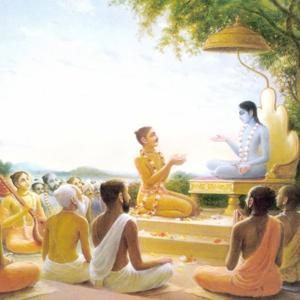
    Sometimes we see a picture of Lord Śiva engaged in meditation. This verse explains that Lord Śiva is always meditating upon Lord Saṅkarṣaṇa in trance. Lord Śiva is in charge of the destruction of the material world. Lord Brahmā creates the material world, Lord Viṣṇu maintains it, and Lord Śiva destroys it. Because destruction is in the mode of ignorance, Lord Śiva and his worshipable Deity, Saṅkarṣaṇa, are technically called tāmasī. Lord Śiva is the incarnation of tamo-guṇa. Since both Lord Śiva and Saṅkarṣaṇa are always enlightened and situated in the transcendental position, they have nothing to do with the modes of material nature — goodness, passion and ignorance — but because their activities involve them with the mode of ignorance, they are sometimes called tāmasī.

    1 hr 12 min
  • Śrīmad Bhāgavatam class on Mon 5th July 2021 by Svarup Sakti Dāsi 5.17.12
    There are four yugas: Satya-yuga, Tretā-yuga, Dvāpara-yuga and Kali-yuga. During the first yuga, Satya-yuga, people were very pious. Everyone practiced the mystic yoga system for spiritual understanding and realization of God. Because everyone was always absorbed in samādhi, no one was interested in material sense enjoyment. During Tretā-yuga, people enjoyed sense pleasure without tribulations. Material miseries began in Dvāpara-yuga, but they were not very stringent. Stringent material miseries really began from the advent of Kali-yuga.
    39 min
  • Śrīmad Bhāgavatam class on Sun 5th July 2021 by His Grace Gangesvara Prabhu 5.17.10-11
    “One should render transcendental loving service to the Supreme Lord Kṛṣṇa favorably and without desire for material profit or gain through fruitive activities or philosophical speculation. That is called pure devotional service.” Those who fully engage in devotional service to Kṛṣṇa just to please Him are not interested in the three divisions of heavenly places, namely, divya-svarga, bhauma-svarga and bila-svarga.
    1 hr 10 min
  • Śrīmad Bhāgavatam class on Sat 3rd July 2021 by SuryaGopal Dāsa 5.17.5-9
    The place where the Ganges flows into the salt water of the Bay of Bengal is still known as Gaṅgā-sāgara, or the meeting place of the Ganges and the Bay of Bengal. On Makara-saṅkrānti, in the month of January—February, thousands of people still go there to bathe, hoping to be liberated. That they can actually be liberated in this way is confirmed herein. For those who bathe in the Ganges at any time, the results of great sacrifices like the Aśvamedha and Rājasūya yajña are not at all difficult to achieve.
    48 min
  • Śrīmad Bhāgavatam class on Fri 2nd July 2021 by Hanuman Dāsa 5.17.4
    We should always remember that the Ganges River comes from the Causal Ocean, beyond the covering of the universe. After the water of the Causal Ocean leaks through the hole created by Lord Vāmanadeva, it flows down to Dhruvaloka (the polestar) and then to the seven planets beneath Dhruvaloka. Then it is carried to the moon by innumerable celestial airplanes, and then it falls to the top of Mount Meru, which is known as Sumeru-parvata. In this way, the water of the Ganges finally reaches the lower planets and the peaks of the Himālayas, and from there it flows through Hardwar and throughout the plains of India, purifying the entire land.
    55 min
  • Śrīmad Bhāgavatam class on Thu 1st July 2021 by His Grace Prabhav Prabhu 5.17.3
    Śrī Caitanya Mahāprabhu has perfectly enunciated and broadcast the process of bhakti-yoga. Consequently, for one who has taken shelter at the lotus feet of Śrī Caitanya Mahāprabhu, the highest perfection of the Māyāvādīs, kaivalya, or becoming one with the Supreme, is considered hellish, to say nothing of the karmīs’ aspiration to be promoted to the heavenly planets. Devotees consider such goals to be worthless phantasmagoria
    58 min
  • Śrīmad Bhāgavatam class on Wed 30th June 2021 by Karuṇānidhi Kṛṣṇa Dāsa 5.17.2
    When a person is firmly fixed in devotional service to the Supreme Personality of Godhead, he is described as vīra-vrata, fully determined. Such a devotee increases his ecstasy in devotional service more and more. Thus as soon as he remembers Lord Viṣṇu, his eyes fill with tears. This is a symptom of a mahā-bhāgavata. Dhruva Mahārāja maintained himself in that devotional ecstasy, and Śrī Caitanya Mahāprabhu also gave us a practical example of transcendental ecstasy when He lived at Jagannātha Purī. His pastimes there are fully narrated in Caitanya-caritāmṛta.
    54 min
  • Śrīmad Bhāgavatam class on Tue 29th June 2021 by GopaVrndesa Dāsa 5.17.1
    The water of the Ganges is called patita-pāvanī, the deliverer of all sinful living beings. It is a proven fact that a person who regularly bathes in the Ganges is purified both externally and internally. Externally his body becomes immune to all kinds of disease, and internally he gradually develops a devotional attitude toward the Supreme Personality of Godhead.
    48 min

About Daily Class

From the publisher's feed

Classes and presentations from the Hare Krishna Temple in Melbourne.