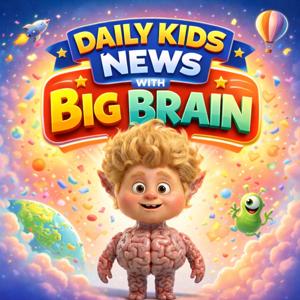
Daily News for Kids with Big Brain

Daily News for Kids with Big Brain

Download on the App Store

Daily News for Kids with Big Brain episodes

  • Big Brain News Ep. 81: Sky Movies, Moon Robots, and a Baby Sloth Named Joy
    Big Brain News — Episode 81 (07/02/2026)
    What’s inside this episode:
    1) The 10-year “cosmic movie”
    • The Vera C. Rubin Observatory will take repeated images of the night sky over many years.
    • Learning focus: observing change over time (patterns, motion, and careful tracking).
    • Vocabulary: observatory, time-lapse, asteroid, track.
    2) NASA’s Moon robot scouts
    • Idea: send robots to explore and map the Moon’s south pole before larger missions.
    • Learning focus: practice missions, measurement, iteration, and planning.
    • Class/home analogy: test a path first, then make a better plan.
    3) Baby sloth named Cusi (“joy”)
    • A Hoffmann’s two-toed sloth baby at Como Park Zoo is growing and exploring new foods.
    • Learning focus: mammals and baby animal care; habitats and keeper routines.
    Parent/Teacher Corner:
    Use this episode to discuss:
    • How scientists use repeated observations to learn.
    • Why big projects take patience (like gardening, building, or long-term class experiments).
    • How zoos support animal health through habitat design, temperature, and diet.
    Discussion questions (kid-friendly):
    • If you could make a time-lapse movie of one thing in nature, what would you film?
    • What’s one kind way people can help animals—at home or in their community?
    #BigBrainNews #KidsNews #ScienceForKids #STEM #AstronomyForKids #NASA #RoboticsForKids #ZooEducation #Sloth

    6 min
  • Big Brain News Ep. 80: Space Saves, Friendly Robots, and a Dino from the Ice
    Big Brain News — Episode 80 (for kids 5–9, with parents/teachers in mind)
    Today’s stories:
    1) NASA and the Swift space telescope
    • Key idea: Orbits can change over time.
    • What’s happening: A planned robotic helper mission could gently nudge Swift to a higher orbit.
    • Learning moment: Small pushes, timed well, can change motion over time (like a merry-go-round).
    2) Full-size humanoid robots and “mass production”
    • Key idea: Mass production means making many copies reliably.
    • Why it matters: Consistent parts and stable design can help robots do repeatable tasks.
    • Learning moment: Walking takes balance + sensing; robots use sensors and computers to move safely.
    3) A dinosaur clue from Antarctica: titanosaur
    • Key idea: Fossils are clues about ancient life and environments.
    • What’s happening: A backbone fragment was identified as titanosaur.
    • Learning moment: Antarctica’s climate changed over millions of years; continents drift like slow puzzle pieces.
    Parent/Teacher Corner:
    These stories are great for talking about how science tools (telescopes and fossils) teach us about the past and the universe, and how engineers design robots for helpful jobs. If your child has big feelings about “robots,” you can frame them as tools people control and test carefully.
    Discussion questions:
    • What job would you give a helpful humanoid robot at home or at school?
    • If you could name a dinosaur found in Antarctica, what would you call it and why?
    7 min
  • Big Brain News Ep. 79: Satellites, Storytime, and Super Batteries!
    In this episode, Big Brain connects three big ideas kids can see in real life: teamwork in technology, careful thinking in science, and community through creativity.
    Stories in Episode 79
    1) SpaceX adds 24 Starlink satellites
    • What satellites do: send and receive signals
    • What “orbit” means (a fast path around Earth)
    • Reuse in engineering: why landing and reusing rocket parts matters
    2) A space puzzle near a reusable space plane
    • “We don’t know yet” is a normal part of science
    • How tracking works: telescopes, radar, and math
    • Why tracking objects in orbit helps keep spacecraft safe
    3) A big California festival celebrates art, dancing, and stories
    • Storytelling builds imagination and empathy
    • Art-making uses science (colors, light, materials)
    • Dancing uses patterns, timing, and teamwork
    Parent/Teacher Corner
    These stories are great for discussing how technology connects to daily life (internet, power, communication) and how arts events help communities share ideas.
    Discussion Questions
    • If you could send one helpful satellite around Earth, what would it do?
    • What’s one art activity you’d want at a big community festival, and why?
    7 min
  • Big Brain News Ep. 78: Fast Rockets, Talking Robotaxis, and Sun Festivals
    In this episode:
    1) Fast rocket launch (Rocket Lab’s Electron)
    • What does it mean to launch quickly after the “go” signal?
    • “Responsive space” explained: sending satellites when they’re needed.
    • Reminder: rockets go up and sideways to reach orbit.
    2) Robotaxis and clear communication (Zoox)
    • Self-driving cars use sensors (like cameras and radar) to understand the road.
    • People also need to understand the car: reflectors and two-way audio can help.
    • Big idea: clear signals make shared spaces feel calmer and easier to navigate.
    3) Inti Raymi in Cusco, Peru
    • A cultural celebration known as the Festival of the Sun.
    • Connections to the Inca civilization and why sunlight mattered for crops.
    • Reenactments and ceremonies help communities remember history respectfully.
    Parent/Teacher Corner:
    These stories are great for talking about how technology communicates and how traditions connect people to history. If vitamin D comes up, keep it simple: sunlight, food, and doctors can help families make good choices.
    Discussion questions:
    • If a robot car could talk, what should it say to help people feel comfortable crossing the street?
    • What’s one tradition your family has, and what does it celebrate?
    6 min
  • Big Brain News Ep. 77: Sharks That Walk, Robots That Remember, and a Baseball Big Win
    Big Brain News Episode 77
    1. Tiny Robots Get a Super-Map Memory Chip
    2. A Newly Described “Walking Shark” Scoots on the Seafloor
    3. What Is the Men’s College World Series?
    Discussion questions:
    - If you could design a robot to explore one place, where would it go and what would it need to remember?
    - Why do you think practice and teamwork matter in sports and in science?
    6 min
  • Big Brain News Ep. 76: Sun Science, Splash Races, and Super Sports
    Big Brain News — Episode 76 (2026-06-22)
    Today’s kid-safe stories connect science, history, and teamwork.
    Story 1: Summer Solstice (Northern Hemisphere)
    • What it is: A day with the most daylight in many places.
    • Why it happens: Earth is tilted, so our side leans toward the Sun in summer.
    • Simple activity: Shadow check—observe a shadow from the same safe spot in the morning, midday, and evening.
    Story 2: Near Stonehenge — Possible Early Sun-Tracking Posts
    • What archaeologists reported: Soil clues that may mark where two wooden posts once stood.
    • Why it matters: Watching sunrise/sunset positions helps people notice seasonal patterns.
    • Conversation prompt: How could people plan planting or celebrations without clocks or calendars?
    Story 3: Dragon Boat Festival Races
    • What it is: A long-running tradition featuring teams paddling in rhythm.
    • Key idea: Timing + coordination = smoother movement (great teamwork example).
    • Quick practice: Clap a steady beat and try a simple group motion together.
    Parent/Teacher Corner
    These stories mix nature, culture, and sports in a light, kid-friendly way. If your child gets curious, look up your local sunset time or watch a short dragon boat clip to spot teamwork.
    Discussion Questions
    1) What’s one thing you notice the Sun doing differently in summer compared to winter?
    2) Which sport or activity do you think takes the best teamwork, and why?
    6 min
  • Big Brain News Ep. 75: Satellites, Sky Magic, and Baby Wolves
    Big Brain News — Episode 75 (2026-06-18)
    Today’s Stories
    1) SpaceX Dragon Splashes Down with Space Science
    • What a cargo capsule returns to Earth (science samples + equipment)
    • Microgravity basics: how floating changes liquids, crystals, and experiments
    • How reentry and parachutes help a capsule land safely
    2) The Moon Makes Venus Disappear (For a Moment)
    • “Lunar occultation” = one space object blocks another
    • Why the closer Moon can cover the far-away Venus (thumb comparison)
    • A simple way to notice motion in the sky over time
    3) A Museum Introduces Super-Rare Red Wolf Pups
    • Red wolves as a rare species and why every pup matters
    • Conservation as teamwork: protecting habitats, research, and breeding programs
    • Biodiversity: many different living things help ecosystems stay strong
    Parent/Teacher Corner
    • Use these stories to connect science learning with real-world care for nature.
    • Try: look up local stargazing times together; practice respectful wildlife watching.
    Skywatching Safety Note
    • Adult help recommended.
    • Never look at the Sun with your eyes or through binoculars/telescopes—only use proper solar viewers or safe, approved solar filters (regular sunglasses are not safe).
    Discussion Questions
    • If you could send one experiment to the space station, what would it be and why?
    • What’s one way people can help wild animals stay safe in the ocean or in forests?
    6 min
  • Big Brain News Ep. 74: Moon Slivers, Baby Salamanders, and Super-Helpful AI Helpers
    Big Brain News — Episode 74 (2026-06-17)
    Today’s stories (for ages 5–9):
    1) Baby Hellbender Salamanders Get a Science “Head-Start”
    • What a head-start program is and why it helps young animals survive
    • Why clean, healthy streams matter for wildlife and communities
    2) A Super-Skinny Moon Visits Mercury After Sunset
    • What Mercury is and why it’s tricky to spot near the Sun’s glare
    • What “earthshine” means (sunlight bouncing Earth → Moon)
    • Skywatching safety: binoculars only with a grown-up; never point them near the Sun
    3) A New Moon Lander: Astrobotic’s Griffin-1
    • What a “lander” does (like a delivery truck for space)
    • Why engineers test space machines (shake, hot/cold, electronics checks)
    • How robots help science by measuring, photographing, and sending data
    Parent/Teacher Corner:
    Use this episode to talk about helping wildlife responsibly and using technology thoughtfully. If you skywatch, review simple Sun-safety rules together.
    Discussion Questions:
    • If you could help one animal in nature, which would you choose and how would you help it?
    • What’s one job you’d want an AI helper to do at home or school?
    6 min
  • Big Brain News Ep. 73: Spiders, Sea Science, and a Super-Sized Flag!
    Episode 73 (June 15, 2026)
    Story 1: A New Cave Spider in Oregon Gets a Real Name
    • Caves can shape how animals adapt over long periods of time.
    • Scientists look at physical features and may compare DNA to confirm a new species.
    • Community-style naming can turn science into a shared celebration.
    Story 2: A Hands-On Ocean Science Space Opens: See More HQ
    • Coastal science studies the place where land meets ocean.
    • Scientists measure wave height, wind, water temperature, and salinity.
    • Interactive exhibits help kids learn by experimenting and exploring.
    • Bilingual spaces invite more families to learn together.
    Story 3: Flag Day Fun at the Smithsonian
    • Flags can act like a “team logo” that helps people remember shared history and symbols.
    • The Smithsonian holds the original Star-Spangled Banner.
    • Museums use careful conservation (light, temperature, gentle handling) to protect historic objects.
    Parent/Teacher Corner
    Today’s stories are all about curiosity: discovering new species, exploring ocean science, and learning history through museum activities. If your child wants to dig deeper, consider a library book on spiders, tides, or U.S. symbols.
    Discussion Questions
    1) If you discovered a new animal, what would you name it and why?
    2) What’s one question you’d ask a scientist who studies the ocean?
    6 min
  • Big Brain News Ep. 72: Three-City Music, Museum Magic, and a Super-Sneaky Snake!
    Big Brain News Episode 72
    1. A Giant World Cup Concert Happened in Three Cities at Once
    2. A Free Museum Day Turned Families into Art Explorers
    3. Meet the Southern Hognose Snake—and How People Can Help Scientists
    Discussion questions:
    - If you could send one helpful idea to protect an animal, what would it be?
    - What’s one artwork or song that makes you feel curious, and why?
    5 min

About Daily News for Kids with Big Brain

From the publisher's feed

Big Brain is your kid’s curiosity buddy, turning yesterday’s real-world stories into a fun, safe 4–6 minute daily show.