
Sign up to save your podcasts
Or

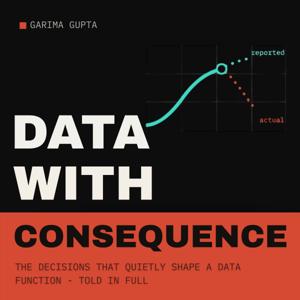


What if the biggest danger of artificial intelligence isn't that it fails, but that it delivers completely wrong answers with absolute confidence?
In this episode of Data With Consequence, I'm sharing a real experience that fundamentally changed how I think about AI, data analytics, and the role of human judgment in business decision-making.
My team built an AI-powered customer churn prediction model that appeared to work perfectly. No errors. No warnings. No technical failures. But buried inside the results was a critical mistake: the model predicted that a company's most loyal founding members were just as likely to leave as everyone else.
The forecast was wrong by fifteen percentage points.
And here's the uncomfortable truth: my data team didn't catch it. A business stakeholder did.
That experience exposed something I believe every executive and data leader needs to understand. AI doesn't necessarily fail loudly. It often fails confidently.
But I'm not here to argue that AI is dangerous or that organizations should slow down adoption. In fact, I've experienced firsthand just how transformative this technology can be.
I'll explain how my team used AI to accelerate complex data modeling projects by five times, reducing work that previously required six to twelve weeks to approximately two weeks.
The difference wasn't simply faster coding. It was our ability to capture business context, reuse knowledge, and apply AI strategically.
And that's where things get interesting.
The same practice that made us dramatically faster—reusing knowledge—was also responsible for our near-disastrous prediction.
So how do we benefit from AI's extraordinary speed without sacrificing accuracy?
I share one of my most important principles: Reuse the concepts. Re-validate every instance.
I'll also introduce my five-step framework, the Consequence Loop, which helps organizations establish the guardrails necessary to prevent confident but incorrect AI outputs from becoming costly business decisions.
The framework covers five essential actions: Context, Constrain, Validate, Codify, and Own.
We'll explore why traditional quality checks aren't enough, why AI confidence scores can be misleading, and why the people who understand your business may be more valuable than the people who understand your algorithms.
I'll also challenge executives to reconsider how they're approaching AI transformation.
Instead of directing teams to build more AI agents or adopt more tools, I believe leaders should focus on defining the business problems that actually need solving.
AI adoption isn't an outcome. Better, faster business decisions are.
Finally, I'll discuss how AI is changing what I look for when hiring data professionals. After interviewing approximately 2,000 candidates throughout my career, I've learned that technical skills alone aren't enough. Curiosity, critical thinking, and the willingness to challenge seemingly perfect results matter more than ever.
If you're leading an organization, managing a data team, or making decisions based on AI-generated insights, this conversation is for you.
Because the technology doesn't own your numbers.
You do.
Now go argue with a machine.
From the publisher's feed