
Sign up to save your podcasts
Or



Patty Glick is the lead author of a new paper that lays out a framework for land management in our modern era of climate change. She explains how the framework was crafted and how it can help land managers adapt their practices to account for our rapidly changing climate.
A panel of raptor biologists discuss the current effort to survey the Snake River canyon’s Prairie falcon population. As you’ll hear in the discussion, the Snake River canyon is a very special place for prairie falcons, and the full canyon survey that’s currently underway is part of a monumental effort to assess the size and health of this unique population.
Amanda Hoffman is the current manager of the Morley Nelson Snake River Birds of Prey NCA. She took over this role in March of 2016, having previously served as the acting associate monument manager at Grand Staircase Escalante National Monument. We talked with Amanda about the challenges that she’s faced since becoming the manager of this NCA, and how she’s taken lessons from the unique history of the area.
Dr. Julie Heath is a professor in the department of Biological Sciences and the Raptor Research Center at Boise State University. Her research lab is focused on addressing questions about how birds respond to large scale environmental change. She has conducted numerous research projects within the Morley Nelson Snake River Birds of Prey NCA, working with a number of other researchers and graduate students. This research has documented how raptors are responding to some of the changes occurring within the NCA and the surrounding area.
Kent Carnie is a lifelong falconer, longtime board member of the Peregrine Fund, and the founder of the Archives of Falconry. His close friendship with Morley Nelson lasted for many decades, and Carnie played a central role in the decision to relocate the Peregrine Fund’s headquarters to its current home in Boise, ID. We discussed with Mr. Carnie the history of American falconry as well as the influence that Morley Nelson had on the sport. Carnie also explains the role that Morley played in the recovery of the peregrine falcon, and the influence that the Peregrine Fund exerted to support the establishment of the Snake River Birds of Prey NCA.
Roger Rosentreter is a retired BLM botanist – he spent 35 years working as the Idaho BLM state botanist. During that time Roger worked throughout Idaho and the Intermountain West, but always maintained a strong connection with the high desert ecosystems of the sagebrush steppe, and has spent quite a bit of time working in the NCA. He has amassed a wealth of knowledge about the introduction of invasive species such as cheatgrass, and has conducted numerous research projects analyzing the effects of these introductions on native species. He has authored close to 100 scientific publications over the course of his career.
John Freemuth is a professor of public policy at Boise State University, but he also serves as the Cencil Andrus endowed chair of Environment and Public Lands for the Andrus Center for Public Policy. During the Clinton administration, Freemuth served as the chair of the science advisory board for the BLM, so he has a vast depth of knowledge on how science can and should affect public policy. We talked with John Freemuth about the legacy of Cecil Andrus and how science should continue to affect policy in the Snake River Birds of Prey NCA.
Dean Hagerman is a historian, graduate student, and former National Guardsman who worked at the Orchard Combat Training Center within the Snake River Birds of Prey NCA. As someone with both direct experience working for the National Guard at their training area inside the NCA, and a graduate student studying the history of this very area, Dean is uniquely positioned to share the history behind this National Guard training center. And this history is quite unique – as Dean points out, there are no other examples on the planet of an active military training area operating from within an area protected for environmental reasons.
John Sullivan was the first manager of the Snake River Birds of Prey National Conservation Area, serving in this role for over a decade. In our interview, Sullivan provides some fascinating insight into the issues that needed to be addressed during the early years of the NCA, including a contentious relationship with an Army National Guard training center.
Tracy Andrus is the middle daughter of former Idaho governor and secretary of the interior Cecil Andrus. Tracy has a wealth of amazing stories about growing up in the Andrus household and traveling to Washington, D.C. for her father’s term as the Interior Secretary. She has become an advocate for public lands in her own right in her role as the president of the Andrus Center for Public Policy at Boise State U, and her insight into the processes behind the establishment of the Snake River Birds of Prey NCA is invaluable.
From the publisher's feed
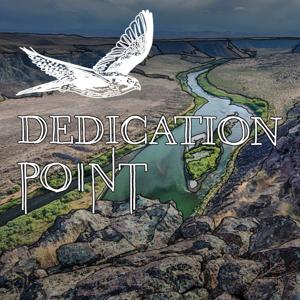
Dedication Point is a podcast that features stories about the Morley Nelson Snake River Birds of Prey National Conservation Area in Southwestern Idaho.