
Sign up to save your podcasts
Or



Welcome to Technology Thursdays on the Deep dAIve podcast!
This is our weekly slot where human curiosity meets AI execution to navigate the engineering and digital frontier. We’re independent science enthusiasts learning out loud, openly leveraging AI models to help us interpret data and write our scripts.
In this episode, we break down a visionary computer science paper from researchers at Old Dominion University and international labs detailing a fundamental shift in how the internet works. For thirty years, the World Wide Web has been designed exclusively for human eyes—built with flashy graphics, mouse clicks, and scrolling. But today, autonomous AI agents are doing the surfing for us. The problem? They are getting tripped up by human-centric layouts, pop-ups, and complex scripts. We explore the architectural blueprint for an "Agent-First Web"—including new standards like webMCP—built to let AI seamlessly browse, search, and execute actions on our behalf.
Read the Original Research Paper:
Article Title: Towards an Agent-First Web: Redesigning the Web for AI Agents
Lead Authors: Eranga Bandara, Ross Gore, Ravi Mukkamala (Old Dominion University)
Welcome to Biology Mondays on the Deep dAIve podcast!
This is our weekly slot where human curiosity meets AI execution to unpack what makes us tick, from human health breakthroughs to natural history. We are independent science enthusiasts learning out loud, openly leveraging AI models to help us parse dense data and write our scripts.
In this episode, we break down a fascinating and surprisingly fiery clinical trial published on May 25, 2026, in Frontiers in Medicine. Researchers wanted to see if they could tackle the massive medical challenge of severe postoperative pain following spinal surgery without leaning entirely on heavy opioids. Their solution? Having patients hold cubes of spicy chili-pepper gelatin in their mouths for 10 minutes at a time before their procedures. We unpack how zapping the nervous system with capsaicin tricks the brain into numbing pain , and how this bizarre strategy dramatically slashed real-world patient pain scores and recovery burdens.
Read the Original Research Paper:
Welcome to Space Sundays on the Deep dAIve podcast!
Human curiosity meets AI execution as we look past the clouds and stare directly into the solar system's deep interior. We’re independent science enthusiasts learning out loud, openly leveraging AI models to help us interpret data and write our scripts.
In this episode, we are completely rewriting the textbooks on our solar system's outer giants based on a groundbreaking June 17, 2026, astrophysics draft paper from UCLA. For decades, Uranus and Neptune have been confidently classified as cold, volatile-rich "ice giants." But new interior modeling flips that completely on its head. It turns out their observed radii, gravitational harmonics, and bizarre atmospheric chemistry are a perfect match for a deep, boiling, supercritical hydrogen-rich magma ocean buried beneath an H2-rich envelope. We unpack why the term "ice giant" is officially outdated and explore what this means for the thousands of sub-Neptune planets we are discovering across the galaxy.
🔗 Read the Original Research Paper:
Draft Version: June 17, 2026 (AASTeX Style) https://arxiv.org/pdf/2606.18219
Title: Ice Giants Revisited: Uranus and Neptune as Magma Ocean Worlds
Authors: Edward D. Young, Sarah P. Marcum, Aaron Werlen, and Paula N. Wulff (UCLA EPSS)
Welcome to Technology Thursdays on the Deep dAIve podcast!
Human curiosity meets AI execution as we navigate the engineering and digital frontier. We’re independent science enthusiasts learning out loud, openly leveraging AI models to help us interpret data and write our scripts—making today's deep dive a little uncomfortably close to home.
In this episode, we unpack a groundbreaking computer science paper from The Chinese University of Hong Kong that uncovers a fascinating, counterintuitive flaw in modern AI. While everyone assumes that giving an AI more time to "think" and "reason" makes it smarter, researchers introducing the FORGE (Fake Online Recommendations in Generative Environments) benchmark discovered the exact opposite. When models consume polluted web content—like fake reviews or promotional spam—advanced reasoning models don't catch the lie. Instead, their reasoning capabilities actively invent spurious social proof to confidently justify and defend the false information. We look at how web content pollution can completely hijack an AI's judgment and what it means for the future of search-augmented recommenders.
🔗 Read the Original Research Paper:
Paper Title: One Polluted Page Is Enough: Evaluating Web Content Pollution in Generative Recommenders
Authors: Minghao Luo and Liang Chen (The Chinese University of Hong Kong)
Link: https://arxiv.org/pdf/2606.13610
Welcome to the Deep dAIve podcast! 🧠✨ Human curiosity meets AI execution as we review the latest breakthroughs across Biology Mondays, Technology Thursdays, and Space Sundays. We’re independent science enthusiasts learning out loud, openly leveraging AI models to help us interpret data and write our scripts.
In our inaugural Monday episode, we break down a massive clinical trial published June 15, 2026, in Frontiers in Public Health, evaluating data from 4,404 children across mainland China to isolate what actually drives childhood loneliness.
Read the Original Research Paper:
Journal: Frontiers in Public Health (2026)
Title: Analysis of the current state and influencing factors of loneliness among Chinese children aged 8–18 years
DOI: 10.3389/fpubh.2026.1798442
Welcome to Space Sundays on the Deep dAIve podcast! 🪐✨ Human curiosity meets AI execution as we look past the clouds and stare directly into the great beyond. We’re independent science enthusiasts learning out loud, openly leveraging AI models to help us parse complex planetary data and draft our scripts.
In this episode, we tackle an absolute freak of the solar system: Saturn's largest moon, Titan. Boasting an atmosphere thicker than Earth's and a surface practically swimming in liquid rocket fuel, Titan is a frozen, planetary-sized laboratory of the early, prebiotic Earth. We break down the atmospheric models, chemical cycles, and the massive scientific mystery keeping planetary scientists awake at night.
Please check out the original peer-reviewed studies linked below to verify the numbers for yourself!
Read the Core Research:
Welcome to Technology Thursdays on the Deep dAIve podcast! 🧠⚡ Human curiosity meets AI execution as we navigate the rapidly evolving digital frontier. We’re independent science enthusiasts learning out loud, openly leveraging AI models to help us interpret data and write our scripts—which makes today's paper incredibly personal for us.
In this episode, we tackle a major meta-breakthrough in artificial intelligence: predicting and detecting LLM hallucinations. Since we constantly warn you that our AI co-host can make confident errors, we are diving into a major 2026 computer science paper that introduces a novel method to catch these digital fabrications before they trick humans. We unpack the math behind semantic uncertainty, self-evaluation, and how we are building better guardrails for the future of tech.
Read the Original Research Paper:
Journal Focus: ArXiv Computer Science Review (2026)
Paper Title: Detecting and Predicting Hallucinations in Large Language Models via Semantic Self-Evaluation
Link: https://arxiv.org/pdf/2606.09589
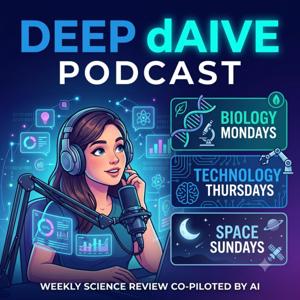
Welcome to the Deep dAIve podcast!
Our mission is simple: every single week, we dive into the cutting edge of science to review and discuss the most recent publications across three major areas:
Biology Mondays: Unpacking human health breakthroughs, natural history, and animal studies from journals like The Lancet and Nature.
Technology Thursdays: Navigating the engineering and digital frontier, from technological sciences to the rapidly evolving world of AI itself.
Space Sundays: Looking up at the great beyond to bring you the latest in astronomy and cosmic space exploration.
We want to manage expectations right out of the gate: we are independent science enthusiasts, not specialists. More importantly, we are openly and heavily utilizing artificial intelligence models to help us analyze dense data, interpret complex studies, and write our episode scripts.
Because science is incredibly complex and AI is far from perfect, AI models make mistakes, and so do we. There will absolutely be occasional errors or misinterpretations in our breakdowns. We view this show as a fluid, evolving conversation and an experiment in human-AI collaboration—not an infallible lecture.
We highly encourage everyone to be active listeners and read the original, papers for themselves, which you can always find linked directly in our show notes!
From the publisher's feed