
Sign up to save your podcasts
Or

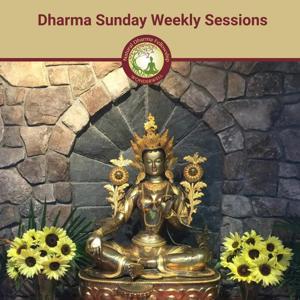


Lama will continue his teaching on The Thirty-Seven Practices of a Bodhisattva (Tibetan: Gyalse Laklen Sorma), which is a famous 14th-century Mahayana text composed by the Tibetan scholar and monk Gyalse Tokme Zangpo. It serves as a practical, step-by-step guide for cultivating compassion, wisdom, and the awakening mind (bodhicitta) to ultimately benefit all sentient beings. All are welcome – no prerequisites.
Here is the link to The Thirty-Seven Practices of a Bodhisattva he will be teaching about.
We will spend this Dharma Sunday in the company of the women who first fought to be included in the audience when Buddha taught. Damchö will narrate that little known story, opening spaces for collective reflection on its implications for the seat women take in Dharma communities today.
We might imagine that Buddha’s teachings were directed to all people from the beginning, but that is not the case. Sanskrit sources contain a detailed account of the interventions that women needed to make in order to be able to receive the Dharma from the Buddha. Drawing on material she encountered during research for her doctoral dissertation, Damcho will narrate that story, opening spaces for collective reflection on its implications for the seat women take in Dharma communities today.
Dharma Sunday | The 21 Semdzin Online Event With Lama Karma Justin Wall July 19, 2026 The 21 Semdzin are a series of practices found in the Dzogchen Upadesha tantras, using visualization, sonification, and embodiment to release effort and rest in non-meditation. Originally found in the “Reverberation of Sound” and the “Union of the Sun and Moon” tantras of the Upadesha class of Dzogchen, the 21 Semdzin were codified by Longchenpa in the 14th Century. Each semdzin, “lit. holding the mind” is a practice of using light, sound, and embodiment to release grasping and rest in unfabricated presence. This will be the first of a two-part series.
The Thirty-Seven Practices of a Bodhisattva (Tibetan: Gyalse Laklen Sorma) is a famous 14th-century Mahayana text composed by the Tibetan scholar and monk Gyalse Tokme Zangpo. It serves as a practical, step-by-step guide for cultivating compassion, wisdom, and the awakening mind (bodhicitta) to ultimately benefit all sentient beings.
Tongxuan: Both wisdom and ignorance have a non-dual nature, but what is the nature of nonduality?
Wansong: Even at dawn, it’s not revealed.
Linquan: Even at dawn it’s not revealed,
Join Lama Willa Baker and the online sangha of Natural Dharma Fellowship for a morning of teaching, prayer, contemplation, meditation practice, and community. Not by the book, Willa’s Dharma Sundays reflect what is most immediately and spontaneously on her heartmind. Time is allotted at the end of every Sunday session for audience participation, questions and reflections. Bring your curiosity, questions and insights.
Written (or discovered) in 1968, the Sadhana of Mahamudra is more relevant now than it has ever been. This long prayer, which includes some of the most poetic descriptions of devotion, longing and awakening in English, is available to meditation students both new and old.
Combining the realization of the Kagyu and the Nyingma schools of Tibetan Buddhism, the Sadhana of Mahamudra emerged at a time of revolution and tumult. The author, Trungpa Rinpoche, was struggling to find a way to connect his deep training in Tibetan Buddhism with the modern world. This sadhana was his answer.
Please join us this Sunday for a discussion of the Sadhana of Mahamudra, and then a group practice session. Most sadhanas are not available without finishing preliminary practices, but in this case the lineage holder has given us permission to do this practice at NDF.
As the poet Theodore Roethke wrote, “In a dark time, the eye begins to see.”
Within our practice traditions, there is sacred technology that helps us touch into the fertile darkness of Prajna Paramita. We will explore these practices together in support of resiliency. This then helps us to navigate in seasons of collective groundlessness.
In the rapidly, ever-evolving world of artificial intelligence, humanity is faced with a myriad of views about what constitutes “intelligence,” consciousness, and the risks of AI. How can the Dharma inform this conversation, and how might mindfulness, insight, and wisdom help us cultivate “right understanding” in the face of these technologies?
Join Lama Willa Baker and the online sangha of Natural Dharma Fellowship for a morning of teaching, prayer, contemplation, meditation practice, and community. Not by the book, Willa’s Dharma Sundays reflect what is most immediately and spontaneously on her heartmind.
From the publisher's feed
Dharma Sundays with Natural Dharma Fellowship include teachings, meditation, and discussions led by NDF Dharma and guest teachers. A wide range of topics are offered.