
Sign up to save your podcasts
Or

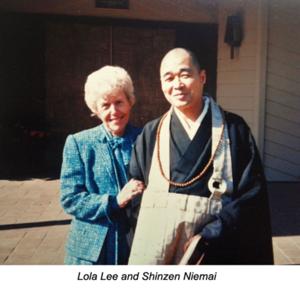

Zen Roshi, Lola McDowell Lee, explores the nature of truth, the limitations of the intellect, and the profound importance of trusting one's own immediate experience.
She begins by introducing a classic Zen Master Tozan’s question: "What is the Buddha?" While working in a storeroom, replied, "This flax weighs three pounds." This seemingly nonsensical answer helps dismantle our reliance on logical analysis.
Lola tells the story of a young student others thought stupid. He who suddenly comes alive in class to ask where numbers go when erased from a blackboard.
And the story of a toddler who stumps his mother by asking how the first clock-maker knew what time it was.
These questions, like the koan, point to mysteries that cannot be solved by conventional logic.
Lee emphasizes that words are merely "fiats" for communication, not the truth themselves. While words carry meaning, they often trap us. If we analyze "three pounds of flax" intellectually, we find no connection to the divine. However, the koan is not a logical proposition but an expression of a state of consciousness. To understand it, one must drop comparative judgments—notions of gain, loss, right, and wrong. The answer points to the "ordinary" nature of reality. There is no other reality than this very ordinary life.
Lee observes that humans are plagued by self-distrust because we remember our lies, mistakes, and failures. Yet we have an innate biological trust exhibited daily: we trust our hearts to beat, our lungs to breathe, and we go to sleep assuming we will wake up.
A person living entirely in a pitch-dark room demands to be convinced that the sun exists before stepping outside. Words cannot convey the experience of light to someone who has known only darkness; one must step out into the unknown to know it. Similarly, demanding proof of God before meditating is a form of distrust that prevents spiritual discovery.
Gurdjeiff described the mind as a broken phonograph record. The repetition creates grooves in the brain, offering a false sense of security. Whether the circle of repetition takes twenty-four hours or ten years, it remains a trap. The goal of religion, she argues, is to get off this self-manufactured wheel and move into the ever-new present moment.
She notes that Zen masters often engage in humble, ordinary tasks like making pickles or weighing flax, defying our expectations that a sage must be an extraordinary, otherworldly figure.
The koan is a tool to exhaust the intellect. By using all of one's psychic power and Hara to solve the unsolvable, the student pushes logic to its breaking point, transforming intellectualization into intuition.
Lola invokes the figure of Hermes Trismegistus to discuss the birth of the Christ consciousness. She ends with a poetic and rhythmic recitation of a Hermetic hymn, calling on the powers of earth, air, fire, and water to sing praises to the "One and All," ultimately guiding the listener toward accepting the gift of God in you and awakening in freedom. Delivered June 1, 1986
 View all episodes
 By I & A Publishing
Zen Roshi, Lola McDowell Lee, explores the nature of truth, the limitations of the intellect, and the profound importance of trusting one's own immediate experience.
She begins by introducing a classic Zen Master Tozan’s question: "What is the Buddha?" While working in a storeroom, replied, "This flax weighs three pounds." This seemingly nonsensical answer helps dismantle our reliance on logical analysis.
Lola tells the story of a young student others thought stupid. He who suddenly comes alive in class to ask where numbers go when erased from a blackboard.
And the story of a toddler who stumps his mother by asking how the first clock-maker knew what time it was.
These questions, like the koan, point to mysteries that cannot be solved by conventional logic.
Lee emphasizes that words are merely "fiats" for communication, not the truth themselves. While words carry meaning, they often trap us. If we analyze "three pounds of flax" intellectually, we find no connection to the divine. However, the koan is not a logical proposition but an expression of a state of consciousness. To understand it, one must drop comparative judgments—notions of gain, loss, right, and wrong. The answer points to the "ordinary" nature of reality. There is no other reality than this very ordinary life.
Lee observes that humans are plagued by self-distrust because we remember our lies, mistakes, and failures. Yet we have an innate biological trust exhibited daily: we trust our hearts to beat, our lungs to breathe, and we go to sleep assuming we will wake up.
A person living entirely in a pitch-dark room demands to be convinced that the sun exists before stepping outside. Words cannot convey the experience of light to someone who has known only darkness; one must step out into the unknown to know it. Similarly, demanding proof of God before meditating is a form of distrust that prevents spiritual discovery.
Gurdjeiff described the mind as a broken phonograph record. The repetition creates grooves in the brain, offering a false sense of security. Whether the circle of repetition takes twenty-four hours or ten years, it remains a trap. The goal of religion, she argues, is to get off this self-manufactured wheel and move into the ever-new present moment.
She notes that Zen masters often engage in humble, ordinary tasks like making pickles or weighing flax, defying our expectations that a sage must be an extraordinary, otherworldly figure.
The koan is a tool to exhaust the intellect. By using all of one's psychic power and Hara to solve the unsolvable, the student pushes logic to its breaking point, transforming intellectualization into intuition.
Lola invokes the figure of Hermes Trismegistus to discuss the birth of the Christ consciousness. She ends with a poetic and rhythmic recitation of a Hermetic hymn, calling on the powers of earth, air, fire, and water to sing praises to the "One and All," ultimately guiding the listener toward accepting the gift of God in you and awakening in freedom. Delivered June 1, 1986