
Sign up to save your podcasts
Or



Confused about residency signaling? In this episode of Don’t Miss That Radiology, Dr. Matthew Hartman reviews the latest evidence on ERAS preference signaling, explains why signaling matters, summarizes current research, and shares practical advice on choosing where to send your signals.
Topics include:
* Why signaling was created
* Gold vs. silver signals
* Latest interview data
* Common mistakes applicants make
* Practical strategy for diagnostic radiology applicants
Whether you’re applying this year or planning ahead, this episode will help you use your signals more effectively.
6 gold
9 silver
Let's maximize our chances
“Don’t signal where you only want an interview. Signal where you’d be happy to match.”
#medicalstudent #eras #residencysignaling #residencyinterview #radiology
Some of the most important findings in radiology announce themselves with a sharp line.
In this episode, Dr. Matt Hartman explains why every crisp interface on an imaging study should make you stop and ask, “Why can I suddenly see this border?” You’ll learn a practical pattern-recognition approach that helps you identify critical diagnoses while avoiding common pitfalls.
Topics include:
* Pneumothorax and the visceral pleural line
* Rigler’s sign and free intraperitoneal air
* Air-fluid levels in achalasia
* Hematocrit levels within hematomas
* Milk of calcium
* Skin folds and other common mimics
Rather than memorizing isolated diagnoses, you’ll learn a visual framework that can be applied across radiology and improve your interpretation of chest radiographs, CT, fluoroscopy, and beyond. Whether you’re a medical student, resident, clinician, or practicing radiologist, this episode will change the way you look at sharp lines on imaging.
🎧 Listen wherever you get your podcasts, or watch the full video on YouTube to follow along with the imaging examples.
Don’t Miss That Radiology—helping you recognize the findings that matter most.
#radiology #medical student #meded #pneumothorax #podcast
Episode 11: All Issues Contrast – Understanding Contrast-Enhanced Imaging
When should you order contrast? When should you avoid it? What do the arterial, portal venous, and delayed phases actually show?
In this episode of Don’t Miss That Radiology, Dr. Matt Hartman explains the fundamentals of contrast-enhanced imaging using real clinical cases and easy-to-remember principles. Rather than memorizing protocols, you’ll learn why tissues enhance differently and how enhancement patterns help narrow your differential diagnosis.
Topics include:
This episode works as an audio podcast, but because we’re discussing imaging, you’ll get even more out of the video version on YouTube or Apple Podcasts, where you can follow along with the CT images as we review each phase.
Remember: Tissue is the issue. Contrast doesn’t just make pictures prettier—it helps reveal the underlying pathology.
If you’re enjoying the series, please subscribe, leave a review, and share the podcast with a colleague, resident, or medical student.
Don’t miss that radiology!
#radiology #medical student #contrast #medicaleducaion
Episode 10: Ultrasound Basics – The Fundamentals Every Medical Student Should Know
Ultrasound is one of the most powerful bedside imaging tools in medicine—but it can be intimidating when you’re first starting out. In this episode of Don’t Miss That Radiology, Dr. Matthew Hartman breaks down the essentials every medical student and resident should know before picking up a probe.
You’ll learn:
* Basic ultrasound physics made simple
* How image orientation works
* Common probe types and when to use them
* Hi yield anatomy
* Common artifacts and how to recognize them
* Clinical applications you’ll encounter on the wards and in the emergency department
Whether you’re preparing for your radiology rotation, learning point-of-care ultrasound (POCUS), or reviewing for exams, this episode provides a practical foundation to help you understand and interpret ultrasound with confidence.
Don’t Miss That Radiology is a high-yield educational podcast designed to help medical students and residents think like radiologists through systematic approaches, memorable frameworks, and real-world clinical cases.
Episode 9: How to Read an Abdominal CT (Part 1) | Don’t Miss That Radiology ⭐
Opening an abdominal CT for the first time can feel overwhelming—but it doesn’t have to.
In this episode, Dr. Matt Hartman walks through a real contrast-enhanced abdominal CT using the same systematic approach he uses every day as a practicing radiologist. Rather than jumping straight to the diagnosis, you’ll learn how a consistent search pattern helps uncover important findings without getting lost.
In this episode you’ll learn:
✅ Why the clinical indication matters before you look at a single image.
✅ Why you should always Scout Before Slice.
✅ How to perform a rapid big-picture review.
✅ How to use windowing (soft tissue, lung, and bone windows).
✅ A practical review of Hounsfield Units (HU).
✅ How to apply Hartman’s 6 Patterns of Tubular Pathology to bowel, ureters, and blood vessels.
✅ How a systematic approach leads you to an important diagnosis.
Whether you’re a medical student starting your radiology rotation, an intern, resident, PA student, NP student, or anyone interested in learning radiology, this episode will help you develop a reliable framework for interpreting abdominal CT scans.
🎧 Subscribe for new episodes every week as we simplify radiology—one case at a time.
⭐ Don’t Miss That Radiology
#Radiology #MedicalStudent #CT #AbdominalCT #RadiologyEducation #FOAMed #MedEd #RadiologyResident #InternalMedicine #EmergencyMedicine
How to Study Radiology | 10 Principles Every Medical Student Should Know
How do you actually study radiology?
After working with hundreds of medical students and residents, I’ve noticed something: the students who become great radiologists aren’t necessarily the ones who memorize the most—they’re the ones who develop a system.
In this episode of Don’t Miss That Radiology, I’ll share the 10 principles I teach students to build confidence, recognize patterns, and think like a radiologist.
In this episode you’ll learn:
⭐ Start with the big picture
⭐ Use a systematic approach
⭐ Why 2–3 hours of focused study beats marathon cramming
⭐ Active learning vs. passive reading
⭐ Why “Whatever is important will be repeated”
⭐ The Pancake Principle 🥞 (slow and steady wins)
⭐ The best high-yield radiology resources
⭐ Why you must learn normal anatomy before pathology
⭐ How to build a study system that actually works
⭐ The mindset that successful radiologists share
Whether you’re a medical student, resident, PA student, NP student, or anyone learning medical imaging, these strategies will help you study more efficiently and retain what matters most.
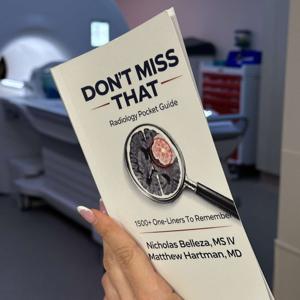
📚 Don’t Miss That Radiology Pocket Guide
Available now.
🎧 Listen on Apple Podcasts, Spotify, YouTube, and wherever you get your podcasts.
🔗 Follow for more:
Remember…
⭐ Whatever is important will be repeated!!
Hartman’s 6 Patterns of Tubular Pathology | Stop Memorizing Diseases. Start Recognizing Patterns.
What if almost every disease affecting a tubular structure could be understood using just six basic patterns?
In this episode of Don’t Miss That Radiology, Dr. Matthew Hartman introduces one of the most powerful frameworks in radiology education: Hartman’s 6 Patterns of Tubular Pathology.
Originally developed and popularized by Dr. David Hartman, this approach teaches you to recognize imaging patterns rather than memorize endless lists of diseases. Whether you’re evaluating the bowel, esophagus, bile ducts, ureters, blood vessels, bronchi, or other tubular structures, these six patterns will help you organize your thinking and build better differential diagnoses.
In this episode you’ll learn:
✅ In-growth (inside the tube)
✅ Outpouching (diverticulum, perforation, fistula)
✅ Narrowing (stenosis/stricture)
✅ Dilatation (obstruction or aneurysm)
✅ Thickening (inflammation or tumor)
✅ Displacement (external mass effect or abnormal position)
This framework is designed for:
If you’ve ever felt overwhelmed trying to memorize hundreds of diagnoses, this episode will change how you approach radiology forever.
Stop memorizing diseases. Start recognizing patterns.
⭐ Subscribe for weekly radiology education designed specifically for medical students and residents.
#radiology #medical student
🎙️ Episode 5: How to Crush Your Radiology Rotation as a Med Student
It’s July, and thousands of medical students are starting their radiology electives and audition rotations. In this episode, we shift from reading images to learning how to stand out on the rotation (though I'll throw in a pearl about XGPN).
You’ll learn practical strategies that can make a lasting impression—from the importance of being early and being well dressed and attentive. We will also go over common mistakes that can hurt your evaluation. We’ll discuss how to work effectively with residents and attendings, what to do before your first day, and how to demonstrate curiosity, professionalism, and initiative without getting in the way.
Whether you’re considering radiology as a career or simply want to maximize your elective, this episode provides actionable advice to help you succeed.
Topics include:
• How to prepare before day one
• Reading room etiquette
• Asking questions that impress
• Common mistakes to avoid
• Tips for earning an outstanding letter of recommendation
• Resources to continue learning after the rotation
Because in radiology, you only see what you know—and attendings notice students who are eager to learn. Remember not to be staring at your smartphones during rotations. Instead have a pocket radiology guide in which you can take notes--I think I know a good one.
We will have a part 2 where we talk about how to approach cases as a medical student if you are on the "hot seat"
#Radiology #MedicalStudent #RadiologyRotation #AuditionRotation #FutureRadiologist #MedicalEducation #DontMissThatRadiology #MedEd
Episode 4: Why Are the Lungs Too White? Blood, Water, Cells, or Pus?
Why do lungs look too white on a chest X-ray? In this episode of Don’t Miss That Radiology ⭐, you’ll learn a simple framework to quickly narrow the differential: blood, water, cells, or pus.
We’ll build a practical approach to chest X-ray interpretation by covering:
Whether you’re preparing for your radiology rotation, studying for shelf or board exams, or simply want to become more confident reading chest X-rays, this episode provides practical, memorable teaching points you can apply on your very next shift.
Don’t miss that diagnosis.
From the publisher's feed