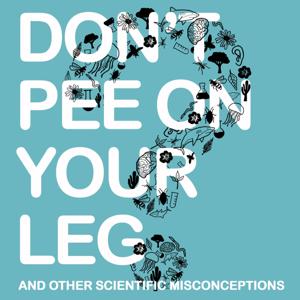
Don't Pee on Your Leg (and other scientific misconceptions)

Don't Pee on Your Leg (and other scientific misconceptions)

By Margaret and Camden Hanzlick-BurtonScience
Download on the App Store

Don't Pee on Your Leg (and other scientific misconceptions) episodes

  • E81: Broken Bones and Hypoallergenic Pets

    Camden and Margaret discuss if broken bone actually heal back stronger (4:18) and if some dog and cat breeds are hypoallergenic (24:23).


    Camden's citations:

    • BBC
    • McGill University
    • Hackensack Meridian Health
    • Golden State Orthopedics
    • University of Texas
    • Principles of Life, Second Edition
    • University of Rochester
    • Mayo Clinic


    Margaret's citations:

    • "There's No Such Thing as a Hypoallergenic Cat" – Smithsonian Magazine (Kristin Schmidt)
    • Dog Allergy Myths – American Academy of Allergy, Asthma & Immunology
    • Pet Allergy – American Academy of Allergy, Asthma & Immunology
    • The Myth of the Hypoallergenic Dog – Dr. David Stukus, Nationwide Children's Hospital
    • The Myth of Hypoallergenic Dogs (and Cats) – Dr. Richard F. Lockey, Journal of Allergy and Clinical Immunology
    • Missouri Alliance for Animal Legislation (MAAL) - Donate to them!
    48 min
  • E80 - Milk and Chameleons

    Camden and Margaret discuss what if only mammals produce milk (2:18) and if chameleons camouflage by changing their color (18:30).


    Camden's citations

    • Lactation – Wikipedia
    • Crop milk – Wikipedia
    • Biology Exchange
    • Ask Hank Anything (YouTube series)
    • The Origin and Evolution of Lactation – Journal of Biology
    • Platypus Milk May Help Us Fight Antibiotic Resistance – Australian Geographic
    • 10 Animals That Make "Milk" and Aren't Mammals – Discover Magazine
    • Inside the Wild Ways Many Creatures Make Milk – Smithsonian Magazine


    Margaret's citations

    • Chameleons, Facts and Photos – National Geographic
    • Chameleons' Craziest Color Changes Aren't for Camouflage – National Geographic (Benji Jones)


    What We're Consuming

    • Camden: "The Man Who Died Twice" by Richard Osman
    • Margaret: "Yesteryear" by Caro Claire Burke and "The Long Walk" by Stephen King


    Have a scientific misconception you'd like us to tackle? Email us at [email protected]Find us on Instagram: @DontPeeonYourLeg

    35 min
  • E79 - Bird Eating and Bird Migration

    Margaret and Camden discuss what it really mean to "eat like a bird" (5:20) and if all birds migrate (17:39).

    Margaret's citations

    • BONUS: Support Knack's Trip to Nationals!
    • Sacramento Audubon Society
    • Golden Gate Bird Alliance
    • The Peregrine Fund
    • American Bird Conservancy
    • The National Zoo
    • What It's Like to Be a Bird by David Allen Sibley
    • Here's How Much Food Three Different Birds Need to Eat Daily – Audubon Society by Mary McCann


    Camden's citations

    • What It's Like to Be a Bird by David Allen Sibley
    • Audubon Society
    • Cornell Lab of Ornithology
    • The Nature Conservancy
    • Loudoun Wildlife Conservancy
    • Kansas State University


    What We're Consuming

    • Camden: Mood Machine by Liz Pelly
    • Margaret: Widow's Bay on Apple TV


    Have a scientific misconception you'd like us to tackle? Email us at [email protected]

    Find us on Instagram: @DontPeeonYourLeg

    40 min
  • E78 - Corn and Heat Loss

    Camden and Margaret discuss if all corn is the same (2:43) and whether most of our body heat is really lost from our heads (17:59).

    Camden's Misconception: Is All Corn the Same?
    • Wikipedia
    • NMSU — Specialty Corns
    • SDSU Extension — Indian Corn & Popcorn
    • Britannica — Why Do Corn Kernels Pop?
    • Nature Scientific Reports — Sweet Corn Sugary Gene Mutation
    • EBSCO Research Starters — Corn Ethanol
    • USDA — Global Demand for Fuel Ethanol Through 2030
    • Scientific American — It's Time to Rethink America's Corn System
    Margaret's Misconception: Is Most of Our Body Heat Really Lost From Our Heads?
    • US Army Survival Guide
    • Cleveland Clinic — Body Heat Loss by Dr. Thomas Waters
    • Ohio State University BuckMD Blog — Medical Mythbusters by Tina Comston
    • University of Rochester Medicine Health Encyclopedia
    • University of Utah Health — Debunking Common Winter Health Myths by Dr. Russell Vinik
    • BBC Science Focus — The Great Cold Head Myth by Abbie Jordan
    33 min
  • E77 - Horses and Pregnancy

    Camden and Margaret discuss whether American wild horses are actually native to North America (3:44) and if breastfeeding can really prevent pregnancy (17:23).

    Camden's Misconception: American wild horses are not native to North America

    Citations:

    • Animal Welfare Institute — Wild Horses as Native North American Wildlife
    • Live Science — The Surprising History of America's Wild Horses (2008)
    • American Wild Horse Conservation — Scientific Research Confirms Native Ancestry (2020)
    • Scientific American — The Secret Lives of Horses (2015)
    • Smithsonian National Zoo — Przewalski's Horse
    • In Defense of Animals — Wild Horses are Native to North America

    Margaret's Misconception: Breastfeeding prevents pregnancy

    Citations:

    • Harvard Medical School — "Can Breastfeeding Really Prevent Pregnancy?" by Dr. Rachel A. Blake
    • Cleveland Clinic — "Yes, You Can Get Pregnant While Breastfeeding" (2024)
    34 min
  • E76 - Bird Bones and the Mind's Eye

    Camden, Margaret, and guest David discuss if bird bones are hollow so birds can fly (6:48) and whether everyone sees things the same way in their mind (22:09).

    Camden's Misconception: Bird bones are hollow so birds can fly

    Citations:

    • "What If? 2" by Randall Munroe
    • The Science of Birds Podcast — "How Birds Breathe"
    • "Bone Density and the Lightweight Skeletons of Birds" by Elizabeth Dumont, UMass Amherst
    • Discovery — "Why Do Birds Have Hollow Bones?"
    • Montana Natural History Center — "Avian Adaptations"
    • Bird Spot — "How Birds' Skeletons Evolved For Flight"
    • Wilderness Awareness School — "Bird Skeletons and Avian Physiology"

    David's Misconception: We all see things the same way in our minds

    Citations:

    • Zeman et al. (2015) — "Lives Without Imagery: Congenital Aphantasia." Cortex
    • Zeman (2024) — "Aphantasia and Hyperphantasia: Exploring Imagery Vividness Extremes." Trends in Cognitive Sciences
    • Dance, Ipser & Simner (2022) — "The Prevalence of Aphantasia in the General Population." Consciousness and Cognition
    • Marks (1973) — Vividness of Visual Imagery Questionnaire (VVIQ). British Journal of Psychology
    • Kay et al. (2022) — "The Pupillary Light Response as a Physiological Index of Aphantasia." eLife
    • Pearson (2019) — "The Human Imagination: The Cognitive Neuroscience of Visual Mental Imagery." Nature Reviews Neuroscience
    • Milton et al. (2021) — "Behavioral and Neural Signatures of Visual Imagery Vividness Extremes." Cerebral Cortex Communications
    • Bainbridge et al. (2021) — "Quantifying Aphantasia Through Drawing." Cortex
    • Wicken et al. (2021) — "The Critical Role of Mental Imagery in Human Emotion." Proceedings of the Royal Society B
    49 min
  • E75 - Vampire Bats and Soap

    Camden and Margaret discuss whether vampire bats actually suck blood and whether antibacterial soap is better for you than regular soap.

    39 min
  • E74 - Asteroids and Concussions

    Camden and Margaret discuss if asteroids really look like cratered potatoes (2:52) and whether you have to lose consciousness to have a concussion (11:49).

    Camden's Misconception: Asteroids look like little potatoes with craters

    Citations:

    • "What If? 2" by Randall Munroe
    • NASA Space Place - Asteroids
    • Scientific American
    • CalTech Cool Cosmos

    Margaret's Misconception: As long as you're conscious, it's not a concussion

    Citations:

    • Concussion Recognition Tool from the Concussion in Sport Group
    • National Institute of Neurological Disorders and Stroke
    • CDC - TBI Data 2024
    • Mayo Clinic - Concussions
    • "Concussion" by Nitin Agarwal, Rut Thakkar, Khoi Than for the American Association of Neurological Surgeons

    What We're Consuming:

    • Camden: "The Thursday Murder Club" by Richard Osman
    • Margaret: "The Dog's Best Friend Game" board game

    Follow us on Instagram: @DontPeeonYourLeg

    Email us your misconceptions: [email protected]

    29 min
  • E73 - Dust and Ears

    Camden and Margaret discuss if household dust is mostly just your dead skin floating around (2:45) and whether our ears keep getting bigger our entire lives (16:05).

    Camden's Misconception: Dust is mostly dead skin

    Citations:

    • "What If? 2" by Randall Munroe
    • "Is Dust Mostly Dead Skin?" by Veritasium
    • "Making an epidermis" by Maranke Koster, University of Colorado Denver

    Margaret's Misconception: Our ears keep getting bigger our entire lives

    Citations:

    • Cleveland Clinic - Cartilage
    • "Do Your Nose and Ears Really Grow with Age?" by Justin Chupungco
    • "Why do old men have big ears?" by James Heathcote
    • "Ear size as a predictor of chronological age" by R Tan, V Osman, G Tan
    • "Human ears grow throughout the entire lifetime" by Niemitz, Nibbrig, and Zacher
    • Today I Found Out
    • "Truth or Myth: Our Nose and our Ears Never Stop Growing" by Michael Hinck

    What We're Consuming:

    • Camden: "Project Hail Mary" by Andy Weir
    • Margaret: Books

    Follow us on Instagram: @DontPeeonYourLeg

    Email us your misconceptions: [email protected]

    32 min
  • E72 - Ladybugs and Steak

    Margaret and Camden discuss whether the spots on a ladybug determine its age (08:54) and if the red liquid that comes out of your steak is actually blood (22:02).

    43 min

About Don't Pee on Your Leg (and other scientific misconceptions)

From the publisher's feed

Is it dangerous to wake a sleepwalker? Is it a good idea to pee on your leg after a jellyfish sting? Join biologists Camden and Margaret as they explore and address these scientific misconceptions and many more!