
Sign up to save your podcasts
Or

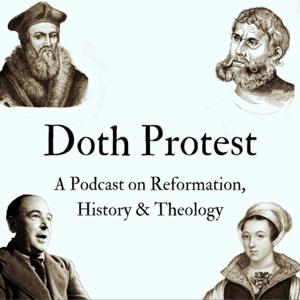


Andrew, Connor, & James dive into a period critical for Luther's intellectual and spiritual growth.
Diogenes Allen & Eric Springsted's book Philosophy for Understanding Theology
Jordan Cooper's Substack post Martin Luther's Relation to Aristotelian Ethics
Denis R. Janz's book Luther and Late Medieval Thomism
Website for the 'Luther stone' in Stotternheim
Berndt Hamm's book The Early Luther: Stages in a Reformation Reorientation
Jean Gerson's classic work The Consolation of Theology
Steven Ozment's book The Age of Reform, 1250-1550: An Intellectual and Religious History of Late Medieval and Reformation Europe
In this episode, Kyle, Andrew, and James look at young Luther in his student years in Eisenach and Erfurt. We discuss the history of those places (including some interesting 20th century history of those places under communism), Luther's thirst for clarity and certainty that his law studies didn't satisfy, and the penitential system of the medieval church. We hope you enjoy.
In the second episode of out Luther series, we continue our discussion on the middle ages (the good, the bad, and thing in between), the intellectual currents of Luther's time, and Luther's origins. (At this rate, we may be in for a longer series!) Enjoy.
- The argument from Aquinas is taken from the book Summa of the Summa (edited by Peter Kreeft)
Andrew is joined by friends of the show the Rev. Connor Longaphie and the Rev. Dr. Kyle Tomlin to discuss the life of Martin Luther. This is the first of a multi-part series. In this episode, we talk about the backdrop of the word that Luther was born into.
Andrew recommended the following biographies of Luther for further reading:
James and Andrew finally get around to completing the English Reformation series, and also give updates on life and a peak at upcoming episodes of the podcast.
We are reposting our 2024 episode from our conversation with Volker Leppin. (The podcast will be on break through January and resuming in February with some exciting new content).
Volker Leppin is the Horace Tracy Pitkin Professor of Historical Theology at Yale Divinity School. Prior to Yale, he taught church history at University of Jena and University of Tübingen. He is the author of many books, monographs, and articles in church history, especially on the Middle Ages, the Reformation, and Martin Luther. He is especially known for his biography of Luther titled Martin Luther: A Late Medieval Life.
The works about Luther that Dr. Leppin mentions were significant for him were:
Karl Holl's "Luther", presented as a lecture on Oct 31st 1917.
Gerhard Ebeling's book Evangelische Evangelienauslegung: Eine Untersuchung zu Luthers Hermeneutik
Heiko Oberman's book Luther: Man Between God and the Devil
(Andrew also brought up Oberman's book The Dawn of the Reformation: Essays in Late Medieval and Early Reformation Thought)
In the past few years, Roman Catholicism (and to a lesser extent Eastern Orthodoxy) has been attractive to people (including younger people) looking for tradition, beauty, and stability in a world that is often chaotic. What are the "pitfalls and possibilities" (to quote Doc Brown) of this 'Current Catholic Moment'?
John brings up the following resources (which he also references in his article above):
-Jaroslav Pelikan's book The Riddle of Roman Catholicism
-Herman Sasse's book Here We Stand
We were delighted for Amy Mantravadi to return to the podcast to discuss her book Face to Face: A Novel of the Reformation,the second of her two-part novel series. (She joined us to discuss the first book Broken Bonds on an episode earlier this year.) Amy is a regular contributor at 1517 and writes about theological and historical topics.
The following works are brought up or referenced in this episode:
-Amy's previous work The Chronicles of Maud trilogy.
-Robert Kolb's Bound Choice, Election, and the Wittenberg Theological Method
-Rudolf & Marilynn Markwald’s book Katharina von Bora: A Reformation Life
-Martin Luther's Bondage of the Will
-Martin Luther's “Against the Robbing and Murdering Hordes of Peasants” (1525), which can be found in Luther's Works, Volume 46
-Coming Soon: Amy's talk “How the Bondage of the Will Changes My Life” will be featured in an upcoming video from the 1517 YouTube channel.
A mix of topics on this episode. We continue to promote James' Substack Rogues and Reformers about his use of comic books as teaching tools for Reformational theology, and we focus particularly on what the Joker's story can teach us about human depravity and gospel-grace. Then, we go to Andrew's latest Mockingbird article on what the former KISS guitarist the late Ace Frehley can teach us about human depravity and gospel-grace. Then, yes, we get to the English Reformation and look at Hugh Latimer, Nicholas Ridley, & Lady Jane Grey.
–Peter Marshall's book Heretics & Believers
–Eric Ives' book Lady Jane Grey: A Tudor Mystery
–Diarmaid MacCulloch's book The Boy King: Edward VI and the Protestant Reformation
Andrew and James continue their chronological walkthrough of the English Reformation discussing Katherine Parr, Edward VI, Martin Bucer, and the 1549 and 1552 Books of Common Prayer. Enjoy!
We want to hear from you. Pease send feedback to [email protected]
Episode Shownotes
-Luther-scholarship that has identified Max Weber as a misinterpretor of Luther's 'two-kingdoms' teaching includes William Wright's book Martin Luther's Understanding of God's Two Kingdoms: A Response to the Challenge of Skepticism and Michael P. DeJonge's Bonhoeffer's Reception of Luther.
- A.G. Dickens' classic text The English Reformation
-
From the publisher's feed

8,610 Listeners

2,190 Listeners

840 Listeners

836 Listeners
870 Listeners

57 Listeners
67 Listeners

134 Listeners
248 Listeners

54 Listeners
14 Listeners

2,507 Listeners

66 Listeners