
Sign up to save your podcasts
Or

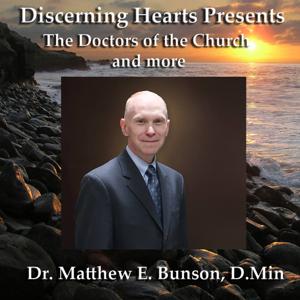


Dr. Matthew Bunson discusses the life, times and teachings of St. Augustine of Hippo (part 2)
Augustine of Hippo
After his Baptism, Augustine decided to return to Africa with his friends, with the idea of living a community life of the monastic kind at the service of God. However, while awaiting their departure in Ostia, his mother fell ill unexpectedly and died shortly afterwards, breaking her son’s heart. Having returned to his homeland at last, the convert settled in Hippo for the very purpose of founding a monastery. In this city on the African coast he was ordained a priest in 391, despite his reticence, and with a few companions began the monastic life which had long been in his mind, dividing his time between prayer, study and preaching. All he wanted was to be at the service of the truth. He did not feel he had a vocation to pastoral life but realized later that God was calling him to be a pastor among others and thus to offer people the gift of the truth. He was ordained a Bishop in Hippo four years later, in 395. Augustine continued to deepen his study of Scripture and of the texts of the Christian tradition and was an exemplary Bishop in his tireless pastoral commitment: he preached several times a week to his faithful, supported the poor and orphans, supervised the formation of the clergy and the organization of mens’ and womens’ monasteries. In short, the former rhetorician asserted himself as one of the most important exponents of Christianity of that time. He was very active in the government of his Diocese – with remarkable, even civil, implications – in the more than 35 years of his Episcopate, and the Bishop of Hippo actually exercised a vast influence in his guidance of the Catholic Church in Roman Africa and, more generally, in the Christianity of his time, coping with religious tendencies and tenacious, disruptive heresies such as Manichaeism, Donatism and Pelagianism, which endangered the Christian faith in the one God, rich in mercy.
And Augustine entrusted himself to God every day until the very end of his life: smitten by fever, while for almost three months his Hippo was being besieged by vandal invaders, the Bishop – his friend Possidius recounts in his Vita Augustini – asked that the penitential psalms be transcribed in large characters, “and that the sheets be attached to the wall, so that while he was bedridden during his illness he could see and read them and he shed constant hot tears” (31, 2). This is how Augustine spent the last days of his life. He died on 28 August 430, when he was not yet 76. We will devote our next encounters to his work, his message and his inner experience.
For more visit Vatican.va
Dr. Matthew Bunson, Senior Fellow of the St. Paul Center for Biblical Theology, is one of the United States’ leading authorities on the papacy and the Church.
His books include: The Encyclopedia of Catholic History; The Encyclopedia of Saints; Papal Wisdom; All Shall Be Well; Encyclopedia of the Roman Empire; and The Angelic Doctor: The Life and World of St. Thomas Aquinas; The Pope Encyclopedia; We Have a Pope! Benedict XVI, the first Catholic biography of the Holy Father in the English language; the Encyclopedia of U.S. Catholic History; Pope Francis. His also the editor of OSV’s “The Catholic Answer” magazine.
The post DC10 St. Augustine of Hippo (part 2) – The Doctors of the Church: The Charism of Wisdom with Dr. Matthew Bunson appeared first on Discerning Hearts Catholic Podcasts.
Dr. Matthew Bunson discusses the life, times and teachings of St. Augustine of Hippo (part 1)
Augustine of Hippo [
n Milan, Augustine acquired the habit of listening – at first for the purpose of enriching his rhetorical baggage – to the eloquent preaching of Bishop Ambrose, who had been a representative of the Emperor for Northern Italy. The African rhetorician was fascinated by the words of the great Milanese Prelate; and not only by his rhetoric. It was above all the content that increasingly touched Augustine’s heart. The great difficulty with the Old Testament, because of its lack of rhetorical beauty and lofty philosophy was resolved in St Ambrose’s preaching through his typological interpretation of the Old Testament: Augustine realized that the whole of the Old Testament was a journey toward Jesus Christ. Thus, he found the key to understanding the beauty and even the philosophical depth of the Old Testament and grasped the whole unity of the mystery of Christ in history, as well as the synthesis between philosophy, rationality and faith in the Logos, in Christ, the Eternal Word who was made flesh.
Augustine soon realized that the allegorical interpretation of Scripture and the Neo-Platonic philosophy practised by the Bishop of Milan enabled him to solve the intellectual difficulties which, when he was younger during his first approach to the biblical texts, had seemed insurmountable to him.
Thus, Augustine followed his reading of the philosophers’ writings by reading Scripture anew, especially the Pauline Letters. His conversion to Christianity on 15 August 386 therefore came at the end of a long and tormented inner journey – of which we shall speak in another catechesis -, and the African moved to the countryside, north of Milan by Lake Como – with his mother Monica, his son Adeodatus and a small group of friends – to prepare himself for Baptism. So it was that at the age of 32 Augustine was baptized by Ambrose in the Cathedral of Milan on 24 April 387, during the Easter Vigil.
For more visit Vatican.va
Dr. Matthew E. Bunson is a Register senior editor and a senior contributor to EWTN News. For the past 20 years, he has been active in the area of Catholic social communications and education, including writing, editing, and teaching on a variety of topics related to Church history, the papacy, the saints, and Catholic culture. He is faculty chair at Catholic Distance University, a senior fellow of the St. Paul Center for Biblical Theology, and the author or co-author of over 50 books including The Encyclopedia of Catholic History, The Pope Encyclopedia, We Have a Pope! Benedict XVI, The Saints Encyclopedia and best-selling biographies of St. Damien of Molokai and St. Kateri Tekakwitha.
The post DC9 St. Augustine of Hippo (part 1) – The Doctors of the Church: The Charism of Wisdom with Dr. Matthew Bunson appeared first on Discerning Hearts Catholic Podcasts.
Dr. Matthew Bunson and Kris McGregor discuss St. Ambrose, the catechumen who became a bishop, in part 2 of this two-part conversation.
Dr. Matthew E. Bunson is a Register senior editor and senior contributor to EWTN News. For the past 20 years, he has been active in the area of Catholic social communications and education, including writing, editing, and teaching on a variety of topics related to Church history, the papacy, the saints, and Catholic culture. He is faculty chair at Catholic Distance University, a senior fellow of the St. Paul Center for Biblical Theology, and the author or co-author of over 50 books including The Encyclopedia of Catholic History, The Pope Encyclopedia, We Have a Pope! Benedict XVI, The Saints Encyclopedia and best-selling biographies of St. Damien of Molokai and St. Kateri Tekakwitha.
The post DC8 St. Ambrose of Milan, Part 2 – The Doctors of the Church with Dr. Matthew Bunson – Discerning Hearts Podcast appeared first on Discerning Hearts Catholic Podcasts.
Dr. Matthew Bunson and Kris McGregor explore St. Gregory of Nazianzus (Nazianzen), a doctor of the Church. St. Gregory faced the Arian heresy and a tension between solitude and serving as a priest. His theological contributions include emphasizing “consubstantial” and defending the Trinity. Dr. Bunson highlights his views on Christ’s full humanity, theosis, and the connection between theology and prayer, making special note of Pope Benedict XVI’s insights on St. Gregory as well.
St. Gregory’s teachings provide timeless prescriptions for addressing heresy, offering valuable lessons for today’s challenges in defending the faith.
Dr. Matthew E. Bunson is a Register senior editor and senior contributor to EWTN News. For the past 20 years, he has been active in the area of Catholic social communications and education, including writing, editing, and teaching on a variety of topics related to Church history, the papacy, the saints, and Catholic culture. He is faculty chair at Catholic Distance University, a senior fellow of the St. Paul Center for Biblical Theology, and the author or co-author of over 50 books including The Encyclopedia of Catholic History, The Pope Encyclopedia, We Have a Pope! Benedict XVI, The Saints Encyclopedia and best-selling biographies of St. Damien of Molokai and St. Kateri Tekakwitha.
The post DC6 St. Gregory of Nazianzus – The Doctors of the Church /w Dr. Matthew Bunson Podcast appeared first on Discerning Hearts Catholic Podcasts.
Dr. Matthew Bunson discusses the life, times and teachings of St. Basil the Great
Siblings: Gregory of Nyssa, Macrina the Younger, Theosebia
Dr. Matthew E. Bunson is a Register senior editor and senior contributor to EWTN News. For the past 20 years, he has been active in the area of Catholic social communications and education, including writing, editing, and teaching on a variety of topics related to Church history, the papacy, the saints, and Catholic culture. He is faculty chair at Catholic Distance University, a senior fellow of the St. Paul Center for Biblical Theology, and the author or co-author of over 50 books including The Encyclopedia of Catholic History, The Pope Encyclopedia, We Have a Pope! Benedict XVI, The Saints Encyclopedia and best-selling biographies of St. Damien of Molokai and St. Kateri Tekakwitha.
The post DC5 St. Basil the Great – The Doctors of the Church w/ Dr. Matthew Bunson – Discerning Hearts Podcast appeared first on Discerning Hearts Catholic Podcasts.
Dr. Matthew Bunson discusses the life, times, and work of St. Ephrem of Syria
The figure of Ephrem is still absolutely timely for the life of the various Christian Churches. We discover him in the first place as a theologian who reflects poetically, on the basis of Holy Scripture, on the mystery of man’s redemption brought about by Christ, the Word of God incarnate. His is a theological reflection expressed in images and symbols taken from nature, daily life and the Bible. Ephrem gives his poetry and liturgical hymns a didactic and catechetical character: they are theological hymns yet at the same time suitable for recitation or liturgical song. On the occasion of liturgical feasts, Ephrem made use of these hymns to spread Church doctrine. Time has proven them to be an extremely effective catechetical instrument for the Christian community.
Ephrem’s reflection on the theme of God the Creator is important: nothing in creation is isolated and the world, next to Sacred Scripture, is a Bible of God. By using his freedom wrongly, man upsets the cosmic order. The role of women was important to Ephrem. The way he spoke of them was always inspired with sensitivity and respect: the dwelling place of Jesus in Mary’s womb greatly increased women’s dignity. Ephrem held that just as there is no Redemption without Jesus, there is no Incarnation without Mary. The divine and human dimensions of the mystery of our redemption can already be found in Ephrem’s texts; poetically and with fundamentally scriptural images, he anticipated the theological background and in some way the very language of the great Christological definitions of the fifth-century Councils.
Ephrem, honoured by Christian tradition with the title “Harp of the Holy Spirit”, remained a deacon of the Church throughout his life. It was a crucial and emblematic decision: he was a deacon, a servant, in his liturgical ministry, and more radically, in his love for Christ, whose praises he sang in an unparalleled way, and also in his love for his brethren, whom he introduced with rare skill to the knowledge of divine Revelation.
For more visit Vatican.va
Dr. Matthew E. Bunson is a Register senior editor and senior contributor to EWTN News. For the past 20 years, he has been active in the area of Catholic social communications and education, including writing, editing, and teaching on a variety of topics related to Church history, the papacy, the saints, and Catholic culture. He is faculty chair at Catholic Distance University, a senior fellow of the St. Paul Center for Biblical Theology, and the author or co-author of over 50 books including The Encyclopedia of Catholic History, The Pope Encyclopedia, We Have a Pope! Benedict XVI, The Saints Encyclopedia, and best-selling biographies of St. Damien of Molokai and St. Kateri Tekakwitha.
The post DC3 St. Ephrem of Syria – The Doctors of the Church: The Charism of Wisdom with Dr. Matthew Bunson appeared first on Discerning Hearts Catholic Podcasts.
Dr. Matthew Bunson and Kris McGregor discuss St. Athanasius of Alexandria, declared a Doctor of the Church in 1568. St. Athanasius played a significant role in defending orthodox Christian doctrine against the Arian heresy. Born around 298 AD, he became Bishop of Alexandria and faced exile multiple times due to his staunch opposition to Arianism.
Despite persecution and false accusations, Athanasius remained steadfast in his defense of Christ’s divinity and humanity; in addition to Christ’s incarnation and its role in salvation, providing clarity on the Trinity and the nature of Christ. He also contributed to the spread of monasticism through his writings on the Desert Fathers, particularly St. Anthony. His life serves as a reminder of the challenges faced in defending the truth and the unwavering commitment required to uphold the faith.
“Athanasius was undoubtedly one of the most important and revered early Church Fathers. But this great Saint was above all the impassioned theologian of the Incarnation of the Logos, the Word of God who – as the Prologue of the fourth Gospel says – “became flesh and dwelt among us” (Jn 1: 14).
For this very reason Athanasius was also the most important and tenacious adversary of the Arian heresy, which at that time threatened faith in Christ, reduced to a creature “halfway” between God and man, according to a recurring tendency in history which we also see manifested today in various forms.
In all likelihood Athanasius was born in Alexandria, Egypt, in about the year 300 A.D. He received a good education before becoming a deacon and secretary to the Bishop of Alexandria, the great Egyptian metropolis. As a close collaborator of his Bishop, the young cleric took part with him in the Council of Nicaea, the first Ecumenical Council, convoked by the Emperor Constantine in May 325 A.D. to ensure Church unity. The Nicene Fathers were thus able to address various issues and primarily the serious problem that had arisen a few years earlier from the preaching of the Alexandrian priest, Arius.
With his theory, Arius threatened authentic faith in Christ, declaring that the Logos was not a true God but a created God, a creature “halfway” between God and man who hence remained for ever inaccessible to us. The Bishops gathered in Nicaea responded by developing and establishing the “Symbol of faith” [“Creed”] which, completed later at the First Council of Constantinople, has endured in the traditions of various Christian denominations and in the liturgy as the Niceno-Constantinopolitan Creed.
In this fundamental text – which expresses the faith of the undivided Church and which we also recite today, every Sunday, in the Eucharistic celebration – the Greek term homooúsiosis featured, in Latin consubstantialis: it means that the Son, the Logos, is “of the same substance” as the Father, he is God of God, he is his substance. Thus, the full divinity of the Son, which was denied by the Arians, was brought into the limelight.”
For more visit Vatican.va
Dr. Matthew E. Bunson is a Register senior editor and a senior contributor to EWTN News. For the past 20 years, he has been active in the area of Catholic social communications and education, including writing, editing, and teaching on a variety of topics related to Church history, the papacy, the saints and Catholic culture. He is faculty chair at Catholic Distance University, a senior fellow of the St. Paul Center for Biblical Theology, and the author or co-author of over 50 books including The Encyclopedia of Catholic History, The Pope Encyclopedia, We Have a Pope! Benedict XVI, The Saints Encyclopedia and best-selling biographies of St. Damien of Molokai and St. Kateri Tekakwitha.
The post DC1 St. Athanasius of Alexandria – The Doctors of the Church: The Charism of Wisdom with Dr. Matthew Bunson – Discerning Hearts Podcast appeared first on Discerning Hearts Catholic Podcasts.
Dr. Matthew Bunson and Kris McGregor discuss St. Hillary of Poitier’s life, conversion, and role in combating Arianism. Despite being the “Hammer of the Aryans,” his gentleness and charity emphasized Christ-like love in defending the faith.
“To sum up the essentials of his doctrine, I would like to say that Hilary found the starting point for his theological reflection in baptismal faith. In De Trinitate, Hilary writes: Jesus “has commanded us to baptize in the name of the Father and of the Son and of the Holy Spirit (cf. Mt 28: 19), that is, in the confession of the Author, of the Only-Begotten One and of the Gift. The Author of all things is one alone, for one alone is God the Father, from whom all things proceed. And one alone is Our Lord Jesus Christ, through whom all things exist (cf. I Cor 8: 6), and one alone is the Spirit (cf. Eph 4: 4), a gift in all…. In nothing can be found to be lacking so great a fullness, in which the immensity in the Eternal One, the revelation in the Image, joy in the Gift, converge in the Father, in the Son and in the Holy Spirit” (De Trinitate 2, 1). God the Father, being wholly love, is able to communicate his divinity to his Son in its fullness. I find particularly beautiful the following formula of St Hilary: “God knows not how to be anything other than love, he knows not how to be anyone other than the Father. Those who love are not envious and the one who is the Father is so in his totality. This name admits no compromise, as if God were father in some aspects and not in others” (ibid., 9, 61).
For this reason the Son is fully God without any gaps or diminishment. “The One who comes from the perfect is perfect because he has all, he has given all” (ibid., 2, 8). Humanity finds salvation in Christ alone, Son of God and Son of man. In assuming our human nature, he has united himself with every man, “he has become the flesh of us all” (Tractatus super Psalmos 54, 9); “he took on himself the nature of all flesh and through it became true life, he has in himself the root of every vine shoot” (ibid., 51, 16). For this very reason the way to Christ is open to all – because he has drawn all into his being as a man -, even if personal conversion is always required: “Through the relationship with his flesh, access to Christ is open to all, on condition that they divest themselves of their former self (cf. Eph 4: 22), nailing it to the Cross (cf. Col 2: 14); provided we give up our former way of life and convert in order to be buried with him in his baptism, in view of life (cf. Col1: 12; Rom 6: 4)” (ibid., 91, 9).
Fidelity to God is a gift of his grace. Therefore, St Hilary asks, at the end of his Treatise on the Trinity, to be able to remain ever faithful to the baptismal faith. It is a feature of this book: reflection is transformed into prayer and prayer returns to reflection. The whole book is a dialogue with God.
For more visit Vatican.va
Hilary of Poitiers
Dr. Matthew E. Bunson is a Register senior editor and senior contributor to EWTN News. For the past 20 years, he has been active in the area of Catholic social communications and education, including writing, editing, and teaching on a variety of topics related to Church history, the papacy, the saints, and Catholic culture. He is faculty chair at Catholic Distance University, a senior fellow of the St. Paul Center for Biblical Theology, and the author or co-author of over 50 books including The Encyclopedia of Catholic History, The Pope Encyclopedia, We Have a Pope! Benedict XVI, The Saints Encyclopedia and best-selling biographies of St. Damien of Molokai and St. Kateri Tekakwitha.
The post DC2 St. Hilary of Poitiers – The Doctors of the Church: The Charism of Wisdom with Dr. Matthew Bunson – Discerning Hearts Podcast appeared first on Discerning Hearts Catholic Podcasts.
Born: 1193, Lauingen, Germany
From Vatican.va, an excerpt from the teachings of Pope Benedict XVI
The title “Great”, (Magnus), with which he has passed into history indicates the vastness and depth of his teaching, which he combined with holiness of life. However, his contemporaries did not hesitate to attribute to him titles of excellence even then. One of his disciples, Ulric of Strasbourg, called him the “wonder and miracle of our epoch”.
He was born in Germany at the beginning of the 13th century. When he was still young he went to Italy, to Padua, the seat of one of the most famous medieval universities. He devoted himself to the study of the so-called “liberal arts”: grammar, rhetoric, dialectics, arithmetic, geometry, astronomy and music, that is, to culture in general, demonstrating that characteristic interest in the natural sciences which was soon to become the favourite field for his specialization. During his stay in Padua he attended the Church of the Dominicans, whom he then joined with the profession of the religious vows. Hagiographic sources suggest that Albert came to this decision gradually. His intense relationship with God, the Dominican Friars’ example of holiness, hearing the sermons of Blessed Jordan of Saxony, St Dominic’s successor at the Master General of the Order of Preachers, were the decisive factors that helped him to overcome every doubt and even to surmount his family’s resistence. God often speaks to us in the years of our youth and points out to us the project of our life. As it was for Albert, so also for all of us, personal prayer, nourished by the Lord’s word, frequent reception of the Sacraments and the spiritual guidance of enlightened people are the means to discover and follow God’s voice. He received the religious habit from Bl. Jordan of Saxony.
After his ordination to the priesthood, his superiors sent him to teach at various theological study centres annexed to the convents of the Dominican Fathers. His brilliant intellectual qualities enabled him to perfect his theological studies at the most famous university in that period, the University of Paris. From that time on St Albert began his extraordinary activity as a writer that he was to pursue throughout his life.
Prestigious tasks were assigned to him. In 1248 he was charged with opening a theological studium at Cologne, one of the most important regional capitals of Germany, where he lived at different times and which became his adopted city. He brought with him from Paris an exceptional student, Thomas Aquinas. The sole merit of having been St Thomas’ teacher would suffice to elicit profound admiration for St Albert. A relationship of mutual esteem and friendship developed between these two great theologians, human attitudes that were very helpful in the development of this branch of knowlege. In 1254, Albert was elected Provincial of the Dominican Fathers’ “Provincia Teutoniae” Teutonic Province which included communities scattered over a vast territory in Central and Northern Europe.
His gifts did not escape the attention of the Pope of that time, Alexander iv, who wanted Albert with him for a certain time at Anagni where the Popes went frequently in Rome itself and at Viterbo, in order to avail himself of Albert’s theological advice. The same Supreme Pontiff appointed Albert Bishop of Regensburg, a large and celebrated diocese, but which was going through a difficult period. From 1260 to 1262, Albert exercised this ministry with unflagging dedication, succeeding in restoring peace and harmony to the city, in reorganizing parishes and convents and in giving a new impetus to charitable activities.
In the year 1263-1264, Albert preached in Germany and in Bohemia, at the request of Pope Urban iv. He later returned to Cologne and took up his role as lecturer, scholar and writer. As a man of prayer, science and charity, his authoritative intervention in various events of the Church and of the society of the time were acclaimed: above all, he was a man of reconciliation and peace in Cologne, where the Archbishop had run seriously foul of the city’s institutions; he did his utmost during the Second Council of Lyons, in 1274, summoned by Pope Gregory X, to encourage union between the Latin and Greek Churches after the separation of the great schism with the East in 1054. He also explained the thought of Thomas Aquinas which had been the subject of objections and even quite unjustified condemnations.
He died in his cell at the convent of the Holy Cross, Cologne, in 1280, and was very soon venerated by his confreres. The Church proposed him for the worship of the faithful with his beatification in 1622 and with his canonization in 1931, when Pope Pius XI proclaimed him Doctor of the Church. This was certainly an appropriate recognition of this great man of God and outstanding scholar, not only of the truths of the faith but of a great many other branches of knowledge; indeed, with a glance at the titles of his very numerous works, we realize that there was something miraculous about his culture and that his encyclopedic interests led him not only to concern himself with philosophy and theology, like other contemporaries of his, but also with every other discipline then known, from physics to chemistry, from astronomy to minerology, from botany to zoology.
For more visit Vatican.va
For more from Dr. Matthew Bunson check out his Discerning Hearts page
Dr. Matthew E. Bunson is a Register senior editor and a senior contributor to EWTN News. For the past 20 years, he has been active in the area of Catholic social communications and education, including writing, editing, and teaching on a variety of topics related to Church history, the papacy, the saints, and Catholic culture. He is faculty chair at Catholic Distance University, a senior fellow of the St. Paul Center for Biblical Theology, and the author or co-author of over 50 books including The Encyclopedia of Catholic History, The Pope Encyclopedia, We Have a Pope! Benedict XVI, The Saints Encyclopedia and best-selling biographies of St. Damien of Molokai and St. Kateri Tekakwitha.
The post DC30 St. Albert the Great – The Doctors of the Church: The Charism of Wisdom w/ Dr. Matthew Bunson Podcast appeared first on Discerning Hearts Catholic Podcasts.
From the publisher's feed
238 Listeners